







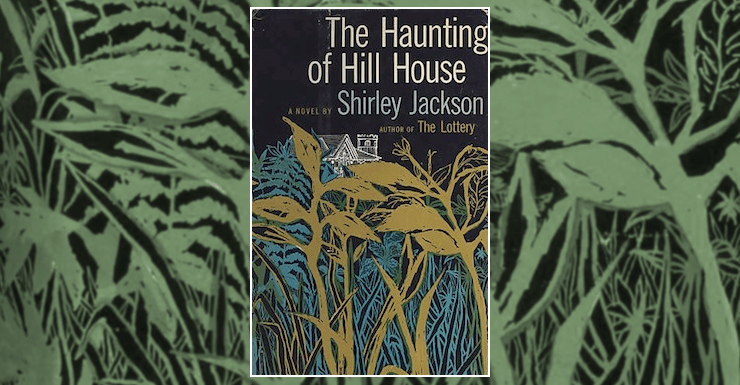
The Haunting of Hill House is perhaps the most-researched, most-written-about of Jackson’s longform works. Published in 1959, the novel follows four people—Dr. Montague, Luke, Theodora, and our protagonist Eleanor—as they attempt to summer at Hill House for the purpose of doing research on its reported supernatural phenomena. Eleanor is a sheltered but damaged woman; she spent her entire adult life caring for her ailing mother, recently deceased, while her sister married and started a family of her own. Even as the novel begins, she’s still under the thumb of her sister and her brother-in-law, living off of a cot in their home. The trip offers her an opportunity to escape, to become something—except the house that awaits is a monstrous place.
Stephen King, in the introduction to the edition of the book that sits on my shelf, notes that “it seems to me that [The Haunting of Hill House] and James’s The Turn of the Screw are the only two great novels of the supernatural in the last hundred years.” It’s hard to debate the claim that this is a deeply significant text in the field: it’s a certain thing that critics and readers alike have found themselves caught up in Jackson’s novel for decades, anxious in the grip of Hill House’s bad geometry and the complex currents of gender, sexuality, and isolation that run underneath.
[Spoilers below, for those who haven’t read the novel.]
The Haunting of Hill House, in part because of these various currents, offers a critic a hundred different paths to take in terms of analysis. Perhaps the most obvious is the queerness of the text: while King in his introduction to the book says there’s the “barest whiff” of a hint that Theo is a lesbian—and also, funnily enough, derides critical reading as if it’s the same as killing a butterfly to pin it up on the wall—I’d argue that it’s far more than a whiff. Rather, given the tropes and signals of the period, it’s as direct as can be without tripping over itself into territory that would’ve given Jackson a hard time with publishers.
However, if you’re familiar with the tropes and signals, the implications about Theo and her “friend” back home aren’t hard to miss. Neither is Eleanor’s grasping after a sense of sexuality that has been denied her: her intense attachment to Theodora and her reflexive attempts to make herself attached to Luke are spelled out with some directness. Critics have been explicating and providing context for the queer subplot of this book since it was published, so there’s not much more for me to explore, but it does give me an avenue into one of the other focal points of the text—and that’s the deep and foreboding sense of isolation that permeates the entire thing.
The isolation of Hill House is both an individual and a group experience: the house attaches its malignancy to vulnerable individuals like Eleanor, who is the absolute picture of self enclosed and restricted, but it also isolates its inhabitants together in the dreadful silent cup of the hillsides. The phrase that lingers from the opening chapter—“whatever walked there, walked alone”—sends a chill up the spine, but it’s difficult to pinpoint the reason initially. The first paragraph, in fact, is a handsome example of Jackson’s prose and the eerie oppressiveness of the landscape she paints:
No live organism can continue for long to exist sanely under conditions of absolute reality; even larks and katydids are supposed, by some, to dream. Hill House, not sane, stood by itself against its hills, holding darkness within; it had stood so for eighty years and might stand for eighty more. Within, walls continued upright, bricks met neatly, floors were firm, and doors were sensibly shut; silence lay steadily against the wood and stone of Hill House, and whatever walked there, walked alone.
That’s a description to make a person breathless. There is nothing direct about the approach; there is nothing direct about the majority of the text. Its effect, however, is undeniable. The careful juxtaposition of implications and images—a house that is not sane, but also appears to be the picture of decency; silence that has physical weight, that could lay steadily, and the so-discomfiting implication of the word whatever as opposed to, let’s say, whomever. The closing word, alone, has the weight of finality.
The same paragraph repeats itself after Eleanor’s abrupt suicide as well, once the house is left to its own devices again, closing the text on the exact phrase that begins it: “whatever walked there, walked alone.” The house is the source of the haunting, the place that magnifies and weaponizes isolation. As Dr. Montague points out, this is a haunting in the traditional sense of the bad place, rather than a specific spirit or ghostly presence. The house’s geometry is off—it has perhaps been as such since the moment it was built, and perhaps influenced its builders to create it as such.
However, near to the end of the text, we also discover that the builder—Mr. Crain—had made his young daughters a disturbing “religious guidance” scrapbook full of inappropriate and fearsome illustrations. It is implied, then, that perhaps the construction wasn’t so happenstance after all. Throughout the exploration of the house’s ill facets, the other characters become more and more alarmed, but Eleanor becomes more and more centered in herself and her concept of belonging at the house. She also attempts to suggest she will follow Theodora back home—except Theodora has her “friend” waiting, and isn’t interested in picking up strays.
The isolation Eleanor feels is intense. She has been singled out as the house’s choice; she has also been rebuffed in her attempts to form a relationship with Theo or Luke. She arrived at Hill House walking alone, and she left it walking alone as well: something the house, if we’re giving it agency, is fully aware of and sinks its claws into. The other characters offer their own tastes of isolation—Luke as the motherless man whose family doesn’t care for him, Dr. Montague as the long suffering husband of a spiritualist wife who doesn’t respect his work, Theodora as a queer woman who’s temporarily estranged from her partner—but it’s Eleanor whose separateness is total.
The result, of course, is death. Eleanor is isolated in terms of her sense of self, her personal agency, her independence—and as a consequence has no grasp on her sense of sexuality, affection, or relationships that aren’t dependent and forced. She is, as we see on her drive up to Hill House, prone to long fantasies and flights of imagination. She lies, also, habitually—since she doesn’t have stories of her own to tell that she’s willing to admit. There is nothing for or of Eleanor that she has the right to call her own until the moment of her suicide, when she thinks, “I am really doing it, I am doing this all by myself, now, at last; this is me, I am really really really doing it by myself.”
The Haunting of Hill House, then, leaves us with both the claustrophobic and so-carefully-constructed terror of the monstrousness of the location—but also the tender and miserable awareness of Eleanor’s short, controlled, unpleasant life. She is unable to grasp at a future in the same manner that Theo has, though it is implied that perhaps meeting and coming to feel passion for Theo has changed her in some real fashion. She is unable to see a continuation of herself once she has been evicted from Hill House and sent back to her unwanted life, so she ends that self in a willful and individually powerful moment.
Jackson, here, has done so many things at once: it is a top-tier haunted house story, to be sure, but it is also a careful representation of female experience in a world as claustrophobic as the bad angles of Hill House. The novel works on layers and layers of implication, dense prose, and arguments made without words having been said. It’s a masterpiece, truly, and for myriad different reasons—but above all else it’s frightening, a slow and anxious and steady sort of frightening. I’ve been glad to revisit it, relearn all of its strange corners, and will for certain do so again in the future.
Originally published in December 2016 to mark the 100th anniversary of Shirley Jackson’s birth.
Lee Mandelo is a writer, critic, and editor whose primary fields of interest are speculative fiction and queer literature, especially when the two coincide. They have two books out, Beyond Binary: Genderqueer and Sexually Fluid Speculative Fiction and We Wuz Pushed: On Joanna Russ and Radical Truth-telling, and in the past have edited for publications like Strange Horizons Magazine. Other work has been featured in magazines such as Stone Telling, Clarkesworld, Apex, and Ideomancer.

Query from a UK reader. What is a katydid and how is it pronounced? I always want to say kay-tee-did. Or is it one of those odd English words that are pronounced completely differently from the way they are spelled?
It’s a grasshopper like insect that makes a noise like crickets. And that’s the pronunciation I use.
Thanks.
I’ve adored The Haunting of Hill House since I first read it in high school back in the mid-1980s.
The 1963 movie adaptation, The Haunting, is one of my favorite horror movies, because it leaves so much to the viewers’ imaginations — unlike the woeful 1999 CGI-fest remake that started off so promisingly…
I’m cautiously optimistic about Netflix’s ten-episode miniseries loosely based on this book, as well as the yet-to-be-released movie version of We Have Always Lived in the Castle starring Crispin Glover and Sebastian Stan, with American Horror Story‘s Taissa Farming as Merricat.
Netflix’s adaptation is FAR removed from Shirley Jackson’s masterpiece, The Haunting of Hill House! On its own, it’s worthy of a strong following. It’s perfect for the Halloween Season. We loved it and screamed loud. What Fun!
I don’t get from the book why Theodora suddenly starts to hate Eleanor, after she realised that the house is aiming only at her… is that an implication of Theo’s narcissism and a connection to her lesbianism?
Antonio – I wasn’t very sure of this either, so I’ll need to re-read, but it seemed to me that the house was manipulating everybody Montague’s group, teasing out whatever qualities made the unit most vulnerable – that’s the reason Montague forgot his own rules so readily. So while some of Theo’s change in attitude may have come from her narcissism, insecurity and capriciousness (and while it could also be that she spurned Eleanor reflexively because she was starting to feel uncomfortable about their closeness) it’s also possible that the house was acting through Theo and encouraging her to respond in the way she did. The whole book is a mire of ambiguity, though, so any interpretation will only go so far.
Because I LOVE the new Haunting of Hill House on Netflix, I went back to the book for the third time to see what I had missed. I just cannot figure out why it’s considered a classic. Jackson is a gifted writer, but with a few exceptions (the wonderful opening paragraph) her prose in The Haunting is purple and her descriptions embarrassingly overwrought. Henry James is equally annoying. Whenever I read The Turn of the Screw I want to paraphrase Bill Murray’s lines in Tootsie: “I read your book, man. What happened?” I couldn’t even finish the Hill House book this time. Flanagan’s film is so much more brilliant than his source material.
I read this a couple of months ago for the first time and was pretty disappointed. I was not scared, mostly confused. I came to the internet looking for answers and I guess I’m not alone. Seems like there are multiple interpretations of the characters and the events of the book. It’s been interesting reading everyone’s thoughts; a lot of the theories I hadn’t even considered while reading. I did think that it was implied that Theo was a lesbian and her “friend” back home was not just a “friend.” When Eleanor asks Theo if she’s married, Theo deflects.
I like your statement “The house is the source of the haunting, the place that magnifies and weaponizes isolation.” Might be why Eleanor feels such a connection to the house and is more affected by (or causes?) the weird events.