







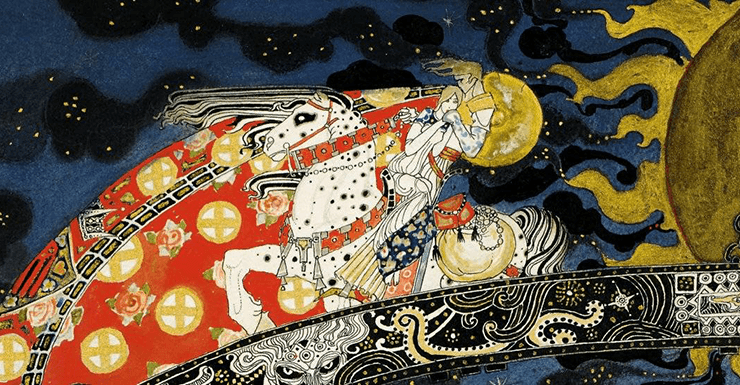
In the second century AD, the Roman writer Lucius Apuleius Madaurensis interrupted the winding plot of his novel, Metamorphoses, or The Golden Ass (a title used to distinguish the work from its predecessor, Ovid’s Metamorphoses) to tell the long story of Cupid and Psyche—long enough to fill a good 1/5 of the final, novel length work. The story tells of a beautiful maiden forced to marry a monster—only to lose him when she tries to discover his real identity.
If this sounds familiar, it should: the story later served as one inspiration for the well-known “Beauty and the Beast,” where a beautiful girl must fall in love with and agree to marry a beast in order to break him from an enchantment. It also helped inspire the rather less well-known “East of the Sun and West of the Moon,” where the beautiful girl marries a beast—and must go on a quest to save him.
I like this story much more.
“East of the Sun, West of the Moon” was collected and published in 1845 by Norwegian folklorists Peter Christen Asbjørnsen and Jørgen Engebretsen Moe, and later collected by Andrew Lang in his The Blue Fairy Book (1889). Their tale beings with a white bear deciding to knock on the door of a poor but large family. So poor that when the bear asks for the youngest daughter, promising to give the family a fortune in return, the father’s response is not “Hell, no,” or even “Wait a minute. Is this bear talking?” or “Can I see a bank statement first?” but “Hmm, let me ask her.” The daughter, not surprisingly, says no, but after three days of lectures and guilt trips from her father, climbs up on the back of the bear, and heads north.
I must admit that when I first read this story, I missed all of the questionable bits, because I could only focus on one bit: she was getting to ride on a bear! Talk about awesome. And something easy enough for Small Me, who rarely even got to ride ponies, to get excited about.
Which was probably not the right reading. After all, in most of these tales, the youngest daughter bravely volunteers to go to the home of the monstrous beast—either to save her father (in most versions) or because she believes she deserves it, for offending the gods (the Cupid and Psyche version) or because an oracle said so (also the Cupid and Psyche version, featuring the typical classical motif of “easily misunderstood oracle.) This girl initially refuses. To be fair, she’s not under the orders of an oracle, and to be also fair, her father’s life isn’t at stake. What is at stake: money, and she does not want to be sold.
Nor can it exactly be comforting to learn that her parents are willing to turn her over to a bear—even a talking bear—for some quick cash.
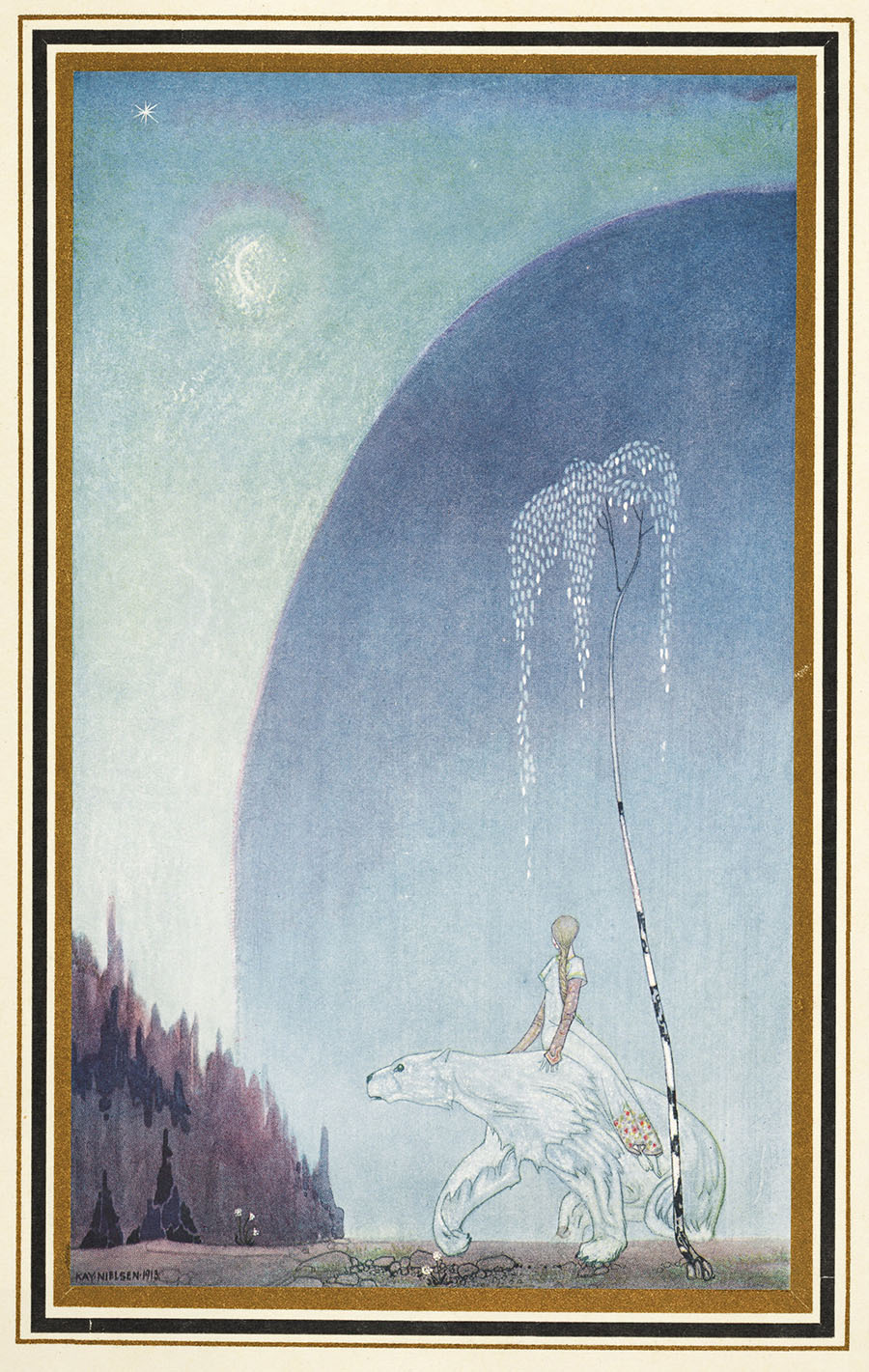
But her parents need the money. So. In the far north, the girl and the bear enter a mountain, finding a castle within. I must admit, I’ve never quite looked at mountains the same way again: who knows what they might be hiding, underneath that snow. During the day, the girl explores the palace, and only has to ring for anything she might want.
And every night, a man comes to her in her bed—a man she never sees in the darkness.
Eventually, all of this gets lonely, and the girl wants to return home—thinking of her brothers and sisters. The bear allows her to leave—as long as she doesn’t talk to her mother. That, too, is a twist in the tale. In most versions, mothers are rarely mentioned: the dangers more usually come from the sisters, evil, jealous, concerned or all three.
In this version, the mother is very definitely on the concern side, convinced that her daughter’s husband is, in fact, a troll. A possibility that should have occurred to you when he showed up to your house as a talking bear, but let us move on. She tells her daughter to light a candle and look at her husband in the dark. Her daughter, having not studied enough classical literature to know what happened to her predecessor Psyche after she does just that, lights the candle, finding a handsome prince.
Who immediately tells her that if she had just waited a little longer, they would have been happy, but since she didn’t, he now must marry someone else—and go and live east of the sun and west of the moon.
This seems, to put it mildly, a bit harsh on everyone concerned. Including the someone else, very definitely getting a husband on the rebound, with a still very interested first wife. After all, to repeat, this version, unlike others, features a concerned mother, not evil sisters trying to stir up trouble. Nonetheless, the prince vanishes, leaving the girl, like Psyche, abandoned in the world, her magical palace vanished.
Like Psyche, the girl decides to search for help. This being an explicitly Christian version—even if the Christianity comes up a bit later in the tale—she does not exactly turn to goddesses for assistance. But she does find three elderly women, who give her magical items, and direct her to the winds. The North Wind is able to take her east of the sun and west of the moon. Deliberate or not, it’s a lovely callback to the Cupid and Psyche tale, where Zephyr, the West Wind, first took Psyche to Cupid.
Unlike Psyche, the girl does not have to complete three tasks. She does, however, trade her three magical gifts to the ugly false bride with the long nose, giving her three chances to spend the night with her husband. He, naturally, sleeps through most of this, but on the third night he finally figures out that just maybe his false wife is giving him a few sleeping potions, skips his nightly drink, and tells his first wife that she can save him if she’s willing to do some laundry.
No. Really.
That’s what he says: he has a shirt stained with three drops of tallow, and he will insist that he can only marry a woman who can remove the stains.
Trolls, as it happens, are not particularly gifted at laundry—to be fair, this is all way before modern spot removers and washing machines. The girl, however, comes from a poor family who presumably couldn’t afford to replace clothes all that often and therefore grew skilled at handwashing. Also, she has magic on her side. One dip, and the trolls are destroyed.
Buy the Book
Miranda in Milan
It’s a remarkably prosaic ending to a story of talking bears, talking winds, and talking…um, trolls. But I suppose it is at least easier than having to descend to the world of the dead, as Psyche does in one of her tasks, or needing to wear out three or seven pairs of iron shoes, as many of the girls in this tale are told they must do before regaining their husbands. In some ways, it’s reassuring to know that a prince can be saved by such common means.
In other ways, of course, the tale remains disturbing: the way that, after having to sacrifice herself for her family, the girl is then blamed for following her mother’s instructions—and forced to wander the world for years, hunting down her husband, and then forced to give up the magical golden items she’s gained on the journey just for a chance to speak to him. (The story does hurriedly tell us that she and the prince do end up with some gold in the end.)
But I can see why the tale so appealed to me as a child, and continues to appeal to me now: the chance to ride a talking bear, the hidden palace beneath a mountain, the chance to ride the North Wind to a place that cannot possibly exist, but does, where a prince is trapped by a troll. A prince who needs to be saved by a girl—who, indeed, can only be saved by a girl, a doing something that even not very magical me could do.
No wonder I sought out the other variants of this tale: “The Singing, Springing Lark,” collected by the Grimms, where the girl marries a lion, not a bear, and must follow a trail of blood, and get help from the sun, the moon, and the winds, and trade her magical dress for a chance to speak with the prince; “The Enchanted Pig,” a Romanian tale collected by Andrew Lang, where the girl marries a pig, not a bear, and must wear out three pairs of iron shoes and an iron staff, and rescue her prince with a ladder formed from chicken bones; “The Black Bull of Norroway,” a Scottish variant where the girl almost marries a bull, and can only flee from a valley of glass after iron shoes are nailed to her feet; “The Feather of Finist the Falcon,” a Russian variant where the girl must also wear out iron shoes in order to find her falcon—and her love.
These are brutal tales, yes, but ones that allowed the girls to have adventures, to do the rescuing, and to speak with animals and stars and winds and the sun and the moon. Among my very favorite fairy tales.
Mari Ness lives in central Florida.


My first encounter with this story was an edited-for-children version where the girl sees the handsome young man walk past her rooms each night to the part of the castle she has bee forbidden to enter. The bear tells her he can’t discuss any of this with her. Curiosity finally gets the better of her (I don’t remember any trip home to see Mom in this version, though I’ve read it in the others you mention, so maybe that was cut too), and she follows the young man.
Again, maybe this was the version I read, but it seemed clear the tallow stains were the ones from the tallow candle that fell onto the sleeping prince. On a symbolic level, this is pretty good. This is what broke the relationship, and only the person who did that can fix it. Because it represents the damaged relationship, the trolls who want to marry him only make things worse.
Going a bit farther on the troll the young man is being forced to marry, it was always my understanding that he’d been cursed by the troll princess, turning him into a bear. If he found a woman who could be trusted to not break the rules set down in the castle for a year and a day, he would be free. If she didn’t, he would be forced to marry the troll.
So, the troll princess clearly doesn’t care about things like love and consent in a relationship. I’m not going to cry for her being in a rebound relationship.
In the edited/made safe for children version, I think the father first refused, but the bear insisted he ask his daughters if any would go with him. The bear was big enough in the illustration that I don’t think he would have had any problem tearing through the poor man’s small hut if he wanted to, so I don’t blame the father for conceding on this point. They all refuse except the youngest, who decides on her own to go with him to save her family from poverty.
Technically, I know it was done to keep the parents from looking bad, but it gave the daughter increased agency. She’s the one making this decision to help her family.
An interesting side note: In Scotland, “At the back of north wind” was an euphemism for death. East of the sun and west of the moon describes a place outside of mortal experience, so the story seems to carry some hints about a journey into the underworld.
Finist the Falcon was one of my favorite tales when I was a child exactly for this reason – it was a girl adventure. Not ideal, but I took all I could get. (Another favorite is Marya Morevna – the Warrior Princess!) The behaviour of the Finist left to be desired, but one cannot get everything I guess. Still, our heroine demanded what she wanted, and got it, went on a journey, received help not from one but three Baba Yagas (in the English translation they are “old women”, but in original – three Yaga sisters, at their most benevolent), and rescued her beloved (from evil marriage).
So interesting! I was convinced I had never read it, but there are elements of it in Jim Henson’s The Storyteller episodes:
“Hans My Hedgehog” has Hans turns into a young man at night, she is warned to not talk to anyone for one more night to keep him human, the girl talks to her mother and everything is ruined (very short summary). The ending of that episode is different.
“The True Bride” has a girl exchanging gifts to have the chance to remind his groom her identity.
@1 I thought it was the troll princess’ mother who had cursed him rather than herself, but it’s been a while since I read it.
The story sounded very familiar and I though that I had read it, but coming to the end of the article I realized that for me, too, the version I had read was “Finist the Falcon“. Which I did like, as much as I can remember (even though my favourite Russian fairy tale remains to be “The Little Humpbacked Horse”).
@@.-@ Like I said, the version I first read was altered and simplified. By they way, there’s a great adaptation by Marianna Mayer illustrated by Mercer Mayer (he of L’il Critter fame). The girl’s background is more fleshed out, and she goes to magical animals representing the different elements for help.
There are at least three modern novel length retellings, too. East by Edith Pattou, Sun & Moon, Ice & Snow by Jessica Day George (which I thought too obviously influenced by the PJ Lynch illustrated version), McKiernan Once Upon a Winter’s Night, and J.M. Ney-Grimm with Troll Bride.
I’ve read all but the McKiernan – don’t get along with his writing – and prefer the last, partly because it fleshes out all the characters in a way that works for me. the Pattou I never quite bought into, although I gave it a second try and things seemed less forced, and George’s wasn’t bad, it just didn’t do much for me.
I loved this story as a child. I first read it in one of the volumes of the My Bookhouse set, where the lovely Kay Nielsen art accompanied it, IIRC.
@ellynne: In Scotland, “At the back of north wind” was an euphemism for death. I didn’t realize that George MacDonald had taken his title directly from a known metaphor. I certainly didn’t know when I began his story that I would be faced with the death of a beloved character. I did not cope with that very well, even though the author had tried to couch it in terms of beauty.
Another retelling of the Cupid-Psyche tale is C.S. Lewis’s Till We Have Faces. Now there’s a version that requires more then one reading!
I agree riding a polar bear to a magic castle castle inside a mountain kind of takes your mind off the more questionable aspects of the tale, even if you’re all grown up.
@ellynne: You forgot to say how gorgeous Mercer Mayer’s illustrations are! Not the Li’l Critter style at all…I love Kay Nielsen’s illustrations as well, but Mayer’s are for a K-3 audience….and still beautiful!
I like the PJ Lynch picture book a lot. In some ways more than Mayer’s version.
Jackie Morris has adapted and illustrated her own novel-length version of this as well, East of the sun, west of the moon (2013). She has a different take on the ending that surprised me.
I, too, first encountered this tale via the Marianna Mayer retelling. Which is wonderful, and as Trey wrote, Mercer Mayer’s accompanying watercolor illustrations are utterly gorgeous. I’m pretty sure it’s regrettably out of print (at least I had trouble finding a copy for a friend’s daughter some years ago), but well worth acquiring if you can find a copy. I think the illustrations rank with some of the finest fantasy art ever, and my mental picture of one of Tolkien’s Ents will always be Mercer Mayer’s Father Forest.
Being from norway I grew up with this story, albeit in film form, “The Polar Bear King”. It’s an absolutely wonderful, creepy film with a few deviations from the story. Maria Bonnevie plays the princess and it’s one of my favourites from my childhood. Also check out the painting by Norwegian painter Theodor Kittelsen: https://goo.gl/images/X4kstK
@14 King Valemon was recorded as a separate story by Asbjørnsen and Moe, wasn’t it? Obviously closely related though.
There’s a work in progress fanfic on AO3 that’s an East of the Sun, West of the Moon and Avatar the Last Airbender (Zutara) fusion that’s just…excellent. I think the author’s in school and can’t update much when classes are in session, but the story so far is really enjoyable.
A Norwegian animation company called Maipo Film is reanimating the story of Kvitebjørn Kong Valemon – The Polar Bear King for a modern take on the tale. With the script being penned by the author Maja Lunde. Can’t wait until I can see it in theaters!
I am familiar with the version of Mercer Mayer’s illustrations. I still have my hardcover copy. I’ve lost the outer cover but my book is still a treasured item. Even as a young American child, seeing Mayer’s Salamander melted my heart and I wanted to meet him too. He is truly beautiful and how appropriate he was chosen to represent the Heart of their Love. You can’t look at him and not be moved. Even looking back on it now, I completely understand the comparison between East of the Sun, West of the Moon to the Cupid and Psyche story. I didn’t even think about Disney’s Beauty and the Beast but yes, it’s there too. How funny this story has versions from all over the globe with the same underlying story. For us humans, we would risk it all for True Love, no matter the consequences. ❤️❤️❤️