







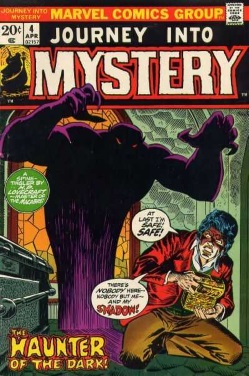
Welcome back to the Lovecraft reread, in which two modern Mythos writers get girl cooties all over old Howard’s original stories. Today we’re looking at “The Haunter of the Dark,” written in November 1935 and first published in the January 1936 issue of Weird Tales.
It’s a sequel of sorts of Robert Bloch’s “Shambler From the Stars” (not available online, and reading it isn’t necessary to appreciate “Haunter”), and Bloch later wrote “The Shadow From the Steeple” as a follow-up. You can read “Haunter” here.
Spoilers ahead for all three stories.
“This stone, once exposed, exerted upon Blake an almost alarming fascination. He could scarcely tear his eyes from it, and as he looked at its glistening surfaces he almost fancied it was transparent, with half-formed worlds of wonder within. Into his mind floated pictures of alien orbs with great stone towers, and other orbs with titan mountains and no mark of life, and still remoter spaces where only a stirring in vague blacknesses told of the presence of consciousness and will.”
On his first trip to Providence, Robert Blake visited an old man who shared his occult obsessions—and whose mysterious death ended the visit. Nevertheless, in 1934, Blake returns to create weird literature and art.
He sets up shop on College Hill. From his west-facing windows he overlooks the city, splendid sunsets, and the “spectral hump” of Federal Hill, a “vast Italian quarter” so avoided by his acquaintances it might as well be the unreachable world his imagination paints it. One structure intrigues him: a huge deserted church with a tower and tapering steeple. Birds avoid the tower, wheeling away as in panic.
Finally he ventures up Federal Hill. No one will direct him to the deserted church, but he finds it: a blackened fane atop a raised lot. Spring hasn’t touched it; the surrounding vegetation is as lifeless as the neglected edifice. A policeman tells Blake the church has stood unused since 1877, when its outlaw congregants fled following the disappearance of some of their neighbors. This heightens Blake’s sense of the church’s evil, and lures him inside through a broken cellar window.
Though dust and cobwebs reign, he discovers a vestry room stocked with such eldritch tomes as the Necronomicon and De Vermis Mysteriis! Well-read cultists, these Starry Wisdom chaps. He also finds a record book in cryptographic script, which he pockets. Next he explores the tower. At the center of its summit chamber, a pillar supports an asymmetrical metal box containing a red-striated black crystal. As Blake stares, his mind fills with visions of alien worlds, and of cosmic depths stirring with consciousness and will.
Then he notices a skeleton clad in decayed 19th century clothing. It sports a reporter’s badge and notes about the Starry Wisdom cult suggesting the Shining Trapezohedron can not only serve as a window on other places—a Mythos palantir!—but can summon the Haunter of the Dark.
Blake supposes the reporter succumbed to heart failure, though the scattered and acid-eaten state of his bones is perplexing. Gazing again into the Trapezohedron, he feels an alien presence, as if something were gazing back. Does the crystal glow in the waning light, and when he snaps the lid shut over it, does something stir in the windowless steeple overhead?
Blake takes off. Back on College Hill he feels increasingly compelled to stare at the church. He also deciphers the record book. It confirms the Shining Trapezohedron is a window on all time and space, and describes the Haunter as an avatar of Nyarlathotep which can be dispelled by strong light. Hence, Blake fears, the stirring he heard in the steeple after he inadvertently summoned the god by closing the box, plunging the crystal into darkness.
Thank saner gods for the streetlights between his home and the church! The Haunter may invade his dreams, but can’t physically visit. It does try to make him sleepwalk back to its lair, but after waking in the tower, on the ladder to the steeple, Blake ties his ankles every night.
He doesn’t reckon on thunderstorms and power failures. During one outage, neighbors hear something flopping inside the church. Only by surrounding the fane with candles and lanterns do they prevent the monster’s egress. In dreams, Blake feels his unholy rapport with the Haunter strengthen; waking, he feels the constant tug of its will. He can only huddle at home, staring at the steeple, waiting.
A final thunderstorm hits. The power goes out. The neighborhood guard around the church blesses each lightning flash, but eventually these cease and wind extinguishes their candles. Something bursts from the tower chamber. Unbearable foetor sickens the crowd. A cloud blacker than the sky streaks east. On College Hill, a student glimpses it before a massive lightning strike. Boom, an upward rush of air, a stench.
The next day Blake’s found dead at his window, face a rictus of terror. Doctors suppose some anomalous effect of the lightning must have killed him. But a superstitious Dr. Dexter heeds the dead man’s last frenzied jottings, which claim he began to share the alien senses of the Haunter as its mind overwhelmed his. Blake feared it would take advantage of the power failure to “unify the forces.” There it is, his last entry cries: “hell-wind—titan blur—black wings—the three-lobed burning eye….”
Dr. Dexter recovers the Trapezohedron not from the church’s tower room but from the lightless steeple. He throws it into the deepest channel of Narragansett Bay. So much for you, Haunter. Or, um, maybe not so much?
What’s Cyclopean: The dark church! We also get “a spectral hill of gibbering gables.” How, pray tell, do gables gibber?
The Degenerate Dutch: Somehow Providence’s Italian quarter is an “unreachable” land of mystery. And of course, not one of Blake’s friends has ever been there. This is kind of like living in DC and boasting that no one you know has visited Anacostia: plausible but it doesn’t say anything great about you, and maybe your friends should get out more. Lovecraft also tries to run with the “superstitious foreigners” trope in spite of the ‘superstitions’ being totally accurate and practically useful.
Mythos Making: The trapezohedron passes through the grasping appendages of Outer ones, Old Ones, Valusian Serpent Men, Lemurians, and Atlantians before Nephren-Kha builds its temple in Khem. Blake seems pretty familiar with the Mythos pantheon, not only recognizing the Standard Scary Bookshelf in the church but praying variously to Azathoth and Yog-Sothoth while trying to avoid Nyarlathotep.
Libronomicon: “Haunter” includes two sets of texts. First up are Blake’s stories: “The Burrower Beneath”, “The Stairs in the Crypt”, “Shaggai”, “In the Vale of Pnath”, and “The Feaster from the Stars.” Some are based on Robert Bloch Stories (for “Feaster” read “Shambler” and get this story’s prequel), while others will be borrowed by later Lovecrafters (e.g., Brian Lumley’s The Burrowers Beneath). Then in the old church we have several infamous volumes: the Necronomicon, Liber Ivonis, Comte d’Erlette’s Cultes des Goules, Unaussprechlichen Kulten, Prinn’s De Vermis Mysteriis, the Pnakotic Manuscripts, and the Book of Dzyan.
Madness Takes Its Toll: Blake’s supposed madness is used by “conservative” commentators to explain away the events around his death.
Anne’s Commentary
And yet again, Lovecraft treats a friend to fictional death. This time, however, he’s just returning the favor. A very young Robert Bloch asked the master’s permission to kill off his literary avatar in the 1935 “Shambler from the Stars.” Not only did Lovecraft grant permission, but he volunteered a Latin translation for Bloch’s invented tome, The Mysteries of the Worm, which debuted in “Shambler” and which we now know and love as Ludvig Prinn’s despicable De Vermis Mysteriis.
“Shambler” is a straightforward tale of inadvertent summoning: The youthful Blake approaches an older occultist with Prinn’s book. Older But Not Wiser gets so into translating the Latin aloud that he launches right into a spell for calling down a servitor from beyond the stars. It comes, invisible but tittering, and drains the old fellow’s blood. As the crimson libation permeates its system, it becomes visible, a jelly-like blob waving tentacles and talons. Blake escapes, the house burns down, no evidence against him.
But Blake gets his in Lovecraft’s rejoinder, this week’s story. Not to be forever silenced, Bloch wrote a sequel to the sequel in 1950, “The Shadow from the Steeple.” It takes up a question Lovecraft leaves to the acute reader: If one wants to avoid plunging the Trapezohedron into darkness, does tossing it into the deepest depths of Narragansett Bay make sense? No, it doesn’t, Bloch tells us, for that freed the Haunter to take over Dr. Dexter’s mind and body. In an atomic age twist, Dexter turns from medicine to nuclear physics and helps develop the H-bomb, thus ensuring the destruction of mankind. Huh. You’d think Nyarlathotep could destroy humanity without going through all that trouble, but maybe he enjoyed the irony of watching it self-destruct?
Anyhow, much of the story is a tedious recap of “Haunter,” followed by a tedious recap of the hero’s sleuthing into the mystery of Blake’s death, followed by a kind of amusing denouement between hero and Dexter. Hero tries to shoot Dexter, but Dexter glows at him in the dark, which somehow kills hero. Radiation poisoning? Whatever. The best part of the story is the conclusion. We’ve learned at the start of the story that two black panthers have recently escaped from a traveling menagerie. As Dexter strolls his night-shrouded garden, the panthers come over the wall. In Lovecraft’s sonnet “Nyarlathotep,” nations “spread the awestruck word, that wild beasts followed him and licked his hands.” And so they lick Dexter’s, while he turns his face “in mockery” to the watching moon.
I find the less successful Mythos stories lose Lovecraft’s sense of awe, rendering the inscrutable all too scruted. Whereas “Haunter” dwells with affection on the mysteries dimly revealed to Blake, first in the Trapezohedron and then in the vast mind and memory of its master. “An infinite gulf of darkness, where solid and semi-solid forms were known only by their windy stirrings, and cloudy patterns of force seemed to superimpose order on chaos and hold forth a key to all the paradoxes and arcana of the worlds we know.” Now that’s some cosmic wonder for you, the more compelling for its pointed vagueness. And what does kill Blake, after all? The ultimate lightning blast doesn’t even crack his window. Could it really have communicated itself to him through the unharmed glass, or does he die because he has merged at last with the Haunter and so must be dispelled along with it?
“Haunter” is one of Lovecraft’s last forays into his Mythos, almost his final meditation on man’s paradoxical drive to know and terror of learning too much; for all its in-joking, its tone remains sober. Is Eden’s apple sweet but poisonous, or is it sweet and poisonous, because the pleasure and the pain can’t be separated? Written in the same year, “The Shadow Out of Time” dwells at much greater length on the question. Knowledge shakes Peaslee, its protagonist, but doesn’t kill him; even after his discoveries in Australia, he can wonder whether his Yithian “ordeal” wasn’t the greatest experience of his life. Poor Blake. He never has a chance to get over the terror. But then again, his counterpart did sic that star vampire on poor Howard, and payback’s a bitch.
Ruthanna’s Commentary
This is the last of Lovecraft’s solo stories, written a little over a year before his death. Lovecraft got his first professional publication at age 31, and died at 46—a short, prolific career, with quality still rising at the end and no sign that he’d hit his peak. Occasionally I’m reminded that if he’d had longer, 90% of his existing stories would have been seen as the sort of early work that usually makes for filler in an author’s later collections. That makes it even more impressive that so much is good (or at least engaging) and wildly original. I’m certainly not the first person to wonder what he would have produced at 50 or 60. Or to consider that his work probably survived through years of obscurity to its current prominence, not solely on its own (very real) merit, but due to his mentoring and his willingness to fling his sandbox wide open for others to play in.
“Haunter” has the quality I expect from these later stories—good integration of description with action, detailed worldbuilding, a central premise that successfully combines temptation and horror. And it manages to stay close to the action even with the usual third-hand framing conceit. That said, I found it a bit of a let down by comparison with some of his other late work—although only by comparison. “Whisperer in Darkness,” “At the Mountains of Madness,” “Shadow Out of Time,” and even “Shadow Over Innsmouth” look in-depth at alien/esoteric cultures and do serious heavy lifting for a more cohesive Mythos, while Haunter hangs a big part of its effect on familiarity with that back story. Still, the shining trapezohedron is awesome—I want one, you know you do too—and much of my complaint is that we don’t get more detail on what can be seen through it. I don’t want everything revealed, but I do want alien worlds, glimpses of the Starry Wisdom Cult’s rituals—and relative to those other stories, Haunter seems short on their details. I could have seen a lot more and still felt like he was leaving a fair amount to the imagination.
I’m not the only one who wants more, and many folks seem to have gone ahead and made it themselves. Aside from Bloch’s sequel, “Haunter” is back story for the Illuminatus Trilogy. The Church of Starry Wisdom appears to have a branch in Westeros. And other branches several places online. I did not click through because I’m not an idiot. The Shining Trapezohedron itself is given to the winner of the Robert Bloch Award. Which I now want, because I’m an idiot.
Of course, everyone wants the trapezohedron. Who wouldn’t? Alien worlds and cosmic secrets? It’s like the Asguardian tesseract and a palantir rolled into one—not surprising as one suspects it of being grand-daddy to both. As with many of Lovecraft’s other late stories, “Sign me up!” seems like an inevitable refrain. The trapezohedron has an interesting pedigree, too—Made With Love in the Workshops of Yuggoth. That fits the Outer One’s special relationship with , and propensity to evangelize for, Nyarlathotep. And we see here, as in “Whisperer,” Lovecraft’s terror that wanting to better understand anything foreign—Italian or Yuggothi—is a temptation most strenuously to be avoided.
Back on Earth, this story is one last love letter to Providence, more compelling than “Charles Dexter Ward.” In “Ward,” the paeans to the city and the verbal maps seem a touch dissociated from the actual action. Here, everything focuses on the contrast between city as comforting home and city as alien horror. So many things can make your beloved home dangerous and unfamilair. You go into the wrong area and realize you don’t know the place at all, or the power goes out, and suddenly it’s not your safe, comforting haven after all. And the fact that it always balances on that edge, and could easily tilt over from comfort into horror, is one of the things that makes you love it—always apocalypse just around the corner.
The ending is ambiguous, and I think it works. I’m left wondering—did the Haunter possess him and then get caught by lightning, as some have suggested? Has Blake’s mind been torn from his body to travel the void shown by the trapezohedron? That seems like something a Yuggothi artifact would do. Has he been killed outright as sacrifice, or punishment? Inquiring minds want to know—and that, the story suggests, is the real danger.
Next week, we return to Kingsport to explore “The Strange High House in the Mist.”
Ruthanna Emrys’s neo-Lovecraftian novelette “The Litany of Earth” is available on Tor.com, along with the more recent but distinctly non-Lovecraftian “Seven Commentaries on an Imperfect Land.” Her work has also appeared at Strange Horizons and Analog. She can frequently be found online on Twitter and Livejournal. She lives in a large, chaotic household—mostly mammalian—outside Washington DC.
Anne M. Pillsworth’s short story “Geldman’s Pharmacy” received honorable mention in The Year’s Best Fantasy and Horror, Thirteenth Annual Collection. “The Madonna of the Abattoir” is published on Tor.com, and her first novel, Summoned, is available from Tor Teen. She currently lives in a Victorian trolley car suburb of Providence, Rhode Island.

A fun story which journeys into the collaborative side of the Mythos: I bet both Lovecraft and Bloch had a lot of fun with this trio. (They’re all found in Tales of the Cthulhu Mythos, along with many other formative stories)
Weird Tales: December 1936, to be precise, along with Robert E. Howard’s “The Fires of Asshurbanipal”, Robert Bloch’s “Mother of Serpents”, Derleth and Schorer’s “The Woman at Loon Point”, Manly Wade Wellman’s “The Theatre Upstairs” and Henry Kuttner’s “It Walks by Night”.
“The Shambler from the Stars” appeared in the September 1935 issue, which also contained Clark Ashton Smith’s “Vulthoom” and a reprint of Edmond Hamilton’s “The Monster-God of Mamurth”. “The Shadow from the Steeple” was in September 1950, which also included Asimov and Pohl’s “Legal Rites”, Manly Wade Wellman’s “The Pineys” and August Derleth’s “Potts’ Triumph”.
Free anthology idea: Lovecraft stories, had he sold them to the magazines of the 40’s and 50’s: Campbellian Competent Guys vs Eldritch Horrors, Planet Stories space opera with ray-guns, weird outfits and Mi-Go, Galaxy social satire where working in the rare books industry proves literally soul-sucking… (many of these probably exist in some form)
I have to ask: who decides when these posts come on?
An enjoyable romp, and I think that’s how Lovecraft approached this one. He was just having a bit of fun, paying Bloch back in kind, not trying to instill a sense of cosmic horror. With all the overdone language general pretentiousness that turns up in his work, it’s easy to forget that the man had a very lively sense of humor.
One thing that jumped out at me was the portrayal of Blake. He really seems more like Clark Ashton Smith, with his painting and whatnot. Sure, Bloch was still very young and had only published a few stories at this point, but the painting seems an odd touch. Or did the young Bloch dabble in that sort of thing as well?
@2: Regarding painting, I have found one later picture by Bloch: http://bit.ly/1DBeeJT. I’m not sure whether it was ever a major interest of his though. I do know that Robert M. Price considers Blake to have aspects of Lovecraft, Smith and Bloch.
“Gibbering gables” is hilarious. And a good exclamation, which I shall use henceforth. As in “Gibbering gables, where did my amulet go?!”
A good tale.As Ruthanna said, it’s not up there with the best tales of Lovecraft’s late period (“Shadow over Innsmouth,” “Shadow Out of Time,” etc) , but it’s well done and holds together. A few general comments:
Church of the Starry Wisdom: Sadly, not there anymore. It’s real-world prototype (St John’s Catholic Church) was torn down some time ago.
Influenced by: Lovecraft seems to have been partially inspired by Ewers’ “The Spider.” Ewers’ tale involves a man whose personality disintegrates after he becomes obsessed with looking through his window at a beautiful woman:
“My name-Richard Braquemont, Richard Braquemont, Richard-oh, I can’t get any farther….”
Influence On: I wonder if “Haunter” might have had some influence on Borges’ “The Aleph.” He credits Wells’ “The Crystal Egg” as the tale’s main inspiration, but maybe….
Bloch and the mythos: Have to give him credit for trying to give us a glimpse of what happens after the “stars are right” in “Strange Eons”
DemetriosX @@@@@ 2: I also noticed the odd detail of the fantastical paintings, which sound so Clark Ashton Smith. I haven’t been able to find any information on Bloch painting, so I’m thinking there’s a bit of Ashton Smith merged with Bloch here. Hey, killing two birds with one Shining Trapezohedron, that’s economical.
A couple of Bloch-related links:
S. T. Joshi’s Robert Bloch Award trapezo- ahem, trophy: http://legiongp.deviantart.com/art/The-Robert-Bloch-Award-The-Haunter-Of-The-Dark-396600278
A brief fanzine article from Bloch on Poe and Lovecraft:
http://alangullette.com/lit/hpl/bloch.htm
Vaguely related question: is there a term for the sense of dread that comes upon you when you realise that the protagonist of the book you are reading is an obvious author-insert?
@5: Now I’ve looked into it, I think that your idea about Ewers is quite right: “The Spider” was included in The Dead Valley and Others: H. P. Lovecraft’s Favorite Horror Stories Volume 2. I also found a reference to a remark by Juan Barrientos in NYRSF, suggesting that “The Aleph” parodies Lovecraft.
Pictures of the real-life Blake’s house and Starry Wisdom church: http://www.hplovecraft.com/creation/sites/rhode.aspx#mumford.
This is one of my favourite HPL tales.
My particular favourite parts are:
1. The background history of the Shining Trapezohedron (try saying “Shining Trapezohedron” five times fast), particularly that it came to rest in the catacombs of Nephren-Ka (oh how I adore these subtle references to earlier works).
2. The description of the interior of the abandoned church as Blake breaks, enters and explores it in the dark. This is one of the most vividly eerie pieces of prose I think Lovecraft ever wrote. I can totally imagine myself in the shoes of the protagonist — the silence and darkness is almost palpable — and somehow this part, as he pokes around uncovering abandoned traces of the Starry Wisdom cult, is even more hair-raising for me than even after he awakens the dreaded “Haunter”.
I once visited Paris in the fall of 2009 and found myself trapped inside a Cathedral at night, after visiting hours. I neither speak nor read French, so when the only priest on duty tried to ward me away from the doors as I approached in the late evening, before turning his back on me and heading back inside, I merely shrugged and followed (apparently unbeknownst to him). The next thing I knew, the whole place was dark and silent and the priest was nowhere to be found. After a few minutes of wandering around drinking in the hallowed atmosphere, I decided to leave and found all the doors of the sanctuary (I believe there were at least two different entrances) firmly locked.
I remained calm (after all, this was a Roman Catholic church and not a Starry Wisdom one) and eventually stumbled into a vestry area. Thankfully there were no ceiling-high shelves of mildewed, disintegrating books, but somewhere within the vestry complex was an outer door which — by the grace of God — was not locked, and led outside to a quiet alley behind the church.
It’s just as well I did not locate the entrance to the steeple — who knows what I may have found lurking up there?
The Shambler From The Stars is available online here:
https://www.google.com/url?sa=t&source=web&rct=j&url=http://hplovecraft.hu/print.php%3Ftype%3Detexts%26id%3D995%26lang%3Dangol&ved=2ahUKEwiO59Os7ODgAhWLEBQKHeH6CZIQFjAPegQIARAB&usg=AOvVaw2j9Fzgi1I00kt0oEa-vlZO
“Lovecraft also tries to run with the “superstitious foreigners” trope in spite of the ‘superstitions’ being totally accurate and practically useful.”
Also, for once, rather heroic with the candle and lantern vigil outside the church during the power cut.