






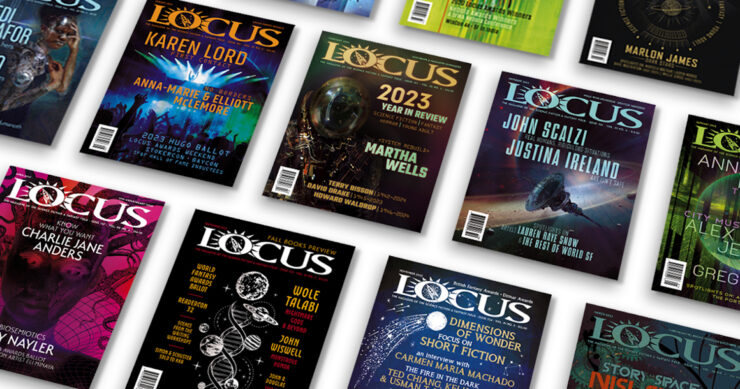
I’ve been aware of Locus Magazine for as long as I can remember: it’s basically the publication of record of science fiction and fantasy, an essential window into everything going on with genre.
Locus started as a zine and still has a certain amount of zinester quirkiness—for many years, it published subversive microfictions about great dates in future history, written by the late great Terry Bisson. But it also has a massive stable of contributors who include some of our most distinguished critics and scholars, and I’m always amazed at how much ground a single issue manages to cover.
When I started reading Locus regularly nearly 20 years ago, I couldn’t believe that something so utterly useful existed in a world dedicated to corner-cutting. Pages of industry news and book deals, list of upcoming publications, interviews with up-and-coming authors whose work I hadn’t gotten to yet… It was all utterly essential, and an amazing crash course and everything to do with SFF publishing and related topics.
Having been interviewed by Locus, I can testify that their interviews are not like other interviews. They sit you down with a tape recorder and ask a ton of questions, and then your answers are presented without the questions you were responding to—and somehow it turns into a sort of stream-of-consciousness essay, a weirdly introspective portrait of not just an author’s career, but how they think. I honestly don’t know how they do that.
But the main thing I value Locus for is, of course, their reviews. There’s a couple of reasons why the magazine’s large and robust review section remains so incredibly important in this day and age.
The first is that it’s one of the few places you can see reviews of a huge cross-section of brand-new speculative fiction books by some truly knowledgeable and adept critics. I recently lost my job as SFF book reviewer for The Washington Post, which hurt but also felt like an intensification of an ongoing trend: newspapers, magazines, websites and everyone else nuking their book content from orbit. As an author who would like to get my own books reviewed somewhere, this feels like an existential nightmare—but it also feels like a threat to the ecosystem that supports every author and keeps genre book publishing vital and innovative.
The fact that Locus tends to review books from the standpoint of a deep knowledge of the genre—and an intense curiosity about what new ideas people are bringing to it—is just an added benefit. Even if Locus were stodgy or clueless, which it very much isn’t, those reviews would be invaluable at this point. As it is, the reviews in Locus are so good that I’m pretty sure they inspire a lot of authors try to rise to the challenge and do their best work.
The other reason I’m especially grateful for Locus’ review section is that they review short fiction. Nobody reviews short fiction anymore, apart from a handful of websites here and there. Short fiction is where all of the genre’s best experiments happen, where people push the limits of what is possible in the fantastical, and yet it gets less and less attention. Short fiction magazines are struggling, thanks in part to changes at Amazon and social media, and it’s an uphill battle to even find out about the best stuff that’s being published right now.
It’s sort of ironic that a genre like science fiction which so often posits more perfect communication and information—e.g., the Ansible—struggles so much with awareness. As a result, great ideas and essential works of fiction fall through the cracks and get ignored. The more people read Locus and pay attention to its reviews and other content, the healthier and more brilliant speculative fiction will be.
Locus Magazine is running their annual fundraiser through April 14th — Go here to donate, subscribe, or get one of their amazing donation gifts.

I have a friend who emigrated to the UK to help her husband care for his elderly parents. I sent a Locus gift subscription after her (and she sent a London Review of Books back to me).
I agree with every word of this piece. I’ve been reading Locus since the early or mid 1990’s and love it so much I bought a lifetime subscription, which has proved a terrific bargain. I contribute yearly as well. Locus is essential to anyone who wants a deep knowledge of the literature of the fantastic.