






Something is rotten in the state of fanfic.
In the last three years, I’ve read more novels that are fanfic with the serial numbers filed off than I had in my entire reading life to date. Partly, I’m better informed about what’s going on in the book industry and when books are coming out of fandom. It’s also simply become more common and more accepted for authors to cop to being fanfic writers, as the stigma of participation in fandom has lessened and, in many circles, vanished.
I’m glad to see the stigma go, and for a while I was celebrating the influence of fandom on romance and SFF spaces. Loads of my most beloved authors, including my two favorite romantasy writers of the moment (Tasha Suri and Freya Marske), came up writing fanfiction. I get a kick out of those little promotional graphics that use AO3-style tags to let readers know what to expect from a forthcoming tradpub novel.
But as the scales continued to tip, a wave of reskinned fanfics have emerged from major publishers, and even I have begun to coalesce some concerns. We’ve seen this type of thing in dribs and drabs over the years—Fifty Shades of Grey most famously, Anna Todd’s After, etc.—but the real boom started with Ali Hazelwood and the Reylo [Rey/Kylo Ren] fandom. At least five tradpub romance novels in the last few years were Reylo fics first, and many more have been written by authors who come from Reylo fandom and promise similar vibes in their books.
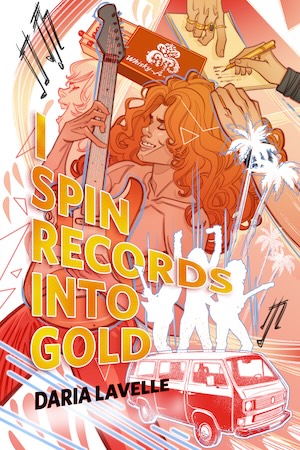
Now, you had to be pretty online to know about the Reylo situation, but the successor to the Reylo boom places the ship name and fanfic origins front and center in marketing efforts. In 2025, we’re getting three major romantasy novels that began life as Dramione [Draco/Hermione] fanfics. I know this because the authors and publishers have made the Harry Potter fanfic connection a key selling point for these books, all of which are receiving extensive, expensive marketing campaigns to ensure their success when they come out1. Two of the three publishers issued (then withdrew, following backlash) cutesy pastel graphics highlighting the Dramione ship. The authors have received extensive pre-pub coverage specifically for coming out of Dramione fandom (NPR, Washington Post, Harper’s, New York Times, thank you Kayleigh Donaldson for spelling it out).
This shift aligns with worrying (to me) overall trends in the media landscape. In the age of corporate consolidation, film and TV have turned to franchises as the most reliable drivers of income. Think of all the Marvel and Star Wars content that’s come out in the last ten years, across media platforms. By and large, the big buzzy media—the things every outlet feels like they have to cover—are going to be the latest installments of some piece of proven IP. A show like Severance or a movie like Sinners feel exciting and unexpected because they were taking such huge swings, going all in on an unproven original property, albeit with the backing of major names in Ben Stiller and Ryan Coogler.
That this kind of imaginative consolidation is bad for art feels so obvious it’s hardly worth saying. Instead of telling their own stories, creatives are funneled into pre-existing IP, often with corporate-issued limitations on what kind of stories they can tell. In a recent interview, Star Trek: Strange New Worlds star Celia Gooding answered a question about prospective queer representation by saying, “Yeah, I think it’s important to remember who we work for. This is Paramount’s Trek.” Oof.
Historically, book publishing hasn’t had anything comparable to this kind of mega–media franchise. The closest bet is a long-running series or beloved author—A Court of Thorns and Roses is a good example—but you can’t diversify that IP. You just have to wait until Sarah J. Maas is ready to write her next book. The closest book publishing could come to capturing ACOTAR energy for non-ACOTAR books would be putting Maas’ name in the promotional copy or asking her for a blurb. You can’t will a phenomenon like ACOTAR into being, and you can’t capitalize on it—the way an MCU or a Star Wars can—with twelve million adjacent TV shows whose artistic quality and creative integrity is, frankly, kinda beside the point.
The Reylo and Dramione booms function like media franchises for book publishing, banking on and extending the reach of reliably lucrative IP. For publishing houses, it’s a clear win. These books can cash in on fannish enthusiasm through an always plausibly deniable connection to the fannish property. No unpleasant associations with an author who has dedicated her considerable financial resources to making life unlivable for trans people in the UK. No copyright fights or licensing fees, either as long as JK Rowling doesn’t kick up a fuss—which it seems, so far, that she hasn’t.
Her silence makes sense. As her virulent transphobia continues to alienate one-time Harry Potter fans, the Dramione literary universe offers an alternative way to participate in the world of Harry Potter. Readers who aren’t bothered by JK Rowling’s transphobia can get more of the content they crave, now with slipcases, midnight release parties, extravagantly gorgeous endpapers. For readers who are nostalgic for the good years with Harry Potter, but don’t want to feel like shitty people, there’s the moral fig leaf of name changes and authors promising that “fan fiction is an act of resistance.”
I mean, maybe.
My view of fandom isn’t a utopian one. Platforms are made and maintained by people with their own prejudices, their own screwy priorities, and their own allegiances to financial pressures. The properties with enormous fandoms tend to be well-funded and long-lasting, which means that they, too, have made their way to us via the capitalist meat-grinder. Still, every degree of separation from those financial, capitalist structures is a degree of benefit, a degree of fanfic’s ability to resist such structures (if it wants to), and to make space for such resistance. If the hugest ship in my fandom is boring or racist or simply not my thing, there are no gatekeepers preventing me from writing my own 150K Black Sails fanfic for the twelve people who want to read it—and that just isn’t the case in book publishing.
It turns out that when you extract fanfic from the spaces and communities that made it special, it stops being special. In a recent piece for Fansplaining, Tessa Gratton wrote:
Fandom is supposed to transform canon/power by opposing it—by dragging story out of the center and into liminal, non-monetary-value queered space, and existing there. … We’re also seeing trad publishers co-opt fandom language to sell original books, and push books based on their direct connections to fandoms. Being consumed and co-opted by publishers is bad for fandoms. At the very least, it moves fandoms toward the center—where the things that matter are money, whiteness, imperialism, heteronormativity, and maintaining the status quo.
Feed fanfic into capitalism, and it comes out shaped like capitalism. The job of agents and editors is to find authors whose books will be successful, which means finding ways to cash on social media trends—like the BookTok popularity of Dramione and Reylo. And those trends aren’t neutral. The TikTok algorithm that produced them is racially biased, suppressing content from Black and queer creators. At the level of the basic mechanics of the platform, virality accrues first and most to white tastemakers and their interests. The publishing industry, whose gatekeepers are overwhelmingly white, has racism problems of its own. The issues of racism, sexism, ableism, and heterosexism compound.
Where fanfic is famously queer, the normative biases of corporate publishers are clear to see in the ships and fandoms that make it to market. Book deals and massive marketing campaigns have accrued overwhelmingly to white authors writing about straight couples, and have drawn from fandom spaces that prioritize redemption arcs for fashy white guys. Two of the three Dramione novels coming out this year feature a female main character enslaved by her male love interest.
That’s gross, although slavefic is hardly unique to this ship or this fandom. What’s new here is the sudden willingness of corporations to throw their support and resources behind fic with the serial numbers filed off, in service of creating shadow franchises to popular IP. From a queer, community-based space that runs on a gift economy, certain winners are now being crowned. The stories that get lifted out of fandom—where a bad (white) man is redeemed by the love of a good (ambiguously brown) woman he’s busily oppressing—are being chosen because those are the stories capitalism always wanted to tell.
I don’t believe that any of the agents, editors, authors, and marketers involved are acting from a place of unbridled cynicism, though the result feels deeply cynical. I would guess, rather, that they’re acting from love; from a true, genuine, heartfelt admiration for the cornucopia of creative talent in fandom. Fanfiction exists because of that love. At its best, it exists as a communal celebration of love freely given. It ignores every rule about length and good taste and normativity and, like, being a straightforward narrative instead of a functioning game of Minesweeper that still manages to hurt your feelings. It’s a raw, bleeding offering of unalloyed weirdness, by creators poking our heads up out of the earth to see if there’s anyone else out there who matches our freak. It’s precious for all the things it offers us that corporations won’t.
A modest proposal: Let’s establish a new fandom stigma for the new millennium. We will continue to celebrate, not stigmatize, reading, writing, and loving fanfic. But we will feel free to disdain the practice of shadow franchising, especially for properties like Harry Potter that are owned by monstrous people. Let’s not get into the habit of trawling the wriggling, unknowable sea floor that is fandom, only to feed its most palatable morsels into the hungry maw of capitalism.
- Literally! In the “Key Selling Points” section on Edelweiss, the record for Alchemised name-checks the Harry Potter fanfic it used to be, and the record for The Irresistible Urge to Fall for Your Enemy mentions the Dramione ship name and the author’s fanfic background. ↩︎

“often with corporate-issued limitations on what kind of stories they can tell” is certainly nothing new WRT to Star Trek. The old “standards and practices” offices.
And it looks like the Superhero franchises may be faltering now, too. We can hope, anyway.
The ban on LGBTQ representation in 1980s-2000s screen Star Trek wasn’t due to anyone’s S&P department (since two of the shows were syndicated rather than network), but was pretty much entirely due to Rick Berman. Look at the other network and syndicated TV of the same era and you’ll see a steady increase in representation and inclusion, while Berman-produced Trek spent 18 years pretending unwaveringly that human sexual diversity didn’t exist at all.
This is, of course, an area where fanfic was famously ahead of the curve, since the very word “slash” for same-sex fanfic originated with Kirk/Spock stories (although those were less about gay inclusion than indulging heterosexual female fanfic writers’ fantasies). The same goes for the licensed professional Star Trek tie-in fiction, since we were putting LGBTQ+ characters in our novels as early as 1998 (though that was a few years before my time). Note that all licensed novels have to be approved by the studio, and they didn’t shoot it down in the books (though in the early years it did have to be kept very subtle).
I agree, though, that it looks like broadcasters are getting more timid about inclusion than they were a few years ago. Greg Berlanti-produced shows like the Arrowverse generally made a point of featuring gay and lesbian characters in lead roles, but the last Arrowverse series, Superman & Lois, was completely heteronormative except for a subplot where Lana Lang’s teenage daughter got kissed by a girl once at camp, offscreen between seasons. Maybe that was meant to be the beginning of a journey toward giving her a girlfriend, but the show retreated from it.
The top pairings on ao3 are overwhelmingly queer (m/m) but publishing cherry picks the n*zi boy and brunette girl every time? Big yikes!
Yeah, it’s kind of interesting, huh? To be fair, the three Dramione books were only popular because of BookTok (not to downplay it, I mean I’m sure it was popular on fandom spaces like Tumblr, and then someone on TikTok was like “hey, read this instead”). But I’m pretty sure that the top two popular ships for HP are Draco/Harry and Lupin/Sirius (I can’t check atm because, of course, AO3 is down for maintenance…).
But yeah, most fandoms where there are more male characters than female characters will more likely than not have a higher percentage of same-sex ships over het ships.
louder for the people in the back
Louder for the people in the back!
And again only louder still for the ones that still have their fingers in their ears trying desperately to pretend that there are no queer folks at all, anywhere!
Great read, even if a bit depressing.
There’s some irony here listing SJM books as original IP, given how heavily they borrow from Anne Bishop’s Black Jewels Series. ACOTAR and CC share a lot of DNA with those books and many romantasy fans read them while waiting for the next SJM.
Hmm – really would have thought copyright law would have put a stop to this? Are the books being published by the same company that published the Harry Potter books? If so, then they have a vested interest and I wonder if they made an unknown backdoor payment to her?
If they are being published by a different company – then I would look for backdoor payments to the original publishing company. At least in the US, by my understanding and belief, the company that the copyright is exclusively licensed to can sue people abusing the copyright without the authors involvement or consent.
Interesting perspective here as I have always looked at fan fiction (including the stuff I wrote using Sid Meir’s Alpha Centauri) as just something people really involved in a fandom do to engage with something they love.
I’m not going to buy the book, but I am genuinely kind of curious what the book version of “Manacled” is even going to contain, because not only is it just the characters of HP, but the plot is essentially “The Handmaid’s Tale.” If you take both of those away, what is even left?
It doesn’t violate copyright to tell a pastiche of another work with the names changed. There are only so many ways to put a plot together, and so many character types, so neither one in general can be copyrighted or trademarked. I mean, how else did Seth McFarlane get away with The Orville?
But it used to be that if book editors saw, say, a slush-pile manuscript about Captain Retnahs and his half-Hephaestean science officer Yomin of the starship Energy, they’d toss it on the reject pile after the first page, along with all the others they saw on a regular basis. So it surprises me that the kind of imitativeness that was once an automatic failure mode is now actually seen as a selling point.
Oh agree it all is determined on how close they are – but advertising it basically as fan-fiction of another property would seem to be asking for trouble. I mean the Orville had differences from Star Trek right? I mean if the Wind Done Gone only got away with it because it was parody though the overall story seemed pretty different … I don’t know copyright law always seemed odd to me, and nominally I practice it as I do IP law. Mostly patents and trademarks though – which don’t always make sense either of course.
I think the whole “advertising it basically as fan-fiction” is where A LOT of people are concerned. In the end, I don’t necessarily care TOO much about books that were originally fanfiction, because a lot of them do work. 50SoG worked because the original fanfic was pretty far removed from Twilight anyway.
Compared to now where these companies are full on, as you said, advertising the fact that this original work was fanfiction, and now people who never knew that will see what’s original and what’s fanfic. Of course, now with 50SoG, it’s easy to see who was who, same thing with After. But if you didn’t know, it wasn’t obvious.
But yeah, I’m worried about what this means legally, tbh. It might not be illegal, because there’s no original idea anymore. Writers are inspired by everything they see. Dante’s Inferno, Paradise Lost and Romeo and Juliet are all technically fanfiction. But it’s moreso the slippery slope of what could happen.
There are some genres where people want the same story over and over. Like romances where the spunky young woman with no money marries the duke.
Right here, for example:
https://reactormag.com/a-knight-to-remember-six-retellings-of-the-story-of-tam-lin/
I peer into my crystal ball and see an eventual intense copyright crackdown on fanfic spaces as a result of all this, repeating the cycle all over again.
This is certainly what I’m afraid of.
What bothers me is fiction that is not professionally written.
Maybe you write new Sherlock Holmes stories that are similar to the originals, with a similar Victorian setting. Maybe you use Sherlock Holmes as a character in your amusing steampunk novel, along with a whole collection of real characters such as Queen Victoria, plus fictional characters such as Dr. Jeckyll. Maybe you write a profound literary novel where you sensitively explore Holmes’s inner depths in a way that Arthur Conan Doyle never did.
All good! As long as it is professionally written.
I am aware that authors are often inspired by each other, and that’s fine. Jane Eyre inspired both Rebecca and Wide Sargasso Sea, both great novels. I am aware that authors can use similar settings for different works–there does not have to be only one magic school in fantasy!
But when a work is a blatant imitation that knows it isn’t good and counts on readers who are desperate for more of same, I’m outta there as a reader.
Sorry, “professionally”? All that means is they got paid for it. Plenty of garbage is “professional” in that money was exchanged for it, and it still isn’t good (I’d actually put a lot of so-called Golden Age SF stories in this bucket). Not to mention there are a substantial number of “professional” authors writing fanfic for free.
The combination of words you want is “well-written”, which is both a tremendously subjective standard and by no means guaranteed by the exchange of cash.
You’re confusing two different definitions of “professional.” In addition to meaning something that’s actually done under contract and for pay, the word is also used to refer to something done with the level of skill that one would expect of a professional, or that lives up to the expected standards of professional work. Whether individual professional works are good enough is a subjective assessment, but people who want to be published professionally have to earn it — they have to outcompete others for the same slot, they have to pass muster with the editor, they have to show they can follow instructions and listen to criticism, etc. So there are certain basic standards, and it’s valid to use the word “professional” to characterize those standards, even if not every professional work actually lives up to them.
When P2P fanfic started becoming a thing, I told my best friend I wouldn’t read it despite my love of fanfic. When they asked why, I said “Because either it’s going to feel eerily similar to the original work, or it wasn’t an amazing fanfic to begin with”. I understand the first to be the case with that new romance that was originally an Our Flag Means Death fic, for instance.
That’s all separate from the risk this puts on fanwork spaces, which wasn’t quite so immediate at the time (no KOSA or similar bills, fewer works to begin with, etc), and all the issues in the actual article.
“that new romance that was originally an OFMD fic”??? Details? Or should I just shove my wallet at everything like Fry? Thanks!
Excellent article.
You mentioned 50 Shades of Grey as being one of the first Fanfic-to-Original works that had a lot of readership. I believe that Cassandra Claire’s series “The Mortal Instruments” came out a few years before that. If I remember correctly, this was based on a Dramione fic called “The Draco Trilogy.” The Series turned into a movie and a tv series as well.
The Draco Trilogy was not Dramione, it was Draco/Ginny if I recall correctly.
Ah yes, thank you so much for this reminder! I always forget about those because they didn’t get the same publicity *for* having been fanfic first.
I love seeing fanfic cross over. I think the problems here are people not complicating the the narratives enough to make their origins/influences harder to access. IMHO, the stories are underdeveloped if you can see the webs that connect them to Potter’s World.
I teach a class called FIX IT, JESUS! wherein I teach writers to take content they perceive as guilty pleasures and draw them into their own identitiy hosts to create a world complicated in ways the author understands intimately.
I think about Sarah Rees Brennan’s IN OTHER LANDS and Netflix’s HALF-BAD, THE BASTARD SON, AND THE DEVIL HIMSELF as responses to Harry Potter’s world. IN OTHER LANDS depicts a question of Harry Potter if he were actuallly a product of his circumstances, and thereby inherently interesting. Elliot actually manages to be erudite, outspoken, pernicious, and Queer. Meanwhile, Nathan Byrne from HALF-BAD, THE BASTARD SON, AND THE DEVIL HIMSELF engages with what he knows about himself to be true and what other people believe about he himself, hsi parentage, and his magical heritage. Nathan, like Elliot, is also Queer, but also Biracial and oppressed by his parentage.
While Brennan’s text holds the Potter comparison closely, Netflix (I refuse to name the author because… the book is actually more racist than the television show) series turns: from the Chosen One into the Cursed One; turns Nathan’s (Potter’s) relationship with proxies for Hermione and Ron from platonic to romantic/sexual; an exodus from the magical establishment toward the fringe/resistance for protectin/information; and from orphan to possessing loving gran, a shitty sister, and an absentee father (which leaves the opportunity for him to return). One could ALMOST miss the Potter comparisons due to the contrasts, but it created an entirely new story.
So, I’m pro- fanfic but before it gets to traditional publication, the stories must be further complicated in order to cease orbiting their influences.
Excellent article! Great job articulating many concerns I’ve had. I plan to reference this often!
On the whole I agree with what you’re saying, but this…
“Fandom is supposed to transform canon/power by opposing it—by dragging story out of the center and into liminal, non-monetary-value queered space, and existing there.”
I hate people who feel the need to gatekeep a fandom. Fandom is a celebration by fans of whatever they want to see in the original works. Nothing more, nothing less. It doesn’t have to oppose it and drag it into anything. It’s great if that what you want from a fanwork, but stop trying to push people into your acceptable boxes.
What I’m trying to say is there has to be room for everyone, and that room happens most easily in a fandom with open minds and hearts.
I don’t necessarily think it’s gatekeeping, like “fandom is by and for the queers only!”, I believe that this is reference to how modern fandom, fanfiction, fanworks, was created by those in a minority (women), and not only that but modern fanfiction was created because these women often wrote Kirk/Spock fanfiction. I mean, they’re the reason why we use not only the / in between character names, but historically, romantic and/or sexual relationships between same-sex characters (often men) were called ‘slash’, and why female character pairings was called ‘femslash’.
I’ve done a lot of research into fandom and fanfiction, as well as the history of it, and fanfiction was a way for those in minority groups (women, BIPOC, queer, trans binary and nonbinary, disabled folks, fat folks, etc.) could write about themselves. Whereas typically for a lot of cishet men, fandom for them was talking about it on messaging boards or social media. This isn’t to say that they didn’t cross over, but it’s moreso that fanfiction and fandom is a way to engage in fandom w/o the need of some overlord, or to pay someone to access fandom. Which is inherently not gatekeeping at all.
Queer in this quote doesn’t mean people from LGBTQIA+ groups but moreso alternative, strange, different. Fandom isn’t a capitalistic space. You’re creating work for free, for others to read, for free, and to engage in. I hope that this makes sense?
Some fair points. I perceive this as a valid criticism of publishers, and who/what they choose to platform; whereas it feels as though with this article and others on the subject, the authors are the ones who are being held to public scrutiny.
As long as a book doesn’t line the pockets of a fascist, then I don’t have a problem with its inspiration, I then judge it on the merits of its storytelling like any other. To me, this is a marketing question being framed as an artistic one.
Yeah, one inherent problem with writing about trends is that one has to name specific books (because otherwise what are the examples? what’s the proof it’s a trend?), and then it comes off like the individual books are the problem, rather than the overarching structures and choices of the publishing houses. I did my best to keep the focus on structures and publishing decisions, rather than individual authors, who I agree are just writing what they’re writing and getting paid for their work in an increasingly hellscape world.
Essentially, I agree it’s a marketing question — but it has implications for artistic questions, too. My problem with this trend is precisely the marketing. Rather than letting the book stand on its own, regardless of its inspiration, publishers are choosing to affiliate with the original property, and that, to me, is a disservice to the authors, and the readers, and fandom. (Thanks so much for reading!!)
Great article!
For me the problem lies with choosing stories not because they are well-written, interesting, unique, or impactful; but instead because they are ‘familiar’. Cozy does not need to mean familiar. I’d rather read drastically different novels that make me think than a bunch of ‘safe’ stories that regurgitate the same tired old story over and over again.
This differs from a trope to me in that a trope can still have a different outcome than the ‘usual’ (ie: a trope of a love triangle is different from the narrative where the queer person is sacrificed to give the chosen one purpose).
Most important here are all the ways, as described in this article; that these capitalistic fanfic publications further continue marginalization of the queer, POC, non-Western cultural stories and storytellers. There’s easily room for everything.
As readers we should be looking to broaden our horizons and read new stories that expand our understanding and promote empathy and acceptance for everyone.
I have a hard time even imagining taking the fanfics I wrote for people to read for free and trying to turn them into monetized commodities. It would desecrate a practice that is profoundly sacred to me. Then again, I like to think that none of my works are flat, safe, and mass-appealing enough to even be elegible for print…
There’s something of a grey area between works intended to resemble other works in acts of reference or commentary, which may have been commercial from the outset, and “true fan fiction,” which I think most people understand to be works produced for free and distributed for free that explicitly take place in established settings. It’s not always distinct. But in the case of a work that was unambiguously the latter, I cannot imagine a case where the storytelling would not suffer from being denatured in such a way… extracted from the carrier bag for which it was designed and packaged into a different (and probably simplified) receptacle.
Then again I’ve never, to my knowledge, actually read a novel that was a repackaged fanfic, so what do I know really.
Genuine question: has copyright just ceased to matter with this trend? Maybe it’s because I’m a Fandom Old, but that’s the biggest thing that I genuinely don’t get about the whole publishing-a-fanfic-and-not-even-being-quiet-about-it phenomenon. I remember the obligatory “I don’t own these characters or this property; please don’t sue me into oblivion” pre-fic disclaimers (hello Anne Rice).
Because they’re now profiting off their work, don’t these authors lose the protection that other fanfic writers previously had under the concept of fair use? Yes, names/other pieces of the stories have been changed, but they’re being completely open about the fact that the works were fanfic from X fandoms. (I’m fairly sure Lucasfilm used to send C&D letters in the past and Rowling has been involved in at least one large legal case, so it’s not like those two aren’t already willing to be litigious.) I just keep waiting for someone to get the pants sued off of them for this and am astonished it hasn’t happened yet.
The legal standard for plagiarism is such that it’s very, very hard to win lawsuits claiming it unless the alleged imitation is either word-for-word, extremely close in detail, and/or it can be shown that the imitator was knowingly and deliberately copying the pre-existing work. The generalization is that ideas cannot be copyrighted, but words can, and copyright in a written work protects ownership in the specific arrangement of words in that particular work. (Note that am not a lawyer, and the foregoing therefore shouldn’t be relied on as legal advice.) Or, as Keith DeCandido and others have put it, it’s the execution of the idea that matters.
As I understand the current state of the landscape (and again, this is a layman’s POV and not to be relied on as technically accurate), it’s actually not illegal to write fanfic, or to create other sorts of derivative work. (For example, there’s now a sizeable YouTube subculture devoted to using AI to create previews and trailers for movies that don’t exist, and to transpose classic animated characters – Scooby Doo, the Flintstones, Kim Possible, etc. – into “real life” versions of themselves.) What’s not legal is to profit from that derivative work, which is why AO3 has been able to grow as dramatically as it has – and why it’s now cracking down as hard as it can on spammers who are trying to extract money from fanfic creators in various ways.
My understanding has always been that it’s technically illegal to write and distribute fanfic using someone else’s intellectual property, but it’s generally allowed to slide as long as no attempt is made to profit from it, because it helps raise the profile of the original work and thus may potentially increase its profits rather than threatening them.
However, if you both tell a distinct story and change the character names, then it doesn’t count as infringement even if the characters are based directly on the original characters. If the character names or the specific story events and dialogue were the same as an existing work, then it would be infringement, but if you change both, it’s a new story, even if the characters’ personalities are entirely derivative. After all, there are many recurring character types that show up throughout fiction, like the top-gun cowboy weary of having to face constant challengers, or the renegade cop who doesn’t play by the rules, or the manic pixie dream girl who upends the hero’s life. So writing a pseudo-fanfic with renamed surrogates of someone else’s characters isn’t infringement, just good old-fashioned unoriginality.
The only one I know about is Irresistable Urge, and that one is not actually the same story. It takes the character tropes of DMATMOBIIL (which was actually, IMHO, already filled with worldbuilding that outdid JKR substantially- I don’t even like HP and I enjoyed that fanfic!) and the very basic story outline (which had nothing to do with HP’s plot) and is otherwise totally different — so that one isn’t repacked fanfic. It’s an homage to their own fanfic but a different piece entirely, so it can’t be held to more than an “inspired by.”
Firstly, I apologise for the LENGTH, because I’ve got opinions on this topic! I’m both a fanfic writer and traditional author (mostly published in local journals). And since 2020 the way fandom has been used is really, really weird. I’m not ancient when it comes to fandom spaces and fanfiction (I came in, maybe 2006? 2007? I used to be on Quizilla before they allowed stories, and you would use quizzes to tell fanfics), but the shift in tone and the shift to making fanfics monetised is just weird.
This isn’t to say fanfics HAVEN’T been monetised before. There was a site called FanLib back in 2007 which was essentially a for-profit fanfic archive, but it was others profiting off of the work of fans rather than the fans themselves (there’s a great Fanlore page about it if you want to read more). There’s also Kindle Worlds which, unlike FanLib, allowed fans to write fanfic and earn royalties for it, but a lot of people saw it as media tie-ins rather than actual fanfiction. And I’m not against writers having a tip jar, or even asking for commissions.
There’s also the gift economy, where fans will create something for free for others. There’s also gifting things, where I might write a fanfic for someone, and they create a piece of art for it. Some people do other forms of fan work, like fanbinding, where (in the form of fanfiction) can bind a book of your work and gift it to the author, or maybe a friend (with the author’s permission). But I saw A LOT of people doing this for Manacled (which is referenced in this piece) and even selling it. A lot of them (if not arguibly, all of them), don’t have the permission from the author to create it, and it also creates a weird legal grey area too. I’m also pretty sure someone also gave Tom Felton ( Draco Malfoy) a bound-copy of Manacled too???? Which, HUH?
This recent trend of filing the serial numbers off is gross, imho. It was cute when 50SoG did it, and hell, I had a laugh with After (and, to give her props, at least it took ages for people to find out that The Mortal Instruments was originally fanfiction, with some people even finding out to this day). But… it just feels really gross to see fanfiction published as original work. Because now you got to wonder, can you actually write? Or are you just relying on someone else’s IP? I love knowing an author also writes fanfiction, because it’s fun and it gives a bit of validity to the craft.
But, it just… I don’t know. I think I’m just worried that there will be a crackdown on fanworks somehow. I mean, my other love is video games, and we’re seeing them crackdown on adult games. Sure, yes, the subject includes topics that I don’t think the average consumer would want to play. But it’s basically that poem by pastor Martin Niemöller, which I won’t quote because it’s becoming a dead horse. So whose to know what’ll happen to fanworks and how these creators view it. Joanne has always been happy for writers to create fanfiction, but in a noncommercial sense. So even though these Dramione fanfics-turned-books won’t feature a lot of the obvious elements of Harry Potter (though I believe one of them that came out did feature a wizarding school, which Joanne doesn’t own the rights too, but considering it was once HP fanfic…), where is the line? And how far will these people go that too many will step over it and something bad happens. Who knows.
Kindle Worlds was certifiably weird – the one arguably good thing to come out of it was that it gave L. J. Smith a chance to do a bit more with her Vampire Diaries universe after she was shown the door over creative differences with the series’ packager (admittedly a complicated situation, notably given that the audience for the TV series had by that time outpaced that for the books). I am entirely not surprised that it did not succeed in the longer term.
All of this AND, fundamentally, 99% of these fics turned trad published books are… Bad. I stand firm in the belief that if your fic can be so easily turned into a piece of trad published fiction, it wasn’t a very good fic AND it likely won’t be a very good book, either. I think it’s a fine line to tread because, of course, both romance writing and fic writing tends to be trivialized in a very gendered way (since it’s mostly women that write both), but truthfully, these books just aren’t strong enough to stand on their own without the bones of fandom. Fic is fic and it simply doesn’t work as anything but.
AND I don’t think it’s even that much on these authors; fic is supposed to be a low-stakes sandbox where you CAN have fun and practice your craft. I think it’s more on the industry looking to make fast cash lazily off the backs of already established IPs and works. Think about it: the moment a big Dramione fic gets published (with it being marketed as Dramione ofc), it guarantees a high-selling book because the fandom will buy it. It’s just all around a shitty way to commercialize art.
The encroachement of professional publishing on fandom really bothers me for this exact reason. I don’t want to see fandom being used as a marketing tool, or people using fanfic as a way to build an audience to essentially, soft-launch a commercial product, because I think you’re right, it will do horrible things to fandom.
I also worry about this kicking off a really nasty copyright crackdown which will inevitably benefit big corporate IP at the expense of smaller creators. Because if these books are seen as “Harry Potter IP” (which I don’t think they are), then all the big names can go after anything with a similar degree of similarity, and that would be terrible.
That being said, I honestly think the concern about the Ghost IP thing is just totally overblown as a stand alone concern. If these books are genuinely stand alone enough to be their own original works by regular standards, then I genuinely don’t see writing a fanfic and deciding to rework it as fundamentally different to being inspired by a book in any other way. One just involves more drafts. There’s been waves of wizard school stories since people have started moving past Harry Potter, everyone knows these are a reaction to HP, its never been a problem. Just like there were waves of dystopian fiction after Hunger Games got popular, and waves of vampire fiction after Twilight and waves of Romantasy right now.
I understand that people are concerned because JK Rowling is so uniquely dangerous among problematic authors, but acting like anything even this vaguely connected to the fandom is going to somehow, feed into that is, in my opinion, creating a form of power for her she fundamentally does not really have, and creating problems where currently no problems exist.
To be clear, my main worry about these “shadow franchises” isn’t so much that it continues to give power to JKR — I honestly don’t know enough to have a take on that! — as that it contributes to an imaginative narrowing and consolidation that I find really troubling, and that I see happening across media spaces more broadly. That this current batch of books is coming out of Harry Potter fandom — when the creator is such a truly loathsome person — threw these problems into sharper relief for me, for sure. But there are far more immediate contributors to “JKR becomes all-powerful” than these used-to-be-fanfics! There’s the new audiobooks, there’s the theme parks, there’s the new TV show coming out. Like, these books are small potatoes, as far as that goes. I don’t love ANY potatoes relating to JKR, but I’m not chiefly worried about these ones.
What does worry me, and it worries me a lot, is a shift where we’re making more and more things into IP for a few powerful franchises, and investing less in the early careers of creators who can, with some time and space and money to do it, make incredible stuff in their own right. You know? Like, I don’t want the biggest releases of the year to be books that a lot of fanfic readers have enjoyed so there’s a built-in audience. I want the biggest releases of the year to be books that editors with plenty of reading time and good compensation have chosen because they think they’re really good. (It’s a bit like the way all the streaming platforms want licenses for the long-running beloved TV show back catalogues, but they do not want to themselves invest in NEW long-running TV shows that have the time to develop a following.)
(rant rant rant ahahahaha)
As someone who works in publishing and has been a lifelong fandom participant, I can only agree that between franchise bloat, AI slop, and cookie-cutter trope/fanfic clones, the industry is in a uniquely sorry, cynical state of affairs.
But there’s something else going on here, too, tied (as it were) to the #tradwife movement and our moment’s conservative turn.
As the writer alludes, r*pey “redemption” stories in which a “bad (white) man is redeemed by the love of a good (ambiguously brown) woman he’s busily oppressing” are in the vested interest not only of capitalism (as are all of the above) but of patriarchy and empire to reproduce. Inculcating an erotic allure for submitting to abuse in order to ultimately turn a bad man (or, metonymically, dominant culture) good rather than forcing them to do their own work is counterproductive in exactly the way they want it to be.
I am a strong believer in the importance of redemption stories. But actual redemption requires genuine repentance and labor on the part of the guilty — not a powerful woman’s doe-eyed self-abasement to him, kink be damned.
I could not possibly agree with this more strongly.
Coming in late:
Like a few others in the discussion, I find the practice of filing off serial numbers reasonably harmless in itself – the two questions we’ve focused on here involve how that practice is used in marketing the resulting work, and the relative degree of craft reflected in both the fannish and non-fannish versions of the works involved.
On the first point, I admit I’m a little surprised that the Star Wars and Potterverse lawyers haven’t been a little more vocal about the marketing – not the publication, but the marketing – of commercially published work as originating from their IPs. But I think the reason for that is they realize (1) that as a practical matter, they’re not really losing anything economically from their own customers in these cases (if anything, the allusions are calling more attention – and customers – to their own IPs, amounting to a net gain), and (2) that as a class, very few if any of the knockoffs are generating enough money in themselves to be worth chasing a percentage of that money.
On the matter of craft – I’m on record as one who believes that Sturgeon’s Law applies equally to fanfic and “profic” (I don’t like that abbreviation, but it’s convenient for the present purpose) – which is to say, more politely, that you can find amazingly good and amazingly awful work on both sides of that divide. Neither shorthand formulation is a descriptor of craft, however often writers with feet on only one side of the line try to apply it that way. (I will note, briefly, that in limiting the current discussion of Dramione and Reylo may be doing a disservice to the earlier body of romantasy arising from Xena/Gabrielle fanfic. There may be a discussion there as to whether the Xenaverse writers were generally better writers than their later counterparts, or because they did a better job of erasing the serial numbers, but I’m not in a position to judge that argument.)
There is, however, a third and ill-acknowledged elephant in the room. Filing off serial numbers is not limited to relationship-driven stories – it is equally applicable to filing off the worldbuilding, and there has rarely if ever been an artistic complaint levied against either fan or pro creators for engaging in that kind of derivation.
Specifically, for example, both Galaxy Quest and The Orville are very openly Star Trek with the serial numbers transposed, and (for example) the under-appreciated “Mageworlds” space opera novels from husband-and-wife writers James Macdonald and Debra Doyle are very much inspired by the Star Wars universe. There are doubtless dozens to hundreds of other possible examples of both SF and fantasy novels that used to be fanfic from either a major film/TV/novel franchise or a prior author’s literary universe – and for the most part, reviewers and readers judge all of those on the specific merits of the commercial work, rather than complaining about the derivative nature of the setting.
Indeed – and just to reinforce my point – if one looks at the Hugo balloting over the near-decade since the Best Series award was created, there is a relevant series with multiple appearances as a finalist which is directly descended from a substantial body of fanwork but *not* focused on a major relationship from that fanwork. I will not name the series or author here, as I don’t think it’s either necessary or appropriate to the discussion, but I will observe that I think the success of that series derives chiefly from the fact that it was just that well-written in both its professional and pre-professional incarnations.
It is, though, interesting that neither the Mageworlds novels nor the series I mention above were ever marketed – except perhaps very informally and mostly by readers and reviewers rather than by their publishers – as being descended from the Star Wars or [REDACTED] franchises. That may say something useful about the particular tropes of genre/category romance as distinct from those of space opera or [other SFF subgenre]…or it may just be an artifact of the writers involved being just that skillful on either side of the pro/fan fence.
“Specifically, for example, both Galaxy Quest and The Orville are very openly Star Trek with the serial numbers transposed”
Well, no. There is a lot of Star Trek in Galaxy Quest, but it’s just one of the multiple vintage SFTV shows GQ homages. The in-universe Galaxy Quest show is a far, far closer parallel to (and contemporary with) Buck Rogers in the 25th Century, mainly its second season, which was itself a Star Trek knockoff. Both GQ and Buck season 2 feature a manly lead played by a spotlight-hogging actor, his best friend who’s the last survivor of an alien warrior race with skullcap-based makeup, and an eye-candy female lead with a nebulously defined shipboard role, and the child prodigy Laredo is clearly based on Gary Coleman’s character from Buck season 1. There’s also a lot that’s borrowed from the Irwin Allen shows and Space: 1999, and just general action tropes like gratuitous deathtraps and countdowns ending at one second.
The problem is that Trek is the only one of GQ’s multiple inspirations that most modern audiences recognize, so they mistakenly assume it’s the only thing being referenced.
The Orville, on the other hand, is such a blatant ST:TNG copy that I’m sure any exec would’ve rejected it out of hand if it hadn’t been from such a successful producer. Although it did manage to grow into a worthwhile show in its own right despite its derivative worldbuilding.
Of course, some degree of homage is part of many franchises. Star Trek itself has an element of Horatio Hornblower fanfic, and Star Wars is Flash Gordon, Akira Kurosawa, and WWII movie fanfic.
Amplification accepted – but I think my broader observation stands; what’s interesting in the present moment are the different attitudes toward emulating pre-existing worldbuilding vs. emulating pre-existing relationships. (If we were having this essay’s discussion thirty-odd years ago, we might be discussing Remington Steele vs. Scarecrow & Mrs. King vs. Moonlighting as the body of source material – nowadays, Castle is arguably a direct descendant of that particular trope-construct, with a discussion to be had about how to look at the Nikki Heat and Derrick Storm tie-in fiction published in connection with the latter series.)
I never saw much of Remington Steele, but I was a loyal viewer of the other two (and have recently been revisiting Scarecrow on Tubi), and I’d say they couldn’t be more different from each other. Moonlighting was a screwball, surrealist romantic comedy playing fast and loose with format and the fourth wall to a degree rarely seen on television since The Monkees and Monty Python. S&MK was a more straightforward, sincere romantic comedy/spy drama with an unusually grounded approach to the spy stuff, driven as much by office politics and bureaucracy as field work and gunplay. They had some broad genre elements in common, but could hardly be considered directly derivative of one another.
I read the first few Nikki Heat novels, and they disappointed me because they didn’t really read like the in-universe Richard Castle novels they purported to be, but more just like Castle tie-in novels with the character names changed to fit the superficial conceit of being in-universe novels. I can’t believe Castle would be so uncreative as to make his novel characters such exact copies of the real people in his life — basically the same kind of “serial numbers filed off” writing we’re talking about here.
Incidentally, did they ever reveal who the actual author of the “Richard Castle” novels was? The showrunner was the most likely candidate, but there were phrasings here and there that suggested to me that the author might be British.
You’re not wrong about the various series’ settings and setups, but what they had in common were the will-they/won’t-they romantic duo as character leads (and in the case of Steele and Moonlighting, the involvement of writer/producer Glenn Gordon Caron, which I recall as having generated a degree of dramatic tension between the two series at the time). The fic-writing fandoms of all four shows – including Castle – were all certainly operating on similar wavefronts with respect to the treatment of the various pairings when they were at their most active.
As to the Castle novels, it turned out that the punchline had been dropped very early on; Tom Straw was, it turned out, an actual Hollywood scriptwriter who was acknowledged as the author of at least the first seven Heat novels. (I was sufficiently unimpressed by the first couple of Heat books that I stopped reading them at that point, and did not pick up any of the Derrick Storm material.)
A similar genre is not remotely the same thing as a direct imitation. Just because two things have one aspect in common doesn’t mean they have everything else in common. It’s the execution that matters, and that can make two variations on the same theme entirely distinct from each other.
The conversation here is not about broad similarities of genre, it’s about deliberate imitation, creating something that’s a direct copy of another work but with superficial details changed to disguise it. That’s an entirely different topic. Nobody would mistake Moonlighting for Scarecrow and Mrs. King fanfiction. They’re barely similar except in the one aspect you mention, and equating them based on that one thing is analogous to equating a guinea pig and a giraffe because they’re both quadrupedal mammals.
(And you’re right, the problem I had with the Heat books is that I had real trouble believing that the in-universe Castle was as mediocre a writer as I judged his real-life ghost to be, not least because – NYT status in this universe notwithstanding – the in-universe Castle couldn’t have gotten as rich as he clearly was on the books his counterpart in our universe was giving us.)
Mind you, I find it tremendously amusing that while the Castle literary franchise promptly evaporated once the TV series was cancelled. the Murder, She Wrote book series is still putting out titles even today, after the passing of both Angela Lansbury and her real-world “collaborator”, Donald Bain. (Amusingly, the two franchises operate on exactly opposite literary conceits – the Castle books purport to be those actually published in the TV series’ universe, whereas the MSW novels feature Jessica herself as protagonist and don’t connect at all with what we know of the books she published in-universe during the TV show’s run.) I’ve read a few of the latter over the years, and found them to be consistently decent mysteries at the more sedate, Christie-like end of the “cozy” spectrum.
Well, no wonder, since Murder, She Wrote was a straight-up Miss Marple pastiche to begin with. It’s right there in the title, a reference to the Miss Marple movie Murder, She Said. And Angela Lansbury had played Marple in a different production a few years before M,SW.
For that matter, both Columbo and Monk owe a lot to Hercule Poirot.
The people who simply don’t understand how a Draco Malfoy/Hermione Granger fanfiction could be sold as an original work would understand a bit better if they’d ever come across these works in their natural habitat and thought, as one often does, “but this has discarded 9 out of 10 known facts about these characters and the Harry Potter world.” Fanfiction is often not in any real sense fanfiction at all, but an arena to generate and share fiction that adheres to particular tropes. Many romance novels feature exactly the same hero and heroine all over again, and many dramione fics are about just that hero and heroine.
Such an incredibly insightful discussion, Jenny! Thank you so much for just articulating it in a way that explains it all so well.
“Book deals and massive marketing campaigns have accrued overwhelmingly to white authors writing about straight couples, and have drawn from fandom spaces that prioritize redemption arcs for fashy white guys. Two of the three Dramione novels coming out this year feature a female main character enslaved by her male love interest.
That’s gross, although slavefic is hardly unique to this ship or this fandom.”
I’m sorry, but I actually find it really difficult to link any of this to each other.
Firstly, I think it would have been great to source some numbers here generally, especially in the marketing campaigns. Secondly, redemption arcs and slavefic are two completely differen things, different tags and all.
But what I unfortunately cannot get behind at all, is the moral stance of the idea that a slave fic is gross, said in such an objective way as if it were a general consensus. First of all, fandom is a sandbox and we all play around in it. Exploring power dynamics through slavefic is neither gross nor immoral, it’s a normal part of fandom, one that has persisted from Trek fanzines of the 60s to pulp fiction for 5quid about a female rape-escape fantasy sold at the train station. The author tries to sound like they’re part of fandom and understands the structures of fandom and its effects but to say slavefic is gross is a personal opinion that feels like they author isn’t really conscious of “dead dove don’t eat” or “don’t like don’t read”. Which, especially in the space of fandom is a very dangerous thing to do, applying a moral value to the fictional exploration of scenarios.