







There is a cliché in the discussion of any book or movie that involves a vivid urban setting: The city isn’t just the backdrop; it’s one of the characters. Usually, I disagree. A meticulously observed and lovingly rendered city—you smell every whiff of pepper and hot grease seeping out from behind alley doorways; your heel skids in the vomit slopped up against the wall beside the tavern; you hear the kids three stories up drumming on the fire escape with pilfered kitchen knives—makes any story richer, and more immersive.
That doesn’t mean the city is a character.
A city only becomes a character, at least in my mind, when it develops goals, emotions, neuroses, when the emergent property of so many people living together becomes something unpredictable, larger than the sum of the constituent parts. We should not be able to know the character of a city from a sampling of a few of its citizens any more than peering at a half dozen neurons under a microscope tells us something about the human mind.
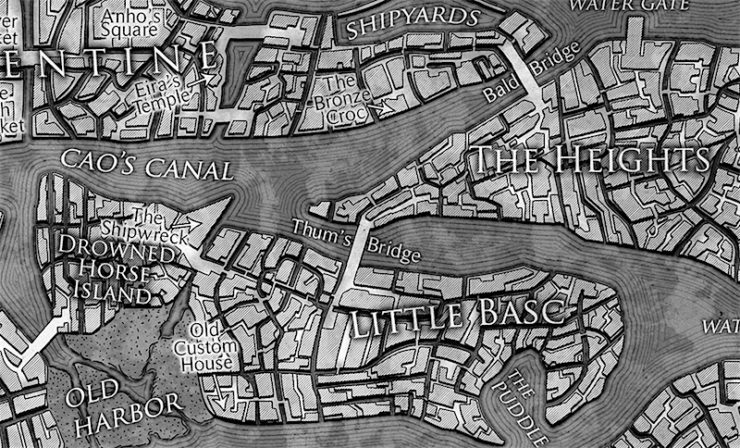
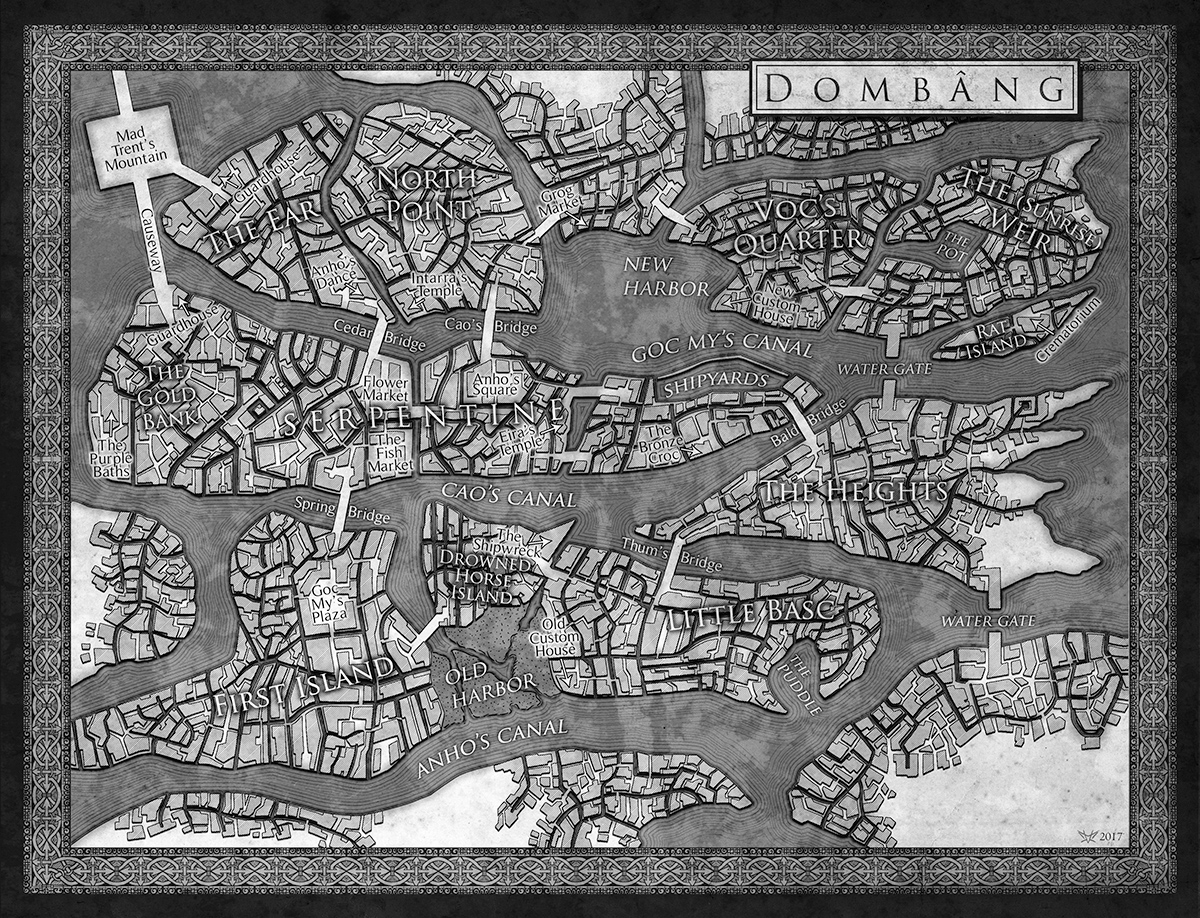
 One of the challenges I set myself in writing Skullsworn, the next installment in the Chronicles of the Unhewn Throne universe, was to create a city every bit as animate as the characters that inhabit it. I don’t know if I’ve succeeded (one vexing thing about writing is that I never know if I’ve succeeded), but Isaac Stewart’s gorgeous cartography seems less to me like a map and more like a portrait. I know all of Dombâng’s cosmetic details: the red lanterns made from the gutted carcasses of fish, the swallow-tail boats poled beneath bridges, the water growing murkier and more foul as one moves east with the current, the haze of white ash settled around the crematorium. Stewart’s map captures something more fundamental. I see a restlessness in the constant flow of causeways and canals, self-loathing in the fractal fragmentation that breaks every element into something smaller, and still smaller, I see something furtive, elusive, feral, in the absolute refusal of long straight lines. Most maps help a viewer to better know a place. This map suggests, even to me, that this is a place that will actively resist being known.
Maybe I’m reading too much into it—I wrote the damn book, after all. And yet, it’s a thrill to look at this map and see the face of a city that, like any good character, seems to have grown in unknowable ways beyond the invention of its own author.

Brian, great insights and a lofty goal. The map even looks alive. As a new fantasy writer working on my first novel, I’ve done a fair amount of world building. Looking at it in this way opens the opportunity to make my writing even richer. Thanks for the insight.
“That doesn’t mean the city is a character.”
Hear, hear! That’s a cliche of criticism that’s been bothering me for a while now. Often heard of entire fantasy worlds as well–ugh. Seldom is it true.
In all the books I’ve ever read, the only city I can think of that could justifiably be called a character would be Ankh-Morpork. That’s partly because of how it’s described, and partly because in a city where even the rats (thank you, Unseen University rubbish heap) and the concept of darkness (thank you, dwarfish not-a-religion) can become sentient, it wouldn’t be in the least bit surprising to learn that the city itself is sentient. And planning to con you out of all your money (posit – Dibbler isn’t a real person, he’s a humanoid manifestation of the city’s psyche…).
Good point. First thing I thought of when you mentioned a city being a character was Ankh-Morpork, but, of course, Pratchett built that pristine mess over multiple books
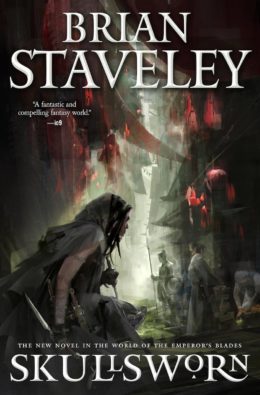
I forgot to tell Brian how much that the cover art helped influence my imagery of this city.