





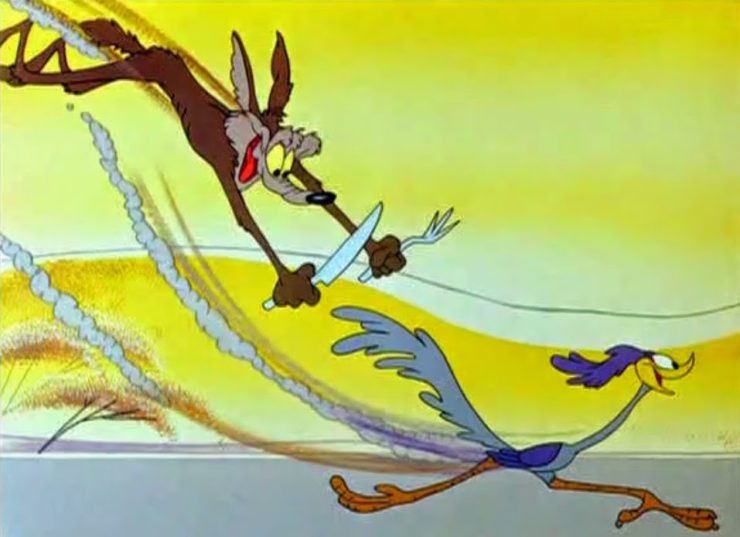
Legendary Looney Tunes/Merrie Melodies director Chuck Jones shared this recollection in his memoir, Chuck Amuck: At one point, the studio had a much-loathed (at least by Jones) business manager who liked to sneak down to the staff rooms to make sure no one was slacking off on the company dime. Whenever he came lurking about, an especially vigilant crewmember would trigger signal lights across the facility, so that when the manager got to the animators’ workspace, he’d find the room a beehive of activity, whether or not the staff had been lollygagging mere seconds before.
It was a different situation, though, when he got to the story room, where directors like Jones, Friz Freleng, and Robert McKimson—plus their associated writers—hung out. There, he’d find the entire crew in a state of intensive goldbricking—one guy would be napping; another would be casually quaffing a Coke; in an especially inspired touch, a creative would promptly stop work, crumple up the sheet of paper, and pick up a racing form. If the manager dared tut-tut the loafers, they’d tut-tut him right back, further confusing the guy. And later, should he sneak back to see if his admonitions had had any effect, he’d discover the staff still diligently lollygagging, only now one wall would be plastered with fifty or so storyboard drawings. The poor schmuck never figured out how the cartoons were getting made.
I’ve no reason to doubt that this scenario happened—maybe even on a daily basis. Yet, reading between the lines, there’s a certain Chuck Jones-ness to the story—it bespeaks a clean symmetry in the contrast between what the manager encountered with the animators as opposed to what he witnessed with the directors. It’s not unlike when, in Jones’ Deduce, You Say (1956), Daffy Duck and Porky Pig—playing Holmes and Watson surrogates—take turns interrogating a suspect, with Porky consistently extracting solicitous responses from the thug while Daffy can only provoke violence. And the ironic capper of that suddenly drawing-bedecked wall has echoes of Bugs Bunny giving the audience a sly glance and a wry tilt of an eyebrow to close out a cartoon. However accurate Jones’ recounting is, the story also serves as a reflection of his methodical nature, a signature trait that the director would imbue in his cartoons.
Buy the Book
Dead Country
All through Chuck Amuck, Jones enumerates various rules he developed that would ultimately transform the Looney Tunes stock company. Bugs Bunny is no longer a wise guy, Brooklynese trickster, but a sophisticated, insouciant adversary who only retaliates when provoked. Daffy Duck went from a wacky radical to a desperate egoist, perpetually sabotaging himself in pursuit of self-aggrandizement. And stories would play out with near-scientific precision, getting to the point where, in the cartoon Fair and Worm-er (1946), Jones graphically shows a bird following a logic path that leads him to realize that he can defeat the cat that’s chasing him by helping a dog chasing the cat.
Fair and Worm-er is notable for another reason: It represents Jones’ and his writers’—notably Michael Maltese and Tedd Pierce—initial attempt to deconstruct the whole notion of a chase cartoon. Here, they try to get to the core of the concept by paradoxically escalating it to the point of absurdity: An apple gets pursued by a worm, who’s chased by a bird, who’s followed in turn by a dog, who’s pursued by a dog catcher, who’s intimidated by his wife, who’s antagonized by a mouse (“Ahhhhh! A mouse! A mouse! A mouse! A mouse!”), with a cameo appearance by Pepé le Pew—who had debuted the year before—serving as a kind-of all-purpose spoiler. The further the hunt progresses, the more rigorous the gags get—entering a lumberyard allows the characters to stack on top of each other, unaware that their target is right above their heads; in escaping Pepé, they progressively slam into a hole which grows to follow their ever-increasing outlines, then shrinks back down as each individual exits the burrow.
The exactitude with which this all plays out is nothing short of mesmerizing, but its rigor also in some ways short-circuits the comedy. Maybe Jones and Co. sensed this themselves, so that when they returned to their deconstruction of the chase three years later, they decided keep it simple: One antagonist, one target, and a setting in the American Southwest. Thus, the Road Runner and Coyote were born. And by that refinement, in defiance of logic, the comedy rose to a conceptual complexity that Fair and Worm-er couldn’t begin to dream of.
Jones has said that the Road Runner and Coyote were created out of his desire to take down the whole concept of the chase cartoon (although Fair and Worm-er suggests that he and his team were thinking along those lines long before). Nevertheless, while the debut entry, Fast and Furry-ous (1949), was meant to be a one-shot, it was greeted with such enthusiasm that the Jones crew knew they couldn’t let it go. Three years later, the second installment, Beep, Beep (1952), was released, and over the course of those subsequent cartoons, Jones the scientist would develop a set of rules under which this universe would operate. Included among the strictures: No dialogue, except for “Beep-beep!”; the Road Runner had to stick to the road; all of the Coyote’s tools had to be provided by the Acme Corporation; and, most affectingly, to quote Jones exactly, “The Coyote is always more humiliated than harmed by his failures.”
The initial run of Road Runner cartoons—with all the rules in place and the audience well-acquainted with the formula—was at its midpoint in 1957 when the newest chapter, Zoom and Bored, debuted. Everything having been firmly established, this installment had no trouble beginning in media venandi, with the Coyote displacing the opening credits as he pursues the Road Runner. But there was something different about this cartoon, something that stuck with me when—after an adolescence where I decided I’d had it with Looney Tunes and especially with Mr. Jones’ minimalist style—I rediscovered it, and realized there was more swirling about that desert terrain than initially struck both my eye and my funny bone.
At this point, we all know about cartoon physics: If you run off a cliff, you won’t actually fall until you look down; if a stick of dynamite explodes mere inches from your face, the damage is no worse than a dusting of soot and a sense of profound mortification; etc, etc. Jones himself acknowledges the tradition within his own Road Runner rules with the corollary, “Whenever possible, make gravity the Coyote’s greatest enemy.” But across the Road Runner and Coyote cartoons, Jones takes physics and pushes them to the limit, simultaneously adhering to the science while also subverting it.
In Zoom and Bored, some of the inversions can be so subtle that they feel, logically, as if they could happen in the real world: A rock loaded onto a catapult, instead of being hurled into the air once triggered, falls backwards, crushing the Coyote; a bomb meant to roll down a long, circuitous ramp instead explodes as soon as a match is touched to it.
(It should be noted that Jones also exploits the physics of comic timing in these gags, devoting considerable effort to the build up—a loving shot of the elaborately designed catapult; a long, slow camera track up the similarly elaborate ramp—before short-circuiting it all with the abrupt deployment of the punch line.)
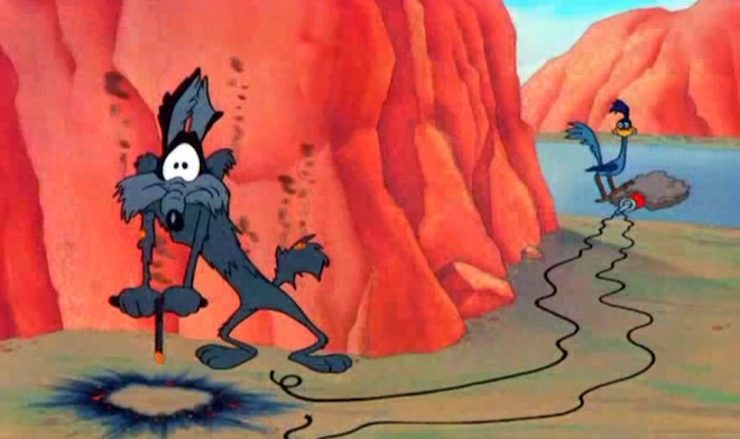
But those short, sharp shocks serve as mere set-ups for the cartoon’s elaborate finale. In it, the Coyote deploys an “Ahab Harpoon Gun” against the Road Runner (and, really, you’d think the name of the device alone would give the dope pause). Too late, the Coyote realizes that his foot is snagged in the rope attached to the spear, and once launched, the projectile is determined to follow its trajectory with a vengeance—over cacti, under rocks, into a narrow pipe and straight through a moving truck—with the helpless Coyote dragged along in its wake. It’s the concept of inertia taken to its logical extreme, capped off when the spear plants itself in a rock wall, allowing the Coyote to pendulum down into a tunnel and the path of an oncoming train, which then propels him upward to a surprisingly graceful landing on a cliff above (and to prompt the Road Runner—seeing his traumatized adversary perched precariously on cliff’s edge and a prime target for a “Meep-meep!” that would once more launch him to his doom—into holding up a sign that reads, “I just don’t have the heart”).
And this is Jones at his precise, methodical best: Taking a concept, refining it to its pure basics, and deriving exquisite comedy out of it. And yet, it is not the thing in Zoom and Bored that has stuck with me for a near half-century. That comes much earlier in the cartoon, in a sequence that is neither as abrupt as the official throwaway gags nor as elaborate as that harpoon finale, but within its brief moment on the screen hints at something unsettlingly profound.
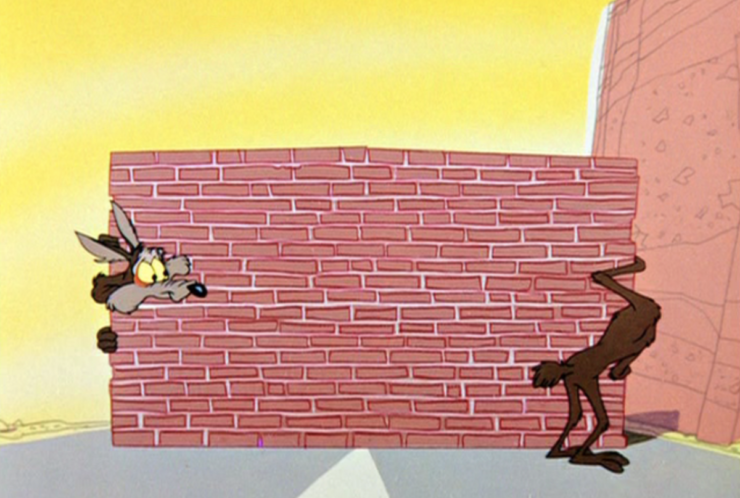
Here’s the setup: The Coyote builds a brick wall in the middle of the road. He waits on one side, hearing the Road Runner’s approach and bracing himself for the collision. And then, nothing. Confused, the Coyote approaches one end, and peers around. There’s a cut to the opposite side, and the camera pulls back to reveal that, as the Coyote’s head pokes around one edge, he discovers he’s staring at himself—specifically his ass—peering around the other. A few simple gestures and a futile attempt to catch himself confirm that, yes, he’s somehow in two places at once (and maybe, to satisfy the Firesign Theatre, not anywhere at all).
And this is what has always obsessed me from the moment I started thinking about it: What the fuck is going on behind that wall? It’s one thing to advance the notion that a harpoon is going to fly straight and true and build a comedy gold out of it; it’s another to posit some mysterious anomaly that bends space and time so one can stare directly up one’s own sphincter. (It’s also a testament to the power of storyboarding over simple writing—a thousand words couldn’t convey the premise any better than could one drawing.)
As is Jones’ nature, the sheer mind-bendingness of the gag comes down to the elegant simplicity of that wall. Elsewhere in the cartoon universe, creatures squash and stretch with aplomb. In Baby Bottleneck (1946), Daffy Duck’s leg gets stretched to approximately the length of a football field, and the animators get quite a bit of (forgive the pun) mileage out of showing him trying to run with the damn thing. But we can’t know that that’s what’s happening here; Jones puts the wall in our way, and that’s where the conceptual magic happens. In a medium where you can portray nearly anything, leaving nothing to the imagination, he obscures our sight, and leaves us to puzzle out the incongruity.
(In the wake of Rick and Morty, though, I’ve managed come up with a theory: The other side of the wall actually exists in an alt-universe, one exactly like ours, but rotated 180°. Thus when the Coyote peers around the wall, he’s not looking at himself, but at a Coyote-B, one who does exactly the same things at exactly the same time, but the other way around. We can then extrapolate from this and, observing how many times the Coyote runs around the wall, come to the conclusion that, by the end of the sequence, we are no longer watching our original Coyote, but Coyote-B. In other words, Zoom and Bored starts out in one universe, and finishes up in a completely different, parallel universe.)
(Or, alternate theory: I’ve got too much time on my hands.)
It has been well-noted that there was a distinct shift in the tone of Looney Tunes and Merrie Melodies once director Bob Clampett left the studio and Chuck Jones rose to fore. Originally the cartoons were hot, frenetic, anarchic. Under Jones’ watch, they became methodical and cooly cerebral… or at least as cooly cerebral as you could be while having rifles still explode in Elmer Fudd’s face. The Road Runner and Coyote cartoons may be the apotheosis of his technique: A way to strip down the narrative to its barest essentials while playing in surprisingly sophisticated ways with basic tools that form the universe. Physics may be adhered to or broken at will —whatever will provoke the most laughs—but, at least for me, Zoom and Bored stands out from the pack for the way it steers its comedy into some revelatory insights into how we observe the universe, and the way we draw conclusions from those observations. In seven minutes, it transports us from the land of the hysterical, to the realm of the philosophical.
* * *
Long, long time ago, child-me had grown frustrated with the Road Runner cartoons, with the sense that—having been weaned on Bugs Bunny and Elmer Fudd; Tom and Jerry; Pixie, Dixie, and Jinks the Cat—I was feeling less empathy for prey Road Runner and more for predator Coyote in his conflict with a universe dead set on thwarting him at every turn. It was only as I grew into my teens and revisited the cartoons that I realized that, yes, that’s exactly what Chuck Jones wanted me to feel; that, in defiance of the Immutable Laws of Cartoon Storytelling—chaser bad/chasee good—the Coyote was the antihero we should all be rooting for.
It took me a while to get there, but maybe you were different. Maybe you glommed onto the inversion earlier, or feel that another cartoon—Road Runner or otherwise—better sums up Chuck Jones’ distinct approach to animated storytelling. If so, hey, look below: There’s a comments section there, and it’s just waiting for your input. But, as always, keep in mind that nobody’s throwing anybody off a cliff, here. Let’s resist the urge to reach for the dynamite, and keep the conversation friendly.
Dan Persons has been knocking about the genre media beat for, oh, a good handful of years, now. He’s presently house critic for the radio show Hour of the Wolf on WBAI 99.5FM in New York, and previously was editor of Cinefantastique and Animefantastique, as well as producer of news updates for The Monster Channel. He is also founder of Anime Philadelphia, a program to encourage theatrical screenings of Japanese animation. And you should taste his One Alarm Chili! Wow!

My theory is that in fact, there is no other side; it’s a one-sided wall.
@1
Yes, a Möbius Wall.
That gag with the bomb atop the ramp is probably my all-time favorite from the Coyote-Road Runner cartoons. The complete undercutting of the set-up is so hilariously surprising.
The coyote reminds me of Camus’ Sisyphus, trying to find meaning in capturing the Roadrunner.
I remember, as little kids, my brother and I watching the two-hour block of Looney Tunes on Nickelodeon every Saturday. We had a chalkboard in the basement, and whenever a Coyote cartoon came on, we started keeping a tally of how many times he exploded, got hit by a truck, fell off a cliff, etc. We always felt so bad for him but couldn’t stop laughing.
Years later, while visiting Arizona, I got to see a road runner live and in person, crossing the road in front of my rental car while at a stop sign. I was amazed that it looked exactly like the cartoon. So many memories brought back that day.
#5
I live in an area that has roadrunners. One day my German shepherd chased one, and man oh man I wish I’d been able to get a photo. It looked very much like the cartoon. Just needed the Latin names next to them.
When I was little, I loved the Road Runner / Coyote cartoons, and I had exactly zero empathy for Wile E. He was just an object to be inventively mangled. Seeing one again as a young adult and having my perspective on it invert came as a bit of a shock.
Roadrunner’s Coyote and “Wile E. Coyote, Genius” (first in “Operation: Rabbit”) are almost two different characters. By not speaking, Roadrunner’s Coyote maintains audience sympathy, at least in some part. He is a carnivore and therefore a predator. He is just doing what he needs to survive, but is primarily thwarted by the realities/physics of their world. Wile E. Coyote speaks and does so in a snobbish manner. His pride/ego makes him tell Bugs he is to be a meal and stains himself irredeemably as the “bad guy”. Bugs also serves as an active participant in thwarting his plans.
Even before my children were born I looked forward to the day I could introduce them to the Looney Tunes universe. And when that day came, and I brought home the 10 DVD set and we sat down to watch what ended up being an 8 hour marathon of cartoons, popcorn, pizza, and flagrant defying of physics, it was as magical as I had always imagined it would be.
This cartoon may be the first example of the ‘it’s full of bees’ meme.
It has occurred to me that Jones’s sense of setting up and timing gags has something in common with those in Laurel and Hardy’s short films–we laugh so hard not because we are surprised at what happens (we can usually see what he’s building up to), but because it happens even more perfectly than we could have imagined.
“Chuck Amuck” is one of my favorite Hollywood autobios/memoirs. You get lots of behind-the-scenes stuff about the Warner Bros/Schlessinger Studios, you get to Jones’ remembrances of the people we only know through the cartoons’ credits, and you get an awful lot of great advice on how to tell stories. I’m always surprised it’s not recommended more as a storytelling guidebook…
And here we have my first existential crisis. I want Wiley E. Coyote to win. Yet, if he does, he will eat Roadrunner. Thus, the cartoon will end. But I enjoy the cartoon. And so I am stuck forever in the purgatory of wanting the very thing that will end the same thing that I want.
In 1990, Grant Morrison took our sympathy for the Coyote to its logical conclusion in Animal Man #5, “The Coyote Gospel”.
https://marswillsendnomore.wordpress.com/2011/11/26/animal-man-5-the-coyote-gospel/
The Road Runner / Coyote moment that has stuck with me my entire life is when Wile E. sets up a fake railway crossing consisting of a single piece of track and two bushes to hide the ends. The Road Runner runs straight through him, landing him on the tracks — where he is promptly run over by a train. As a kid, this blew my mind in the same way the brick wall gag blew yours.
Re: the part about “the Road Runner—seeing his traumatized adversary perched precariously on cliff’s edge and a prime target for a “Meep-meep!””.
You missed an opportunity for some intertextuality here: “perilously perched upon a precipice”.
I always love a good allitteration, I do. Meep-meep!
The scene where Coyote builds a brick wall in the middle of the road, then peeps away at his own behind,
You realize what the logical consequence is if you draw it out to its brutal end?
@15 JP: And like the brick wall gag, Jones is using another obscuring technique, here employing the edges of the frame. The rest of the track doesn’t exist, until it does. It’s kind’ve a reverse object permanence.
@15,18: I have always sort of lumped the train tracks gag in with painting a tunnel on the side of the cliff, which usually ends up with the Road Runner being able to pass through the ostensibly non-existent tunnel while the Coyote runs smack into the rock face, or a truck emerging to flatten the Coyote, or both. But that one doesn’t rely on obscuring boundaries, so much as flexible ontology: things and representations of things become interchangeable as needed. I guess the train tracks gag uses both gimmicks.
My favorite gadget was: Coyote puts on roller scates, straps an outboard motor to his waist. Motor propeller is in a tub filled with water on a wagon pulled by Coyote. So, he is pushed by the motor that is pushing against the water in a tub that he is pulling.
How many roasted chicken might W. E. Coyote have bought for all the stuff he’s had delivered?
For me the main fun was always that subversion of physics in those failing contraptions. Already as adults, my brother and me discovered how hilarious individual stills of these cartoons were. Amazing how much detail the cartoonists put into these.
@13 Christine: “And here we have my first existential crisis. I want Wiley E. Coyote to win. Yet, if he does, he will eat Roadrunner. Thus, the cartoon will end. But I enjoy the cartoon. And so I am stuck forever in the purgatory of wanting the very thing that will end the same thing that I want.”
Reading this comment makes me think about the concept of there having been official laws of the universe behind the Roadrunner cartoons. If, for example, one of those laws that Coyote must remain intact through all catastrophic endings extends to Roadrunner, then would Roadrunner cease upon becoming prey?
Then, I think what are the implications of the fact that Coyote has been personified into singular instance of the tricky Coyote (i.e. as the instance “Wile E.”), but Roadrunner is always just a type, and never instantiated as a particular thing (e.g. “Flite E.”). Perhaps, one could dissertate on the various ways in which Coyote illustrates the agonistic relationship of the instantiated individual being toward the abstraction that it encounters as reality.
In the short “Zip Zip Hooray!” two boys watch a Road Runner cartoon and make comments that echo this article; at which point, taking the meta to its absurd level, the Coyote stops chasing the Road Runner in order to address the two kids, and us viewers, through the TV. And even recognizing his situation, the Coyote continues to get torn up in pursuit of Road Runner.
Jones was a master of animation for TV, he knew how to design his characters for maximum effect, and how to tweak the audience to get the payoff of any gag.
@23 Steven:
<<Jones was a master of animation for TV…>>
More than maybe you were thinking of: His The Dover Boys at Pimento University is generally cited as the first example of limited animation, which — for better or worse — allowed the art to survive during the transition from theatrical presentation to TV.
One of my favorite gags is the coyote putting together a metal wall that’s supposed to pop up, getting the roadrunner to run into it and get caught. Of course it doesn’t work, so the coyote goes to check it out, as he is wont to do. Only this time he doesn’t get caught by his own trap, so he gives up and walks away. It’s not until near the end of the episode that the wall finally catches the coyote unawares.
One of my favorite Road Runner gags is the last scene of “Guided Muscle:; after the Coyote is caught in the TNT blast, he’s hovering over the blast hole.
Then he dismounts and walks off screen. He comes back and posts a sign: WANTED – ONE GULLIBLE COYOTE – APPLY TO MANAGER OF THIS THEATER. Then he walks off screen again and drags the Warner Bros. “That’s All, Folks!” title card on screen.
And speaking of “The Dover Boys”, there’s that great bit when Dan Backslide has just kidnapped Dora Standpipe, and discovers she’s still holding on to the tree where she’s counting off for hide-and-seek. He drives back, puts the tree back in place, then consults his Handbook of Useful Information for “How to Remove Young Lady from Tree”. He whips out two Jiffy Tire Irons, and pries her off the tree and into his car.
It precedes the Acme gags in the Road Runner series. And unlike them, in this instance, it works!
Don’t forget the classic Tom Smith filk song about the coyote and roadrunner, “Operation: Desert Storm” :
https://tomsmith.bandcamp.com/track/operation-desert-storm [lyrics at link]
Acme’s contraptions always seemed to go by the Cartoon Law of Functionality-if it ain’t broke, don’t use it the way you think it’s going to work.
As a “genius,” Wyle E always overthought his plans to the point of failure.
@22 Royar: I’m not going to pretend I fully understand your summation — ‘cuz I don’t — but just to address your comparison of an instantiated “Wile E.” Coyote as opposed to an uninstantiated Road Runner, it should be noted that, at least initially in the Road Runner and Coyote cartoons, the Coyote was not instantiated. Similar to the Road Runner, he was merely the Coyote, and is labelled as such at the beginning of the cartoons. The name “Wile E.” was attached when he was paired with Bugs Bunny, and you’ll note that he is a very different character, verbose and egotistical, where in the Road Runner cartoons he hews closer to the Mark Twain description Jones cites: Scruffy; somewhat pathetic; and always hungry. And his actions can be read that way: motivated by hunger and perhaps also from an existential conflict with the universe, as opposed to the Bugs Bunny cartoons, where it’s clearly a war of wits.
Of course, as time progressed, the two identities melded into one, so he’s Wile E. in all cases, to the point where, as noted above, in Zip Zip Hooray, he drops his Road Runner persona (seen in archival footage) and assumes the Wile E. personality to address the kids.
Doesn’t help that Jones himself alternates between referring to him as the Coyote and as Wile E. Coyote without making the distinction. I guess time and popular opinion has dictated that he’s Wile E. everywhere.
Maybe someday we can look into the whole Michigan J. Frog thing.
Zoom and Bored is probably the greatest of the Roadrunner and Coyote shorts, but Chuck’s masterpiece is Duck Amuck. It drives home his belief that personality was more important that the physical gags. The physical gags were just the punch lines to complex personality driven jokes. The Hunter Trilogy shorts are excellent examples, but it was never so apparent as it was in Duck Amuck. According to Chuck:
I always remember feeling vaguely sorry for the coyote, and like Christine @13, recognizing that the fulfillment of the desire would result in the end of the cartoon. Is this some statement about how sometimes the wanting is better than the having?
That said the one road runner moment that sticks out is an episode where he DOES catch him in a fashion, but it involved (for reasons I do not completely remember, only that it involved running through a series of pipes that similarly twist reality) Wile E. Coyote shrinking and then catching up with a gigantic road runner. He can do nothing but hold up a sign that says something like, “Okay, now what?”.
@29 Dan Persons: I recall one cartoon with a sheepdog (Sam) and a wolf (Ralph) [the wolf looked like the coyote]. In that cartoon, the two characters clocked in and out to begin and end their shifts. That struck me in my teen years (1970s) as saying something about cartoons and what they could be. Later examples (all seen later, I mean) made me view the main LT/MM stock characters as contract players (like the studio system contract actors). This made it possible to view those Bugs Bunny cartoons in particular as just plays with staging and characterization provided by the Toons using their own personalities (maybe method or technique based).
I think there are other cartoons where this view would be a stretch because in cartoons such as the Simpsons each character seems locked into hir one persona. Bugs and the Looney Toons lineup seem like salaried actors, playing roles. They are easy to imagine in different roles and settings. It’s more difficult to imagine Homer Simpson acting differently within a different context—the way most actors can inhabit different characters.
@32 Royar: There are actually a handful of Simpsons eps where they toy with the idea that the characters are playing roles in a fictional setting. But I’m hard-pressed to think of another cartoon series that so frequently had the characters imply they were performers within the context of the fictional setting — breaking the narrative to complain about contracts, or harangue the animator, or threaten that they were going take their grievances to “J.L,” aka Jack Warner.
No, Rick and Morty doesn’t count. That’s a more traditional breaking of the fourth wall.
@32/@33
The Bugs Bunny cartoon “What’s Up Doc” is about the famous cartoon actor Bugs Bunny telling his life story