





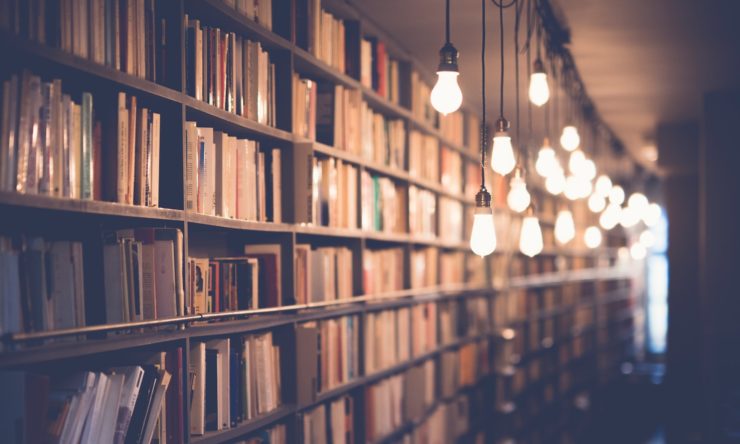
Over the years, Reactor has published an assortment of essays praising the good old physical book, in particular the paperback. Each writer, including myself, talked about the unique virtues of physical books. However, to enjoy a book, you have to first acquire that book. Among the most valuable resources available to readers: the wonderful brick-and-mortar used bookstore.
Why would I, notorious for being antisocial1, willingly venture into brick-and-mortar used bookstores? Why not stick to online booksellers such as Abe or Alibris? Starting with least persuasive to most, my own personal reasons are:
Supporting local business: I’d much rather support local small businesses, rather than connecting indirectly to a stranger through a branch of Amazon, or some other online used book intermediary. Particularly now, given (gestures at the world).
Sensorium: No online bookseller, no matter how well-stocked, can provide the sensory environment of a bookstore. As well, for all their virtues, new bookstores do not provide the full experience of stepping into a used bookstore to inhale the aroma of a hundred different grades of paper (some still pristine, others self-destructing) and inks long disused (almost entirely non-arsenical), with occasional delicate mycotoxin high notes. Each lungful of air reminds readers of the wonders that await.
The thrill of the hunt: There’s nothing quite like discovering a copy of a book for which one has been searching for years. The (potentially) immediate gratification of online sources might be convenient, but it’s no fun. It just doesn’t feel sporting to rattle keys on a keyboard, whereas patiently searching shelf after shelf, in store after store, over months and years, does.
It’s the difference between buying meat from Loblaws or heading out, flint-pointed spear in hand, to look for a tasty moose. Yeah, the grocery store will be faster, and might not involve as many broken bones2, but the survivors appreciate their meal more.
A special case of the thrill of the hunt is the joy of serendipity, something used bookstores share with libraries and new bookstores. Online stores don’t offer the chance to discover items you would have wanted had you known they existed3.
Cost: Used books are (usually) cheaper than new books4. As we do not yet live in a post-scarcity world, being able buy more books for the same price is useful.
Now, some authors would rightfully point out that they don’t see any money from used bookstore sales. It’s not like there’s any used bookstore analog of the Public Lending Right Program. Granting that, there are two reasons why that’s not as bad as it sounds, one weak and one strong.
The weak argument is that the author did get their money for that particular copy when it sold for the first time, which is what their contract promised them. It’s true they won’t get the money they would have received had the person bought a new copy, but there’s no guarantee that that reader would have bought a new copy had the used one not been available.
A much stronger case for used books from the point of view of authors is that used books can hook readers who were previously unfamiliar with the author’s work. Sure, the second Poul Anderson novel I ever bought was a used copy of There Will Be Time. The next sixty or so were new.
Variety: New bookstores are limited to the books that are in print. Used bookstores are not. Therefore, you can find in used bookstores works you could never find in your local Chapters/Indigo, Words Worth, or even Bakka-Phoenix (if you don’t check out their used books). Even special orders would avail you not, for books long out of print5. But as long as the paper hasn’t self-destructed, any book that was ever in print could turn up in a used bookstore.
No doubt there are other, equally valid reasons for visiting used bookstores, assuming you are able to do so (I realize that may not be the case for everyone). These are mine, but please share your thoughts in the comments below.
- The last time I was indoors with people who were neither in my bubble or family, and for reasons not related to work, health, or food purchase, would have been February 20th, 2020. ↩︎
- Depending on how diligently the store salts its walk in winter, and how observant drivers in the parking lot are. See my children’s book Mommy and Daddy Are Never Coming Home Because They Thought Cybertrucks Brake for Pedestrians. ↩︎
- I was delighted to discover that the Dana Porter Library at the University of Waterloo does offer a shelf-scanning option. Their online catalogue allows users to see entries for books adjacent to the book the user originally wanted. O brave new world, that has such software embellishments in’t. However, that will only show you the books that are properly catalogued. I helped convert Dana Porter Library to a computerized system. This meant taking every book off its shelf to barcode and record. Unexpected discoveries abounded! Some delightful, some… less delightful (shudder). That was more than forty years ago. I am sure chaos has crept back in. ↩︎
- I’d argue this is often true (at least from a certain point of view) even for the high-priced rare books, because you generally cannot buy those new for any price. ↩︎
- Usually. I was bemused to find a copy of Glen Cook’s The Swordbearer in a newly opened Chapters back in 1999 or 2000. Not the Tor edition, but the 1982 Timescape paperback. Having poked through distributor warehouses, I can totally believe that a copy of The Swordbearer sat on an insufficiently lit warehouse shelf for almost twenty years. ↩︎


Re Footnote 3- I love browsing university stacks- just wandering through, eyeballing what’s waiting to be found.
A good chunk of my time as a shelf pixie was spent walking along the stacks, looking for improperly shelved (or deliberately hidden) books.
Something David Friedman pointed out on Usenet back in the day: used bookstores indirectly increase sales of new books, by effectively lowering their cost. Some people will buy a book new because they know they can then sell it, who would not buy it at full cost. I disagree with him on many things, but this particular point falls solidly into his area of expertise.
While in college, my husband and I acquired several books for the solitary that they were on the 5/$1 shelf.
I think it’s also the case that if publishers can block book re-use and sharing (university e-books), they do. In Andre Norton’s “Quest Crosstime”, the hero gets a blaster which only works in his hand. Judge Dredd’s gun also does that. Imagine it for books. Publishers aren’t fond of libraries, either.
Also, maybe I’m commercially innocent, I don’t think I’ve bought and read a book and then sold it, or expected to – except at university, possibly, which was a long time ago. Before encrypted PDFs. I’ve given books to charity sales.
There are three enormous used book stores here in Michigan that we visit at least yearly and highly recommend: Lowry’s Books in Three Rivers, Curious Bookshop in East Lansing, and John K. King Used and Rare Books in Detroit.
I lived in Michigan for a bit. Never went to Three Rivers, unfortunately, but LOVED these other two stores!
My favorite used book store closed 6 years ago. When I got my driver’s license in 1981 it became one of my regular stops, and several feet of my shelves are filled with books acquired there. There’s still a shop within walking distance of where I live, but it doesn’t have quite the breadth of Hole in the Wall nor, to be fair, the narrow halls lined with highly flammable paper.
If it’s the same “Hole in the Wall”, my shelves and comic boxes are similarly stocked. Although Winchester has successfully replaced it with 2 stores, but I still miss it.
And the comment software stripped out the link to the local bookstore.
https://www.restonsusedbookshop.com/
I work in a university library that also has the virtual shelf-browsing feature. In fact for a lot of the books, they don’t have a dust jacket or are library bound on the shelf, but the virtual browse shows their nice cover art, so in one way it’s even better than coming into the library, which no longer has an asbestos problem.
It may also lead one into L-space.
“The truth is that even big collections of ordinary books distort space, as can readily be proved by anyone who has been around a really old-fashioned secondhand bookshop, one that looks as though they were designed by M. Escher on a bad day and has more stairways than storeys and those rows of shelves which end in little doors that are surely too small for a full-sized human to enter. The relevant equation is: Knowledge = power = energy = matter = mass; a good bookshop is just a genteel Black Hole that knows how to read.”
-Pterry
And your opinion of BMV is…?
Re footnote 5:
The newly-opened Chapters in my neighbourhood started out with an extensive spread of new, hard-to-find books on large tables at the front of the store. I believe that these were stock they’d bought up from independent booksellers they’d previously driven out of business in other cities.
Once all of the local independents closed down, the Chapters reverted to a diminished book inventory. But hey, you could pick up great coffee mugs and weighted blankets there.
For those who shoplift, used book stores generally have far worse security than new book stores.
Before you jump on me, let me explain: Therefore they have higher “leakage,” and so deserve our support more.
Used bookshops also tend to have, for want of a better word, character, from the elite rare book shop to shops like Moe’s in Berkeley in the days of my misspent yout. Moe’s is now a respectable bookshop, but back in the day Moe Moskowitz had open boxes of books on the floor in front of many of the shelves, and would stand on them to reach the higher shelves (Moe was not a very tall man) while smoking one of the stinkiest stogies it has ever been my displeasure to smell (that cigar was something of a trademark; when Berkeley passed a no-smoking-in-public-indoor-places law, Moe disobeyed, then sued to demand his right to smoke in his own store. He lost, mostly).
Considering that there’s no aftermarket for a shoplifted used book, I would consider shoplifting from a used bookstore in the same moral category as Jean Valjean stealing a loaf of bread: He absolutely had to eat it (i.e. read it) to survive, therefore it was justified. I’m guessing anyone who steals from a used bookstore is doing so to read the book and they have little money. If they’re just shoplifters, there are many more lucrative things to pinch.
Honestly, these are the stores that put bargain books on carts OUTSIDE the store, just begging to be taken.
Generally speaking, San Fransisco of the 1970s and 1980s had some amazing used book stores. There was one in particular I think was four stories tall. Whenever I visited my grandparents in Sausalito, I’d trek over to that store in particular.
(There was an SF store near the Tenderloin, not too far from the O’Farrell Theatre that was just jam-packed with SFF books… none used as far as I remember. Still carried off a sack of books from there…)
I also have very fond memories of Hay on Wye.
Yeah, SanFran had some great stores. The one by the Tenderloin was, and still is, Borderlands Books.
There were several really big used bookshops; do recall where the one you’re thinking of was? There was one that I particularly liked, called Green Apple Books, which seems to still be open with several locations, including one at the airport.
But my favorite — oddly enough (or maybe not), also near the Tenderloin — was McDonald’s, which had, among its many wonders, shelves and shelves of old Astoundings. Back in the early ’70s, at a time when Gordon Dickson’s stuff was mostly out of print, I scored the three issues with Dorsai! serialized in them for about two bucks a pop. Good times. Closed, alas, these seventeen years… They don’t make bookshops like that anymore.
Once when I was in Chambersburg, PA, visiting my grandparents (at their Old Folks’ Home, which was actually quite nice), I found a nifty little used bookshop where I picked up copies of Three Men in a Boat and Null-A Three. One of these was very good, the other was just hard to come by…
My boyfriend-now-husband-of-many-years and I, used to do bookstore crawls up Telegraph Avenue. Shakespeare’s, Moe’s, and Cody’s. (Moe took to chewing his cigars instead of smoking them.) When we had time we’d work all the way up, ending at UC Berkeley’s bookstore, which had a public/popular part and a textbook part. Cody’s was my favorite bookstore ever. There was one bookstore on University Avenue that shelved all its books by publisher instead of subject or author, making it very hard to find anything.
I would do that occasionally. More often, I would start at campus, walk one block, turn left, duck into the Channing Garage shopping area, and spend much of my afternoon at the Other Change of Hobbit…
We were on a Morris dance team with one of the founders of the Other Change of Hobbit. We went there sometimes, but preferred Dark Carnival. An SF and mystery bookstore with the kind of houses-put-together, twisty isles, books all over including stacked on the stairs, vibe this column mentions.
My girlfriend-now-wife-of-36-years and I did that same bookstore crawl up Telegraph Avenue, hitting Shakespeare’s, Moe’s, Cody’s, (and Half-Price Books). We actually began that walk separately, several years before we were introduced. Based on the amount of time we each spent there we probably, unknowingly, bumped into each other many times in Moe’s in the narrow basement aisle between the used Science Fiction paperbacks and the old used Rolling Stone magazines.
My whole house is a lot like a used bookstore.
WRT paperbacks self-destructing, this very much depends on where you are. Here in dry Colorado I have many books from the 60s and 70s in near mint condition, whereas those from Jacksonville*, Florida are yellow, brittle, and roach-stained (unavoidable in Fla.). During my used book expedition in NYC several years ago I found that the shops had almost no mass market paperbacks. Whether that’s from them deteriorating, or being considered disposable, I don’t know.
*Chamblin Book Mine, a huge, awesome used bookstore; if it had existed in my teen years, spending my summers down there, I would have begged for a job.
I love Chamblin Book Mine. They also now have a downtown store.
Yes a thousand times yes to this article. I love used book stores and heartily wish there were more/better ones here in Houston. We do have a fantastic one in walking distance (Kaboom Books) that has all the things one could want from a used bookstore, but I still wish we had more. All of the reasons you listed above are wonderful reasons to go to a used bookstore. I will sadly state that I do continue to shop for used books that I particularly want on online spaces as well, just because well…sometimes I do want a particular book right now. That aside, the in-person used bookstore experience is much preferable, obviously.
One other note as to used books and buying used books, maybe slightly off topic. Apart from supporting a local business/business owner, I prefer buying used books simply because I do not want to contribute to the consumerist mentality of only owning new items and would rather source a used item if available, if simply to continue to support the habit of recycling/reuse in general.
I still mourn the loss of the Montrose Half-Price Books. And the Kroger too
I had a rather unlikely experience a month or two past where I decided to reread M. Lucie Chin’s 1988 The Fairy of Ku-She. My copy had gone missing in the 30+ years since I last saw it, so on a whim I checked A Second Look and KW Book Store to see if they had a copy of a book that had a single edition 37 years earlier… and one of them did!
(OTOH it took decades to replace my copy of Loren McGregor’s The Network)
Nothing attracts a book-wyrm more than used store. Electrify the floor and it would be a human bug-zapper to us.
The very first used bookstore I ever visited was = called The Book Exchange located in Beaver, West-byGawd-Virginia. I had about a couple mile walk to get the grocery store, where I bought my comics off the spinner rack. (No lie; one route I took actually meant I had to cross Beaver Creek on a wooden foot-bridge about 10 feet high.) Main street -or the equivalency of a main street- was a two-lane road nestled between mountains and The Book Exchange was a little more than half-way. I just happened to wander in it one day, because somehow I found out they had used comics and there being no comics stores in the area – comic book stores was barley even a thing back then-, it was like finding that enchanted ye olde shoppe from a story. I thought I hit the lottery when I found out I could trade my used comics and books for store credit! Been hooked ever since.
Is it me or are used book stores making a come-back? Seems like some time in the 90s, or maybe early 2000s, they all closed down in my area, but now I keep running across them.
I was in my local used book store with my kids who loves poking around all the books. One mentioned that older books all smell good (they were 6 at the time). The single staff member at the time was chatting with me and she explained to my kids that the ink and paper breaking down very slowly release compounds into the air which contain benzaldehyde and vanillin, giving off an almond and vanilla scent. But also damp adds to this and gives off a musty scent, so there’s always a mix of good and bad smells in a used book shop and if they are a good shop, they will have very few musty smelling books and more nice smelling books, giving off the same effect as a perfume haha. I looked it up and right enough, there are almond and vanilla notes given off.
Whenever our family traveled, we made sure to visit local bookstores. Some stand out particularly:
In the days before charges for luggage, we’d occasionally buy an inexpensive suitcase to cart back all the books!
Back when I made frequent business trips, a thing I would do in a strange city is grab the yellow pages enter for “bookstores, used”, and explore the city that way.
The thing about a used bookshop in a strange city is the collection will invariably have some surprises.
My first trip to Seattle (a week long) I had to buy another suitcase to haul my discoveries home.
If we’re advocating for particular used book stores, I vote The Green Hand in Portland, Maine. It’s my favorite.
I have many fond memories of perusing the shelves of Powell’s Books in Portland OR. This was in the early 70’s before they moved into the old car dealership building on Burnside. Tall shelves, close together – a treasure house of my favorite science fiction. I’d spend a long time looking at different copies of the same book, trying to find the perfect balance between cost and condition. It was wonderful. Powell’s is still a great store to spend hours in, but it’s a bit overwhelming compared to the 1973 version.
heh. you think I need a reason …