






I don’t just follow authors whose work I like—I also follow editors who buy the sort of book I enjoy, and the publishers who make those books available. Often, I have very specific memories about when and where and from whom1 I bought my books, which I am sure is a great comfort to friends whose names I clearly have misplaced.
In some cases, I can even tell you which was the very first book from a given publisher that I bought. Not the older publishers—or at least, not always. But the dewy-cheeked infants of publishing, lines founded after I started buying books? Those I remember.
Here are five (well, maybe six) such books from my shelves.
DAW Books
DAW Books was founded in 1971 by Donald A. Wollheim and Elsie B. Wollheim, Early DAW had two characteristics that brought it to my attention: DAW specialized in science fiction and fantasy and DAW paperbacks had bright yellow spines that were visible from across a store2. There are whole shelves of yellow spines in my library.

My first DAW was the June 1972 mass market edition of Gordon R. Dickson’s 1971 Tactics of Mistake. Tactics, part of Dickson’s unfinished Childe Cycle, details the adventures of military genius Cletus Grahame in the early days of interstellar colonization. It’s not my favourite book in the series—Cletus doesn’t show much genius, it’s just that his enemies are dolts—but it was my first DAW purchase.
Orbit Books
To quote Wikipedia: “Orbit Books was founded in 1974 as part of the Macdonald Futura publishing company.”
I don’t know anything about the personalities involved.

Oddly, despite Orbit being very much British3, the first Orbit-published book I owned was by American author Poul Anderson. Specifically, the September 1975 paperback of Anderson’s 1974 novel A Midsummer Tempest.
Tempest details efforts to ensure Charles I’s victory, thus saving the Fair Folk. If “GO STUARTS FOR GREAT JUSTICE” wasn’t unusual enough4, Tempest is set in a world in which Shakespeare was the Great Historian, a world in which Shakespeare’s anachronisms (and presumably, his geographic liberties) are simple historical fact.
Del Rey Books
Ballantine imprint Del Rey Books was founded in 1977 and named for Judy-Lynn del Rey. It happened that her tastes and those of her rather curmudgeonly husband, Lester, lined up with mine. Each month, I’d look for the Del Rey ad in the SF magazines I read, then pester long-suffering booksellers about whether the featured books, whose release dates were unambiguously months away, had arrived yet.

My first Del Rey was the March 1977 paperback of James White’s 1977 Monsters and Medics.
Monsters and Medics is a collection rather than a novel. Contents include an author’s introduction, a short novel, three novelettes, and three short stories, all of which I enjoyed enough to become a James White fan.
Tor Books
Founded by Tom Doherty in 1980, Tor is the inspiration for this article. Or rather, @purblind.bsky.social’s question (wondering what the oldest Tor we have on our shelves are….) was the impetus.
There are two books that were my first book from Tor. Which one was actually first depends on whether you count Tor as a continuation of Tor / Pinnacle Books or as two different, if closely connected, companies.

If Tor / Pinnacle is just an early phase of Tor, then my first Tor was the June 1981 paperback original of Poul Anderson’s The Psycho-Technic League.
The collection gathers stories from an early future history Anderson had discarded. I gather that Anderson had second thoughts about the setting’s political views, but I’d liked the individual stories and was happy to have them in one place.
Also, the book had that JIM BAEN PRESENTS banner. I followed Baen from Galaxy to Ace to Tor and—but more on that later.
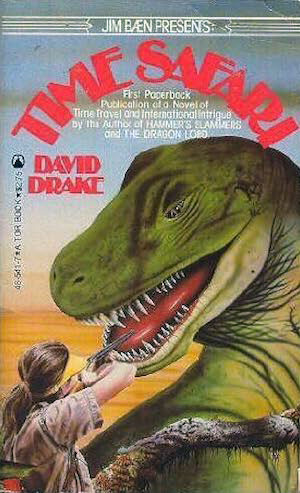
If Tor / Pinnacle is distinct from Tor, then my first Tor was the 1982 paperback original of David Drake’s Time Safari.
The Time Safari stories, which I recall as having been inspired by de Camp’s 1956 novelette “A Gun for Dinosaur,” detail the experiences of Henry Vickers as he guides would-be hunters in the age of dinosaurs.
Baen Books
Jim Baen5 founded Baen Books in 1983, following a somewhat convoluted sequence of events beginning with the collapse of Pocketbooks’ Timescape imprint6. Having followed Baen from Galaxy to Ace to Tor, of course I followed him to Baen.

My first Baen was the August 1984 paperback of Lewis Shiner’s proto-cyberpunk novel Frontera—which tells what happened to the Martian colony after governments collapsed on Earth.
So, those are my firsts with those particular publishers. Do you remember your first books from various publishers? If not, you can probably work out what they must have been using the ISFDB. It is a game everyone can play.
- I gather booksellers don’t expect customers to thank them for their excellent service half a century after the store in question went out of business. ↩︎
- It may surprise people to learn that I am much more adept at spotting books and book-related items than anything else. I once failed to notice the schoolmates I was looking for because my attention was distracted by an unfamiliar-to-me Book Nook two blocks behind them. Don’t worry! I did manage to slip away from the field trip to buy a couple of bags of books. ↩︎
- The US Orbit came along much, much later. ↩︎
- The only reason Charles I is not the worst king ever is because “worst king ever” is an exceedingly competitive field. Looking at you, Emperor Huizong! ↩︎
- With Tom Doherty’s assistance. It apparently still comes as a surprise to some fans to learn that Doherty has always been and still remains a silent partner in Baen Books. ↩︎
- For reasons of word count, I am limiting myself to publishing lines that are still around. That said, my first Timescape book was Syd Logsdon’s 1981 A Fond Farewell to Dying. (I’ve written in more detail about the Timescape line here, if you’re interested.) ↩︎


Is it just me or could the guy on Tactics of Mistake be played by Nicholas Hoult?
When ISFDB complains about overload, don’t expect people not to point at you.
James, you’re talking about the Big Dogs of SF publishing. What I remember are the small press books I bought. Best as I can determine, here were my firsts:
Subterranean Press: I bought Howard Waldrop’s ‘Heart of Whitenesse’ in 2005, not particularly early in Sub Press’s history but the prices probably held me back for awhile. Big Waldrop fan, I had to get it. Have bought many more Sub Press books since.
Golden Gryphon Press: I bought James Patrick Kelly’s ‘Think Like a Dinosaur’ when it was published as Golden Gryphon #1 in 1997, and decided to become a completist in GG by simply keeping up with their output of 3-4 books a year. You should see my complete set of hardcovers in numerical order!
Small Beer Press: Fairly early on I bought Ray Vukcevich’s ‘Meet Me in the Moon Room’ from Kelly and Gavin’s passion project. I’ve bought many others since. I greatly admire the story collections they publish that wouldn’t get a sniff from a major publisher.
I can’t really remember for major publishers, so I’ll play this one.
Scream/Press: John Shirley’s excellent (though sometimes quite disturbing) collection Heatseeker. I’m pretty sure I’ve never bought anything else by them.
Arkham House: James Tiptree, Jr’s Her Smoke Rose up Forever, the original version with the introduction by John Clute. Have bought several others from them, and was quite sad when they went OOB.
Canyon Press: Richard A. Lupoff’s novella “The Digital Wristwatch of Philip K. Dick.” Don’t believe I ever heard of them again.
Pennyfarthing Press: Lupoff’s collection The Ova Hamlet Papers.
Lume Books: Lupoff’s collection The Doom that Came to Dunwich.
Seven Stories Press: Kurt Vonnegut, Complete Stories.
Donald M. Grant: Steven King’s first Dark Tower book, The Gunslinger.
Gregg Press: Samuel R. Delany’s Dhalgren.
Ooo. Gregg Press. The only one I own is Bester’s ”The Stars My Destination’, which I bought in 1976 shortly after it was published. I also own the Tiptree book from Arkham House, which I bought in September 1991. I own a handful of Arkham House books but that one was the first I bought.
I don’t own any Gregg Press books… but the University of Waterloo did and I had access to their libraries.
I did sell some Gregg Press books, staffing Hartwell’s booth at Boskone. He had to step away and I was there.
Gregg Press did library editions, right?
Again, no bookshelves to browse. Pretty sure I have a Gregg lib. edition of the Jack Vance dragon book. Whose title escapes me. Novella-length. That distinctive olive-green plain-cloth binding. VERY sturdy.
The first grown up SF book I recall buying was Dune, published by Ace. Previously I’d bought Lord of the Rings which was, IIRC, Ballantine.
Don’t know who was publishing Asimov and Clarke in the mid to late 70’s.
I think Disco-Era Clarke fiction was mostly published by Ballantine/Del Rey.
Which cover?
Asimov had multiple publishers, although his fiction was usually published by Doubleday (non-fiction was more varied).
I think Henry VI or John, or Louis XVI of France, could give Charles I a run for his money. For that matter, there was also Lucius Tarquinius Superbus, and Leopold II of Belgium. (I’m not counting emperors, tsars, sultans, etc. )
King Donald I must surely be in the running?
Well, Leopold is certainly in the running, with Stalin, Hitler, and Mao for worst human being in the 20th Century.
Worst king? Any country with a monarchy has more than a few contenders. Since emperors, czars, kaisers, sultans, and shahs (I’m looking at you, Reza Pahlavi) are just trivial variants of kings, why are you leaving them out? Makes the field of horrible humans too large?
Well, okay, but competing with Nero, Caligula, Commodus, Stalin, Hitler, Mao, and a variety of other rulers is a tough bar to clear (or depth to sink to, depending on your preferred figure of speech). Interesting that you see emperors as just variants of kings (which they are, sometimes even more so)–the Romans were so desperate to follow their own “No Kings” rule, that everyone from Augustus on used “Imperator” rather than “Rex”.
Though by the time they switched to Greek and moved to Constantinople, they happily used “Basileus”, which had evolved from “prince/chieftain” to “king” in classical times. (E.g., the Persian Emperor had been Basileus Basileōn, “King of Kings”, or Megas Basileus, “Great King”.)
I don’t know if anyone complained about advertising the Princeps/Imperator/Dominus/etc. as a straightforward king in the Eastern provinces.
Fascinating digression thread, everyone! Keep up the great work! 😊 I always have unusual things to research based on any James Davis Nicoll column, but subsets of ideas sprung from the footnotes are always a treat. 👏
I can remember reading some of those early published books, but not whether I bought them at the time, or later, or just read them from the library.
The Deceivers by Alfred Bester was probably my first Tor book. I really liked it. The kind of silly romance it has was the kind I liked as a high school student. The wordplay and diagrams-in-the-text were a favorite thing of mine. I was inured to the weird sexism at the time (I still read Piers Anthony then!)
I am going to guess that the Retief book Baen published in its first year was my first one from them. I liked the Retief series, maybe because it had engaging thought-mysteries like a slightly more grown up version of Encyclopedia Brown, but with snark? I barely remember.
Keith Laumer *sigh*
I didn’t buy any Laumer from Baen because I already owned the works of his I wanted in older Ballantine, Pocket, and Ace editions. By the time Baen was established, I had read the Laumer interview in Dream Makers Volume II (1983), so I better understood the nature of Laumer’s health issues but before that, I’d noticed the effect the debilitating stroke had had on his writing. I didn’t want to buy new Laumer because new Laumer just made me sad. It wasn’t Laumer’s fault that parts of his brain no longer worked!
I had the impression from poking through ISFDB that following the stroke, the principle editor willing to keep Laumer’s career going was Jim Baen. If only he’d thought of turning the Bolo books into a shared universe project a decade earlier, to provide Laumer with an income without the need to publish Laumer’s post-stroke fiction.
Hmm. Tactics of Mistake is DAW #9, the lowest number of the many I own, but it doesn’t feel, at this late date, like the first one I bought. If I had to guess, that would probably be The Birthgrave, the one without an introduction by MZB. But I didn’t always buy books when they first came out, and many of them I acquired used. Interesting question.
The first Ace book I bought was Andre Norton’s Storm Over Warlock.
The first book I bought from Saga Press is almost certainly Peter Beagle’s I’m Afraid You’ve Got Dragons. It may also be the only book I have from them, which simplifies the question.
Anyone remember Purple Unicorn Books? I ordered a lot from them over the years.
I remember seeing the first four DAW books on a book rack at a department store back when they first came out. I ultimately bought The Book of Van Vogt, then later purchased The Mind Behind the Eye by Joseph Green. The following month I picked up the 1972 Annual World’s Best SF, and occasional DAWs after that,
About two years later a bookstore in the neighboring city was closing and somehow had many DAW paperbacks at three for the price of one. Still in high school, I spent a ton of hard-earned money picking up most of them. That began a decade long obsession of collecting every DAW paperback that was being published (including the Cap Kennedy books)…
I don’t know that even I would subject myself to a second Cap Kennedy book and I am pretty merciless.
My first Haikasoru was Issui Ogawa’s The Next Continent, which I liked enough to obsessively collect Haikasoru books.
I certainly struggle to remember specific publishers, although I think my first proper purchased book was the Corgi of McCaffrey’s DragonSinger with the glorious art of David Roe.
Another early one was Penguin’s Earthsea Trilogy.
But I can definitely still remember my first few second hand bookstores. Those are indelible.
I had a cogent reply but my comment hit the word count for a tor essay. So I am repurposing my comment.
First one I can remember was the Ace Books edition of “The Zero Stone” by Andre Norton.
I think my first Ace was either Norton’s Galactic Derelict or Ace Science Fiction Reader, ed. Donald Wollheim.
The Norton had a binding error, with the final signature included twice. The plot ended well before I expected it to.
Heh. Those used to be fairly common. And were always VERY annoying!
Another plus for ebooks! Besides being weightless, and not subject to in-the-box moving exile. Or taking up bookshelf space!
Thanks for this. A fun trip down Memory Lane.
I’ve read a number of the books you mention, but the only one I recall liking was David Drake’s dino novel. Which was OK, but certainly not in the same league with “A Gun for Dinosaur”!
Sadly, my books are still boxed up, awaiting a move now scheduled for the end of this month. Small house, so I’m not sure how we’ll fit in all of our bookcases….
Ohhh, I can definitely play this game!
Most of my book-buying has been in recent years, and I keep track with spreadsheets, so it’s not as hard for me as those of you thinking back decades.
1998: Tor: Wizard’s First Rule by Terry Goodkind (a strange book first Tor book at 12 years old)
2017: Orbit (US): The Fifth Season by N. K. Jemisin
2017: Tordotcom: Binti by Nnedi Okorafor
2018: Night Shade Books: The Windup Girl by Paolo Bacigalupi
2019: Saga Press: Trail of Lightning by Rebecca Roanhorse
2020: Baen Books: Mirror Dance by Lois McMaster Bujold
2020: Solaris: The Quantum Magician by Derek Kunsken
2022: ChiZine Publications: Angels & Exiles by Yves Meynard
2022: Tachyon Publications: The Very Best of Kate Elliott by Kate Elliott
2023: Neon Hemlock: And What Can We Offer You Tonight by Premee Mohamed
2023: Subterranean Press: New Amsterdam by Elizabeth Bear
2024: Shadowpaw Press: The Downloaded by Robert J. Sawyer
2024: Stelliform Press: Green Fuse Burning by Tiffany Morris
2026: The BumblePuppy Press: Cascade & Blight by Rachel A. Rosen – just a few days ago
That’s all I’ve got for now.
I think it was probably Ballentine Books (but it could have been Del Ray) back in the 60s. I usually read library books as I was a broke middle school student, but I think I bought this book about a man who was defrosted in the future to a world where it was was 100% women who used cloning to reproduce. I think it was the author’s response to a new pill called “birth control” since that was used as the cause of males no longer being born.
Hmm. My first purchase was Frank Herbert’s The Dragon in the Sea from New English Library. I got that at a charity booksale at school when I was 15 or so. Previously, I was limited in what my small branch library had on it’s shelves – which frankly wasn’t much. We lived in an affluent area stuffed with retirees so the library catered for them not nerdy teen-aged girls… I must have read Dune at around the same time because I was enthusing about it to my father. He opened it and started reading and promptly said ‘But this is Arab culture!’