







“Infection”
Written by J. Michael Straczynski
Directed by Richard Compton
Season 1, Episode 4
Production episode 101
Original air date: February 16, 1994
It was the dawn of the third age… A reporter from Interstellar Network News (which, for some reason, is abbreviated ISN), Mary Ann Cramer, has arrived on B5 in order to interview Sinclair, an interview he is ducking. It’s the second anniversary of B5 going live, and ISN wants to interview the guy in charge. Garibaldi is stuck running interference with her.
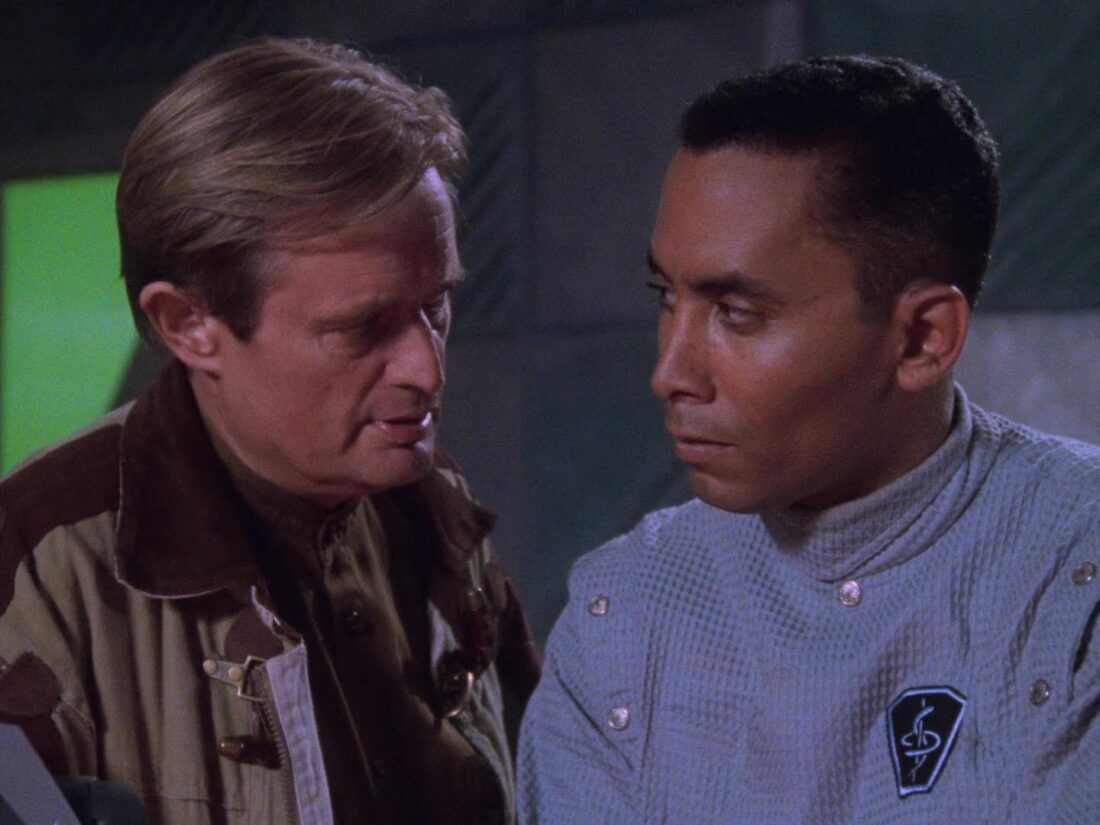
Franklin is surprised to get a visit from his mentor, Dr. Vance Hendricks, who promises him a grand adventure like nothing he’s ever seen before, so that can’t be good. Meantime in the docking bay, a customs officer questions Hendricks’ partner, Nelson Drake, suspecting him of smuggling something. Drake eventually kills the customs officer due to the fact that he is smuggling something.
Garibaldi investigates the death of the customs officer, the cause of which seems to be a simple heart attack, though Garibaldi still thinks it suspicious.
Hendricks explains that he and Drake retrieved some artifacts from Ikarra VII. They were sponsored by Interplanetary Expeditions. What they found are thousands of years old, but in perfect shape—and are also organic, which is why Hendricks brought them to Franklin to examine. This may give them the breakthrough to create organic technology like what the Vorlons and Minbari have. Hendricks also lies and says that the items went through quarantine at their previous stop on the way to B5.
While unpacking some items, one glows and hits Drake with a massive electric discharge, throwing him across the cabin into the bulkhead. Drake does not report this to anyone, nor do Franklin or Hendricks notice his bizarre subsequent behavior.
Sinclair continues to duck Cramer. Garibaldi’s attempt to get her to talk to him results in her asking him probing questions about all the prior jobs he’s been fired from, at which point he, too, ducks her.
Franklin goes to MedLab to find it darkened and a transformed Drake inside. The latter says, “Protect!” and fires a nasty ray-beam at Franklin. Hendricks says that it appears that one of the devices they found bonds to a person, enhancing them. He promises to do more research. He also says that Drake handled all the paperwork for getting them through customs.
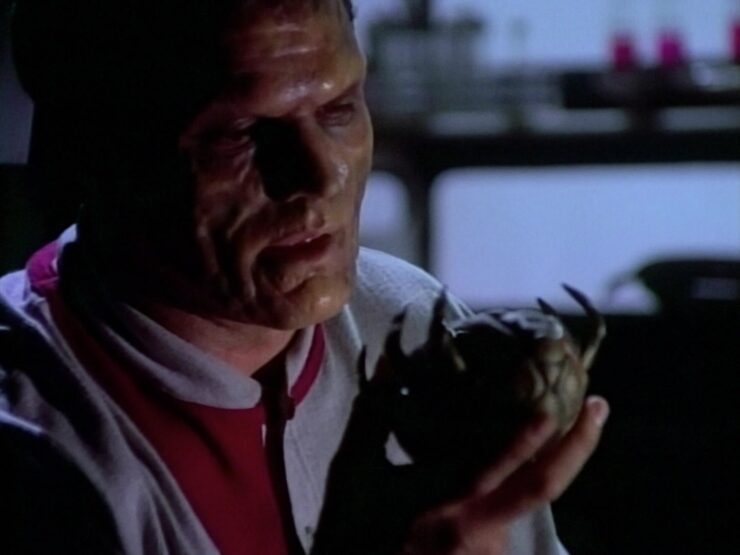
Drake kills two people in downbelow. The zappy thing gets more powerful with each shot, to the point that CinC can pick up the blasts on scanners. But his first confrontation with security ends with Drake blasting through a bulkhead and escaping.
It’s quickly determined that the zappy thing needs time to recharge, but that time decreases with each shot, plus it gets more powerful each time.
Hendricks and Franklin’s research reveals that the tech they found was constructed in order to create soldiers who would defend only “pure Ikarrans,” basing its programming on ideology rather than science. The problem was that there was no such thing as a “pure Ikarran,” and eventually the soldiers wiped out everyone, even the ones on their side.
Sinclair lures Drake away from populated areas, and also taunts him, saying he failed, and finally gets him to access the host’s memories, as Drake has been to Ikarra VII as it is today: a dead world. The tech figures out that it failed and discorporates in a puff of illogic.
Franklin found a device for cardiac stimulation in Drake’s things that matches two markings on the customs officer’s neck. If used on a healthy person, it would induce a heart attack. Drake is guilty of murder. Hendricks offers Franklin half the money he’ll get from IPX—which, he says, is a front for a bio-weapons developer—if he doesn’t turn him in. But Franklin called security before he confronted Hendricks. Later, two people from EarthDome show up to confiscate the bio-tech.
Finally, Sinclair sits down with Cramer and speaks his mind—including why he thinks, despite the expense and the skepticism of many back on Earth—it’s vital that humanity continue to go out into space.
Nothing’s the same anymore. Garibaldi calls Sinclair on his constant need to barge in and do all the rough missions his own self, making it clear that it’s not just because he’s the top-billed character but also because he still hasn’t figured out how to stop fighting in a war.
Ivanova is God. When Cramer tries to barge her way into CinC during a crisis, Ivanova gets rid of her by standing in front of her and very calmly saying, “Don’t—you’re too young to experience that much pain.” Cramer immediately departs.
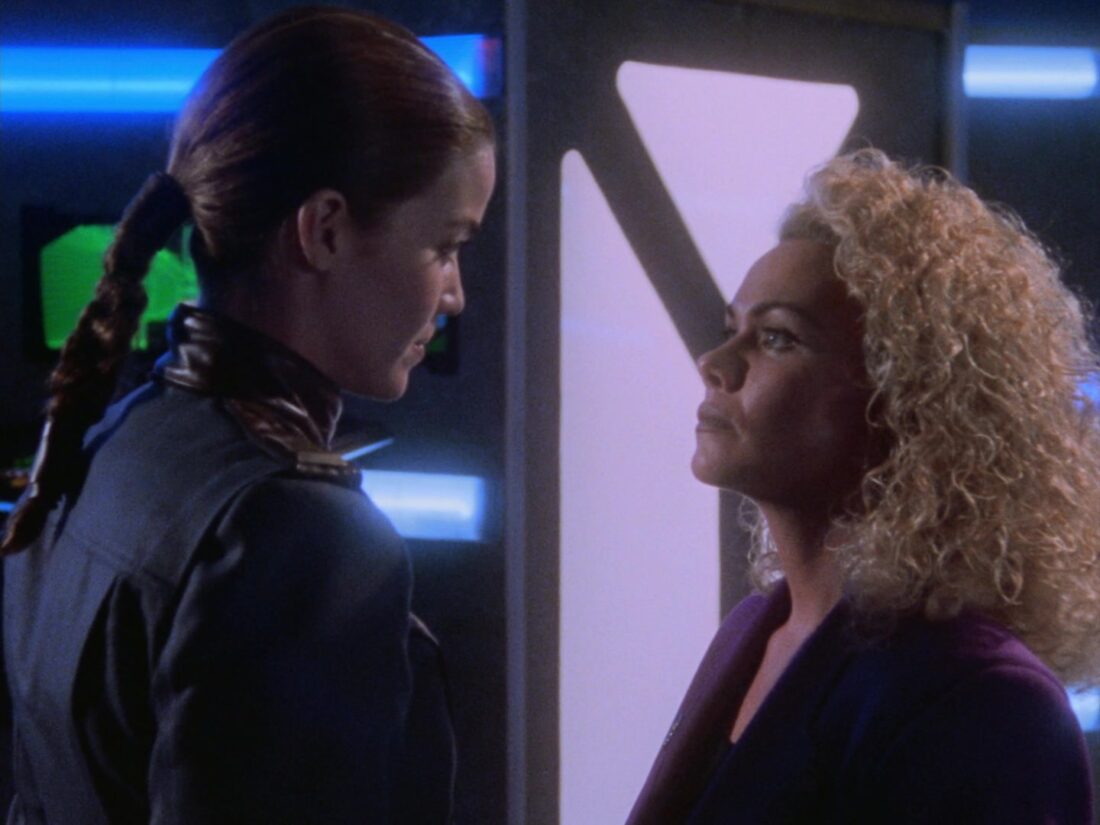
The household god of frustration. Sinclair tells Garibaldi that he’s avoiding Cramer because the last time he gave an interview to a journalist and spoke his mind, he was transferred to a distant outpost. Garibaldi tells him that he shouldn’t fret—just speak his mind again, and worst case, he’s transferred out and Garibaldi gets his job. What’s the problem?????
Welcome aboard. Marshall Teague plays his first of three roles in the franchise, as Drake; he’ll return in the recurring role of Ta’Lon throughout seasons two to five, and again in Crusade’s “The Long Road” as Captain Daniels. Patricia Healy makes her first of two appearances as Cramer; she’ll be back in “By Any Means Necessary.”
But the big guest is our first Robert Knepper moment of the B5 Rewatch, as I had totally forgotten that the late great David McCallum played Hendricks. McCallum is, of course, best known for his iconic role of Ilya Kuryakin in The Man from U.N.C.L.E. and his long-running final role as Dr. “Ducky” Mallard for the first two decades of NCIS.
Trivial matters. This episode has the first mention of the possibly very dodgy Interplanetary Expeditions, which will be seen a bunch more again.
This was the first episode written and produced once the show went to series, though it was never intended to be the first aired.
Only four of the ten people listed in the opening credits appear in this episode. Bill Mumy and Caitlin Brown have yet to make their first appearances, despite being credited.
The echoes of all of our conversations.
“There’s one thing that every scientist on the planet agrees on: whether it happens in a hundred years or a thousand years or a million years, eventually our sun will grow cold and go out. When that happens, it won’t just take us—it’ll take Marilyn Monroe and Laozi and Einstein and Morobuto and Buddy Holly and Aristophanes, and all of this… all of this was for nothing unless we go to the stars.”
—Sinclair’s answer to Cramer’s interview question, and also the only worthwhile part of the episode.

The name of the place is Babylon 5. “What’s the worst that could happen?” It’s never a good sign when an episode of B5 doesn’t have any of the three most interesting characters in it. Delenn, G’Kar, and Mollari are the heart and soul of this show, and that none of them appear in this episode is but one of a billion problems with it, the biggest of them being that it’s awful.
Seriously, this script would make for one of the weaker episodes of Space: 1999 or Buck Rogers in the 25th Century or the original Battlestar Galactica or Gene Roddenberry’s Andromeda, much less the show that promised to be the vanguard of a new age of great SF TV. B5 got some great guest stars over its run, and I thought I remembered all the good ones, but I’d totally forgotten that David McCallum was ever on this show. It’s a testament to how truly dreadful this episode is that it made me forget that McCallum was in it.
“Infection” is a tiresome collection of weak clichés, boring action, and tired tropes, from the mentor-gone-evil to the manly hero avoiding the plucky female journalist who just wants to ask him some questions to the laughable look of Drake after being transformed.
It does have one redeeming feature, but the problem is, you have suffer through the entire crappy episode to get to it. Sinclair’s answer to Cramer’s question about whether humanity should continue to go into space or stay home where it’s safe and only has humans in it is brilliant (and quoted in “The echoes of all our conversations” above), erudite, and, most of all, quite true. (I wish half the people he cited weren’t from twentieth-century Western civilization, but I also love that his list included the creators of both the Tao Te Ching and “Peggy Sue.”)
Some might say that Garibaldi’s come-to-Jesus speech to Sinclair is a redeeming feature, too, but I’m not one of them. It’s a legitimate complaint from Garibaldi, and it certainly provides justification for Sinclair being at the forefront of the action all the time. But it feels too much like Straczynski came up with a Marvel No-Prize to explain why the guy at the top of the opening credits does all the cool actiony stuff, rather than an actual bit of characterization.
Next week: “The Parliament of Dreams.”

I had forgotten how bad much of the first season was and I know there are at least a few more really bad ones upcoming that I do recall…
Did we not recognize how bad it was at the time or did we not care?
I really loved how Franklin and Hendricks manage to extract an entire, detailed history out of the biomatrix of one of the items, even though a chunk of said history could only have been recorded after everyone on the planet would have been exterminated by their own weapons.
We only have 1-2 more truly terrible episodes in season 1. (Depending on how you feel about Grail).
None of the future seasons have episodes that are *quite* this bad.
In fact, Infection is rated the worst episode of the series on many lists.
So, for those of you who are struggling along watching B5 for the first time, most of your pain is already over!
Worst of Season 1 definitely. But worst of the whole series? IMO that dubious distinction goes to “A View from the Gallery”.
I definitely knew how bad it was at the time, but you have to consider this was before we had a glut of TV sci-fi to choose from. Nowadays there are so many shows to watch, you can’t even keep up, but in ’94 TNG had just finished and DS9 was finding its legs; Seaquest was struggling against network interference that made each season dumber than the previous; X-Files was starting up, but it dipped too much into the paranormal and conspiracy theories for a lot of SF fans; and everything else in syndication (Superboy, Superforce, Time Trax) was even worse than B5. If you were lucky you might have the Sci-Fi Channel or local stations with reruns of the Twilight Zone, BSG and the Irwin Allen oeuvre.
Good point. While there was a marked increase in the overall quality of SFTV starting around 1989 (with TNG season 3, Alien Nation, and Quantum Leap), it wasn’t all at once, and there was still a lot of cheese out there, especially in first-run syndication. As with early TNG, it may have been weak by modern standards, but for its time it was pretty good, and as you say, there was a limited selection.
Indeed, as I’ve mentioned before, the later glut of SFTV was only made possible by the inexpensive CGI technology that B5 was the first show to use. So at this point, when it was just starting out, there wouldn’t have been as much competition. Also, as cheesy as the FX look today, they were pretty amazing for the time, able to show far more elaborate and spectacular scenes than other shows could, with the tradeoff of looking more fake (but then, in those days, FX always looked fake to some degree).
Yes, this is exactly it. The first season’s pretty average for the time (certainly the first half) and is one of the few shows of that period that were close to TNG in terms of budget so it was something to persevere with in those days – although on original run I got to the point of thinking “Can I spend an hour a week on something average?” after the first few episodes. I’m just glad I went back (I think a friend was watching it and kept up.) It would have been nice not to have to go through these episodes to get to the good stuff, but most first seasons take time to find their groove.
Oh, B5 was nowhere near TNG in terms of budget. TNG was a big-budget show, averaging a million and a half per episode, which was high in those days. According to JMS, “Babylon 5 started out with a budget of around $650K and ended up a little over $800K in year five.” https://twitter.com/straczynski/status/1340131138128375808
So B5 got made with less than half of TNG’s budget, and it shows in the cheaper sets and props, like this episode’s use of an unmodified taser to represent a futuristic medical instrument, and the complete lack of any location filming so far. But it had the secret weapon of a breakthrough in inexpensive CGI, and to its credit, it went all-in on the creature makeup and FX, so those compensated for the cheap look of the rest of the production.
I don’t think B5 did any location filming…there might have been a couple shots outdoors, but they were at the soundstage. As I recall, they didn’t go anywhere to shoot outdoor scenes…it’s been a while so maybe there was something, but it was pretty minor.
That’s interesting. I know over here in the UK, unless I’m misremembering which given it was 30 years ago is possible, the promos in listings magazines made a big point of saying it had a decent budget in comparison to other shows, but clearly nowhere near TNG!
The CGI doesn’t bother me for the most part. By today’s standards it’s quite primitive, but I have no problem contextualizing how advanced it was for the time.
It also helps to remember that none of us were watching any of this on HD screens: it was all lo-res CRTs.
Yeah, as I said in my review of “The Gathering,” the CGI is no worse than pretty much all CGI prior to 2010 or so.
—Keith R.A. DeCandido
The comparison shouldn’t really be to other CGI, though, since nothing else on TV was using this level of CGI at the time, and even feature films were still only using CGI to a limited extent. The comparison should be to what contemporary shows like TNG and DS9 were doing with traditional miniature effects, matte paintings, and the like — which looked better but was far more limited in the kinds of shots that could be achieved. For instance, a physical miniature mounted on a pole in front of a bluescreen can’t be shown to spin around on two axes and show every side of itself to the camera in a single shot, like B5 fighters often did. And something like the final shot of the pilot, where it starts looking in the command center windows and then pulls out to reveal the whole station, could be done with miniatures if you did a careful motion-control dissolve from a larger-scale miniature of the windows to a smaller-scale miniature of the whole station, but it would’ve been a lot more difficult. And a lot of the elaborate space battle scenes in B5 would probably have been done far more piecemeal, with much shorter, more limited shots intercutting with actor reaction shots and descriptive dialogue. B5’s CGI allowed doing the kind of long, continuous, complex shots of the kind that had previously only been practical with a feature film’s budget and schedule, and doing it on a weekly basis.
I was talking about in terms of what it’s like to watch it now in the 2020s, not what it was like 30 years ago….
—Keith R.A. DeCandido
In those terms, I think the CGI actually holds up better than I expected. Though it helps that it’s limited mostly to objects like ships and stations so far.
Yeah. I just rewatched the SciFi “Children of Dune” a couple weeks ago and, hoo boy, the 4k hdtv does it no favors at all.
Still, it’ll probably end up being better than whatever Denis Villeneuve comes up with. Guy has already hamstrung himself by not having Alia in Part 2, and it’ll cascade from there.
I don’t even notice the CGI anymore. I wish I could say the same for the plot :P
I didn’t notice much of a plot either
Certainly not in “Infection”! (sorry, JMS; it was just BAD!)
The Atlanta TV station aired a promo for “TKO” during an episode of TNG and I was pretty happy not watching “B5” for quite some time.
I came back for Babylon 5’s fourth season and have gone back to watch most of series, especially with it being on Tubi. Season 4 is the only season of B5 that I own on DVD.
I don’t think I was the only one who bailed on the show first season and got back into it after accidentally catching a Shadow War episode and discovering the show had somehow gotten good.
I’ll also add that rewatching the first season a year or two ago, I was pleasantly surprised to find the first season was a little better than I’d remembered. Which isn’t to say it’s good….
Anyway, B5 has been a classic example of “Once you get through the first season, it’s awesome!” amongst everyone I’ve known who tried recommending the show to the uninitiated for decades.
After the first season, nothing is the same anymore. Including the quality of the show!
When I introduce the series to new initiates, I usually stick to a small, curated sampling of first season episodes that either 1) include key plot/character points that are good to know once you get to the second season, and/or 2) manage to be decent episodes overall.
Yeah. I’d go with:
I used to convert non-fans into fans with the help of a single one page sheet explaining the basic background of the show, who the major races were, and then start them off with Signs and Portents/Babylon Squared/Chrysalis. If they were really interested, we would go back and fill in most of the season 1 blanks and then move on to season 2.
I would assume they extrapolated the final stages of the species’s annihilation from the archaeological record, once they had the Ikarrans’ data to put it in context.
One of those early episodes where you can tell JMS has certain plot and character points penciled in for this episode, and he was more worried about delivering them than the logic of the story.
Yes, that was quite ridiculous. They even had a moving picture of the researcher who’s brain waves were used.
The biotech was laced with deposits of that useful mineral, Plotexpositionium….
—Keith R.A. DeCandido
Oh yes, this is quite bad. Easily ranks as one of the worst of the series.
I’m going to disagree when it comes to Garibaldi’s conversation with Sinclair. I think it takes one of the best scenes of “The Gathering” – Sinclair’s memory of the Battle of the Line – and carries that haunted, tortured aspect of Sinclair’s character into the series as a whole. And I think it connects well with what we see in episodes like “And the Sky Full of Stars”. Sinclair always seemed to hold that aspect, so much so that one can palpably feel how much the weight was lifted by the time “War Without End” comes along.
(How much of that was O’Hare carrying and battling his own demons at the time is a sad point to consider.)
Anyway, beyond that, I love Sinclair’s speech at the end; it is, I would agree, the most worthwhile element of the whole mess. Though I give it slight credit for introducing some key elements of the grand tapestry: the existence of organic technology, which powers seem to have it, the legend of a war roughly 1000 years ago, and as mentioned, the shady Interplanetary Expeditions. And while it is a point beaten to death by Sinclair towards the end, his whole bit about “obsessing about the enemy leads to becoming the enemy” is echoed down the line by Delenn as a Minbari cultural standpoint, which is intriguing given the Sinclair-Minbari connections.
When I re-watch Babylon5 I tend to skip “Infection”, one of the very few problematic (read ‘bad’) episodes in the series, but this time I tried to see it with new eyes, and was able to appreciate the little seeds it planted toward the development of the overall story arc, even though the episode suffers from several quite cringe-worthy moments.
For example, the discovery of organic technology on the ruins of Ikarra introduces a theme that will become quite important as the story progresses, as is the timeline of that civilization’s destruction: the thousand years elapsed since the world’s destruction will come into play later on with the mention of the Shadows and their last attempt at conquest.
Once again, Sinclair puts his life on the line, and this time Garibaldi calls him on it, wondering if his friend does not have something of a death wish, and I loved how he speaks about “looking for something worth dying for because it’s easier than finding something worth living for” – this is not the last time we will hear this sentence, although it will be asked in a somewhat different way…
And a special mention goes to Ivanova’s warning to the nosy reporter: “You’re too young to experience that much pain”. This is Susan Ivanova at her nasty best :-)
I forgot to mention the “something worth dying for” line. It’s one of those moments in the first season where you can see how something was very specifically being set up for Sinclair, but ultimately went to Sheridan. Especially when we take certain implications of “Parliament of Dreams” into account for Sinclair and Delenn.
“Obsessing about the enemy leads to becoming the enemy” sets up an arc that ends up being for Sheridan, too.
New watcher. So far, this show is 0 for 4 for me (5, if you count the 2 hour movie/pilot). And it hasn’t even been close. This show is bad. I will continue watching because 1) to keep up with the rewatch; 2) which means I only have to subject myself to 1 episode a week; and 3) because I’ve heard the hype for this show for many years now.
If it wasn’t that you’re watching via the rewatch, I’d say skip ahead. In some ways you can start from Season 2, as the show does a soft reset at that point and reintroduces itself via a new character, and probably get a better sense of what the show is. That said, you’ll miss Babylon Squared, which is a very interesting episode.
As another new watcher, I understand where you’re coming from, but I’d be more generous and say that the rest of the episodes have either been watchable or thought-provoking. This is the first one that’s been neither.
Once you get through the first season, it’s awesome!
😂🤪
I absolutely agree. If I didn’t have so many people telling me to stick it out, I’d be reconsidering my commitment. But it’s good conversation around here, so I’ll still be checking in every week.
It’s definitely of its time. It never gets any more naturalistic in the performances and staging, but hopefully you’ll get used to it and the overarching plot and characters will drag you in. The writing gets a lot better on the whole but it takes time to get there.
It is certainly possible that the show just won’t work for either of you. I tried to get my wife to watch it with me a few years ago; she gave it a fair shot, but just didn’t really get into it. It happens. But I think even the most ardent fans would agree that this episode in particular is among the worst of the show.
The next episode is a much better litmus test. Personally, I’d say that if you don’t enjoy “Parliament of Dreams”, Babylon 5 probably isn’t for you.
I’ve seen that play either way. There are several podcasts/YouTube review channels watching and reacting to Babylon 5 as first time viewers. At least one of them disliked Parliament of Dreams, but became huge fans of the show. Admittedly they thought TKO was a good episode and didn’t like the first half of season 2 that much. Once it got going, they were on board. So someone can dislike POD and still eventually come around. I, personally, love Parliament of Dreams.
The Parliament of Dreams isn’t an action episode, so people who are mostly looking for that won’t consider it their favorite. But, to me, it is the first episode where the soul of the show, so to speak, starts to really reveal itself.
This isn’t a great one, but I wouldn’t say it’s entirely awful. I respect that JMS was at least trying to do a commentary on Nazism and bigotry, somewhere between the Daleks and “Let That Be Your Last Battlefield” on the spectrum of sci-fi allegorical aliens, although in execution it’s just as heavy-handed as those examples, reminding me especially of the latter. For all that many members of Trek and B5 fandoms insist on seeing each other as rivals, it was always clear to me that JMS was very, very much trying to do his own version of Star Trek, to convey the same kinds of philosophical statements, but in a way that was closer to TOS where humanity was still imperfect and learning than TNG where it was presumed to have all the answers. And that’s very evident here. This is very much TOS-style writing, even if it’s third-season TOS.
This episode also underlines something I’ve mentioned before — that B5, certainly this early in its run, was a far more episodic series than its modern reputation has it. This one is such a standalone that it doesn’t even have any of the main alien characters in it, making it perhaps the only episode focused only on the human regulars (plus guest stars). It’s evident that the way JMS approached continuity was not to make everything part of an ongoing serial like the overused pattern today, but to tell episodic stories that foreshadowed later developments in ways that weren’t evident until later (in this case, with the alien biotech).
I wonder if the lack of aliens is the reason this was shot first after the pilot. Maybe they were still working on redesigning the Minbari, Narn, and Centauri makeups, so they put an alien-free episode (aside from background extras) first in the schedule.
But the ambassadors are missed, since there’s a lot of weak acting here; I was unimpressed by Richard Biggs as Dr. Franklin, and the reporter was strident and unpleasant. There’s also some signs of really low budget, like the futuristic heart stimulator device that’s obviously just a 1980s-vintage taser, and the customs inspection system that looks more like something out of the 1950s than the 2250s. They don’t even have x-rays, just a guy looking through the bags?
Garibaldi confronting Sinclair about throwing himself into danger was a good touch. I don’t see it as a “No-Prize” afterthought — after all, this one was shot before the earlier episodes showing Sinclair’s extreme risk-taking, so JMS knew all along that this was what he was building toward. He was starting with the cliche and then subverting it. Which is a risky thing to do, because it still looks like a cliche before the subversion happens.
I’m not as enthusiastic about Sinclair’s final speech, though. For one thing, there’s that first sentence — “There’s one thing that every scientist on the planet agrees on: whether it happens in a hundred years or a thousand years or a million years, eventually our sun will grow cold and go out.” No, I’m sorry, every qualified scientist on the planet would say that’s staggeringly wrong in every possible way and reads as if JMS got his astronomical education out of a 19th-century book. Our Sun is actually getting gradually hotter and larger, and in about a billion years it’ll be hot enough to boil away all Earth’s water, and four billion years after that it’ll cast off its atmosphere and leave a superhot, very slowly cooling white dwarf behind. The only stars that “grow cold” at the end of their life cycles are the smallest red dwarfs, and they burn their fuel so slowly that it may be trillions of years before it happens.
The stuff after that is okay, but way too short to really get the point across. I presume he means it’s all for nothing unless we go to the stars to make sure all that cultural heritage is preserved rather than erased. But I’m not sure that point comes across well enough for every viewer to pick up on it.
What you say isn’t wrong, but it DOES introduce a few things which drive the rest of the “novel for television” – SInclair’s obsession and the real introduction of organic tech, that the characters make very clear earth wants it VERY badly.
Even in the “episodic” installments, there is foreshadoing, some of it very subtle.
Yes, that’s exactly my point — that episodic storytelling does not forbid strong continuity and never has. It’s a mistake to call B5 a serial; it’s an episodic show with a preplanned and structured continuity between its episodes, as opposed to the more improvised continuity that a show like ST:TNG had.
I think the one it most reminds me of is the TNG episode”Arsenal of Freedom.”
It is TOS-style, but also in the sense that it feels like that the whole script is from the 60s. What i would forgive to an episode in the 60s becomes awful by the 90s. :)
I thought TNG season 1 was weak, but so far B5 is significantly worse in comparison.
Yes, this one always strikes me as a pastiche of “The Changeling”, with “Protect!” standing in for “Sterilize!”.
I don’t think “The Changeling” works as an analogy, because Nomad wasn’t driven by Nazi-ish ideology, just scrambled programming that merged “seek out new life forms” with “sterilize soil samples.” This was much more of a “Last Battlefield” parallel, a cautionary tale about an alien race that wiped itself out because of its intolerance of difference.
One thing the public didn’t know at the time, but that came out in JMS’s memoir Becoming Superman, is that his horrifically abusive father was a Nazi sympathizer, and worse. So he wasn’t just telling a superficial story about an alien killing machine — he was trying to make an allegorical statement about the horrors of Nazism and similar beliefs. He did it in a rather clumsy and heavy-handed way, but I guess knowing his past makes me sympathetic to what he was trying to achieve with Sinclair’s monologue to the Ikarri protector.
I agree that the allegorical overlay is different, but the mechanics are more or less the same: alien killing machine with a catch-phrase threatens a rampage, but is stopped by means of a “clever” rhetorical device.
But I do agree that there are also echoes of “Last Battlefield”.
Or like this.
MST3K – MONAD (youtube.com)
I didn’t see Sinclair’s argument as just a logic puzzle like Kirk used on Nomad. It reminded me more of “Day of the Dove,” Kirk’s speech to Kang about the futility of endless war, combined with “Battlefield” and the revelation of the destroyed Cheron. Sinclair didn’t trick the guardian into self-destructing — just the opposite, he convinced it to look at the facts, the hard proof of where its programming had led.
Although I was surprised he didn’t make the obvious argument that the guardian was itself impure because it was possessing a non-Ikaaran host. Now, that would have been like “The Changeling.”
Sinclair’s speech is good, but sentiments like that get used to justify too much woo-woo, like Musk’s promised Mars colony. C.S. Lewis had a great rebuttal to that line of thinking in Out of the Silent Planet — colonizing new worlds will require modifications to humanity so drastic that it won’t even be humanity anymore. Why should we shape policies around the possibility that one day giant squids descended from us will live on Epsilon Vega?
I think it’s important to recall that Lewis’ argument against space colonization in Out of the Silent Planet (and later in his 1958 essay “Religion and Rocketry”) was not that humans must be modified to live on other planets, but that humans would likely emulate the European colonizers by killing or enslaving the natives and taking their land. Weston in fact stated that was his very intention, and that human survival mattered more than morality or the rights of other beings to live.
Sinclair is not making that argument, but then the few colonies Earth has are on either lifeless planets (Mars, the Jovian moons) or on worlds we infer had no native cultures on them (Orion 7, Proxima 3). Plus, Earth was on the receiving end of genocide a little over a decade prior; I would hope that Sinclair would have given a hard no on any human plan for expansion that involved wiping others out. Mr. Bennett made the argument for space habitats as another option (as Babylon 5 itself demonstrates) but I’d point out that that is an option that requires both political will and a strong moral conscience. If we were presented with an inhabited planet with a breathable atmosphere and the option of building thousands of Bernal Spheres or O’Neill Cylinders, which option would we choose?
Going to the stars is the best way to insure our continued survival… but what we do when we get there matters as well.
“If we were presented with an inhabited planet with a breathable atmosphere and the option of building thousands of Bernal Spheres or O’Neill Cylinders, which option would we choose?”
In a sci-fi universe where alien planets look like the forest outside Vancouver and have food we can eat, colonizing planets seems simpler. But realistically, alien planets might have substantially different atmospheres, climates, and gravities, and their food might be based on different nucleic acids or have dangerously high or low metal content. Conversely, if an alien world’s biota were edible to humans, then it follows that humans would be edible to its microorganisms, creating a disease risk that fiction usually glosses over except when it’s plot-convenient to acknowledge it. (Not from viruses, which require genetic compatibility, but possibly from bacteria or similar microbes.)
So in realistic terms, any alien planet, even and perhaps especially a life-bearing one, might have to be terraformed extensively to be made habitable for humans, or else humans would have to bioengineer ourselves to make ourselves compatible with its biosphere. It would be far safer and more practical to build artificial worlds that are perfectly adapted to human needs. Particularly since we could build megastructures containing thousands of planets’ worth of habitable surface area out of the materials of the Main Asteroid Belt, Kuiper Belt, and Oort Cloud, so we wouldn’t even have to leave the Sol System to do it.
Alien microbes would have a different evolutionary history to life on Earth, and would probably look quite alien to the innate immune system, which exists specifically to destroy anything that looks alien to the body. They might be designed to subvert the immune defences of life on their own world, but could not be designed to subvert our own defences, never having encountered them during their evolutionary history.
We therefore ought to be pretty resistant to an alien infection.
OTOH, if their ecosystem was competitively superior to ours, it might successfully colonise our own planet and present us with a biosphere we couldn’t eat.
On the other hand, microbes have very short generations and evolve extremely rapidly, which is why we have such trouble with new antibiotic-resistant strains. So our immune systems might be effective against an alien planet’s microbes at first, but eventually they’d adapt to us, perhaps within a matter of years.
Based on past discussions and reading, I think there’s also the risk that the immune system could overreact to alien proteins or the like and trigger a dangerous allergic response. I think this came up in some of Poul Anderson’s fiction, and/or maybe Hal Clement’s.
I had this argument (about alien viruses vs bacteria and other self-sufficient pathogens) with several people on usenet about the time B5 and TNG were in first run. You managed to say it better in one concise paragraph than all the posts I made. Bravo.
There are much more practical reasons to go to space — for instance, the supply of helium and rare earth elements available for mining on Earth is finite, and much of modern technology would be crippled if they ever ran out, yet they’re vastly more abundant in space and in the asteroids. Orbiting satellites could provide even more solar power than surface arrays, there are pharmaceuticals and materials that can only be manufactured in microgravity, etc.
And we don’t need to change ourselves to settle other worlds; we can build artificial habitats, megastructures like Babylon 5 itself (which is based on a habitat design called a Bernal sphere), that are tailored to human needs. By converting the material of the asteroids and comets into space habitats, we could build hundreds of planets’ worth of habitable surface area right here in Sol System. (Although as I explore in my Troubleshooter series, it would be a good idea to engineer ourselves for space in some ways, e.g. with greater radiation resistance.)
But Sinclair’s basic point is right even if his grasp of the science is ludicrously wrong. The Sun’s gonna be fine for the next few hundred million years, but there are other possible disasters that could befall us on Earth, like an asteroid impact or a climate catastrophe. So it’s just good sense not to put all our eggs in one basket. The only way a civilization can hope to avoid eventual extinction is to colonize space. That’s why humans survived when all other hominins died out — because we were the only hominin branch that was crazy enough to want to live outside our environmental comfort zone, to wander into a bunch of different climate zones and invent ways to survive in them, so that we could endure environmental changes that killed off hominins limited to a narrower habitat range. What makes us human, essentially, is our compulsion to explore and expand beyond our limits.
I noticed that the Ikarran swears to/by the Great Maker, which is otherwise specific to the Centauri. I’m wondering whether they are supposed to have been an ancestor or ally in the past. Plus, the 1000 years ago date puts them in the time of the last Shadow War, presumably on the Shadow side since they are the ones to use people directly as tools.
We don’t get much background on it, but there appears to be several ‘Maker’ based religions in universe. It is probably just a generic term for the most part, particularly since the Centauri are polytheistic, as we’ll learn next episode.
Has Mollari used the term “Great Maker” yet? It seems like it could have been devised just as a generic god-like term
The tone of this episode is all over the place, vacillating between serious space drama and ridiculous Roger Corman film. My attention would perk up during some of the quieter moments, but I would quickly lose interest again. It’s been less than 24 hours since I tried to watch it, and I can’t tell you anything about it other than that I liked the final scene, even if I somewhat disagree with the sentiment, because I don’t think the fact that our sun will eventually wipe us out makes what we’ve achieved as a species meaningless. If that were true, then going to the stars wouldn’t lend it any more meaning, because some day all those stars will go out as well. Either our lives and our achievements have meaning in and of themselves, or they don’t, because ultimately no one will be around to remember them.
At any rate, if there were any big story developments that I missed, let me know and I’ll give it another try.
In terms of “big story developments”, I mentioned a few of the seeds that were being planted in my main comment above. The takeaway here is that organic technology is a thing, and some of the major powers (particularly the Vorlons) appear to have it. We have at least one example now of how that organic technology uses another living being to operate. And in this particular case, it involved a conflict that took place roughly 1000 years ago.
Much of what Sinclair said regarding “obsessing over the enemy leads to becoming the enemy” and so forth is, interesting enough, going to come up again later down the road in another context.
Thanks! I’m trying not to read other comments too thoroughly to avoid major spoilers, so I appreciate you repeating yourself here.
The business about the Sun is nonsense, but the idea is sound — a population limited to one habitat can be wiped out if a single large enough disaster befalls it, but a population that lives in many habitats is far more likely to survive, because no disaster is likely to befall them all at once.
Sure, but that’s not what I’m talking about. I’m talking about it being “all for nothing” if it’s wiped out, because it’s going be wiped out eventually. I don’t think “quantinty” is a very good metric for establishing a meaning of life.
Stars like the Sun will last for billions of years, not the paltry million that Sinclair laughably suggested. Cooler red dwarfs might last for hundreds of billions of years. And there are always new stars being born out of the remains of the old ones; it’ll be something like 100 trillion years before star formation ends. On the scale of a species lifetime, that’s practically eternity.
Yes, everything ends eventually, but the goal is to keep things going as long as possible. You don’t kill yourself at 20 just because you know you won’t make it to 200. You try to make it last as long as you can, and leave something behind for your descendants. That’s what every generation of humans has ever done, and you and I are the beneficiaries of everything that previous generations have left for us. So how the hell is it wrong to strive to leave a legacy for those who come after us?
I didn’t say it was wrong. I’m not against the survival of the species. I just disagree that the fact that something ends robs it of its inherent value. Just because I don’t have kids doesn’t make my life any less meaningful to me, and when our species as a whole ends, it won’t make any of our lives less meaningful to ourselves or one another. That’s not “nothing.”
Hmm, put that way, it’s an interesting thought. But I would submit that it’s a different matter if you allow something to end when it doesn’t have to. What Sinclair is saying, I think, is that, since we can go to the stars and make sure our history and heritage can live on and be known to the universe, it would be negligent if we chose not to do so because we were too short-sighted. A life lived to its fullest is not a waste even if it ends, but a potential left unfulfilled would be a waste.
Now that is a sentiment I certainly can agree with. Perhaps Sinclair should have said something more along the lines of not wanting humanity to let down the likes of “Marilyn Monroe and Laozi and Einstein and Morobuto and Buddy Holly and Aristophanes” by allowing the human journey to end prematurely. But I don’t think the negligence or shortsightedness of future generations can diminish them.
I think one of the main points of the episode is that the audience is spoon fed the sci Fi cliche of man merging with technology in order to make the shadow ship mergers not come out of left field. A lot of early plot points were in those first few episodes to prepare us for things down the road
It’s not good, but for what looks like a monster-of-the-week episode it’s packed with lore, as Critical Myth pointed out. We’ve got the 1000 year cycle, organic tech and EarthGov’s interest in it, the Ikarrans were clearly under the influence of the Shadows, and maybe a couple more things. The big one, though, is in Garibaldi’s speech. Had Sinclair gone to Z’Ha’Dum, we might even have had a flashback to that moment. As it is, Lorien specifically tells Sheridan that they’ve established what he thinks is worth dying for, but then asks what he thinks is worth living for. What looks like a throwaway line to explain some Main Character Syndrome is actually foreshadowing for something three years down the line.
The previous episode’s story was bad, but it was told quite well…this is a worse story presented/told terribly. :D
“If you need me, I’ll be over there, getting drunk with the rest of the aliens.”
Speaking of David McCallum, if you ever watched it before, a rewatch of “Sapphire and Steel” might be interesting. Or painful.
I watched that a few years back and was underwhelmed. Too weird and conceptually vague for me, and very, very stagey, the stories almost entirely limited to a single claustrophobic set per serial. (I think only one serial had location shooting, and that was just a building roof.)
Foreshadowing is neither a requirement nor an excuse. All the stuff this forgettable episode teases is utterly irrelevant because a) it’s all introduced later without need for the foreshadowing and b) this episode is so incredibly forgettable that the foreshadowing becomes moot.
—Keith R.A. DeCandido
Yeah, I agree. With hindsight you can see connections in this episode to the larger arcs, but those connections don’t really add anything important or useful. If you deleted this episode entirely, the only thing that gets lost is Garibaldi’s speech to Sinclair which could easily have been dropped into one of the other early episodes.
Definitely agree, Keith. I love the show to bits when it gets going, but the idea that something is being set up doesn’t mean that the writing has to be actively bad or uninspired.
Oof. Can’t add much beyond what krad has written. A few interesting bits of world-building nearly completely overwhelmed by bad writing and acting.
The best thing about this episode is that, every time I have re-watched the series, I breathe a sigh of relief as the closing credits roll since I know the worst is now past! There are a few clunker episodes yet to come, but generally those have individual aspects that fall flat rather than being mostly 42 minutes of suckage.
Did we know this one was so bad at the time? Maybe…but JMS sure did! Go find his comments at the time (available at the Lurker’s Guide and elsewhere). JMS feels only slightly better about this episode than George Lucas does about his Holiday Special.
Agree, this is one of the, if not the, weakest episodes of the series. I do like Sinclair’s speech and I like Garibaldi confronting him on his death wish. It also is the first appearance of Marshall Teague in the show. He plays the Drake and the Ikarran Drake turns into. Because he did well with prosthetics he comes back again as a fairly beloved character T’Lon. I have heard him interviewed and he has some great stories about B5. Since this was the first episode shot, he was the first person in full body prosthetics. They put him in a tank, stuck straws up his nose and poured latex(?) or another molding compound around him. Then they went to lunch and forgot about him until after lunch. Since he wasn’t claustrophobic, he had no problem. He’s an interesting guy.
Certain actors — Andreas Katsulas, Tony Todd, Doug Jones, Marshall Teague, to name but a few — have made a career out of playing aliens and strange beings precisely because they can handle the prosthetics.
—Keith R.A. DeCandido
It was nice to see McCallum again. Beyond that, though…well.
I can see 70 from here, and I’m still too young to experience this much pain.
The first season of Babylon 5 did such a great job of wasting some great guest stars, and this is certainly one of the better examples (though I still think the worst is actually early in season 3). I also have a hard time remembering David McCallum was in this, which may be for the best.
And it isn’t like the other guest stars fare much better. The reporter is a caricature, and ultimately disappears. Marshall Teague as Drake is not much of a performance, although he does have some good stories about the full-body prosthetic they stuffed him into. It was apparently not something they had done before, and did not realize just how hot it would become for the actor. After a while on set, they were hearing a sloshing sound as he moved around, so they poked a hole in one of the feet which then produced a stream of water as a result of how much he was sweating inside the suit.
Richard Biggs as Franklin also takes a fair bit of time to develop into a decent character. Some of that is deliberate as with G’Kar, but the change is far more subtle with him, so it is harder to remember just how unlikable he can be at times. We do get an early look at his compulsive tendencies and self-righteousness. Both of which will cause him problems down the line.
I find Sinclair’s speech at the end less inspiring than I did originally. As noted up thread, it is the kind of thing that people say to justify ego-building projects or impractical space colony fantasies. Not that I’m against dreaming, but we do need to face up to the fact that all our eggs are stuck in the current basket for the foreseeable future.
Honestly, Franklin is one of those characters that I feel that I should like, but whom I was never really able to warm up to. Maybe it’s just the way Richard Biggs plays him, or the fact that the poor guy ends up getting saddled with boring soap opera plots while everyone else is off doing cool science fiction stuff, but he’s probably my second least favourite character on the series.
I get so sick of people saying “Let’s solve our problems on Earth rather than go into space.” To borrow an analogy from a cartoon in a Planetary Society newsletter I once subscribed to, that’s like living on a small, crowded island and saying “Let’s solve our problems here before we try sailing to other lands.” The resources of space are inconceivably immense. The mineral wealth of the asteroid belt is dozens of times greater than what you’d get if you strip-mined the entire crust of the Earth down to the mantle. And then there are all the everyday technologies that were originally developed for or refined by the space program, like Kevlar, memory foam, smoke detectors, water filters, scratch-resistant eyeglasses, the tiny cameras in our phones, etc. Not to mention how much we depend on satellites for weather forecasting, GPS, global communication, and other everyday things. Going into space is not a failure to address Earth’s needs, it’s the solution to Earth’s needs.
And like it or not, history shows that no frontier has ever become practical to develop until private enterprise finds a way to turn a profit from it. So yes, some rich people might be pursuing their vanity projects right now, but it’s laying the foundation for more practical space industries further down the road. Nothing new looks practical when it begins, but that doesn’t mean it isn’t worth pursuing.
And I’m tired of people saying that we can solve all our problems by leaving this island to its fate and going off to exploit other islands instead. Not what you said? Well, your straw manning of my comment isn’t what I said either. Although I do suppose this does provides another example of why I find the speech less inspiring now than I used to. After all, how inspiring can it be when even a mild criticism of its premise inspires such angry rants in rebuttal?
And so what that there are lots of resources in space? Resources existing is a very different thing from them being economically viable or even potentially usable to any degree. Take the example of helium 3 on the moon you used up thread. Yes, there is helium 3 on the moon, and more than we can find naturally on Earth, but it is incredibly rare and diffuse. We are talking parts per billion. You would have to process cubic kilometres of lunar regolith to squeeze out mere grams of the stuff. And for what? A hypothetical fusion reactor that we don’t even know how to build? And aren’t even really trying to learn how to build since there are more promising options? Plus the fact that we already make helium 3 as a byproduct of existing nuclear reactions already. The only thing helium 3 mining on the moon is useful for at this point is to determine if the person bringing it up actually knows what they are talking about.
Space research is fine, and does provide many side benefits and technologies, but that is an entirely different question to using space as a resource base or colony location. On that front, it is not a viable solution to our resource issues, at least not for any reasonably foreseeable timeline. Your island metaphor ignores the issue that the people on your hypothetical overcrowded island can’t actually breathe the air, drink the water, or eat any of the non-existent plants and animals on those other hypothetical lands they are supposedly going to sail to, and so would have to bring all of those things with them from the already strained resources of their current island. And doing so would make that island’s problems even worse. More importantly, it also ignores the many non-hypothetical cases where people didn’t look after their own lands well enough and suffered major catastrophic declines as a result. Which is why, “maybe we should pay a bit more attention to the fouling of our own (and only) nest,” is still worth saying.
“Angry rant?” Where did you get that? I’m speaking from a place of optimism, pointing out the enormous potential that critics of the space program tend to be unaware of.
“Which is why, “maybe we should pay a bit more attention to the fouling of our own (and only) nest,” is still worth saying.”
No, it really isn’t, because it’s a false dichotomy. As I (and Jaime) said, what we learn from space is applicable to our problems on Earth. The universe isn’t divided into unrelated pieces — it’s all an interconnected whole, and what we learn about any part of it can be applicable to other parts. It’s invalid to say that any field of knowledge is not worth pursuing, because what you discover in one field could be of great importance in others.
Also, countless people who’ve traveled in space have said that seeing the Earth from orbit made them realize how small and vulnerable it is, or how it’s all one place instead of a bunch of separate countries. Traveling into space made them care more about their responsibility to Earth, not less. So the belief that focusing on space somehow means abandoning Earth is getting it completely backward.
When you start your reply with, “I’m so sick of people saying…”, what follows is not going to come off as a considerate statement. As to your points here, your first statement in your original reply after how sick of people like me you were and the island analogy was, “The resources of space are inconceivably immense. The mineral wealth of the asteroid belt is dozens of times greater than what you’d get is you strip-mined the entire crust of the Earth down to the mantle.” And, as noted, your other comments in the thread referenced mining Helium 3 from the Moon, as well as other references to rare earths and so forth that you state we need to go and grab before we run out of them on Earth. That’s not about space research or the technological benefits of the same, but exploiting space for its resources. I have no problem with the former, but the latter is effectively fantasy at this point. And as for the ridiculously tiny number of people who have travelled to space coming back with a greater appreciation for the planet? Great for them, but not exactly scalable.
I never mentioned helium-3, by the way. I meant regular helium, which has many important uses in industry and manufacturing, particularly in cryogenics, and whose supply on Earth is finite and unrecoverable. https://www.acs.org/greenchemistry/research-innovation/endangered-elements/helium.html
Also worth pointing out, as Kim Stanley Robinson notes, that space science is an Earth science (and in fact, James Hansen, who sounded the alarm on global warming in the US Congress, had been studying the greenhouse effect in the context of the planet Venus)
Ditto for Carl Sagan, who was one of the first proponents of the idea that Venus’s high temperatures came from a runaway greenhouse effect.
So the whole part of the episode dealing with the weapon system is horrible. But the rest is fine. I was super happy at how the customs officer was actually competent – obviously he gets zapped due to Plot but if this were Star Trek he wouldn’t have figured out the bad guy was hiding something in the first place.
Obviously Garibaldi was making a joke when he said he’d get the command if Sinclair is transferred. But would he? It would make more sense for Ivanova to be next in line, and Garibaldi seems to be in a separate division.
Maybe it’s just early-installment weirdness. According to JMS’s online comments preserved at the Lurkers’ Guide, this was not only the first episode filmed after the pilot, but the first one he wrote, even though it was intended to be (or ended up being) later in the story sequence. So he was probably still feeling some things out, like what the chain of command was.
Obviously, the command would go to Ivanova or, as we’ll see later, somebody of much higher rank or importance. Garibaldi is probably joking. It’s easy to forget that he and Sinclair are old friends, so that could be an old bit between them. He also frequently uses humor to deescalate a situation or soften a message, so I don’t think he was being serious.
I like the concept itself. The notion that scientists and programmers thought they could create a soldier that was capable of determining one’s level of racial purity – it makes for an interesting scenario. Of course they would wipe the entire Ikarran race out.
Still, you can tell it all fell apart when the ending is essentially B5’s version of ‘Kirk causes a robot to self-destruct through a logical loophole‘. It’s one of the episode’s many clichés. There’s not much else to say about the A story. It doesn’t shed any new light on Franklin (“Believers” is the next important one for him). McCallum isn’t bad, but the Hendricks character is forgettable. A potentially interesting archeology story becomes a series of tired corridor confrontations. The only purpose for this episode is to establish the IPX itself. A hook that will become a major plot point for the Sheridan family and the Shadow arc in the future.
And the ISN character, Mary Ann Cramer, is the worst. There is no reason for her to be so angry and adversarial towards Garibaldi just because Sinclair is dodging her. She should be used to this kind of avoidance and rejection. Which military or government officer likes to give press interviews? There are ways to create this kind of tension, but this one failed miserably. Every season there’s at least one ISN-heavy episode. It’s part of Straczynski’s Clark arc – showing Earth’s gradual loss of press freedom as the show goes on.
I for one never understood why this episode was the first thing shot after “The Gathering”, but Christopher brings up an interesting possibility. It could be the Minbari redesigns might not have been finalized by this point, thus delaying the filming of both “Midnight” and “Soul Hunter”. But then again, a LOT of season 1 is shot out of order for reasons passing understanding. The finale itself, “Chrysalis” is actually filmed in the middle of the season for some reason. And the last thing filmed was “Eyes” – the cliff notes episode. In retrospect, I think some of the episode reshuffling might have happened because of O’Hare’s condition. He’s certainly not the front-and-center focus of every episode this season.
JMS himself offered a far more mundane explanation (circa 1994) for this episode’s position in the production order:
JMS has said here and there that during the first season they had to film some of the CGI-heavy episodes earlier to give themselves more time to produce those effects on the back end. As they got better with the technology (and rendering times shortened) in later seasons, they were able to avoid that problem.
I can see the merit of filming the finale early, particularly for a show working on such a limited budget (as I mentioned above, B5 was working with less than 45% of ST:TNG’s per-episode budget). Maybe they wanted to make sure they didn’t run out of money before they shot the comparatively expensive finale. If they shot the finale first and ran out of money or time later, they could cut back on the less important episodes in the middle.
It could be, but I don’t think “Chrysalis” was necessarily that expensive or tough to put together. As I recall, it mainly takes place on the standing sets, with few guest stars. The only crowd is in the Zocalo during the new year countdown scene. CGI-wise, it only has a few scenes: the Earthforce One explosion itself, that very brief Morden/associates conversation, and the equally brief Shadow attack on the Quadrant 37 Narn base, plus the practical ‘chrysalis effect itself.
In comparison, the CGI-heavy two parter, “A Voice in the Wilderness” – that had multiple separate story threads, plus designing the innards of Epsilon III, and a pretty big space battle – was one of the last things filmed that year.
I have to say that whilst its not that good its not THAT bad. This could have easily been an episode of ST:DS9 and no one would have blinked. Just another ho hum episode.
I think we got spoiled with the depth of plot and characters in B5 and this one just does not stand up to others in the generally weak Season 1.
I think the biggest stinker is Grey 17, but that at least does have a decent B plot
I always view the so-called ‘B’ plot of Grey 17 to be the real plot, and the episode named by mistake. ^^;;
I agree on grey 17 and tko. The a plots may be meh but the b plots are so good that I still enjoy them. This one doesn’t have any b plot so there’s nothing to distract from the meh aplot
I took the B5 rewatch here as a trigger to do my own, long planned one, although I do keep my own pace and did already speed ahead (currently at the first couple of episodes of season 2). What I enjoyed at B5 when it came out was mainly the glimpses into a larger universe that were sprinkled into the episodes: why did the Minbari stop the war on the brink of victory, the decaying empire of the Centauri, the hate and rise of the Narn (although shown rather heavy-handed), the misterious Vorlons, the multitude of species, etc. And then it got even better with Babylon Squared and the appearance of Bester and Mr. Morden. From the beginning I felt like been thrown into a “real” world.
But having said that, I agree that the actual A plots of the first episodes are often pretty bad, full of cliches, and in general badly though out and writen. Luckily the show survived this false start until it could shine.
It’s easy to forget just how many episodes of B5 were TOS-style morality plays before the story arc really kicked into gear. I think that ChristopherLBennett is right that this one is comparable to “Let That Be Your Last Battlefield” in terms of how (unsubtly) it delivers its message. Basically, it takes that sort of sledgehammer morality and combines it with the plot of a TNG-era “fun with DNA” episode, except, alas, with none of Michael Westmore’s talent at creating monster makeups.
I thought the monster makeup was reasonably good; I’m puzzled to see it criticized.
He’s not so bad once he fully transformed, but the intermediate stages look grotty.
Riffing opportunities: Whenever a barrage is is fired at Nelson to no effect, you could go with either, “Ha, ha!” or “Your weapons are useless!” Tragically, no good place to insert a Guyver riff.
While a theme in the series concerns the importance of an independent press that isn’t simply a trumpeter of propaganda, it seems like most of the reporters get portrayed as abrasive jerkwads. Makes you wonder if JMS has had some unhappy experiences dealing with the press.
JMS worked as a journalist before he got into TV writing.
Oh…100% agreed! I am SO glad that this was not the first ep aired (or the first I saw). It was atrocious, and I’m sure David McCallum is spinning in his grave as we discuss this, err, producton.
Though, I do consider Garibaldi confronting SInclair on his need to be the hero not a bad charqacter sketch of what drives the Commander. I’m remembering that Garibaldi says something like ” So, it’s easy to find something to die for. DO you ever have somethjng to LIVE for?” (but I may be misremembering from another, much later episode with a certain “older than the Old Ones character asking another B5 “hero” much the same question.)
Good analysis, Keith!
Not a great episode, but it does foreshadow (pun intended) the fact that there are ancient threats and technologies lurking out there that people should be wary of. The universe of B5 is not a benign environment.
Yeah, but there’s nothing new about stories involving dangerous ancient alien ruins or relics. It’s a well that Star Trek and plenty of other sci-fi went to often enough (owing something to Lovecraft, no doubt), so taken on its own, without foreknowledge of the story arc, it doesn’t make this one any less cliched.
The cliches don’t bother me as much as they do you as mentioned before *shrug* and this ending quote was one of the things that stuck in my mind, and when the show was airing was when I knew this was a show I wanted to watch. Was one of those moments someone says better than you ever could something you have always wanted to say and thus instantly know to be true.