







“The Coming of Shadows”
Written by J. Michael Straczynski
Directed by Janet Greek
Season 2, Episode 9
Production episode 209
Original air date: February 1, 1995
It was the dawn of the third age… On Centauri Prime, the prime minister begs the emperor to forego his planned visit to B5. His health is not the best, and what if there’s a crisis? The emperor pooh-poohs his concerns, and thanks the PM for his friendship and service. The emperor also refuses to wear a wig of proper standing-up Centauri hair, choosing instead to revel in his baldness.
On B5, G’Kar very loudly and angrily protests Sheridan allowing the emperor—whom the Narn view as a war criminal—to set foot on the station. Sheridan points out that the whole point of B5 is that everyone is welcome, and that G’Kar should take advantage of the opportunity to open up a dialogue with the emperor. G’Kar storms off in a huff.
Mollari and Refa discuss the emperor’s impending arrival. Refa and his people have prepared a speech for Mollari to give after the emperor’s speech. It criticizes the current regime as weak and “predicts” several possible crises, all of which Refa’s people are working to manufacture. Mollari is concerned that this will put him on the outs with the royal court, but Refa dismisses that as irrelevant, given the emperor’s poor health.
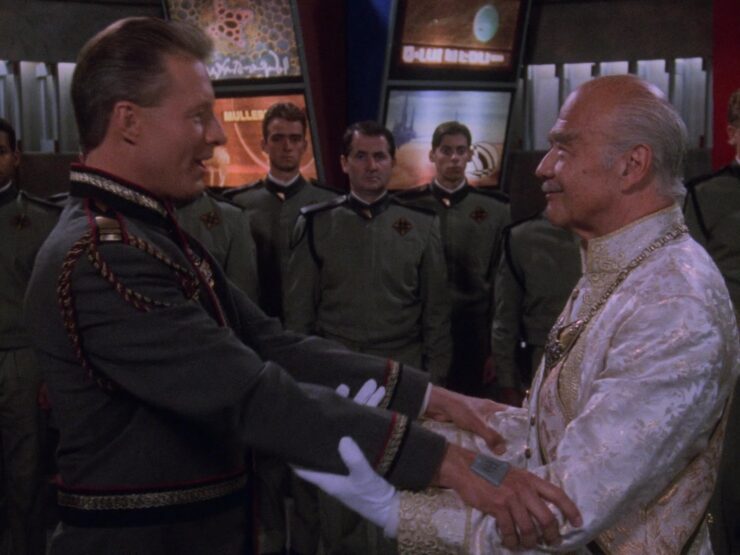
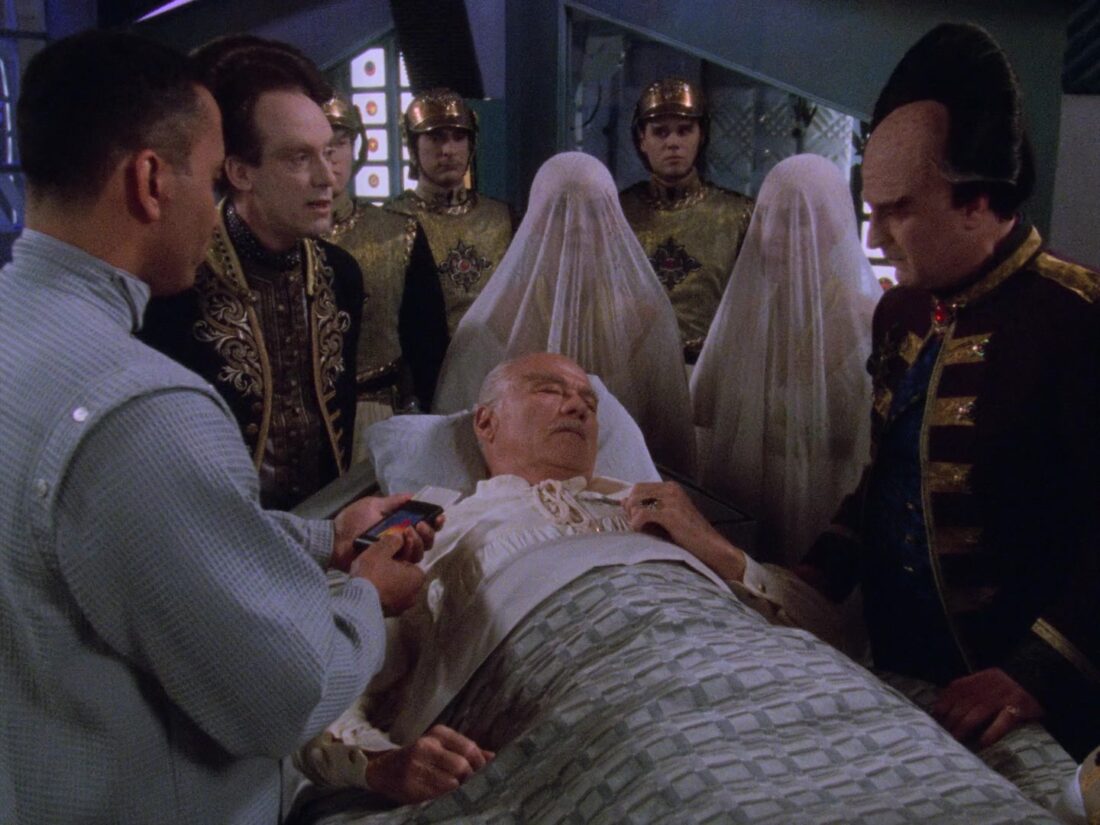
The emperor arrives, greeted by Sheridan and an honor guard. The emperor expresses great admiration for what B5 has accomplished. Privately, the emperor asks Franklin about Kosh, as he’s always wanted to see a Vorlon.
G’Kar consults with a member of the Kha’Ri. The plan is for the ambassador to assassinate the emperor. G’Kar knows that it will be his final act as a living person, but he is willing to make that sacrifice for Narn. G’Kar leaves a note explicitly saying that he’s acting alone without the knowledge of the Kha’Ri or anyone else, thus keeping the government’s hands clean. He bequeaths his copy of the Book of G’Quan to Na’Toth, and requests that his body be sent home to his family on Narn.
The emperor and Sheridan have a private chat in the Observation Dome, where the former laments that he’s never made a single choice of his own in his life. From the moment of his birth, his destiny was established, and he’s never done anything because he just feels like it.
There’s a huge gathering for the emperor’s reception. To Sheridan’s disappointment, Kosh is a no-show; to his pleasant surprise, G’Kar isn’t. Sheridan congratulates G’Kar on his forward-thinking appearance, to which G’Kar makes a rather neutral reply, given that actually saying, “I’m gonna kill the mo-fo” wouldn’t be practical.
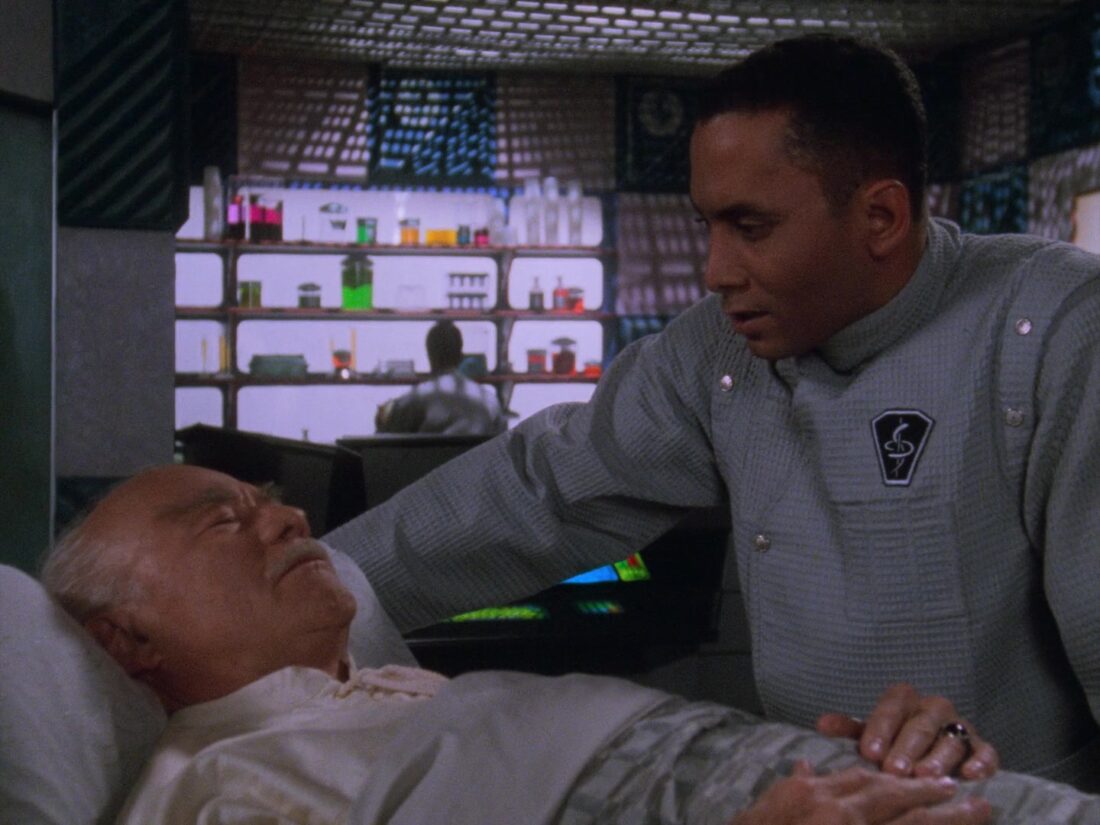
But the emperor never makes it to the reception, as he collapses while en route. He’s taken to medlab, where it’s clear that he’s dying, and he can’t really be moved. Franklin is given a message to take to G’Kar: an apology. G’Kar—who is initially royally pissed off that he went to all the trouble of putting his affairs in order only to be denied the opportunity to actually commit the assassination—is gobsmacked by Franklin’s message. The emperor’s message is a sincere and regretful apology, and filled with a hope that relations can at last improve between their peoples.
Alas, Refa and Mollari have other ideas. Factions are already moving into place, and Refa says their people must make a big move to put them at the forefront of those jockeying for power. Mollari’s solution is to have Vir contact Morden and have him sic the Shadows on Quadrant 14.
G’Kar, overwhelmed by the emperor’s apology, buys Mollari a drink, having hope for the first time in a long time.
Then Quadrant 14 is attacked by Shadows. The Centauri military ships Mollari told Refa to send there arrive after the attack is over to clean up, and they find most of the civilians on the colony dead.
A person dressed in black has been following Garibaldi around. When Garibaldi makes him, he tosses him in a cell, unable to deal with him what with the extra security related to the emperor’s visit. Finally, however, Garibaldi agrees to see the person, who has a data crystal with a recorded message from Sinclair for him. While he is serving as Earth’s ambassador to Minbar, as everyone was told, he is also performing a second function: forming a group called the Rangers. The person who delivered the message is one of them, and he was sent to B5 with explicit instructions to only give that message to Garibaldi.
Sinclair asks Garibaldi to keep the Rangers a secret for now, but to also give them free rein on B5. He also says to keep close to Kosh and to watch out for Shadows. Which Garibaldi probably thought had a small S.
G’Kar receives the report of the massacre at Quadrant 14. The Kha’Ri are at a loss to explain how the Centauri managed it, but it did happen. Enraged, G’Kar makes a beeline for Mollari’s quarters, tossing security guards aside like twigs en route. He’s eventually stopped by Sheridan and a half-dozen armed guards, the captain convincing him that strangling Mollari to death won’t accomplish anything. G’Kar returns to his quarters, broken and weeping.
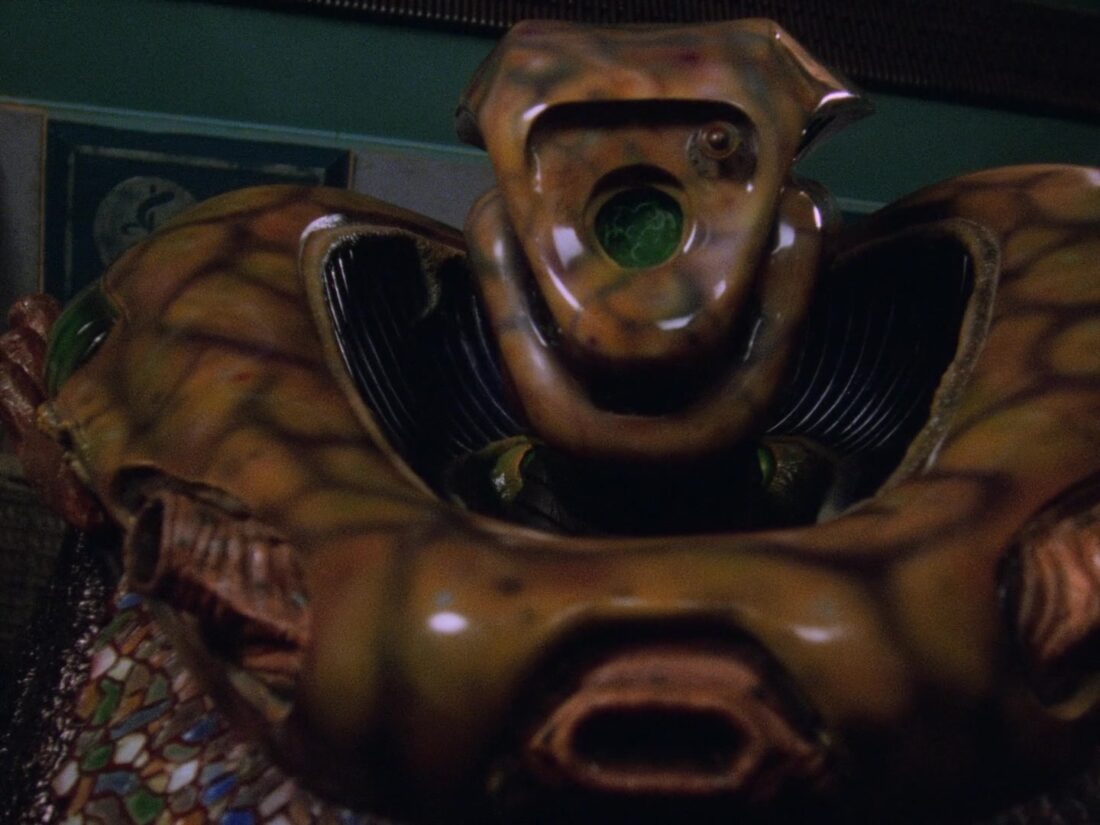
The emperor’s condition is worsening. He weakly says that he wishes he could’ve seen Montana. Er, that is, that he could see a Vorlon. And then, sure enough, Kosh shows up.
Sheridan calls a council meeting, and goes in person to G’Kar’s quarters to request that he attend. The ambassador, subdued, agrees to do so, and thanks Sheridan for stopping him earlier.
Refa and Mollari visit the emperor in medlab, gleefully telling him of the successful attack on Quadrant 14. The emperor whispers his final words to Mollari: that he and Refa are both damned. Mollari, however, lies to everyone by saying that the emperor’s final words were, “Continue, take my people back to the stars!”
Armed with at least some of Sinclair’s information (Garibaldi says very little, mostly that he has intel that the Centauri have help, but doesn’t say where it’s from), Sheridan asks Mollari about the survivors of Quadrant 14, and says that Earth has authorized him to send observers there to interview the survivors and find out how, exactly, the Centauri were so easily able to conquer the colony. Unwilling to allow that, but also unwilling to go to war with Earth as well, Mollari agrees to let the survivors go free to return to Narn.
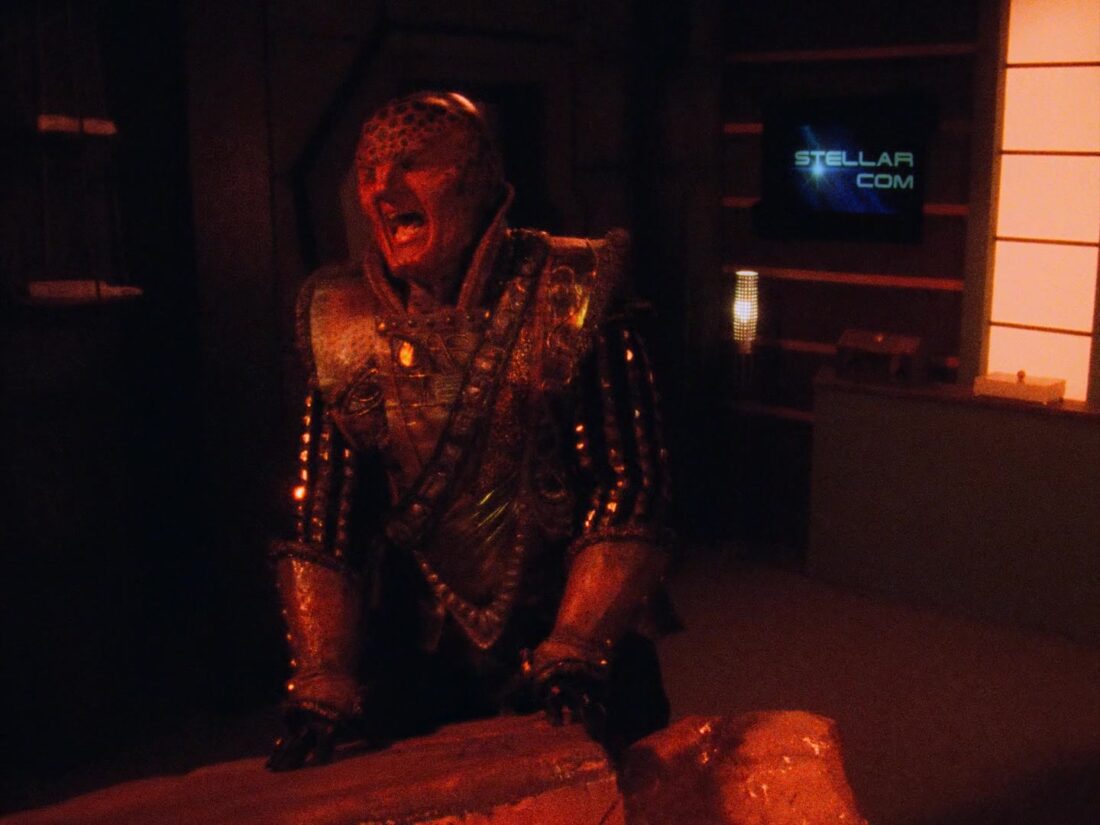
G’Kar then announces that the Narn—who refuse to ever live in subjugation again—have officially declared war on the Centauri Republic.
Refa tells Mollari that things are proceeding apace. The prime minister committed suicide upon hearing of the emperor’s death (this is a lie—he’s killed by Refa’s operatives), and Refa’s faction is consolidating power and neutralizing their enemies. The emperor’s nephew, who is one of Refa’s people, is now on the throne.
Garibaldi thanks the Ranger for the information, and asks if anyone else on the station knows about what’s going on. The Ranger says there is one other person.
Cut to Delenn, who also has a message from Sinclair…
Nothing’s the same anymore. While Sinclair is indeed serving as Earth’s ambassador to Minbar, he is also now in charge of the Rangers, though Earth doesn’t know that…
Get the hell out of our galaxy! Sheridan gets to share a heart-to-heart with the emperor and also twice has to talk G’Kar out of doing something stupid.
The household god of frustration. Garibaldi is put in an awkward position by Sinclair, but he manages to thread the needle of keeping the Rangers secret while making use of their intelligence.
If you value your lives, be somewhere else. Delenn is also a part of the Rangers, though the extent of her involvement is not yet clear.
In the glorious days of the Centauri Republic… Had the emperor lived, there might have been peace with the Narn, maybe even the beginnings of an alliance. But instead, he died, leaving Mollari and Refa to wreak havoc in his name instead.
Though it take a thousand years, we will be free. Quite a busy episode for G’Kar—he goes from righteous indignation about the emperor’s visit to planning the emperor’s assassination to being frustrated by the emperor’s collapse before he can be killed to being given hope by the emperor’s words to being devastated by Mollari and Refa’s actions to being the spokesperson for a people now at war.
We live for the one, we die for the one. We’re introduced to the Rangers. All we know about them thus far is that they’re a small but potent army made up of humans and Minbari, they’re mostly just gathering intelligence at the moment, they’re headquartered on Minbar, and Sinclair is their leader.
The Shadowy Vorlons. The Shadows wipe out Quadrant 14 on Mollari’s behalf. Meanwhile, Kosh has all of two lines of dialogue, but they’re quite effective: The emperor asks how this will all end, and the Vorlon says, “In fire.” So that’s encouraging…
Looking ahead. Mollari has one of his prophetic dreams. He sees his hand reaching out from a star. He sees himself being crowned emperor looking the same age as he is now. He sees himself standing on a desert, watching Shadow vessels fly overhead. He sees himself several decades hence, sitting on the throne, and then himself and G’Kar strangling each other, the Narn with one eye missing.
The hand reaching out of a star is a dramatization of something Elric described to him in “The Geometry of Shadows.” His watching the Shadows overhead will come to fruition in “The Hour of the Wolf.” His foreseeing himself dying with his hands around G’Kar’s throat was first mentioned in “Midnight on the Firing Line,” and will be seen in full context in “War Without End, Part II.”
Welcome aboard. Michael O’Hare makes an unexpected appearance as Sinclair, not billed until the closing credits to keep his return a surprise. He’ll be back in the “War Without End” two-parter next season. Fredric Lehne plays the Ranger who delivers the message.
William Forward (Refa) and Jeff Conaway (Allan) officially becoming recurring regulars with their reappearances in this episode, the former returning from “The Geometry of Shadows,” the latter from “A Spider in the Web.” Forward will be back in “Knives,” Conaway in “Acts of Sacrifice.” Ardwight Chamberlain is back from “Chrysalis” as the voice of Kosh, having only one devastating two-word line of dialogue; he’ll be back in “All Alone in the Night.”
But the big guests are the first—and last—appearances of the Centauri emperor and prime minister, played, respectively, by two greats: Turhan Bey and Malachi Throne.
Trivial matters. This episode officially starts a new Narn-Centauri war. In addition, it introduces the Rangers, who will become quite important as the franchise progresses.
The emperor and prime minister are not named in this episode; however, when they are discussed in “Knives” later this season, they are referred to as Emperor Turhan and Prime Minister Malachi, thus giving both characters the same family names as the given names of the actors playing them.
Mollari expresses concern about offending the royal court and losing his standing with them; it was established in “Soul Mates” that he had become a favorite of the court, so much so that the emperor granted him two divorces.
Sinclair was established as being reassigned to be ambassador to Minbar in “Points of Departure.”
The emperor’s nephew who takes the throne his uncle’s death will not be named or seen until the top of season four: Cartagia, who will be played by Wortham Krimmer.
While Ed Wasser does not appear, Mollari does have Vir contact Morden to have him set the Shadows on Quadrant 14.
This episode won the Hugo Award for Best Dramatic Presentation at the 1996 World Science Fiction convention in Anaheim (your humble rewatcher was in attendance for that). Two years earlier, “The Gathering” had been nominated, but lost to Jurassic Park. At the time, both television episodes and movies were eligible for the award; in 2003, the award was split into “short form” and “long form.” Until this win for B5, the only time a TV show had won, it was either an episode of Star Trek (original or Next Generation) or The Twilight Zone; otherwise, it had been all movies. B5 will receive two more nominations, for “Severed Dreams” and “Sleeping in Light,” with the former also winning.
And now for something really trivial: This is the first of two times Malachi Throne will appear as a high-ranking minister of a foreign government and then die in the same episode; it’ll happen again in “The Red Mass” on The West Wing, where he plays Israeli Foreign Minister Ben Yosef, whose plane is shot down.
The echoes of all of our conversations. “The past tempts us, the present confuses us, the future frightens us—and our lives slip away, moment by moment, lost in that vast, terrible in-between. But there is still time to seize that one last fragile moment, to choose something better.”
The emperor, waxing philosophic.
The name of the place is Babylon 5. “We are now at war.” In a lot of ways, B5 up to this point has been a big tease. There’ve been hints of things and threats of things and (ahem) signs and portents, but this is the first episode where it feels like shit is getting real.
For starters, this is how you show the devastating impact of the death of the leader of a large nation (as opposed to the bloodless death of Santiago in “Chrysalis”). Over the course of the episode, we get to know the emperor, get a feel for who he is and what he wants, and what he means to the Centauri Republic. The conflict between his desire to normalize relations with the Narn and to take responsibility for the Centauris’ crimes, and Mollari and Refa’s (and the Shadows’) desire for more power and control, is the heart of the episode, and the source of the awful tragedy. His death is meaningful in so many ways.
So many great performances in this, starting with Turhan Bey’s bravura turn as the emperor, who too late finally makes an actual choice of his own, one that fails to have the consequences he wanted it to have. William Forward’s Refa and Peter Jurasik’s Mollari calmly setting the Centauri Republic on an awful path, with Stephen Furst’s Vir trying and failing to be a conscience. Bruce Boxleitner’s Sheridan feels like the only grownup in this situation, trying to convince both the emperor and G’Kar to be reasonable and sensible, and not really succeeding with either. (Malachi Throne is also his usual fine self, though it feels like an actor of Throne’s calibre should have had a more substantial role than this.)
But the episode is absolutely owned by Andreas Katsulas. G’Kar goes on quite the roller coaster in this episode, and Katsulas nails every upward climb and every downward spiral: his anger at the emperor’s very presence, his resigned determination to kill him if it’s literally the last thing he ever does, his frustration at being denied the assassination attempt, his joy at the emperor’s apology, and his righteous fury at the destruction of Quadrant 14. Every single moment is real and pure and devastating, each emotion sharp as a knife, even through the craptons of latex and red contact lenses and such.
No scene, however, lands as nastily as G’Kar’s declaration of war in the council chambers, which is at once preternaturally calm and a seething volcano ready to erupt again at any minute.
On top of that, we get introduced to the Rangers, complete with surprise Michael O’Hare cameo. This is another thing that feels like it’s being kept secret for no compellingly good reason, especially given that a Ranger’s gonna be in the opening credits next season and one of the attempts at a spinoff will focus on the Rangers. Still, it’s a start, and it’s nice to see O’Hare again.
Next week: “GROPOS.”

“Meanwhile, Kosh has all of two lines of dialogue”
Mods, that should be words, not lines.
That CG model of the Centauri palace has not aged well.
Riffable moments
[as a Shadow ship pops out of hyperspace during the attack]
Hey there, guys! What did I miss?
G’Kar: I’m going to get you…
Line?
It’s not the sort of thing that most people would have though of in the 90s, but Garibaldi blithely popping that message crystal into the station’s systems is really stupid. Oh, plenty of people today would just a blindly stick a thumb drive given them by some rando into their computer, but we’ve seen that Garibaldi has some decent IT skills and a level of paranoia that ought to preclude him from doing so.
Turhan Bey will return in Season 5, in a different role obviously. That will be his final appearance in anything, though he lived for another 14 years. And I guess we can add the Emperor to the “vaguely Eastern European” column of Centauri accents.
It’s fascinating watching the development of Londo’s death dream over the course of the series. It becomes a little clearer each time we see it (or the events themselves), and even then the pieces don’t always mean what they seem to.
“It’s not the sort of thing that most people would have though of in the 90s, but Garibaldi blithely popping that message crystal into the station’s systems is really stupid.”
Haha. I work in IT and this is the first thing I thought when he did that. XD
“And I guess we can add the Emperor to the “vaguely Eastern European” column of Centauri accents.”
Central European, rather, since Bey was from Austria.
As any wag worth his salt would tell you – with a wink and a grin – Central Europe can look vaguely Eastern, if you stand far enough to the west and not too far north or south.
I’ll assume Garabaldi has, in addition to his real computer, an airgapped system that’s just for playing messages/casually accessing crystals he finds in the course of an investigation and does not connect to the station’s computer. In his line of work, that must come up a lot. What took me aback was that this highly confidential message does not appear to be password protected or encrypted in any way; had somebody killed the Ranger and taken the crystal off his person, Sinclair’s message could have ended up with anybody. I thought it was password protected but that must be a different message that comes in a later episode.
What’s more, in their context I’m not sure how good a video message even is as a way of communicating. Forget about deepfakes that hadn’t been IRL invented yet, within the context of B5 Changeling Nets are a real thing and apparently work pretty well– the Minbari who used one even briefly impersonated Sinclair. Sinclair doesn’t really say anything that only Sinclair would know. So how do you know the person in the message is actually Sinclair and not some guy in a Changeling Net? It ends up working out, but I don’t think JMS fully thought out the implications of what he established.
Data crystals never made sense since they can’t be labelled. Unless that aspect is included in the password protection.
THIS message does not have a password, but it begins with “Hello, old friend.” Which is later used as a password for the message from Sinclair to Garibaldi as he explains why he couldn’t allow Garibaldi to return to B4.
Maybe the “password” was Garibaldi’s DNA or something in his skin chemistry or microbiome, which the crystal sampled when he touched it.
Was going to suggest the same, biometrics feel more likely with Minbari tech.
I always felt that Babylon 5 should remembered as a great show if only for the reason that it had the character of G’Kar. Such an awesome character and journey.
My favorite story thread to follow is the contrasting journeys of G’Kar and Mollari as they weave through the rest of the storylines.
Each of their rising and falling arcs is essentially the inverse of the other’s, with all the foreshadowing, hubris, and fated outcome of Greek tragedy. I think JMS does a fine job using this as both a tool to present the larger themes, and also to illustrate personal impact to individual people through the eyes of these two specific characters. It’s the heart of the show.
And I agree with both Charles and strueb: none of it would work without the talent of the two actors who do such a good job fleshing out the characters for us.
…and Peter Jurasik. His Mollari is superb! (and he complimented me once on my “Mollari accent”.) Apart from each other – and certainly when together!
To me, this one is not just the episode where the plot actually gets started, it’s also the episode where G’Kar definitively ceases to be the 2-dimensional villain of the first season. In fact, this happens the moment he hears about Turhan’s apology.
It does show the side of G’Kar that explains a lot of his later growth. We know the Centauri did horrible things to Narn. Everyone admits it, although nobody seems that upset about it. As one podcast I listen to states they have “Centauri privilege”. We later find out how G’Kar was personally affected by the Centauri occupation. And yet, all the Emperor has to say is “we were wrong and I’m sorry” and G’Kar is willing to accept it and start some process of reconciliation. That is unusually generous. I can’t think of many people who would react that way instead of saying, or at least thinking “too little, too late”.
What the emperor did was the start of a process. Up until then, the Centauri weren’t even willing to admit to any wrong doing. Yes, it’s “just” an apology, but it’s an important first step. G’Ksr recognized that. The problem is that the emperor’s death prevented anybody from taking the many subsequent steps.
—Keith R.A. DeCandido
Sigh. That should be G’Kar, not G’Ksr. Stupid phone….
—Keith R.A. DeCandido
Every once in a while I start typing on the phone or ipad and between auto-carrot and predictive text it gets really bizarre.
An incredible episode. I can still remember all the beats, from the sincerity and regrets of Emperor Turhan to G’Kar’s pathos and the way he shakes his head while screaming “Not again!” just as it’s happening again.
I had caught a few episodes of the second season of B5 on TV before this, after missing the first season entirely – so I had no context at all for when we see Kosh briefly appear, who is not really introduced, and I remember thinking “Who/what is THAT?”
This episode is what really hooked me on B5.
So, it has come to this. This is why we needed “A Race through Dark Places” to buffer the episodes between this and “Soul Mates”. The comedy/bleak drama whiplash would have been more jarring.”The Coming of Shadows” is B5 at its absolute tragic best. That Hugo was rightfully earned.
The performances across this episode are so high-level that they even elevate the usual lesser ones around. Even Biggs as Franklin is hitting emotional beats with a lot more care than usual. That scene between him and G’Kar as he explains the Emperor’s wishes is one of my personal favorites across the show’s entire run. Beautifully directed by Greek.
That scene also speaks loudly about an essential aspect of war and how they don’t really end. In real life, treaties are made, compromises and such, while resentment and contempt linger. And yet, how many times has a person of power stepped up and just said “I’m sorry” to the other? Emperor Turhan made the personal sacrifice to do one thing of meaning in his life, and that was journeying in frail health to neutral territory and stand in front of a meaningful Narn like G’Kar and say those words. If only real life nations with bloody histories had Turnhans of their own willing to turn the page and make real amends. That scene, and Bey’s entire performance as the Emperor chokes me up to this day. A one-time guest character that absolutely made the best impression with a simple, yet rich and memorable arc of his own.
I often debate to myself whether Refa or Morden are the worst beings in the universe. This week it’s Refa’s turn, with Londo not too far behind. Not only sanctioning Londo’s carnage through the Shadows but also murdering Malachi. He didn’t just damn himself, as Turhan put it. He damned the Centauri as a whole. And Londo almost greedily asking Vir to contact Morden is one of those scenes where you see the bomb below the table about to go off and there is nothing you can do stop it (you don’t even need to show Morden himself to convey the gravity of the situation). Terrifying to watch every single time.
And Katsulas takes G’Kar through the worst the character’s ever been since the occupation. A tour de force performance so powerful and yet so nuanced that it ranks up there with the best in the business, whether it’s his desperate, almost terrified “NOT AGAIN!” to Sheridan or the official declaration of open war at the very end. This is not the confident scheming Narn from season 1. This is a person who’s about to lose his power, and everything he worked so hard to build. And billions will suffer (kudos also to Thornton and the VFX artists for the depiction of the Shadow attack on Quadrant 14 – the way the Narn fighters desperately scramble to catch up with the Shadow ships and are boxed-in by cloaked reinforcements and torn apart before the Shadow ships rip the planet apart with their massive lasers).
I don’t recall if they ever mention the Rangers by name in this episode. We obviously have one of them in uniform and Sinclair’s message. But if my memory is accurate, they’re only named in dialogue later in the season’s second to last episode, “The Long, Twilight, Struggle”. Still, it’s great that the script found the time to introduce that very important aspect of the show’s mythology in the middle of such a charged moment for the Narn and Centauri.
“I often debate to myself whether Refa or Morden are the worst beings in the universe.”
I suppose I’d give the edge to Refa, since Morden was basically just a willing instrument of the Shadows, carrying out their instructions without remorse, while Refa pursued his own ambitions and initiated the evil schemes.
Indeed. For Morden (yes; he was a “puppet”), what Londo asked him was “strictly business”. Had G’Kar, say. succumbed and wanted Morden to do that thing for the Narns, Morden would have just as easily had the Shadows dispatch their destruction on behalf of the Narns.
Didn’t matter much to him – whereas Refa is the ultimate scheming “nationalist” partisan.
Oh, Refa’s far, far worse.
Morden’s just the Mouth of Sauron to the Shadows’ Mordor.
But Refa’s the Centauri’s Franz von Papen and Mitch McConnell all-in-one.
A ruthless, selfish fascist enabling a greater evil to advance his own political and personal agendas (and whose actions will ultimately cause so much destruction and death in the years to come).
The canonical novel The Shadow Within is interesting in that it establishes Morden’s loyalty to the Shadows comes from them rescuing his family from a fate worse than death, after which he wholeheartedly supports them. But there is also something of an inference that he may have been altered or adjusted in some way, just not as severely as other servants.
Not quite as simple as that – he’d convinced himself that his family was suffering a fate worse than death. The Shadows give him visions – with practically no time to set up anything like reality – confirming this fate then ending this fate. Morden is loyal to them ever after, even later admitting he knows he was manipulated. There’s an implant in him but little more.
That’s what I usually tell myself. Plus, the later revelation that putting people inside Shadow ships can warp their minds beyond repair also lends credibility to the idea that Morden may not in fact be a willing participant at all.
And in an episode already packed with memorable lines, it also has one of my favorite Sheridan lines across the show’s entire run, perfectly delivered by Boxleitner:
SHERIDAN: 100 years of blood isn’t something you forget overnight!
This is the episode where I feel like the series finally hits all cylinders. There were some solid episodes before this, but “The Coming of Shadows” changes the game in many ways. And yet, I would argue that it only succeeds as much as it does because of all the time and preparation that came before it. We needed to get to know characters like G’Kar over time so that moments like this would have the necessary impact.
In every rewatch, this is the episode I anticipate, because the story really starts to move forward from here.
As this rewatch has progressed, I had started to wonder if, perhaps, too much time had passed. Maybe my tastes had changed too much. Maybe I just didn’t like the show as much as I used to – the flaws were becoming too hard to ignore.
But, as I watched this episode, I wasn’t thinking about the trivia or the history, or the evolution of TV storytelling. I was just back in the story, with the characters. And that was great!
There are nits to pick, but I love this episode. I love the way it calls back to, and inverts, Midnight on the Firing Line. I love the pathos and the sincerity of Turhan Bey’s performance. I love how Peter Jurasik is able to communicate, mostly without words, that Londo *knows* he’s on the wrong course; *knows* that he’s ashamed of what he’s doing, even while he does it anyway. And, perhaps most of all, I love the exhaustion that Andreas Katsulas loads onto the words “We are now at war.”
This is episode 31 in broadcast order (not counting The Gathering). It’s a lot of set-up to get to this point. No show today would be given the luxury of 31 episodes to find its feet. But I think this episode deserved its Hugo then, and it stands up pretty well now as far as I’m concerned.
The script to this episode, with some material cut from the final episode, is included in JMS’s The Complete Book of Scriptwriting, which I have. Maybe I’ll check it out for comparison sometime.
Definitely a hell of an episode, wrenching in how close the decent people come to averting a disaster that the indecent people have already made inevitable — a feeling that carries a particularly strong resonance at this moment in American history. G’Kar is a revelation, running the full gamut, and Katsulas knocks it out of the park.
It does seem a little sketchy that it was Dr. Franklin who delivered the emperor’s apology to G’Kar at second hand. Why would G’Kar believe him so readily? It would’ve made more sense if, at least, Franklin had recorded a video of the emperor’s words to bring to G’Kar.
I tend to find these big CGI sequences of Shadow ships causing mass destruction underwhelming, because they’re just digital objects seen at a distance, without any personal perspective beyond (in this case) a couple of brief glimpses of random fighter pilots. So the victims weren’t established as anything but statistics. I get that they didn’t have the budget to make up a bunch of Narn-colonist extras and show their terror as they were bombarded, but maybe instead of a fighter pilot, they could’ve shown the commander or a crewmember of that orbital base listening to the screams and pleas of the victims.
To lighten the mood a bit: It struck me while I was watching this that the orbits around Narn eyes are shaped kind of like butterfly wings. Something for the “can’t unsee it” list.
I always got the impression that Franklin’s relaying the Emperor’s message was a pretense to get G’kar to meet with him in person (which happens off screen, unfortunately).
Regarding Franklin, the way I see it, he had gained an appreciation and respect from other alien races by this point (the events in “Believers” being the exception). Remembering, of course, he’s a xenobiologist who refused to turn in his detailed info about Minbari biology to Earth officials during the war, which he told Delenn last season. Which is why people like Londo and G’Kar have ample reason to trust Franklin, much like they trust Garibaldi whenever a security problem comes up. He’s an unbiased blue collar working-class physician only interested in the well-being of everyone, never actively taking political sides the way Sheridan and Ivanova often have to. Aliens come in to Medlab and he helps, just doing his job.
That’s all true, but even so, for something this big, something that goes so far against G’Kar’s preconceptions, you’d think it would take more than hearsay to convince him, no matter how unbiased the source. It just seems like a a structural problem in the writing not to have Turhan apologize to G’Kar face-to-face. Having it relayed through an intermediary reduces its potency.
But that’s part of the tragedy, Turhan’s tragedy: the one time in his life that ge chooses, and he seems to fail completely. He never gets to apologize directly to a Narn, and his death gets used as part of what drives the coming conflict.
In another way, this action still creates the possibility of a change which happens later, and sets a precedent. Importantly, the Emperor says an apology and admission of wrong is a step in a process of atonement. This wasn’t supposed to be “we apologize and that’s it,” but a step in a process.
Franklin has no reason to lie to G’kar, but as profound as that is the fact that the Centauri Emperor, likely on his deathbed, thought his highest priority was to tell the doctor to deliver a message to G’kar.
We’ll get to see a version of what we don’t get here, eventually. Not getting it is the point of the episode.
That’s all true, from Turhan’s side of the equation. I’m just saying I would’ve expected G’Kar to be more skeptical, to need more evidence before he accepted it. People aren’t easily convinced of things that contradict their preconceptions, even if they come from a trusted source.
Sinclair says that the Rangers are mostly human and some Minbari. I wonder if those humans have “Minbari souls,” whatever that means using whatever metric the Minbari have to quantify it. I also wonder how long they’ve been in training. They were probably already a functional unit when Sinclair transferred to Minbar. There are some structural elements we’re clearly not seeing or being told about.
From I remember each family of the warror caste was was supposed to send a few of there own to the rangers. As time went by the warror caste came to see the rangers as joke they fewer and fewer of them sent people. Thats why it filled with mostly humans. The few minbari that are part of the ranger are mostly regilous and worker caste. Valen was the one who founded ths rangers and made the aggrement with the warroir caste to send a few of warrors to the rangers.
I only relatively recently read “To Dream in the City of Sorrows,” the only B5 tie-in book that was deemed 100% canonical by JMS – and it’s about exactly this. Sinclair’s arrival on Minbar, being a fish out of water, being introduced to the Rangers, to Ulkesh (a.k.a. Kosh II), to Marcus. He takes the 1000-year-old institution of the Rangers, revitalizing it and growing it to be a large fighting force again. Suffice to say there was significant consternation among the Minbari when humans were admitted to the rangers, let alone for a human to rise to lead them as Anla’shok Na (Ranger One) and later Entil’Zha (The One).
The Shadow Within and the three trilogies published after the show ended, the Psi-Corps Trilogy (about Bester), Legions of Fire trilogy (about Londo as Emperor) and Passing of the Techno-Mage Trilogy (about Galen, Morden, Justin and a bit more), are all considered canonical as well.
Right. City of Sorrows is the only one of the original series of Dell tie-in novels to be retroactively considered fully canonical, with The Shadow Within being considered something like 90% canonical, if I recall. They were published during the run of the series, so JMS didn’t have time to supervise them closely enough to keep them canon-consistent, except for the one written by his wife. But the three Del Rey trilogies published after the series were all outlined and supervised by JMS and are thus all canonical. City and Shadow were both republished by Del Rey while the other Dell novels were not.
It was always “going to be canonical” JMS’ wife a the time, Kathryn Drennan wrote it. And I belive she wrote from his notes.
Well, yes, all the Dell novels were meant to be canonical at the time they were written. That was the intention that was publicized at the time. But in practice, it turned out that JMS didn’t have time to supervise them as directly as he hoped, since he was busy producing the actual show. Thus, nearly all of the Dell novels ended up being inconsistent with the show to a greater or lesser extent and were retroactively decanonized, with City of Sorrows and most of The Shadow Within being the only exceptions. I believe JMS said that most of the Dell novels have at least some “canon value” while not being strictly canonical, though I don’t know if he still holds to that.
This is a classic illustration of why tie-ins made during an ongoing series are hardly ever canonical — because it’s just too hard to coordinate two moving targets with each other. Usually the only canonical tie-ins are the ones produced after the series ends, like the Del Rey B5 trilogies, or the post-finale Buffy/Angel comics, because canon requires the show creators to control the creation themselves, and that can only happen once they’re no longer busy making the show.
Of course, even non-canonical tie-in novels are required to stay consistent with the series continuity as it exists at the time; any inconsistencies crop up retroactively, because the series ignores the tie-ins. That’s the other reason the only canonical tie-ins are usually post-series; even supposedly canonical tie-ins tend to get contradicted by new canon (e.g. Star Wars: The Bad Batch presenting the death of Caleb Dume’s master in Order 66 differently than the “canonical” comic did, and Tales of the Jedi retelling a scene from the Ahsoka novel differently than the novel depicted it). But sometimes the inconsistencies crop up even before publication because there’s no time to change the books to reflect the changes in the show. That’s what happened with the Dell B5 novels, basically.
I still wish WB would re-publish the novels.
Drives me crazy there aren’t electronic copies available.
It’s not as simple as that. A publisher would have to buy the rights to reprint the books from Warner Bros. Speaking as someone who’s been in the publishing industry for 35 years, it’d be a very hard sell. Tie-in novels to a franchise that has been virtually inactive since 2002 isn’t exactly a recipe for brisk sales……
—Keith R.A. DeCandido
Powerful episode. There are a lot of wonderful character/acting moments in this, but Andreas Katsulas continues to impress.
Bobby
I do enjoy Vir’s tiny moment of integrity when he stares down Refa, forcing Refa to set his own glass down on a table.
Vir’s walking a fine line, and it’s only getting harder to do.
Not directly related to this episode, but it always irritated me that the Centauri “Republic” was ruled by an Emperor, when not having an Emperor is almost the definition of a Republic. Especially since we’re hearing this in English, where the word has a specific meaning
I suppose options are
(1) JMS didn’t really worry about the definition and just thought “republic” sounded cool and old-fashioned and maybe roman-ish
(2) Like the Roman Empire, the Centauri were once a pure republic and kept calling themselves by the Centauri word for “Republic” after the Emperors took over, and humans just go with what they call themselves because we’re polite
(3) The Centauri word was mistranslated and everyone is too busy to fix it
Would have been a nice touch if eg G’Kar or Garibaldi insisted on calling them the Centauri Empire as a point of pedantry, though.
According to some of the tie-in material, the original civilisation was called the Centauri Empire, but the noble houses wanted more accountability, so the Emperor created the Centaurum (the Centauri Senate) as essentially a way of sharing the blame/accountability for the genocide of the Xon. The Emperor was still in charge but he now liked to call himself “first among equals”, and the Centaurum was deemed to be the elected (with a big asterisk) representative body of the Centauri people, so they changed the name. On paper the Emperor “downgraded” from an absolute ruler to something more like a Roman dictator. Of course, the reality of the situation varied immensely from emperor to emperor.
Cartagia is named for the first time n Knives later this season as well.
For my money, the best episode of the entire show. Severed Dreams seems to by its main competition but that I feel requires a lot more context, being Part 3 of a 3-parter (effectively) and building on masses of continuity. This one also has a lot of callbacks (especially to Midnight on the Firing Line) but I think it stands alone a lot better, and it is pure Shakespearean tragedy.
Running through my own immense trivia archive for this episode:
This episode takes place in April 2259 according to the DVD special features.According to JMS, the Emperor’s vision of his own death (that most Centauri share) had a Vorlon present, hence his fascination with them.This episode features a rather universe-breaking idea, that telepathic signals can travel instantly FTL without the need for expensive tachyon relays. JMS seemed to realise this immediately after this episode aired and the four Centauri telepath thing is never mentioned again.This episode introduces almost the entire Centauri navy, including the Vorchan-class attack cruiser (the smallest ship we’ve seen so far capable of solo jumps), the Sentri-class fighter and the Primus-class battlecruiser, although the one we see in this episode is a special version adapted for the Emperor’s use. Cheesily, the Centauri shuttle design is the Earthforce design turned purple with a capital of flanges attached to it, but this is a CGI heavy episode, so far enough.This episode shows the computer dictating G’Kar’s last testament from left to right, but other episodes show Narns writing from right to left.Originally the events of this episode were split between several: the Shadow attack and Narn declaration of war would have happened in The Very Long Night of Susan Ivanova, the death of the Emperor would have happened in Rites of Passage and Sinclair’s message to Garibaldi (filmed earlier in the season when O’Hare was in town) would have been in A Race Through Dark Places. Season 2 was running too many episodes too long though, so Very Long Night and Rites of Passage were merged into this episode and the insert moved out of Race.
In regards to the Emperor’s telepaths, it gets stated in the canonicaloid Legions of Fire trilogy that Cartagia didn’t like telepaths and had them executed. And of course the Drakh wouldn’t care for Londo having any in his retinue.
“Cheesily, the Centauri shuttle design is the Earthforce design turned purple with a capital of flanges attached to it”
I thought it looked very much the same, but I wasn’t sure. Maybe the Centauri subcontracted the company that built the Earthforce shuttles to build some for them too.
“This episode shows the computer dictating G’Kar’s last testament from left to right, but other episodes show Narns writing from right to left.”
Japanese is traditionally written top to bottom and right to left, but it’s displayed on computer screens horizontally and left to right, since the software is designed to display that way for writing in Western languages (and Japanese TV shows and movies often display screen text left-to-right as well). Maybe it’s a similar thing where G’Kar’s computer follows the prevailing display format of the station computers.
It’s possible the Emperor – or his managers – deliberately chose an Earth type ship as a symbolic gesture of trust (“We’re not just guests, we’re friends: we even like your shuttles!”).
I just don’t think it should be all that important to justify why one nation might use another nation’s ships. Sci-fi’s tendency to require every species or society to have a completely separate ship design language is a convenient visual shorthand to tell the audience who’s who, but it’s rather unrealistic if you think about it. In real life, it’s quite common for one country to use ships built or owned by a different country. Countries buy or hire vessels from each other, or they trade them in treaty negotiations, or they capture enemy prize ships and convert them into assets for their own side, or whatever. There are a ton of reasons why the Centauri might have Earth-built ships in their service, or vice-versa. Far from being a mistake or an anomaly that needs special justification, it really should be a more commonplace thing. Even if Centauri consider Earth capital ships too primitive compared to their own, it makes sense that they might have bought or traded for a number of shuttles, at least.
Could be that both are using adapted human technology to ensure compatibility with Babylon 5 hardware and software.
More (also, why have bullet point options if they don’t show up in the options)?
JMS sent a memo around after this episode was filmed saying this was the level of quality they should strive to attain every single week. Peter Jurasik replied with a note saying fair enough, but they needed the same quality of script every week, something he later admitted was only “half-joking.”
Jurasik said this was the first episode he felt it “hard” to keep up with Katsulas.
There was an additional line of dialogue cut after Londo’s “For once, we have something in common.” He pauses then says, “I am an old man, what is lost by trying, as the humans say, who dares wins.” Vir replies “Who dares sometimes gets his head cut off and stuck on a pike.” The elimination of this line allowed JMS to reuse it in In the Shadow of Z’ha’dum.
The scene with Londo looking at the Shadow ships was shot in the studio car park and is one of only two location shots in the entire show (the other being in The Hour of the Wolf and basically reprising this exact scene).
This episode blew its budget, so to bring it back under control JMS omitted hiring Ed Wasser for the episode.
This episode, and the whole show, won a “Shadow Hugo Award” from Sci-Fi.com, to be presented by the SFFWA. JMS had resigned from the SFFWA over a battle over the refusal to reinstate the Dramatic Nebula Award (an early 1990s online argument where JMS had a bitter argument with George RR Martin, which JMS lost). JMS said he wouldn’t go into the SFFWA suite if he was “dying of lung cancer and they were giving out free chemotherapy at the door.”
Turhan Bey originally auditioned for Elric in Geometry of Shadows but JMS thought he was “too nice” and held him back for the Emperor.
To the mods, ” what he means to the Centaur Republic” c should be the Centauri Republic. they aren’t half horse after all
You’re quite right, they’re all peacocks!
And their wives would say that they’re all pea and no <CENSORED>.
A bit of trivia that avoids spoilers: Very much later in the show, the Hugo won by this episode shows up as a decoration in someone’s office. If you know what a Hugo looks like, you can’t miss it.
I quite liked this episode, though I admit to being a little bit confused by the Emperor being portrayed as a man of peace, because I thought Mollari having arranged the destruction of a Narn outpost in Quadrant 37 is what improved his standing enough for the Emperor to grant him his divorces. He did say something about not being allowed to make his own choices, so perhaps that wasn’t his idea.
Anyway, I really enjoyed G’Kar in this one. I’m glad that, in between some of his more powerful scenes, Andreas Katsulas got the chance to be a bit goofy once again. While I highly approve of the character being taken more seriously this season, it’s nice to see that the show can still have fun with him. It was also nice to see Sinclair again.
This is the first time I got a really good look at the Shadows’ ships, and I don’t think I like them, which is weird because the ship designs have been one of my favorite things about this show so far.
It has previously been established that the emperor has had virtually no direct involvement in governing, much of which is due to his ill health. Likely the flunkies who reported to him on Londo’s accomplishments edited out the more problematic details.
Finally, an almost perfect B5 episode. I liked G’Kar from the beginning, now even more. :)