







“The Corps is Mother, the Corps is Father”
Written by J. Michael Staczynski
Directed by Stephen Furst
Season 5, Episode 13
Production episode 514
Original air date: April 15, 1998
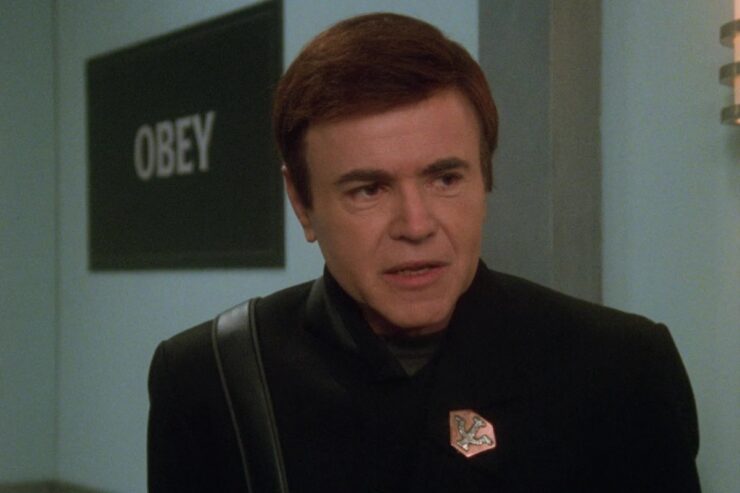
It was the dawn of the third age… At Psi Corps HQ (which has apparently been reconstructed—or moved to a new location—since it was bombed), Bester meets with Director Drake, who introduces him to two new recruits, Lauren Ashley and Chen Hikaru, who are both big fans of Bester. Drake assigns them to shadow Bester.
A telepath named Jonathan Harris is muttering to himself while reading a brochure for B5. He gets up and departs, leaving the corpse of his roommate behind.
Bester is showing his two ducklings around, including observing a training exercise in blocking a psionic attack and then to an inspirational video/propaganda piece recorded by a happy telepath. The latter is interrupted by the body of Harris’ victim being found. Bester is summoned to the scene, as Harris was a student of his.
Ashley stops by Bester’s quarters that night: she’s traumatized by seeing her first dead body, and asks Bester if it gets easier. He says it gets easier when it’s mundanes, but never when it’s fellow telepaths. Ashley also makes a pass, but Bester politely declines.
Drake then shows up and gleefully informs Bester that they have intel that Harris has gone to Bester’s favorite place: Babylon 5. In addition, Drake informs Bester that Harris was trained in attack probes, a “mind shredder.”
Bester, Chen, and Ashley head to B5, as they don’t trust Earth Alliance forces to handle this.
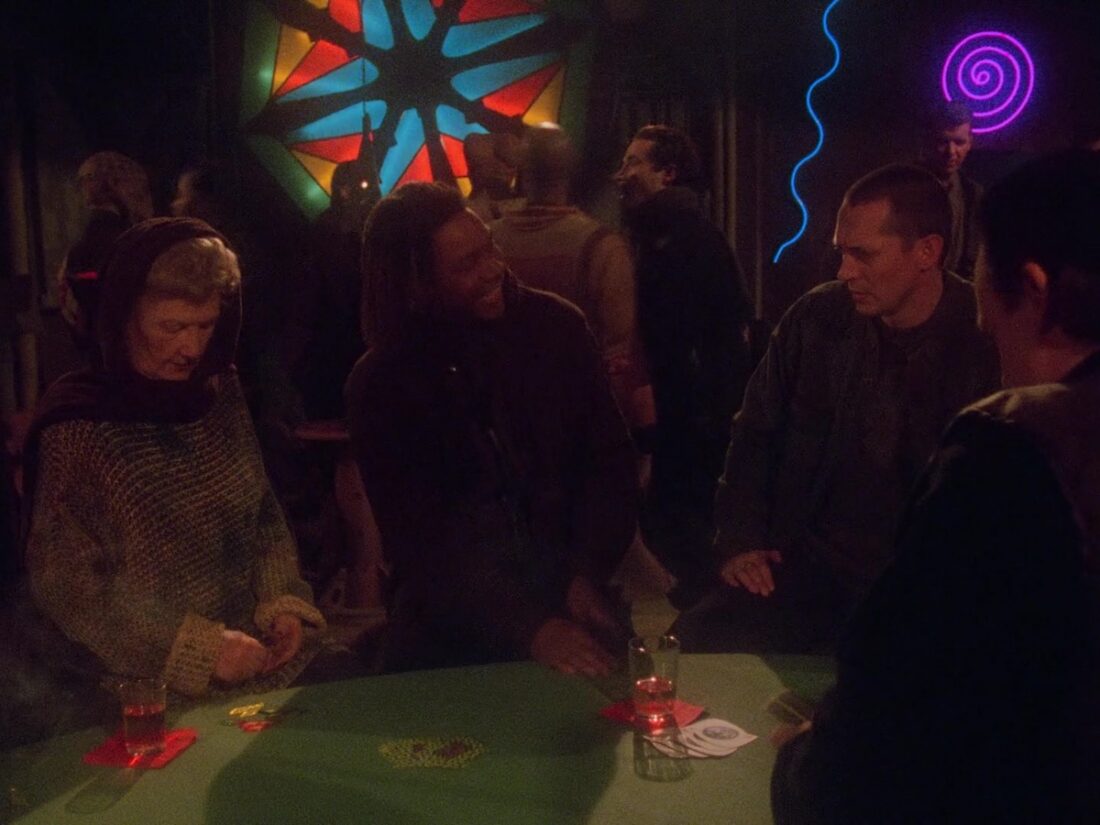
On B5, Harris joins a card game in downbelow. He has no knowledge of the rules, but he wins in pretty short order. After departing the table, one of the losers approaches him and accuses him of cheating (which he did; using telepathy to win games is illegal). Harris’ personality changes and he uses his mind-shredding abilities to kill the guy. This is witnessed by a man named Bryce.
Bester learns that a Drazi gave Harris a fake identicard. He also learns the location of Harris’ quarters from a surface mind scan. While Bester goes to report this to security, Chen decides to show initiative and go to the quarters in question—where he finds a dead body.
Allan isn’t thrilled to see that Bester’s arrival heralds corpses on the station, but Bester tartly points out that the body has been dead for two days, so he was killed before they arrived. Franklin’s autopsy indicates a manner of death that had to have been caused by a telepath, specifically a P12. However, Harris is only a P10, and a P10 can’t do that. Franklin suggests that maybe he was misdiagnosed as a P10, and Bester arrogantly explains that that doesn’t happen.
There’s another body, and this one happened after Bester’s arrival: the other gambler. Telepaths aren’t allowed to gamble, or kill people, so the situation is really bad. Bester tells Ashley to keep an eye on security’s examination of the items in Harris’ quarters, while he has Chen go to downbelow to find other places where Harris might be gambling. Bester assumes (correctly, as it happens) that Harris is trying to get enough money to get passage off the station and far away from Earth and the Corps.
Chen sees Harris in downbelow, but before he can contact Bester to tell him, Bryce kills him. The Babcom terminal Chen was about to use recorded the killing, but all they can see of the killer is his hand, and his skin is lighter than Harris’ and also tattooed—which means there’s another killer on the station.
Security found handwritten notes in Harris’ quarters—written in more than one different style of handwriting—and also some recordings, in some of which he’s raving at his roommate and talking about Jonathan Harris in the third person.
Bester realizes to his shock that Harris must have what is these days referred to as Dissociative Identity Disorder. One of his personalities must be a P12, which explains the murder that a P10 couldn’t have accomplished.
They track Harris and Bryce and a firefight breaks out, but Bryce is subdued, and Harris kind of collapses on his own. Security releases both men to the Corps’ custody. In hyperspace, Bester allows Ashley the “honor” of shoving Bryce out the airlock, murdering him in cold blood. This is a rite of passage for new Psi Cops, spacing mundanes. Ashley continues to fangoober Bester as they head home.
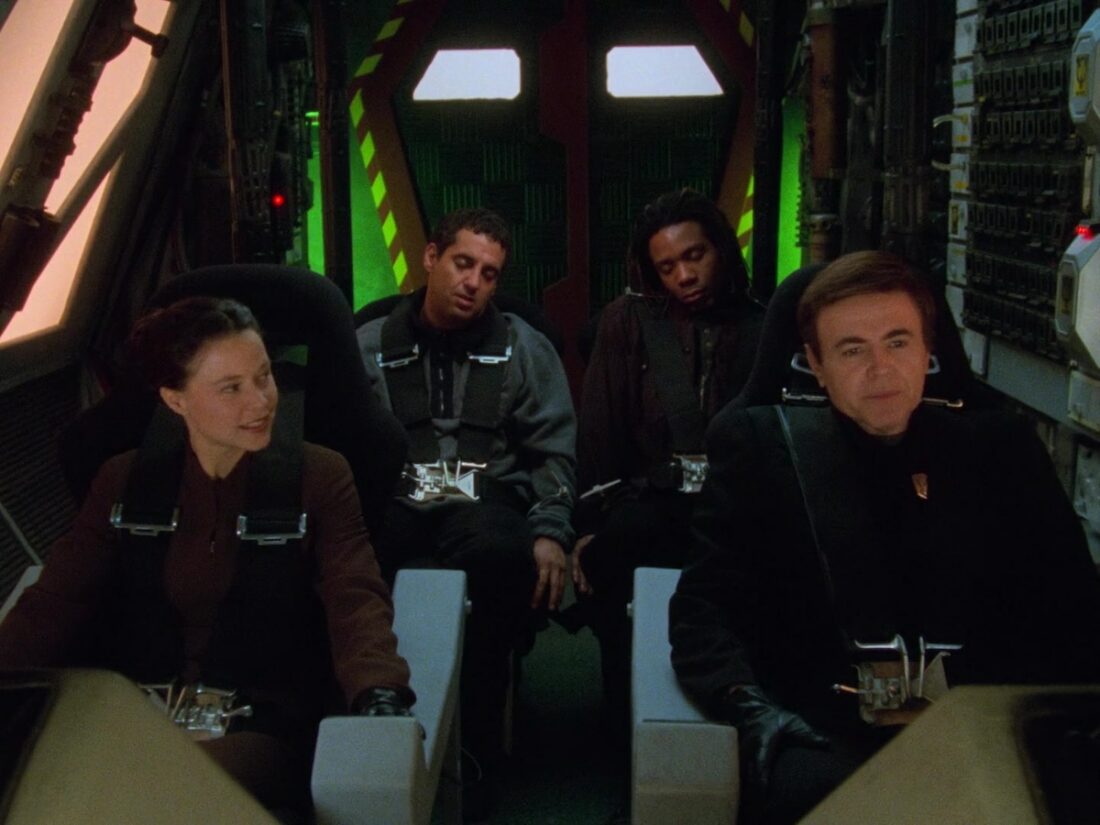
The Corps is mother, the Corps is father. Apparently, Psi Corps keeps a giant mothership in hyperspace that nobody knows about. It’s not really clear what the ship’s purpose is, since the smaller ships that dock with it have to be able to enter a jumpgate and travel through it to get to and from the mothership, but whatever.
No sex, please, we’re EarthForce. Ashley hits on Bester more than once, but Bester declines. Apparently his feelings for Carolyn are strong enough that he won’t cheat on her. (Though he did cheat on his wife with Carolyn.)
Welcome aboard. Back from “Phoenix Rising” is Walter Koenig, making his final on-screen appearance as Bester. (Koenig was also set to guest star in an episode of Crusade, but the series was cancelled before the episode in question was filmed.)
Dana Barron and Reggie Lee play Bester’s ducklings, Vince Riotta plays Bryce, and Dex Elliot Sanders plays Harris.
And this week’s Robert Knepper moment is the welcome appearance of the great character actor Mike Genovese as Drake. While he has had many roles over the years, to me, Genovese will always be Lieutenant Garfield on The Flash series from 1990.
Trivial matters. For the second time this season (after “Secrets of the Soul”), none of the five primary leads appear in the episode at all. The only opening-credits regulars who appear are from the “also starring” section of the opening credits: Richard Biggs and Jeff Conaway. This technically ties this episode with “Intersections in Real Time” for the one with the fewest opening-credits regulars, though in this case both those appearing have lines of dialogue, which Mira Furlan didn’t in the earlier episode.
This is the third and final B5 episode directed by Vir actor Stephen Furst. Amusingly, all three episodes—“The Illusion of Truth,” “The Deconstruction of Falling Stars,” and this one—have the theme of alternate perspectives from a normal episode of B5. He will go on to direct two episodes of Crusade.
Telepaths apparently can’t detect alternate personalities, which retroactively explains how Talia Winters’ embedded personality that came to the fore in “Divided Loyalties” went undetected by several different intense telepathic experiences she underwent (bonding with Ironheart in “Mind War,” being recorded by Abbut in “Deathwalker,” etc.).
Viewers may have thought that the character named Jonathan Harris was a tribute to the actor who played Dr. Smith in Lost in Space alongside Bill Mumy, but it was, in fact, the prize in a B5 fan club raffle held at the 1997 World Science Fiction Convention in San Antonio.
The echoes of all of our conversations.
“You’re an optimist. Thank you—I’d almost forgotten what one of your kind looked like”
—Bester to Franklin.
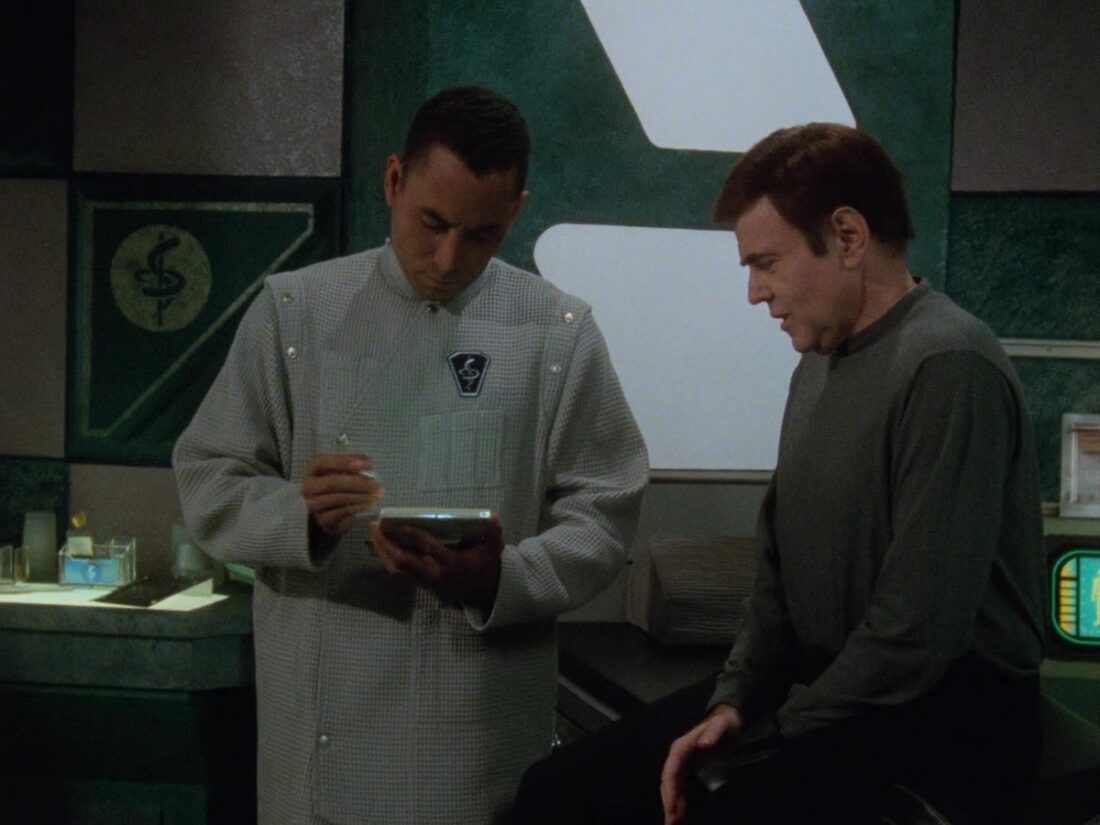
The name of the place is Babylon 5. “We don’t often see a sense of humor in Psi Corps.” After four-and-a-half years of being gleefully evil every time he showed up, Walter Koenig gets rewarded with a spotlight episode of his own. It’s always fun to get a different perspective in an episode, and when B5 does it, it generally works, and this episode does indeed generally work. The notion of a telepath with multiple personalities is an interesting one, though it’s pretty much just a plot device here. There’s a lot to explore that the episode doesn’t bother with, unfortunately—including nary a mention or indication that Psi Corps HQ was bombed just a couple of episodes ago…
Dex Elliott Sanders does a nice job with Harris’ multiple modes. Bester’s ducklings are not quite as successful. Dana Barron is adequate as a Bester groupie, but not much more than that. Her eagerness is a little too underplayed, and Koenig winds up acting her off the screen every time they’re together. Reggie Lee is even less adequate, but at least he has the good graces to be knocked off.
Though that points up the major problem with the episode. One of the things that we’ve been told about the Psi Corps from jump is that they care for their own, seen most recently in the conclusion to the Byron storyline. This entire episode is predicated on the Corps being the ones to take care of Harris rather than let EarthForce authorities or B5 security handle it. But then Chen is killed, and it barely even registers. There’s no outrage, no expressions of grief, no ramping up the hunt to take care of a mundane who dared kill a telepath. It’s just the next step in the mystery, a redshirt who’s killed but barely acknowledged after that. The way Barron plays Ashley, it feels like her only thoughts on the death of her colleague is that he’s out of the way so she can flirt more aggressively with Bester…
It’s also a missed opportunity to have Bester on the station and deny us any interactions between him and either Sheridan or Garibaldi.
Still, this is a nice little change-of-pace, showing how insular and awful the Corps is. Notably, Chen and Ashley’s demeanor is classic member-of-a-cult behavior, thus accomplishing in one episode what never came together in multiple episodes of Byron and his gaggle of rogue telepaths….
Next week: “Meditations on the Abyss.”

I was rather disappointed in this episode when it first aired for the reasons you bring up. It also signaled a disinterest in resolving the side plot of Garibaldi over-riding the block in his harming Bester, which seemed (for me) very much against what we know of Garibaldi’s personalty. The character was very tenacious.
In fact, the episode didn’t feel like it moved anything forward or wrapped anything up. It felt like, “Let’s give Bester an episode” which I’m very much in favor of, but also, “Let’s make it not have any impact on the long arc.” Which felt like a waste.
I remember hoping at the time that this might be some sort of precursor to trying out a psi-focused series, but no such luck. Instead we got Crusade, which did have a good psi character, but had no chance to grow an audience.
Thanks for these episode reviews–enjoying them all.
To me, this one feels like it’s mostly planting seeds for the Telepath War stuff we never got. Mostly that’s the mothership (and I think Bester mentioned others too) hiding in hyperspace. Having those pop out at the start of the war would have let B5 fans with good memories go, “Oh yeah, Bester mentioned those…”
I initially agreed with Keith about Dana Barron’s performance, but I’m not so sure. It’s possible that we’re seeing the character mirroring Bester’s somewhat flat affect. It would be an interesting choice for the actor.
I thought this worked pretty well, and Koenig’s Bester was certainly able to carry a whole episode as the “hero,” but it has a couple of dated aspects. It’s rather cavalier about things that would get a lecture from HR these days — Bester only turns down Lauren’s advance because he loves Carolyn, not because it’s inappropriate for a mentor to sleep with his student, and Lauren doesn’t bat an eye when Chen talks about breaking into the girls’ dorm (to do what???). That could’ve been meant to suggest something unsavory about Psi Corps values, which have been established in the past to include enforced, arranged marriages, but it seems more like just a reflection of the era’s general unconcern with sexual harassment.
Also, JMS continues to mangle Asian names. I could buy someone named “Chen Hikaru” if he were using Asian-style surname-first name order (as Keith seems to be interpreting it) and were of mixed Chinese/Japanese heritage (though I suspect JMS just didn’t know or care about the difference), but Drake and Bester seemed to be using “Chen” as his given name, as Bester addressed Ashley as “Lauren” and Drake addressed him as “Al.” (After all, they consider each other family, so they use familiar address.) While I find a couple of online sources claiming Chen can be a Chinese given name, it’s far more often a surname, while Hikaru is never a surname in Japanese as far as I know.
As for why the Psi Corps has big motherships in hyperspace, the clear implication is that they’re warships standing by to be used when the telepaths launch their war against the “mundanes.”
I don’t buy the idea that different DID personalities could have different psionic ratings. Maybe it wasn’t understood at the time, but I believe the modern understanding is that the distinct personalities in DID aren’t really complete, separate people, but just aspects of a single personality dissociated from each other (hence the current name for the condition). Some of them might not have access to knowledge or skills accessible to other parts, but I’d think something like psionic ability would be an innate, physical potential of the brain that could be objectively measured, so you could tell if a telepath were using less than the full potential he was capable of. I mean, I think that’s how it’s always been portrayed, that a psionic rating measures an individual’s maximum potential even if they haven’t learned to use it yet. So the twist here was hard for me to believe.
Also, why did the Psi Cops even have the authority to take Bryce off the station? I could see them having authority over one of their own members, but a “mundane” criminal committing crimes aboard B5 should be subject to B5’s and the Alliance’s justice system. So that part was unbelievable, contrived to set up the (very predictable) shock ending.
I suspect (and someone with the script book might be able to confirm) that as a Bester-focused episode, JMS used the name Hikaru as a nod to Sulu and Chekov. Still absolutely a butchering of Asian names, though.
The way I read it, at least the first time I saw the episode, was that Lauren came on to Bester like a student with a crush, and Bester let her down gently instead of directly replying that it would be inappropriate. I think the intent here was for the audience to think exactly that, and then her spacing the guy at the end was the twist to make us realize that, no, they really are all horrible people, not just Bester. That said, the show doesn’t have a great track record with regards to sexual harassment (hello, Garibaldi in the elevator) so maybe not.
I didn’t see anything in the script book commentary for the episode about JMS’ intentions for using Hikaru. I also looked at the Lurker’s Guide, out of curiosity, and there was no indication there either.
I’m not surprised, because if JMS had actually put any real thought into naming Asian characters, he presumably would’ve made the effort to get it right instead of just tossing in these not-quite-right names over and over. A lot of the names he used sound like they’re based on misremembering names he’d heard somewhere, like “Hidoshi” instead of Hideyoshi or Hiroshi, say.
I recognize the pattern because I did it myself when I was younger — just coming up with ethnic names that seemed to sound appropriately ethnic, without doing the research to double-check my assumptions. And of course writers for other shows like Star Trek have done it, like Gene Roddenberry naming Sulu after a sea that he mistakenly believed abutted multiple Asian countries (it’s actually just two) since he thought it would make him appropriately “pan-Asian.” The character of Leila Kalomi in “This Side of Paradise” was initially meant as a love interest for Sulu and was given a name meant to sound Polynesian, except that “Leila” is actually a Persian or Arabic name and the writer was probably thinking of “Leilani,” while “Kalomi” seems to be pure fabrication. Conversely, I’ve seen writers of Japanese shows come up with silly names for American characters, like “Mac Windy.”
I see Lauren the same way. Given the way the Corps socializes recruits, I have no problem seeing her as both a student with a crush and as a casual mundane-killer. She’s internalized that mundanes are inferior, and aren’t worthy of any more heartache than killing an annoying pest. The contradiction is in our heads only, not hers.
One of the things I actually found intriguing about Byron was that, for all his peaceful talk and supposedly enlightened views, he retained that underlying disdain for mundanes. One could argue that it factored into his bad decisions in seeking a homeland for his followers; it never occurred to him that he could approach the mundanes in a reasonable way and work towards his goals.
Right. History is full of people who are kind and compassionate toward those they consider part of their own community, yet uncaring and brutal toward those they see as outsiders or threats. (Cf. the infamous photo of Nazi death camp employees having a cheery outing together.) And convincing people they need to see outsiders as dangerous inferiors to be contained or eliminated has always been an effective way to manipulate them and win their allegiance.
Possibly, but JMS naming him after Sulu would just underline his failure to do any serious research into Asian names, just going off his own very limited knowledge base rather than doing the homework to expand and error-check his knowledge. (Kind of like how nearly every South Asian character in Gene Roddenberry’s productions was named Singh.)
Incidentally, Reggie Lee’s appearance here is kind of a minor “Robert Knepper moment” for me, since I remember him from his later supporting role as Sgt. Wu in Grimm, where he was kind of a breakout cast member. He was also in the 2009 Star Trek movie as the administrator of the Kobayashi Maru simulation.
This time around all of the messaging in Psi Corps HQ felt really over the top to me. At least Byron’s groupies seemed drawn to him because he (to them, at least) had some sort of charisma in addition to his aspirations, but why anyone would want to live/work in a place with such unsubtle and openly fascist messaging is beyond me. “Welcome to Evil Corps, Inc.!”
I wonder whether it was intentional on JMS’s part that Bester makes such noise about telepaths being a family, but then lets Chen’s murder pass without comment. A way of pointing out Bester’s hypocrisy.
I kind of liked this ending to the main credits sequence, with the B5 logo on the back of the station, more than the standard ending with JMS’s name seemingly emblazoned on the station.
We see plenty of people readily aligning themselves with openly fascist messaging all around us in the United States right now. If fascist messaging didn’t work, it wouldn’t be so damn dangerous.
The thing that annoys me about the signs in the Psi Corps HQ is not how blatant they are, but how cheap they look. Effective propaganda usually relies on using aesthetic and emotional cues to bypass rational thought. These signs give me the emotional impact of a “please clean up after yourself” sign in a lunchroom.
Granted. I guess I just remain optimistic or naive enough to think that, especially in the far future, people would be a bit more concerned about aligning themselves with such a blatantly Orwellian organization.
That’s what people probably thought in the 1950s, that the world had learned from WWII and would never be so foolish as to fall for fascism again. But generational knowledge is often forgotten by later generations, so the same patterns repeat over and over.
Yeah…yeah… :|
Plus Telepaths are demonized by society and forced into Psi Corps. Everything in Earth culture says Telepaths are wrong and must be either jailed, drugged into oblivion or join Psi Corps, the only institution that accepts and actually sees them as valuable. I totally understand why they would buy Bester’s rhetoric. What else do they have, They can believe their abilities make them inferior, needing control and worthless as people or they can believe their abilities make them superior. Telepaths are treated horribly by Earth and yes that includes Sheridan.
This just makes me wish JMS hadn’t so throughly made a mess of the telepath arc, because if you look past the various acting and production choices that were made (granted, for a TV show that’s an unreasonable request), a fair amount of Byron’s messaging (to be sure, not all of it!) seemed geared toward advocating for a different path.
Delenn herself thought the telepaths’ request for a homeworld wasn’t inherently unreasonable (though the way they went about asking was just about the dumbest approach they could have possibly taken), and when Byron himself wasn’t drinking the “telepaths are inherently superior” Kool-Aid he seemed open to the idea of trying to find a better way to try to co-exist.
Perhaps, but I think you’re being charitable concerning Byron’s mindset regarding mundanes. He proposes what he sees as totally reasonable and is gobsmacked that the mundanes in control don’t agree.
IMHO, of course…
Like I said, some of Byron’s messaging seemed decent, but far from all of it.
Frankly the whole “let’s steal secrets from the ambassadors and blackmail them in order to get a homeworld for ourselves” seemed almost out of character relative to the character we’d seen to that point. As if the knowledge of his origins radicalized him. Would have been a good time for him to listen to Lyta.
“As if the knowledge of his origins radicalized him.”
Well, yeah, that was pretty clearly the point.
Maybe it’s just my personality, or my difficulties caring about Byron as a character in general, or I’m just being dense, but I just don’t see why finding out the Vorlons are responsible for the creation of human (and other) telepaths should have such a profound effect on him.
The nearest analog I can readily come up with is that I’m gay, and my understanding is that that’s due to circumstances entirely beyond my control. If I suddenly, incontrovertibly, learned that it actually was a choice I’d made, or that “God” made me gay…I mean…so what? The circumstances wouldn’t change my life to this point, and it wouldn’t change who I am as a person.
I’m 100% sympathetic to the notion that the telepaths might deserve a world of their own after the persecution they’ve faced…but using a change in their understanding of their origins as justification to violate the minds of others who weren’t even responsible for it (as Lyta rightly points out), and then try to -coerce- a homeworld from the people they violated was just a deeply stupid thing to do.
The saddest irony of it all is that for all her claims of “remembering” Byron, Lyta will betray the principle Byron seemed to argue the most for (though when he scanned the ambassadors and then tried to blackmail them, he rather showed he wasn’t himself above violence in certain forms/circumstances at least): pacifism.
The difference from the gay analogy is that the Vorlons didn’t just make them telepathic, they made them telepathic so that non-telepaths could use them as tools or weapons. So it’s not a neutral difference, it’s an intentional exploitation.
So no, it didn’t change how Byron saw himself or other telepaths as people, but it completely changed how he saw non-telepaths — not just neutral bystanders to the telepaths’ evolutionary process, but the deliberate exploiters of his people, or at least their beneficiaries.
Mmm…unwitting beneficiaries and exploiters, sure, but it would have been nice if Mister High-Minded Long-Haired Telepath could have recognized that the vast majority of everyone had no idea that the Vorlons were responsible for human (and other) telepaths.
That doesn’t exonerate them from the uses to which they’ve put telepaths…and like I said, I do think it’s reasonable of them to request a planet of their own…but essentially, for lack of being able to punish the parties actually responsible for their situation, he’s punishing the middleman while simultaneously sabotaging his own agenda.
It’s just such a blatant case of “How did you think this was going to work out for your people, Byron?”
Of course the way Byron chose to act in response to his anger was irrational, but that’s separate from the question of why the revelation made him angry in the first place. What we feel and why is one thing, how we choose to act on those feelings is another.
It’s pretty clear from the hyperspace mothership appearance that this episode was meant to set up the Telepath War movie that never got made. Though I am surprised to learn he was going to appear on Crusade. Until reading his wiki passage just now, I’d always assumed Bester died during the Telepath War (that we know takes place between here and the upcoming Call to Arms TV movie).
While I find it awkward that the episode never bothers to bring up Byron, the HQ bombing or anything that happened over the past half season (which I do understand JMS wanting to move past), the episode still works reasonably well. It dials up the paranoia, and the plot is actually quite reminiscent of season 1’s “Mind War” to a degree. Bester even comes with a redshirt partner in tow.
In a way, it’s a nice moment with things coming full circle while still leaving plenty open. Doing Bester’s final outing from his POV is a deserved change of pace (and Furst as usual does a nice job with the tonal shifts). They even change the opening titles, giving us that bit of subliminal Corps propaganda.
That being said, the episode works best when Bester himself is the focus. Chen and Ashley, I could have done without. Chen is a classic one-note overachieving greedy apprentice trying to upstage his boss.
And the fact that no one seems to react at all to his death? To me at least that implies that the whole party line about the Corps taking care of their own was always BS. In five seasons, Bester has only shown love, respect care and affection for Carolyn. Everyone else has always been beneath him, fellow telepaths included.
And Ashley? Ugh. I see what JMS was going for. Her initial horror at seeing a dead person is meant for us to assume that she’s not going to make it and will quit instead, allowing for JMS to subvert that trope with her decision to gleefully ask Bester to be given the honor of tossing the mundane out the airlock. Not nearly enough work was done on the character to justify this shocking-yet-expected turn. Her mooning over Bester doesn’t help things either. And yeah, there is no way the Corps gets jurisdiction over mundanes without a fight – Zack really dropped the ball there.
I don’t have a problem with Garibaldi being MIA from this episode. In fact, it’s a wise choice. Bester would have been the first one to realize he was getting loaded (and without the need to smell his breath, obviously, being a telepath and all). Imagine him having that extra power of blackmail over him. It would have thrown a big wrench over the whole Garibaldi arc, directly affecting the upcoming S5 episodes.
I’m not sure I entirely agree that Bester and Ashley don’t react to Chen’s murder. They execute his killer in cold blood, and it’s obviously a ritualized moment between them. They just don’t talk about it. But perhaps they don’t need to because they both know what they intend. Bester is generally non-emotive and Ashley is trying to emulate him. So they don’t make a fuss, they just take care of business.
(I acknowledge that this reads in an interpretation for which there is little direct evidence. If this was the intention, both the script and Furst’s direction could have made it more obvious.)
“That being said, the episode works best when Bester himself is the focus. Chen and Ashley, I could have done without.”
Except they were necessary to show how the Corps sees Bester, to show us the reverse of the usual perspective and put Bester in a context where he’s a good guy, the hero of the story, a cheerful, joking Cool Boss admired by his peers and proteges and caring about his friends and community — both to contrast with how he’s usually been portrayed and to lull the audience before the final Shocking Twist.
Maybe the execution could’ve been better (true enough of the season in general), but I love the idea in principle. Most of us are different people in different contexts, and we can be seen very differently by the people we interact with in different settings. It’s nice to see a story that acknowledges that.
You might be interested to know that there is a trilogy of books devoted to the Psi Corps, and the third book covers the fate of Bester pretty well. Not many hints about the Telepath War, sadly…we got more in what little of Crusade there was…but it is a fairly good conclusion to the character.
I’m not sure how easy or hard it would be to find that book these days. Some of those later trilogies are hard to find for a reasonable price.
I knew there was a Psi Corps book trilogy, but I deliberately held off from reading the synopsis in order to avoid spoilers, intending to read them myself some day (which never happened). Now I know he lives to old age in prison. A fitting end, all things considered.
I was disappointed that the Bester trilogy didn’t actually depict the Telepath War. It seemed disingenuous for JMS to require the trilogy author to jump over it, since by that point it didn’t seem likely that he’d get to make more B5-universe content on TV, so he should’ve taken the opportunity to tell the story in the books. As it is, the Bester trilogy feels more like a tetralogy that’s missing its third installment.
Agreed. I’ve come to appreciate the books for what they are, but it’s pretty clear there’s a big chunk of the story missing.
I’ve come to the conclusion that JMS just never quite knew how to go about telling the story of the Telepath War correctly, so he kept working around the edges of it instead, to the satisfaction of practically no one.
As you noted, some of the better episodes of B5 are the “one-offs”, and this was one (certainly not perfect, but quite watchable). Koenig was, as usual, superb; his sycophants, not so much, Ashley was far TOO fan-girlish, but I’m not sure whethe it was the actress or her lines.
Seeds that were planted previously have begun to grow for the upcoming telepath war, but we never get to see it blow up.
I enjoyed “Crusade”; too bad it never was allowed to be what it was supposed to be, but – I think the telepath war would have been an outstanding series (and we’d get to know the denouement of the Lyta Alexander story) in its own right (write?).