





“The Parliament of Dreams”
Written by J. Michael Straczynski
Directed by Jim Johnston
Season 1, Episode 5
Production episode 108
Original air date: February 23, 1994
It was the dawn of the third age… It’s a festival of religions on B5. Each species on the station is encouraged to show off their primary religion to everyone else. In addition, both G’Kar and Delenn have new aides show up.
In Delenn’s case, Lennier is very honored to be tapped for this duty, as he was just a novitiate prior to this. He also refers to Delenn by her title of “Satai,” which she gently asks him not to continue to do, as her role on the Grey Council isn’t generally known, and she wants to keep it that way. She also urges him to stop looking down at the floor in her presence, as he’ll be constantly walking into things.
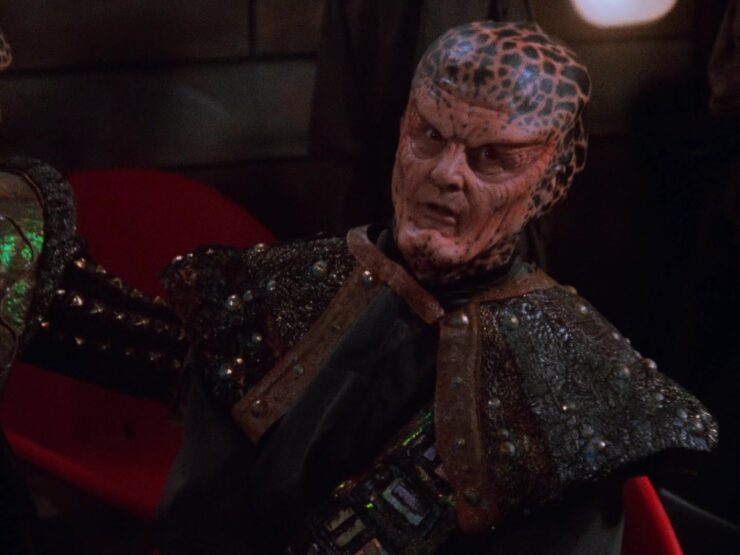
G’Kar, meantime, has bigger problems. One of his greatest rivals, Du’Rog, has sent him a message via a courier: he’s dying, and his final act before death is to put out an assassination contract on G’Kar in revenge for all the indignities G’Kar has visited upon him. Du’Rog threatens that the assassin could be anyone, including someone very close to him. It’s right after he finds this out that his new aide, Na’Toth, shows up.
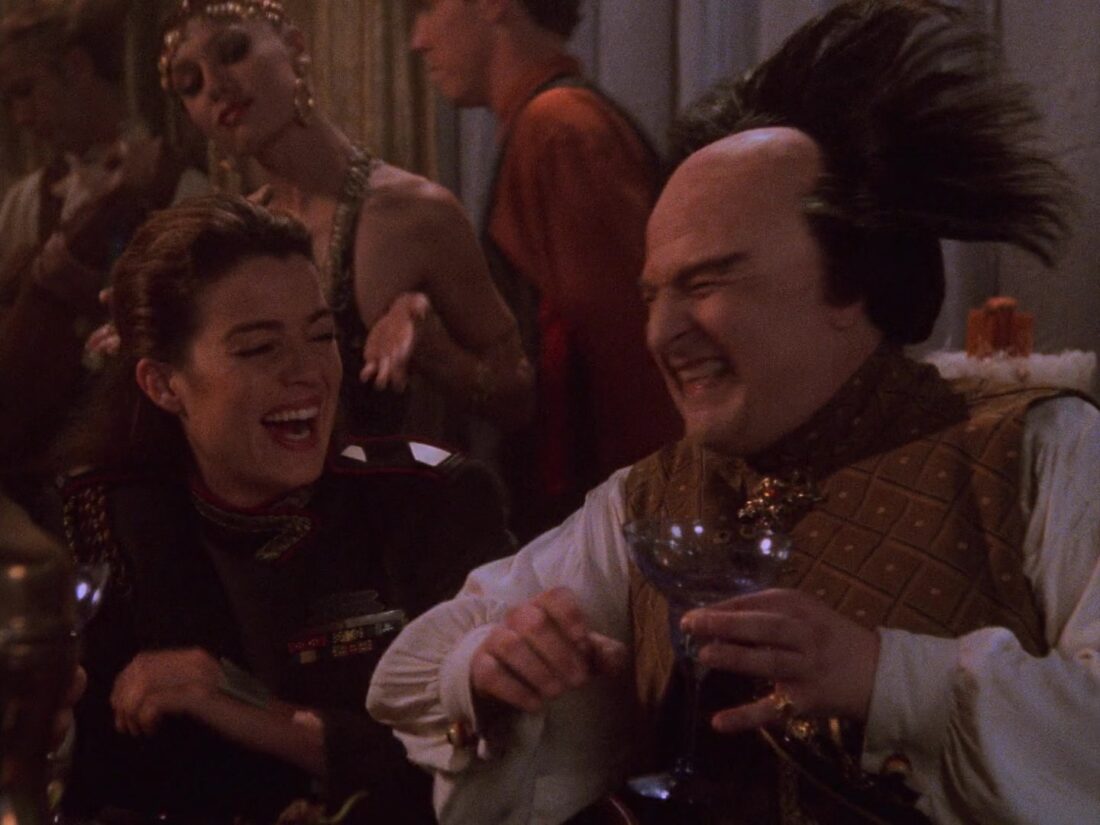
We see a popular Centauri religious rite: a drunken feast, celebrating the fact that the Centauri survived their war against the other species that shared their homeworld, the Xon. When Ivanova asks about the statues on the table, Mollari explains that they’re the Centauri gods, and he climbs up onto the table and explains who they each are before he, as Vir says, “becomes one with his inner self,” prompting Garibaldi to say that he’s passed out, and Vir says, without missing a beat, “That, too.”
Catherine Sakai has come on board the station. Garibaldi warns Sinclair about it. It turns out that Sinclair and Sakai have a past, and Sakai insists that she had no idea until she arrived that Sinclair was in charge of the station, or she never would have docked, as she had promised to stay away. However, Sinclair says there’s no need to keep that promise, as he and Sykes have broken up. He invites her to dinner at Fresh Air so they can catch up. That dinner is a mix of amusing and awkward, as they both have done this dance before, going back to when they first met at the Academy and their time serving together: they catch up, they ask about each others’ families, they fall into bed, something goes horribly wrong, and they go their separate ways. Both question whether they should go through all that again.
G’Kar decides to take Na’Toth into his confidence regarding the assassination. Na’Toth points out that, if there really was an assassin, they’d be from the Thenta Makur (the assassin’s guild), and they’d leave a black flower to warn him. G’Kar has seen no such thing. Na’Toth also wonders why G’Kar is taking her into his confidence, since she herself is an obvious suspect for being the assassin, what with her assignment and the fact that Du’Rog was a sponsor of Na’Toth’s father. G’Kar quotes a human saying that he thinks Earthers stole from the Narn: keep your friends close and your enemies closer.
The next morning, G’Kar awakens to a black flower in his bed. He charges Na’Toth with finding Tu’Pari, the courier who brought the message from Du’Rog, then he goes to N’Grath to hire a bodyguard. G’Kar can’t go to Garibaldi or report this officially, as his specific relationship with Du’Rog might come out. For his own part, G’Kar could give a damn if it does come out, but the revelations would compromise his position as Narn ambassador.
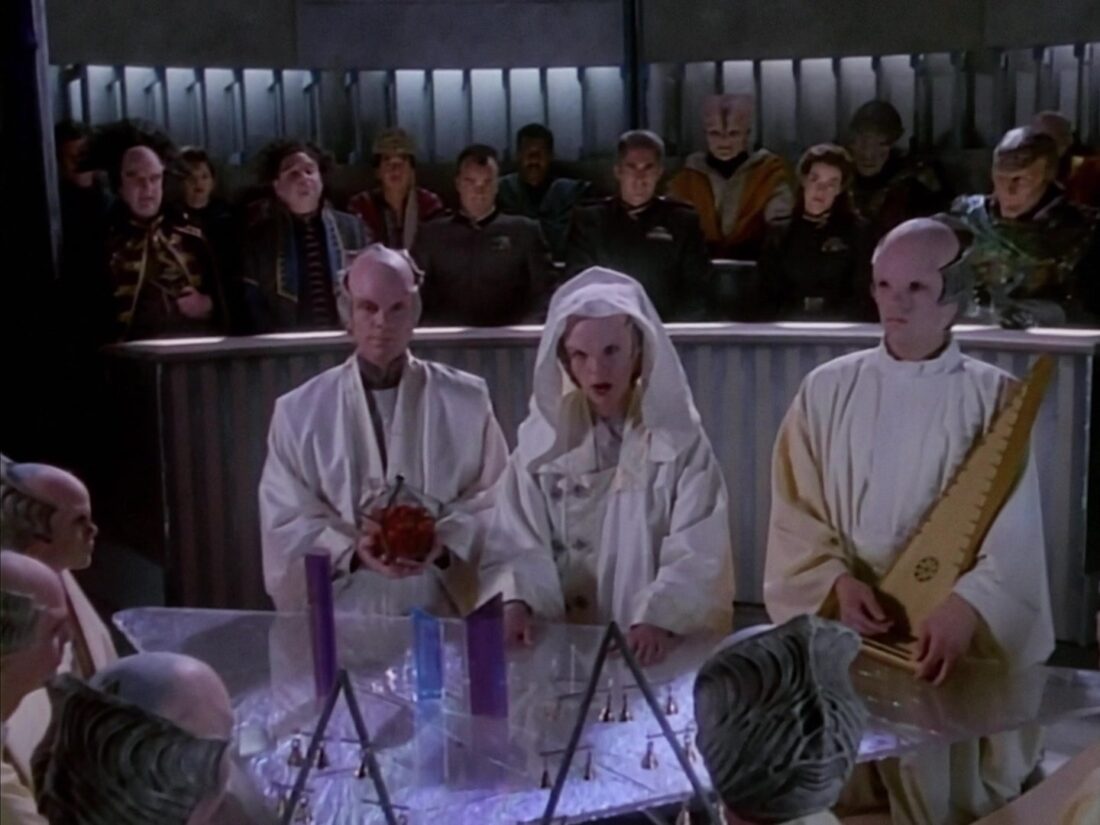
Delenn, Lennier, and some other Minbari perform a Rebirth Ceremony for the station’s VIPs. Part of the ceremony involves Delenn giving piece of fruit to each of the audience. (G’Kar, notably, surreptitiously switches his fruit with Ivanova’s, just in case.) It ends with Delenn giving Sinclair a significant look and saying, “And so it begins.” That’s not ominous at all…
G’Kar storms to his quarters, livid that the Riar bodyguard he’d hired from N’Grath never showed. He finds the Riar in his bedroom, dead, a black flower next to the corpse. Garibaldi and a security team arrive to investigate, with G’Kar playing dumb and claiming to have absolutely no clue why this total stranger of a Riar could possibly be in his room. When Garibaldi continues to question, G’Kar cites diplomatic immunity.
Sakai finds out that her latest survey mission turned up large quantities of Quantium 40, which is apparently very valuable, and entitles her to a massive-ass commission. Not wanting to celebrate this largesse alone, Sakai goes to Sinclair’s quarters with a basket of food and a bottle of wine. After a few false starts, they wind up in bed together.
Na’Toth finds Tu’Pari and brings him to G’Kar’s quarters. The ambassador immediately interrogates him, and Tu’Pari admits that the data crystal he delivered came from Na’Toth’s father. G’Kar contacts the Narn homeworld demanding that Na’Toth be recalled. The person on the other end apologizes for the lateness of the courier, as he met with a horrible accident while on his way to B5. At that point, the jig being up, Tu’Pari ambushes G’Kar. He takes G’Kar to a remote part of the station with a pain-giver attached to his person. If he gets too close to Tu’Pari, it goes off, plus the assassin has a control for it. He tortures G’Kar for a while, though the ambassador refuses to give Tu’Pari the satisfaction of a scream.
Then Na’Toth shows up, claiming to be Tu’Pari’s backup. To prove what she says, she kicks G’Kar repeatedly. Tu’Pari is still skeptical, a skepticism that is justified when G’Kar jumps him, Na’Toth’s kicks having destroyed the pain-giver. Na’Toth injects Tu’Pari with a sedative that keeps him unconscious past the deadline for G’Kar’s assassination. In addition, G’Kar transfers money into Tu’Pari’s account. It will appear to the guild that he violated the contract, which is a big no-no. Tu’Pari leaves the station in fear and disgrace.
Sakai goes off to her next gig, but promises to work out of the station going forward so she and Sinclair can make a go of it.
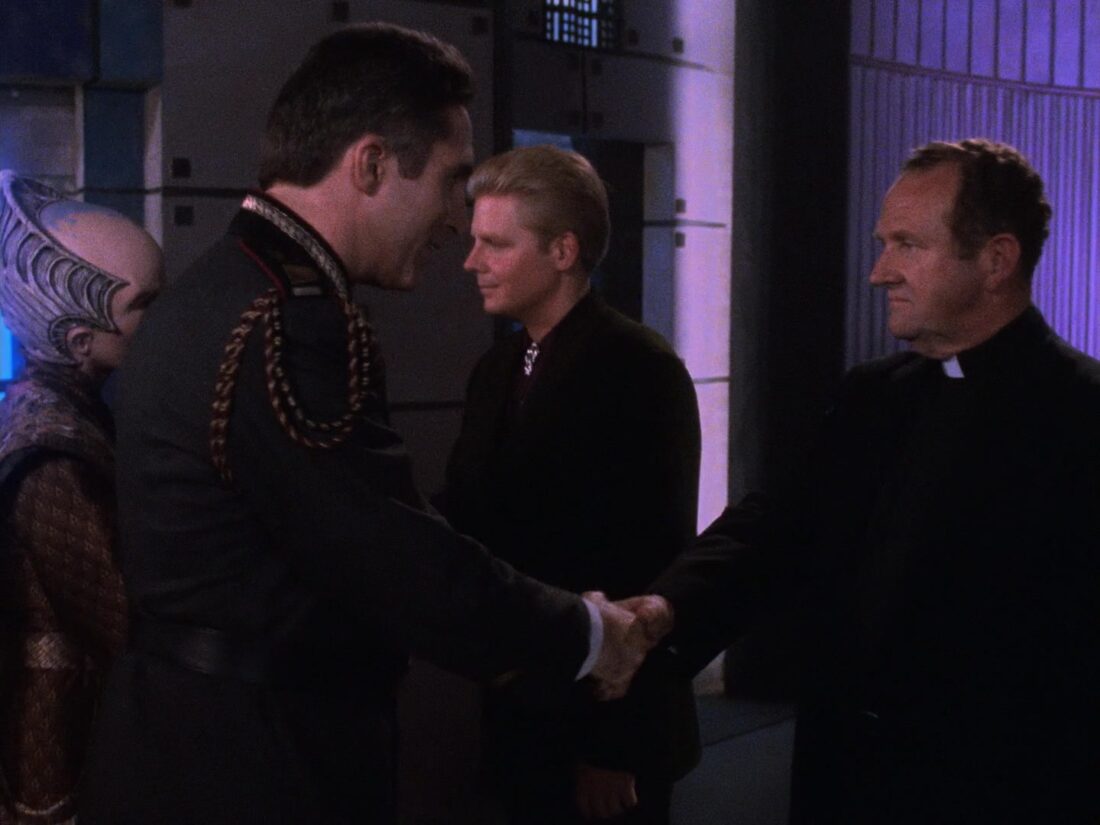
Sinclair, who has been struggling with how to do for Earth what Delenn did for the Minbari and Mollari did for the Centauri, finally presents the command staff and the ambassadors with the Religion Receiving Line: the first person he introduces is an atheist, then a Roman Catholic priest, then a Zen Buddhist, then a Muslim, then an Orthodox Jew, then Oglala-Sioux, and so on down the line.
Nothing’s the same anymore. Sinclair has a fondness for Alfred, Lord Tennyson’s Ulysses. He listens to a reading of it, and has been doing so since the Academy, to the point that Sakai can quote parts of it to him.
Ivanova is God. Ivanova is the only non-Centauri who seems to be enjoying the Centauri feast.
The household god of frustration. Garibaldi opens the episode confiscating a Drazi knife, refusing to accept the Drazi’s claim that it’s part of his religion. The security chief thinks the whole religious ceremony thing is a silly goose and he can’t wait for it to be over.
If you value your lives, be somewhere else. The Rebirth Ceremony, at least according to Sakai, also can double as a marriage ceremony, which makes Sinclair and viewer wonder if anyone wound up married in the eyes of the Minbari after it was all over.
In the glorious days of the Centauri Republic… The Centauri started the feast during their war with the Xon to celebrate those who survived the last round of battles with the enemy. The tradition continued after the Centauri won and the Xon were wiped out.
Though it take a thousand years, we will be free. G’Kar, unsurprisingly, had some shady dealings with fellow Narn, and pissed off one of them enough to take out a contract on G’Kar’s life on his deathbed.
Looking ahead. The Minbari ceremony is the latest in a series of occasions when Delenn is acting weird toward Sinclair.
In addition, the notion of G’Kar refusing to scream while being tortured is one that will be revisited.
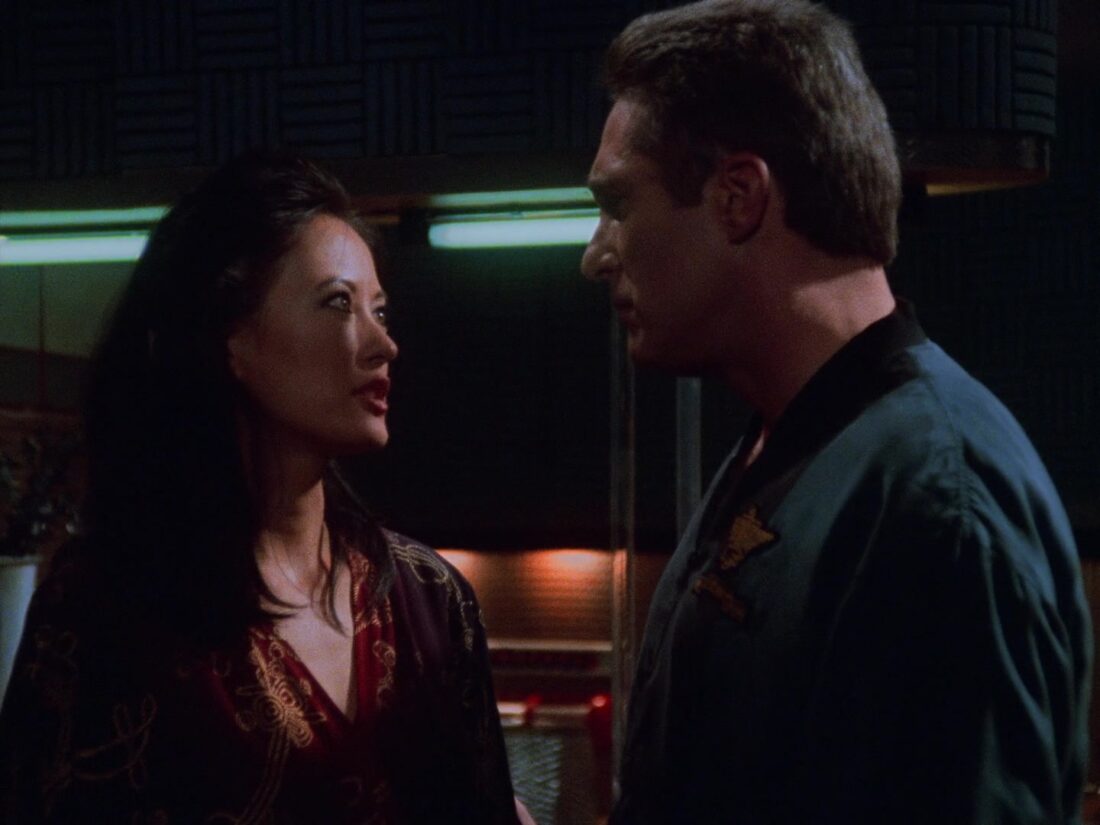
No sex, please, we’re EarthForce. Sinclair and Sakai progress to the on-again phase of their on-again/off-again relationship. It’s established that, some time since “The Gathering,” Sinclair and Sykes broke up, which Sinclair credits to his refusing to resign his commission and go into business with her, as she requested in that episode.
In addition, G’Kar’s proclivity for human women, hinted at in “The Gathering,” is seen twice here, once in Na’Toth’s dialogue, once when Garibaldi finds a human woman’s panties in G’Kar’s couch.
Welcome aboard. Julia Nickson debuts the recurring role of Sakai; she’ll be back next time in “Mind War.” In addition, veteran character actor Thomas Kopache plays Tu’Pari. Mark Hendrickson plays Du’Rog—it’s one of dozens of alien characters he plays throughout the franchise, though it’s one of the few with dialogue.
Trivial matters. After being in the opening credits since the start, Bill Mumy and Caitlin Brown finally make their debuts as, respectively, Lennier and Na’Toth. It’s established that G’Kar’s previous aide, Ko D’Ath, died in an unfortunate airlock accident, a rather nasty way to write out poor Mary Woronov, who couldn’t deal with the facial prosthetics or contact lenses and quit after one appearance in “Born to the Purple.”
The Narn do not participate in the ceremony of religion-showing-off. We’ll learn more about the Narn faiths in “By Any Means Necessary.”
The echoes of all of our conversations.
“Are you Ambassador G’Kar?”
“This is Ambassador G’Kar’s quarters. This is Ambassador G’Kar’s table. This is Ambassador G’Kar’s dinner. Which part of this progression escapes you?”
—Tu’Pari asking a stupid question and G’Kar saying, “Duh!”
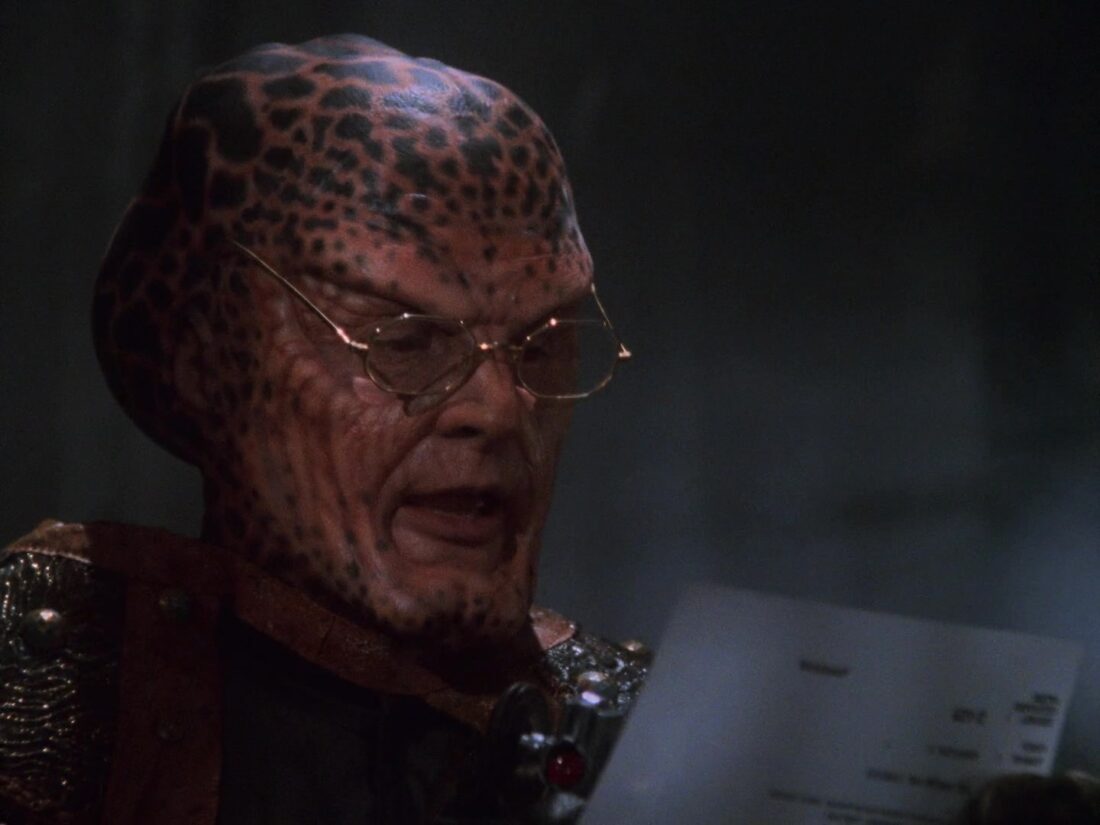
The name of the place is Babylon 5. “Gods for all occasions!” Okay, I have two extremely minor pet peeves about this generally quite good episode, and I want to get them out of the way.
One: why the hell is a Narn wearing Earth-style spectacles? Why would a species that doesn’t have external ears develop a device whose entire design is predicated on having ears that stick out on the side of the head? Why would a species that doesn’t have external ears use a device whose entire design is predicated on having ears that stick out on the side of the head? For that matter, how are Tu’Pari’s glasses being held onto his head? (J. Michael Straczynski explained online that Tu’Pari uses human spectacles because the Narn have a prejudice against mechanical improvements to oneself, which explains why G’Kar will later go around with only one eye, but that only answers my first question, not my other two. He should be wearing a pince-nez, if anything…)
Two: Sinclair introduces the rabbi in the Religion Receiving Line as an Orthodox Jew. He and Ivanova then shake hands, and no! An Orthodox Jewish male would not touch a woman he was not married to or a very close relative of in so casual a situation. He’s very obviously neither of those things, because Ivanova’s reaction would be more direct and affectionate if it were the case. And you can’t explain it away by saying that maybe Orthodox Judaism has changed in the three centuries that B5 is in the future, because Orthodox Judaism hasn’t changed in the last five thousand seven hundred and eighty-four years. In fact, what defines Orthodox Judaism is that it hasn’t changed ever. If it does change, then it’s another form of Judaism, not Orthodox.
Sigh.
Okay, now that that’s all off my chest… This is a decent little episode. G’Kar’s plotline is pretty straightforward, although the misdirects are muted by Caitlin Brown being in the opening credits, making it extremely unlikely that she is either the assassin or the assassin’s backup. Still, Brown’s Na’Toth is much more compelling than Mary Woronov’s more stereotypical Ko D’Ath was, and she and Andreas Katsulas play off each other nicely.
Seeing the different religious ceremonies was fun. It’s a little to Planet of Hats-ish to see only one Centauri ceremony and one Minbari ceremony but then have Earth show off how many religions there are. Having said that, the ceremonies are definitely appropriate: the Centauri eat, drink, and are merry because they’re not dead yet, and the Minbari are all ritualized and sedate and ceremonial and stuff. Each is very fitting. For that matter, the Narn not participating is also very fitting, as even at this early stage it’s obvious that the Narn play things close to the vest and don’t reveal much to outsiders. (Indeed, G’Kar’s reluctance to let any non-Narn in on his crisis is a plot point.)
And Sinclair introducing representatives from all over Earth is lovely, as is his kicking off with an atheist (which is Straczynski’s own philosophy). I especially like that he put the Muslim and the Jew next to each other (which he has said was quite deliberate).
Next week: “Mind War.”


“So Many Fishes” is one of my favorite G’Kar moments. I sometimes can’t help singing it myself while cooking in my own kitchen (just for my own amusement).
It was amusing, although I would have sworn it was a pre-existing song since it sounded very human. (e.g., “when Bonnie comes back” – I thought it must be some old Scottish ditty!) :)
I recall reading that it was supposed to sound like the Narn equivalent of an aria from a Gilbert & Sullivan operetta.
The fact that G’Kar wants to eat what appears to be an entire pig’s head, snout-first, has always amused me as well.
Trying to eat the pig’s head was very Klingon of him. :D
Klingons use cutlery. G’Kar is way past that.
I’m glad you enjoyed it. I must confess that it fell right out of my head between when I watched it and when I wrote about the episode.
—Keith R.A. DeCandido
This is a huge improvement. JMS said online that this was the first episode written after the show began filming so that he could write to the actors’ performances, and I’m not sure if that’s the key difference, but this is where the show starts firing on all cylinders. It’s clever and funny and thoughtful and there’s a lot going on that pretty much all works, though the bit about the bodyguard was too much of a throwaway. Also, I’m not a fan of torture scenes, a plot device that’s far more overused now than it was when this was made, but it manages to be entertaining because it’s not just relying on the torture for its impact, but is more about the character work.
And there are some delightful touches like the song G’Kar sings at the beginning, which I assumed was some old music hall ditty but was actually an original Christopher Franke composition in the style of Gilbert & Sullivan. Which makes me very curious about its in-universe origins. Did G’Kar compose it himself? Anyway, it’s one of the touches that really sets this show apart from Star Trek.
Lennier and Na’Toth both make strong impressions in their debuts, and it’s a good episode for Vir too.
The stuff between Sinclair and Sakai seemed a bit overdramatic at points, but JMS said he based most of it on his personal experience and dared anyone to say it wasn’t authentic, so I’ll take his word for it. Julia Nickson is an improvement over Sinclair’s pilot love interest.
As for the “Planet of Hats” complaint, I think that was intentional to suggest that cultures like the Minbari (a theocracy) and Centauri (an imperial state) have less religious freedom than humans or Narn (who will later be established to have multiple faiths). And the dialogue did establish all along that the ceremony was recognizing each planet’s “dominant religion,” implying the existence of others. (It’s also a subtle warning sign about where Earth’s government is going that it defined the festival as a celebration of “dominant” religions rather than all religions.)
Anyway, that final scene is just beautiful, moving in its simplicity. According to JMS’s comments linked above, many of the extras in that scene were actual believers in their stated faiths and were addressed by their real names. He didn’t specify whether that included the Orthodox rabbi.
As for the spectacles, it’s obvious they’re being kept on by the pressure of the temple pieces against the sides of his head. The prosthetic headpiece makes the character’s head wider than a human head, so just that pressure alone would be enough to keep human-style glasses in place.
On the spectacles, I was curious and checked to see if they are in the script (as published in the B5 script book series). And they aren’t. That implies either the director or the performer came up with the idea during ahooting. Creating a new prop requires time, which would have required knowing about the glasses earlier in production, so their own option would have been human glasses. I don’t blame JMS for that. It’s pretty clearly an affectation anyway.
Christopher’s speculation about G’Kar writing that song inspires me to guess that G’Kar and Du’Rog are old enemies in part because he produced one of G’Kar’s underground musicals which bombed. G’Kar wants not to speak of that because while the Narn love opera, they view light opera about as we view snuff films. Du’Rog couldn’t expose G’Kar without dishonoring his own name as well, so he was forced to hire an assassin instead.
Probably my favorite episode up to this point. G’Kar is quite possibly my favorite character of the series, so it’s great for him to get the spotlight. The entire assassination plot is a bit ridiculous, so I saw the inclusion of the spectacles to be part of the overall absurdity. Speaking of which, there is a lot of interesting information about Narn society included with the silliness.
I love the Centauri ritual because it perfectly fits the decadent undertones of all things Centauri. “But in purple, I’m stunning!” And Susan looks like she’s having a great time because Claudia Christian couldn’t stop laughing at Peter Jurasik’s antics. I think that one scene told us more about the Centauri than much of “Born to the Purple”.
I remember reading a full explanation as to everything that happens at the Minbari ceremony, down to what everyone does with the piece of fruit and what it is meant to symbolize. A lot of work went into that scene. And of course, we get the first reference to “The Nine”, an indirect reference to Valen (just called “he” here), and more interesting significance given to the Delenn-Sinclair connection. It was, of course, meant to mean something very different from what eventually was revealed. But it continues to add to the overall mystery.
There is more that I like about this episode: the introduction of Lennier and Na’Toth, the ending scene, etc. But then there’s the part that I always trip over: nearly everything to do with Jeff and Catherine.
I find most of their scenes together to be super awkward. I know JMS says that much of their dialogue was written based on his memory of living through similar experiences, but it comes across as overly florid and theatrical. And most of it was given to Catherine, and Julia Nickson is so focused on just trying to deliver those damn lines that there’s no chance of displaying whatever chemistry might somehow exist with O’Hare. Speaking of which, there is very little chemistry there. Sure, it’s supposed to be a little awkward, but it still feels incredibly forced.
Still, one of my favorites of the first season!
“It pleases me to know that you will live in fear, G’kar. But not for long,”
The mention of household gods brought to mind a Harry Turtledove novel with that title. When I first saw that volume, I was not familiar with the concept of household gods. As a result, I thought it might be a sequel of The Case of the Toxic Spell Dump, which features a setting where both secular and divine magic are used to provide modern conveniences (with household gods being sort of akin to household appliances).
RIffing moment: “Will you follow me into fire? Into storm? Into darkness? Into death? And the nine said…”
Can I think about it first?
One unfortunate moment occurs when G’Kar lifts Tu’Pari above his head. The effect brings to mind the scene in the Doctor Who serial Tomb of the Cybermen, when Toberman lifts the Cybercontroller over his head and tosses it into a bank of computers.
As to why Ivanova is the only one enjoying herself at the Centauri ceremony, Sinclair is all wound up about Catherine, while Garibaldi and Delenn can’t partake in the booze.
Though the moment was part of the script, none of the other performers were told that Jurasik would be climbing on the table. So Ivanova’s startled yelp and Delenn’s horrified expression are a result of Enforced Method Acting.
“none of the other performers were told that Jurasik would be climbing on the table.” Is that true? Because I’d always noticed during Londo crawling along the table that Doyle is busy clearing dishes and cups off the table ahead of where Jurasik was about to come crashing down, so he must have had some advance notice that it would happen.
It looked to me like Garibaldi caught the dish that Londo knocked into Delenn’s lap. It was after Londo’s table dive, not before.
Watch again. I’d link to the YouTube clip, but links seem to be problematic with the new website’s comment section.
When he gets up on the table, Vir starts moving statues out of the way. Londo kisses Li’s <ahem> assets and Garibaldi is clearing a plate and a cup. Londo keeps going. Yes, he knocks a plate into Delenn’s lap, but then Garibaldi secures multiple (plastic) cups while Londo is telling Delenn she’s cute for a Minbari. All this is happening while Londo is on the table. And then at the end, Londo collapses into a conveniently Londo-shaped clear patch of table, whereas before it was filled with clutter.
I may have watched this show too many times over the years. But this stood out to me from the beginning.
I did not expect a good episode after the previous two, but here we are. The story was not groundbreaking, but it was decent and managed to move forward with building both the universe and the characters in it. I was also laughing about the glasses, but i did not mind it that much. It seemed reasonable to get human glasses on Babylon 5, even if it’s not exactly practical for a Narn. :)
On the other hand, i was quite upset that the special Minbari fruits seemed very common Earth tomatoes…:)
I think this was the episode that convinced me to keep watching. I was in a watch party with friends for this first season and IIRC, this was generally agreed among us to be a hopeful sign of things to come. I recall reading a comment from JMS somewhere that the end scene was done in one take. Prior to the scene, Michael O’Hare was introduced (once only) to each person and then the scene was shot. As someone who is crap with names, that memory demonstration always impressed me :)
JMS actually said (see my link in my comment above) that “We went down this line of 250 people, and went over their names *twice* with O’Hare. That’s all. After that, he got each name right every time; amazingly quick memorization.” So it was twice, not once, but still quite a feat. (Though “250 people” seems exaggerated.)
In a different quote on the same page, he also says there were 160 extras in the scene. So, yeah, it’s probably not a precise number. Anyway, while it is certainly possible that O’Hare did memorize everyone’s name, the scene as aired only actually names the first few people before panning down the rest of the line.
That said, I would have taken more than two takes to get it right, even if it was just the first dozen or so names.
There are several first season episodes that made me realize that B5 was not your typical SciFi show and really wasn’t a Star Trek wanna be. This is the first. It acknowledges religion is important various races, without making it based on aliens who are simply more advanced than “we” are. It shows that one those religions can be joyous and raucous and based on celebrating genocide. It shows another as being staid and somber and imbued with “great meaning”. It also shows humans as still believing in religions and not only having one religion.
It is odd that both the Centauri and the Minbari are shown as having only one religion. Frankly, I can see Londo picking the most fun tradition and running with that, whether or not there are more. The Minbari are later portrayed as being pretty conformist as a society and as a one that bows to authority, so only having one acknowledged religion tracks.
This is one of my favorite episodes. N’Toth is a breath of fresh air and totally delightful. The rest of the G’Kar story may not be terribly new, but the dialog and acting make it really enjoyable.
Last week, someone said if you don’t like this episode, B5 probably isn’t for you. I wouldn’t go that far, but this does give a real feel for how issues will be handled and really sets up a sense of how B5 works as a show.
Everyone was asked to give an example of the celebration of their “dominant” religious belief, which explains why we only saw what we saw. We see a bit of variation within the Minbari religious caste over time, IIRC. The Centauri are also ultimately a bit more complex, with their tendency to add certain emperors to the list. But anyway, if anything, Sinclair couldn’t follow the rules this time around, which actually fits with what we’ve seen as his character so far. (And the desire to be inclusive also fits his later choices.)
Granted that this is my own head-canon, but I think Sinclair did follow the rules, just with his own little spin on them (and all but abusing the letter of the law to get what he wants while still technically following the rules is very much a character trait of his). What is humanity’s “dominant” belief system? Well, why can’t it be the belief that people can follow whatever faith or non-faith they choose to? And he just showed that to everyone in a fairly simple but effective way.
That’s not just your head-canon, it’s exactly what JMS intended. In his own words from the Lurkers’ Guide page: “As to the interpretation of the final tag scene…my thought was that it’s a way of saying, “Our dominant belief is that ALL beliefs are respected.””
So now I’m wondering if I happened across that at some point in the decades since this was broadcast. Oh well, still nice to know my thinking on the scene is right, even if I didn’t come up with it independently.
This helps me think better of the receiving line, which has always struck me as a shallow way to handle the multiplicity of religions – rattle them off, but don’t engage in any dialogue or discussion about any of them. I don’t dispute that peaceful coexistence of different religions is better than where we are now, but, were I a non-human representative on B5, I wouldn’t come away from Sinclair’s reception line feeling like I knew anything mroe about Earth religions than I did before.
I always assumed that after the reception line, a meet and great commenced allowing more detailed (but still “shallow” due to lack of time) discussion.
But would that be any different than the Centauri and Minbari celebrations? No religious tradition is going to be understood by seeing one ceremony. I’m Catholic and the shallow understanding of my faith and our ceremonies practically screams off the screen when I see it depicted.
I’m sure practitioners of other faiths feel exactly the same way with their own religions; they would see the problems that are invisible to me.
That’s a fair assumption, I suppose.
As a former comparative religions major, it’s a frustrating scene to watch, because it sort of implies “pick one, pick the other, they’re all the same” — which, even leaving aside the notion of faith commitments, they just aren’t.
But, sure, I get that because TV logistics and not wanting to “get it wrong” and all. I’m not sure I could have come up with a better dramatization.
I thought the point was to say they’re not the same, that Sinclair chose to highlight our diversity of beliefs rather than call one of them “dominant” over the others. And that people with different beliefs can choose to coexist rather than fight.
If the receiving line was the whole thing, then I would agree. But it seems entirely possible that this was just an introduction, and that there was some kind of mixer afterwards.
What I do wonder is where are the reps of the non-aligned worlds? Presumably they should have been invited as well. I suppose the answer to that is probably shooting logistics: there were enough people on set as it was.
Yeah, you’re probably right. We only saw brief portions of the Centauri and Minbari celebrations (the former of which was said to potentially last for days), so it stands to reason we only saw the beginning of the Earth event.
But out of universe, as a scene in a TV episode, I think the simple statement of just having them all standing there, just being acknowledged and coexisting peacefully, is quite potent. I got misty-eyed by the end.
In this episode we get to enjoy some of the best character moments: for example, Sinclair looks far more authentic in his exchanges with Sakai than he did with Sykes in “The Gathering”, thanks to what I always perceive as the realistic portrayal of a difficult, on-and-off relationship that’s very aptly described as “three parts passion and two parts teeth”.
Our perception of G’Kar does change a little here: so far he’s been aggressive and duplicitous and not very likable (and what comes to the fore here about his shady past dealings is no help at all), but the plight he finds himself in, and the way it’s resolved shine a light on a different side of his character. The refusal to scream out in pain when the assassin is working on him gives us a hint of his inner strength, but for me his best comes out in his exchanges with Na’Toth, particularly toward the end when it appears they are very well suited to each other, especially as co-conspirators.
During the Centauri ceremony I always have to smile at Londo’s drunken antics, and one of my favorite moments comes when he crashes down on the table and Vir and Garibaldi share that comment about the inner self and passing out.
But that joyful celebration does not completely hide the realization that the Centauri prevailed over another species by totally decimating them, and saluting their disappearance with a “good riddance!” that even gentle Vir can thoughtlessly enjoy. It’s a look on the darker side of the Centauri soul that will come soon into play…
I was a little surprised that the “Echos of all our Conversations” wasn’t;
“With luck, they may never find you, but if they do, you will know pain ..”
“.. and you will know fear ..”
“.. and then you will die. Have a pleasant flight.”
That was a candidate, but it’s only really funny in context.
—Keith R.A. DeCandido
This gets at two of the things that I really admire about Babylon 5: first of all, that it acknowledges religion in its worldbuilding in a way that goes beyond silly superstitions that advanced civilizations are fated to outgrow (something which Star Trek understandably catches a lot of flak for, but which was really a widespread feature of20th century SF), and secondly, that it acknowledges the plurality of human cultures
(although it does later fall victim to the temptation to just give America’s tragically dysfunctional Congressional system to the entire world). What I don’t understand, though, is why so many of the crew were being such sourpusses at the Centauri and Minbari religious festivals.As I remarked in a prior post regarding the Centauri festival, Sinclair was all wound up about Katherine arrival on B5, while Garibaldi couldn’t partake in the booze.
“Will you follow me into fire? Will you follow me into darkness? Will you follow me into death?” is referenced much later on as part of the ritual induction of a new member of the Grey Council, seen in In the Beginning.
And, “I cannot have an aide who will not look up. You will be forever walking into things,” is also what Dukhat said to Delenn when she entered his service, seen in season 4’s Atonement. Loved those callbacks.
Keith DeCandido: ‘Orthodox Judaism hasn’t changed in the last five thousand seven hundred and eighty-four years. In fact, what defines Orthodox Judaism is that it hasn’t changed ever. If it does change, then it’s another form of Judaism, not Orthodox.’
Assuming that you are not being facetious/ironic, that statement is completely incorrect. Firstly, in 2,000 BC, nothing remotely recognizable as Judaism existed. At best, one might point to various Semitic precursor faiths that will eventually evolve/transform into something that we will recognize as an ancestral form of Judaism. Secondly, contemporary Orthodox Rabbinic Judaism is very different from the Judaism that existed during the Second Temple Period. To cite only some very obvious points, Judaism during the Second Temple Period was structured around the existence of the Second Temple, which is not the case for post-Second Temple Rabbinic Judaism . The Tanakh was also still being assembled/written during this period (cf. the Book of Jeremiah, which was significantly altered/expanded during the epoch of the Second Temple). And then there’s the fact that the Talmud itself was only formally codified and reduced to writing after the the destruction of the Second Temple by the Romans.
Orthodox Judaism is not a fly frozen in amber. It is a living tradition, and living traditions change and grow in response to the world around them.
In fact, he really was an orthodox Jew. Almost everyone in the line was using their actual name and faith.
I have cousins who belong to a Egalitarian Orthodox congregation. “Halachic Egalitarianism” has been around for about 20+ years, in which adherents follow Modern Orthodox observances while practicing gender equality in matters of worship and personal interactions (e.g., men and women sit together, both men and women lead services, etc.). So it would be entirely plausible for an “Orthodox” rabbi to shake hands with a woman who was not a relative.
I picked that number because it’s that year in the Jewish calendar and I was exaggerating for effect, yes. My greater point stands.
—Keith R.A. DeCandido
Keith, I have some thoughts on this myself I’d love to share with you later when we have time. I disagree with some of what you’ve noted, but I’m glad that you did take note! Honestly, I’m more concerned with what happens when Ivanova’s rabbi comes to the station and eats alien fish at a non-kosher restaurant…
I enjoyed this one.
Bobby
It’s a fun episode, though it sags in a couple of places. It also really shows off what the show does well: character and humorous moments scattered through otherwise serious moments.
I thought the dialog between Sinclair and Sakai was a bit soap-opera-y, but not terrible. They’ve danced this dance so many times, they find it inevitable, yet somehow dull. Of course, if O’Hare had stuck around, then things would have much worse than they ever have in the past. The later workaround for Sheridan is one of the few things that felt klunky to me.
According to JMS, he knew Bill Mumy would fit in, because when they shot his arrival scene and Delenn asked him for news of home as they left the arrival lounge, he ad libbed “Beatlemania is back.”
Watching this episode’s opening scene made me realize what’s off about this show for me. The dialogue is more clever than it is natural, and I feel like it bleeds into the performances.
“You’re testing my patience. Move on before I decide to flunk out.”
It’s a cute line, but nobody talks like that. I feel that way about most of the dialogue between Sinclair and Sakai as well. The writer may claim that the relationship was authentic, but nothing they say to each other sounds anything other than an actor delivering a line.
That being said, this was easily my favorite episode so far, with both an entertaining plot and a lot of nice world building, which is clearly this show’s biggest strength. I wasn’t aware that Andreas Katsulas had such comic chops, and Vir wasn’t actively annoying. The final scene, with Sinclair introducing the ambassadors to representatives of Earth’s many religions was a nice touch as well, even if I wish they’d changed up their costumes a bit so they didn’t look like stereotypes. This is supposed to be hundreds of years in the future.
Perhaps, but for the scene to work they have to be immediately identifiable. And the dress of many faiths change little over time. From my own tradition, a Catholic priest would be pretty obvious over the last couple of centuries. There would be slight details differing, but not anything that would hide their denomination.
That’s a fair point. I guess that scene would have been difficult to pull off without either looking like a lineup of stereotypes or offending someone by messing with their traditional religious attire. They probably erred on the side of caution.
I’ll bet Joss Whedon’s writing gives you intense pain. :P
I didn’t say it was painful. It’s just not what I was expecting. I’ll take clever writing over bad writing any day.
Yes, I’d agree, JMS isn’t really a naturalistic writer and loves to make statements via his characters that you can only really hear his voice speaking through them. I wonder if some of the first season “bad acting” is due to people working out how to deliver the dialogue. Jerry Doyle gets markedly better and I can’t believe he just suddenly becomes a better actor out of nowhere! But like others have said, it’s a bit like theatre and didactic writers like George Bernard Shaw, if you can accept the manners of it, then it becomes enjoyable and there’s no reason for fiction has to be naturalistic.
But there will still be moments of cringe through all five seasons!
IIRC, JMS is a huge fan of Rod Serling and even emulates his practice of dictating scripts into a recorder to be transcribed later. So they have similar writing styles, with a use of language that’s more poetic and polemical than naturalistic. JMS was the story editor on the syndicated “third season” of the 1980s Twilight Zone revival (which was really more of a reboot of the reboot, a separate production that reused the same title sequence), and his scripts for the show were much more Serlingesque than the two CBS seasons of the revival had been.
And both Serling and JMS had the same problem that, on a show where they wrote the vast majority of the scripts, all the characters eventually ended up sounding like the author.
That’s a very good point – I’m sure he wrote a Twilight Zone comic series at some point too, though I haven’t read it.
I enjoy the Twilight Zone, but I tend to prefer Matheson episodes to Serling!
That makes a massive amount of sense.
“I wonder if some of the first season “bad acting” is due to people working out how to deliver the dialogue. ”
Yeah, that’s what I meant about it bleeding into the performances. I don’t think they’re bad, but they’re more exaggerated than I was expecting, as if nobody’s quite comfortable yet (except Peter Jurasik. He sells every line).
I’m with Christopher, about 50/50 on “B5 is stagier in many ways and that’s fine” and “people in my life talk like that.” Early Star Trek can get very stagey (TOS and TNG especially). I always found the BSG reboot dialogue to be dour, overdramatic, and unrealistic: if I survived a near-extinction event I’d be dealing with it with tons of bad jokes, but BSG is one of the most humorless sci-fi programs I ever watched to the end.
Honestly, I feel like TOS and TNG hold a great deal better with the “stagey” dialogue then they would if they were written in an actual 60s/80s vernacular style.
I find all 1960s TV to be very stagey, but I think that’s part of its charm. I just didn’t expect a show from the 1990s to feel the same way.
Dialogue that is more clever than natural is a constant with Straczynski’s writing, alas….
—Keith R.A. DeCandido
That’s not necessarily a bad thing. I doubt real Elizabethans spoke in witty and philosophical iambic pentameter, but I still enjoy Shakespeare.
“‘Romeo, Romeo, wherefore art thou, Romeo.’ Dad, nobody talks like this!”
Yeah, but when I watch Shakespeare, I’m up for it. The soul-crushingly beautiful poetry and prose is the reason I’m there. However, your point is taken. I fully accept this is my problem. I’ll just have to adjust my expectations again.
““You’re testing my patience. Move on before I decide to flunk out.”
It’s a cute line, but nobody talks like that.”
I can imagine my pun-loving family members or my writer friends saying something like that. You can’t generalize about what “everybody” or “nobody” does, because people aren’t monolithic. I realized in my teens, if not earlier, that my way of using words was different from how any of my peers talked.
Well I can certainly imagine a writer talking like that, but that’s the problem. Whenever a lot of these lines are spoken, that’s all I can imagine – the writer.
Most of my family members aren’t writers, but most of us are quick with a bad pun.
But as far as the author’s voice overwhelming the characters, expect a lot of that in later seasons once JMS becomes the sole writer. After a while, it all ends up sounding like an extended monologue.
It sounds like you come from a very entertaining family :)
The Centauri religious ritual is one of the funniest scenes the show did during that first year. I still get belly laughs out of Londo’s Centauri/Xon storytelling. And I don’t think Ivanova was supposed to be laughing or enjoying that dinner. I’m pretty sure that between Jurasik’s table antics Claudia Christian couldn’t hold it in and broke character completely, indirectly making the whole thing even funnier.
And somehow G’Kar manages to compete for the same audience laughs. The scene where he wakes up with the black flower by his bedside (an obvious Godfather reference) and screams loudly gets me every time. B5 only gets funnier when it portrays G’Kar as having a bit of a bumbling idiot side contrasting to his usual self-assured power driven mode (or his seething anger towards the Centauri). His inability to trust anyone only adds to the indirect comedy. He ends up trusting the freaking courier when he plays the Na’toth backstabber card – there’s no other reaction than to laugh. And the G’Kar/Na’toth dynamic is already a major step over Ko D’ath (shame that the character’s inbuilt trapdoor was an airlock accident).
As I understand from a B5 book I read years ago (The Babylon File), there was another actress lined up to play Na’ Toth before Caitlin Brown came onboard. Susan Kellermann was cast to play Na’toth, but had a complete nervous breakdown when testing the Narn prosthetics. She came in after Mary Woronov.
Absolutely love the ending with Sinclair introducing the various religious leaders. It’s a great display of both religious tolerance and diversity, but also paints Sinclair in an even better light when we later learn he actually had a jesuit education as a child. It’s heartening to see that despite the religious extremism seen across the globe in today’s troubled times, there are writers like Straczynski, who understand the world is a complex place, and he can write someone like Sinclair – a positive example of a religious character who nevertheless is able to embrace the fact that there are other voices and beliefs in his world.
While I like Sakai a lot more than Carolyn, I never quite get the chemistry between them, if there is any. This is one situation I’m kind of glad Sinclair ended up being replaced by Sheridan. Maybe the show’s development would have proved me wrong, had Sinclair and Catherine stayed, but I can’t picture him going to Z’ha’dum to save her the same way Sheridan was furiously intent in finding out about his wife’s fate. In short, I’m glad we got the Anna Sheridan backstory instead. It made the IPX/Z’ha’dum thread more cathartic and meaningful.
The Centauri/Xon storytelling that Londo does is very dark though. The Centauri, at some time in their past, flat-out exterminated a sapient species. (Do we ever find out more about that?) Played for laughs, but a look at how ruthless they are and a foreshadowing of what they try to do to the Narn.
Didn’t we do the same, though, with regard to the Neanderthals and other hominins? Although genetic evidence shows that we actually interbred with them, so it may have been more a case of assimilation than extermination, or some combination of the two.
And judging from Vir’s tale about counting their survivors, the Xon were trying just as hard to exterminate the Centauri, so it was arguably self-defense. Although history is written by the victors, so there’s no telling how truthful that claim is.
I think there are several ways that Sheridan works better in the story, although I am split on Anna being better than Catherine for going to Z’hadum. I do think it fits with Sheridan’s character for him to go off to confront and destroy The Shadows. I do think that it would have been more impactful for the audience with Catherine coming back. She would have been someone we knew and we had seen the relationship between her and Sinclair, instead of just hearing about it. The scene of an unshown Anna walking through B5 with some people seeming to react to her makes sense if it is Catherine who had been there and would be recognized. Anna was just a picture in Sheridan’s office.
That said, in the end, I think the switch of Sheridan for Sinclair works to the advantage of the series in many ways, which I will touch on as we get to them. I wish that the replacement had been the fan theory that WB didn’t find O’Hare a compelling enough actor and forced the casting change, instead of O’Hare being so terribly ill, but I do think it worked out for the best.
This is a better episode than what came before, but it is mostly that final scene that really sticks with me. I always love watching that. The G’Kar and Na’Toth plot is fun with a lot of really good humour, but that gets offset by the Sinclair and Sakai moments. Julia Nickson does her best, but the dialogue is horrible, and a couple of the line readings are Star Wars prequels bad. Thankfully she gets better to work with in her subsequent appearances.
Also, we don’t actually know that the Narn don’t participate in the religion-sharing, we just don’t see it, or any others, but given we saw the Drazi coming to the station for the festival in the opening, there were probably other ceremonies taking place off-screen.
This is a fun episode and really shows what the actors can get itno once they get out of the first episode issues. G’kar getting his dinner ready is just a fun scene (apparently Andreas adlibbed the “stay put” line when he put the crab thing on the plate.) I also really did like that the narn religion isn’t brought up because of how private it is. Also, as for the assassin wearing the glasses, i think its ok if he is, maybe it’s a quirk he likes human spectacles…even if they don’t make sense biologially.
Londo’s entire rapture of getting drunk is just hilarious.
I assume it’s just coincidence that “Xon” was also the name of the Vulcan character David Gautreaux was supposed to play in Star Trek: Phase II? I can’t think of a good reason B5 would name the species the Centauri wiped out as any kind of weird homage, but then again, Easter eggs don’t always need a good justification. :)
Probably coincidence, yeah. Like the coincidence that Stargate SG-1 had an ancient alien species called the Nox, which is Xon spelled backward. (With the main one played by Armin Shimerman.) With names that short, there are bound to be a lot of recurrences of the same letter combinations, and sci-fi writers like to use names that end in “on” (Klingon, Cylon, Vorlon, Zordon, etc.). Also, “Xon” has three letters in common with “xeno-,” the Greek prefix meaning “alien,” so maybe there’s something there too.
Tuesday Morning Quarterback once said something to the effect that Vorlon sounds like a laundry additive.
“Now! With added Vorlon(TM)!”
Oh dammit I’ll never be able to unsee that now. Kosh’s encounter suit even looks kind of like a top-loader.
This was a great episode; much more cohesive than what came before.
I liked the religious theme, as I never bought the premise from so many SF stories that humanity would outgrow religion. Combined with showing a future with poverty, political strife and greed, the B5 universe feels far more real to me than Star Trek.
I don’t mind the dialogue, as warching the characters say what we all wish we could say makes the proceedings a lot more fun to watch.
The thing with Star Trek is that the humans are shown as basically post-religious, but the aliens are often not only religious, but with a single main religion for the whole species. B5 tends towards the single religion for aliens part, but has humans with a range of beliefs, and varied practices within a belief system.
There weren’t too many writers who used explicitly religious themes in sf, at least in the first 2/3 or so of the last century. The only major works where religion was a theme that I recall were Dune and A Canticle For Leibowitz.
Asimov, Clarke, Heinlein, and Piper were non-religious to actively anti-religious. So were so many others.
Ehhh…I don’t know that I would call Clarke’s stories non-religious or anti-religious. Childhood’s End was about a rapture midwifed by aliens who looked like the Devil (and I think it was kind of written in dialogue with C.S. Lewis); 2001 leaned hard into the numinous/”sufficiently advanced alien” trope (albeit more so in the film than in the screenplay or the novel); “The Nine Billion Names of God” literally ends with the monks being proven right about the universe.
I dunno… I recently re-read Clarke’s The Songs of Distant Earth, in which humanity had seeded the stars by sending out robot ships with stored embryos to habitable worlds where the human populations would be raised and educated by robots (which would never work, because infants can’t survive or develop properly without human touch, affection, and interaction, but that’s another conversation entirely), and the novel stated that the organizers of the program had expunged the colonists’ databases of Earth history and culture of anything remotely suggestive of religion, allowing humans to make a fresh start without the toxic ideas that had done so much damage on Earth. And there was no indication that the colonists’ total lack of any awareness of religion had been bad for them in any way; indeed, the novel didn’t have a great deal of conflict or plot of any kind.
As for Childhood’s End, it seems kind of anti-religious to say that our cultural beliefs in devils were really just a psychic foreboding of visitation by an alien species, and that interpreting the Overlords as demonic was simply superstition. We’d mistakenly interpreted them as evil because we sensed they would herald the end of humanity as we know it, but that end was something more benevolent than we feared, the next stage of our evolution (hence the title). And I never saw the ending as a “Rapture” so much as the kind of “evolution into energy beings” idea that was common in SF in that era — see The Outer Limits‘ “The Sixth Finger,” Star Trek‘s Thasians and Organians, and the like. The idea does share a resonance with traditional beliefs of souls transcending bodies and such, but it’s a secularized version thereof.
And Clarke’s intent in 2001 wasn’t anything spiritual, just a recognition that real aliens would probably be too different for us to comprehend or imagine. I read about the development of the novel/film in the book The Lost Worlds of 2001, a collection of early story outlines and draft scenes, and there were several attempts to depict the aliens and their society onscreen before it was decided that nothing Clarke could imagine was alien enough, so they just decided to leave the aliens unshown and have them communicate symbolically or abstractly.
On this viewing, initially the storylines seemed to me somewhat anodyne and I started to wonder how much of this episode’s feeling of vast improvement was merely the Halo Effect of its not being “Soul Hunter” or “Infection”. But I did note two aspects that, in conjunction with several other things already mentioned by Keith or other commenters, helped give this one more heft.
It finally starts making use of its somewhat large ensemble: nine of the eleven characters in the opening credits make an appearance. And while several roles are small, none are token. The simple addition of more characters to the story, all of whom have legitimate reasons to be there, certainly makes the world seem larger and more fleshed-out.
i also noted that none of the storylines given to non-human species couldn’t have been assigned to humans. This stood in stark contrast to the Weird Alien Beliefs and Technology that drove “Soul Hunter” and “Infection”, a trope which was not only cliche but at risk of falling down hard when paired with budget/writing/acting issues (ahem). This episode pulled back from that in favor of an approach from classic SFF (well, speculative fiction in general) to attribute to “aliens” attributes/storylines that some might dismiss as contrived/unrealistic if attributed to humans. It suggested that, despite the CGI and prosthetics, this show wanted to be a bit more idea-driven.
because Orthodox Judaism hasn’t changed in the last five thousand seven hundred and eighty-four years.
jesus, it really is that old.
Nice pun, even if it was not intentional. You began your comment after the quote with “Jesus” when referring to Judaism.
This was always an early favorite of mine, because it was my first taste of slight Internet fame in the days long before karma and influencers existed.
Joe had posted on GEnie, asking for suggestions for the name of a mineral used in the construction of jumpgates. I looked over at the old box full of Commodore 64 floppies on my desk and saw the software for QuantumLink, and thought of “Quantium-40.”
Joe used it in the show, and also named the waiter at Fresh Aire after me for offering the suggestion. Sinclair being told “David will be your waiter tonight” was a highlight for me in my early fandom.
That’s cool, I guess, but I have to wonder what the name means. It sounds like it’s supposed to be an isotope of some transuranic element called quantium, but no transuranic could have an atomic mass as puny as 40, which is the mass of the most common isotopes of argon and calcium and a rare isotope of potassium. But the B5 wiki just calls it a “mineral” instead of an element, so maybe the number is meant to represent some crystalline phase, like how water has various crystalline phases called ice-I, ice-II, ice-III, etc. But if it were a mineral, I’d think it would more likely end in “-ite” than “-ium.” Which leaves the possibility that it’s actually a brand name some mining company gave it, or something.
Anyway, given that origin story, I’m surprised you didn’t call it Quantium 64.
I look back and chuckle over this line. Especially because of how it’s used later on (in one of the B5 TV movies) with a much younger Delenn in a much-the-same situation. But no spoilers, there…
Both Londo and G’Kar are becoming, at this point, two of my favorite characters in JMS’s “novel for TV”. And they only get better.
I thihght it rather shortsigheted and human-centric, that the alien races are protrayed as (mostly) monolithic in their religions, while only earth has a plethora of belief systems.
That said, this WAS a decent episode. (and Na’Toth seriously endeared herself to me!)
As I mentioned above, only the Centauri and Minbari were portrayed as having a single “dominant” religion, and one is an imperial state and the other is a theocracy, so it’s plausible that neither government would encourage religious freedom. And we’ll see later that the Narn do have multiple religions.
As someone who has gone through “first season-itis” with the various Trek series, I’m adept at watching early episodes that are, well, not so great.
This episode feels like the first where the show has woken up, and says yes, this is Babylon 5. This is first really good episode so far, that feels like the pieces starting to come together to form the eventual tapestry.