






It seems like King Kong, one of the acknowledged landmarks of fantasy cinema, would not necessarily have been a ripe candidate for a remake. The original 1933 movie, despite being dated in many ways, was still a groundbreaking effort in visual effects and such an iconic film that even an update with the latest advances in technology might have felt like something no studio or filmmaker would dare attempt.
And yet it happened twice—in 1976 and again in 2005. The latter, of course, was co-written and directed by Peter Jackson, who used the leverage from his Lord of the Rings trilogy to make his own version of one of his all-time favorite films. While flawed and bloated, Jackson’s take on the classic story was nevertheless a hit with audiences and critics, grossing more than $557 million worldwide and earning an 84% score on Rotten Tomatoes. The 1976 version, on the other hand, remains the outlier of the three versions: while profitable, it scored only mixed reviews from critics and is perceived as the weakest of the three—and a mediocre film in general.
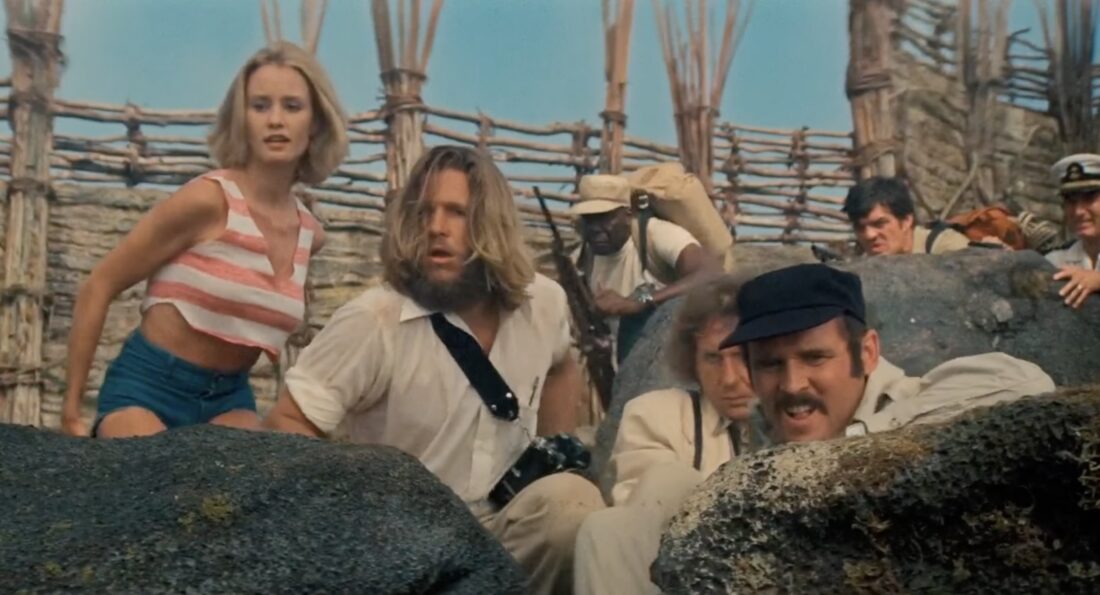
But is it really? Fifty years after its release, King Kong ’76—directed by John Guillermin (The Towering Inferno) and produced by legendary Italian movie mogul Dino De Laurentiis (whose resume ranged from early Fellini classics like La Strada to campy ‘60s fare like Barbarella to David Lynch’s Dune)—perhaps deserves some reappraisal. De Laurentiis’ version certainly pivots away from key aspects of the original, yet arguably provides a more sympathetic, even pro-nature take on the giant ape and his clash with the civilized world that makes us feel for Kong and his plight and paints him as more than just a rampaging beast.
The story remains essentially the same, although some details are different: an expedition to an unexplored island reveals the existence of Kong, a gigantic ape who is a mythic, almost god-like figure to the primitive tribe that worships him. A beautiful, aspiring actress with the expedition is offered to Kong by the tribe as a sacrifice, but he is instead strangely drawn to her. This leads to him being captured and brought to New York, where he is ruthlessly exploited by modern civilization and goes on a rampage that ends with his lonely death as he plummets from a New York skyscraper (the Empire State Building in the original, the Twin Towers in the ’76 film).
De Laurentiis landed the rights to King Kong after an ABC-TV executive, Michael Eisner (who later became CEO of Disney), pitched the idea of a remake to both Universal Studios and Paramount Pictures. The latter brought De Laurentiis on board as producer, and he quickly secured the rights from RKO-General, a holding company that retained the remnants of RKO Pictures, which produced the original 1933 version of Kong. Since Universal apparently claimed to have the rights as well, due to the novelization of the original film being in the public domain, De Laurentiis rushed his version into production before Universal could strike first (it was Universal that eventually produced the Peter Jackson version).
Following that, De Laurentiis hired Lorenzo Semple Jr.—whose credits included the 1960s Batman TV series as well as classic ‘70s conspiracy thrillers The Parallax View and Three Days of the Condor—to pen the screenplay. From the start, De Laurentiis wanted to jettison Kong’s many battles with dinosaurs (he only fights a giant snake in this one) and update the story to a modern-day setting. Semple told Starlog magazine in 1983, “We made a very deliberate attempt not to be anything like the original movie in tone or mood. Dino wanted it to be light and amusing, rather than portentous. I don’t think the original was meant to be mythic.”
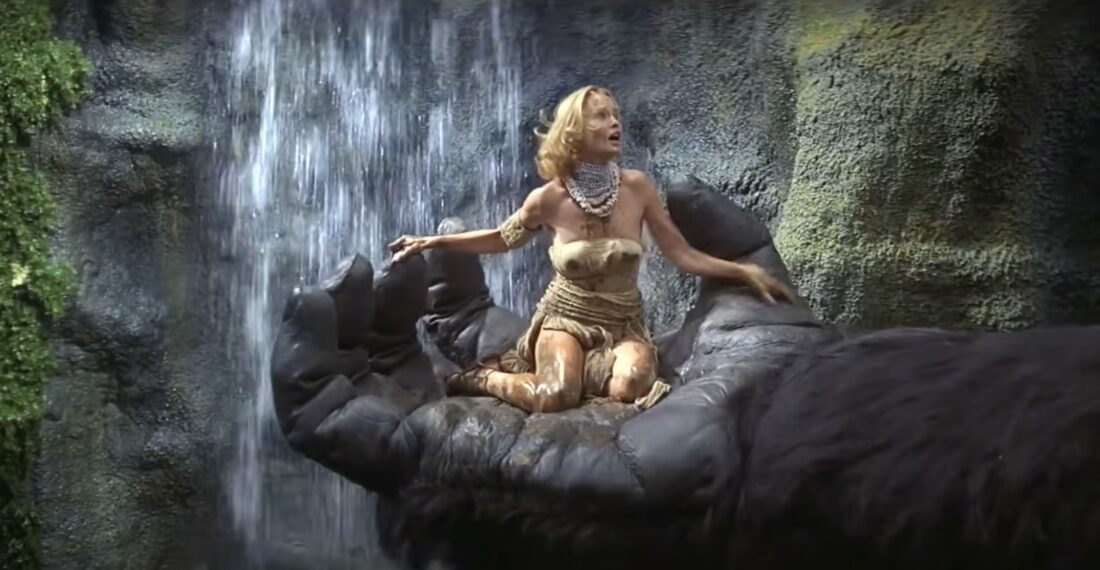
Semple’s script isn’t excessively campy, like his work on Batman, but there is a lot more self-aware humor in the film. “I had my horoscope done before I flew out to Hong Kong,” says Dwan, the female lead (and Kong’s “love interest”), played by Jessica Lange. “And it said that I was going to cross over water and meet the biggest person in my life.” Lines like that permeate the script but don’t necessarily weigh it down, and in many ways Semple’s screenplay succeeds at updating the story while retaining many of the signature sequences from the 1933 film.
One of the cleverest things he does is turn the original’s Carl Denham (Robert Armstrong), a documentary filmmaker, into Fred Wilson (Charles Grodin), an executive with the Petrox Oil Company who charters a ship to look for untapped oil reserves on what he believes to be a previously unmapped island hidden behind a permanent fog bank (the atoll is never explicitly called Skull Island in the film). When the island’s oil turns out to be unusable, making the whole trip a potential waste and putting Wilson’s job on the line, the emergence of Kong provides him with an opportunity to capture the giant ape and exploit him for promotional purposes.
Whether Semple wanted to intentionally poke fun at the people writing his own paycheck—Paramount was owned by Gulf and Western at the time—it’s all too clear that Petrox and the smarmy, manipulative Wilson are quick to exploit natural resources and leave behind a trail of destruction no matter what the cost. “Even an environmental rapist like you—even you—wouldn’t be asshole enough to wipe out a unique new species of animal,” sneers Jack Prescott (Jeff Bridges), the primate paleontologist who initially stows away on Wilson’s ship yet grudgingly joins the expedition. Maybe Wilson wouldn’t kill Kong outright (although he initially considers it), but his removal of the giant ape from his habitat not only traumatizes Kong but, as Prescott suggests, is more than likely to upset the natural order on the island.
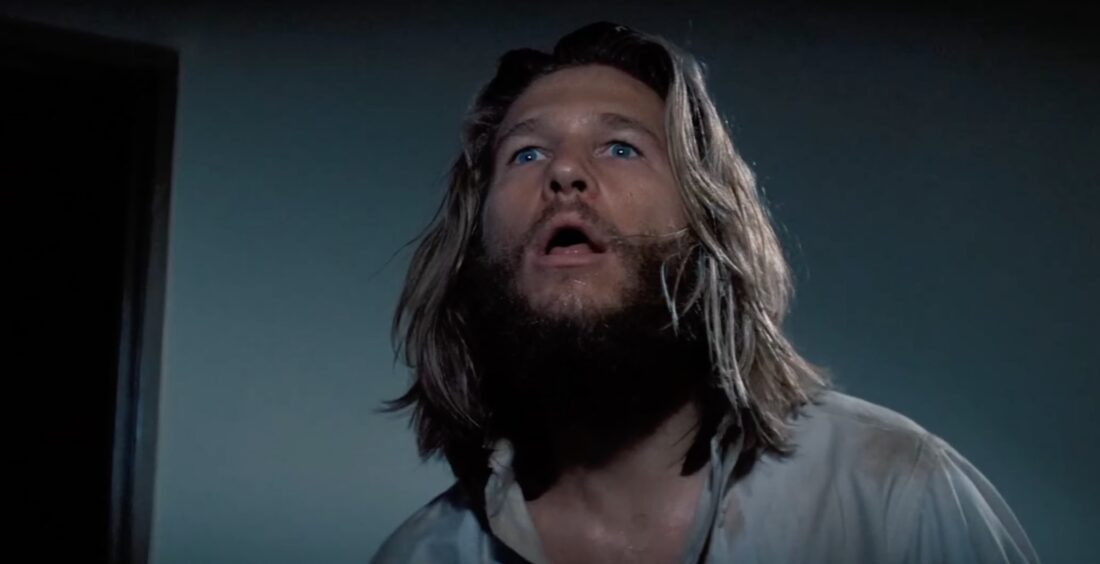
Prescott is a reimagining of the character of Jack Driscoll from the 1933 film, the ship’s first mate played by Bruce Cabot. The Driscoll character is a tough, no-nonsense “man’s man” who resents the presence of actress Ann Darrow (Fay Wray) on the voyage (he’s got a thing about women on boats) until he eventually falls in love with her and bravely risks his own life to rescue her from Kong. Driscoll is more or less a square-jawed stuntman with little on his mind, while Prescott is a scientist and activist who is forced to become an action hero while struggling to protect not just Dwan but Kong himself from Petrox’s predations. Bridges is terrific in the role, and he and the excellent Grodin square off magnificently throughout the movie, while Bridges proves himself to be a formidable physical actor as well.
And then there’s Dwan (as she notes, her name is Dawn but she switches the middle letters to make it more memorable). In her film debut, future two-time Oscar winner Jessica Lange is almost preternaturally gorgeous, and this being 1976, De Laurentiis and director John Guillermin drape her in the skimpiest outfits possible. But while Lange’s performance was heavily criticized at the time as unconvincing and inexperienced, film historian Ray Morton states in his book, King Kong: The History of a Movie Icon, that this was intentional on Lange’s part—she purposely plays Dwan out of the gate as naïve and somewhat dizzy, giving the character room to grow, while her work earned accolades from Jeff Bridges.
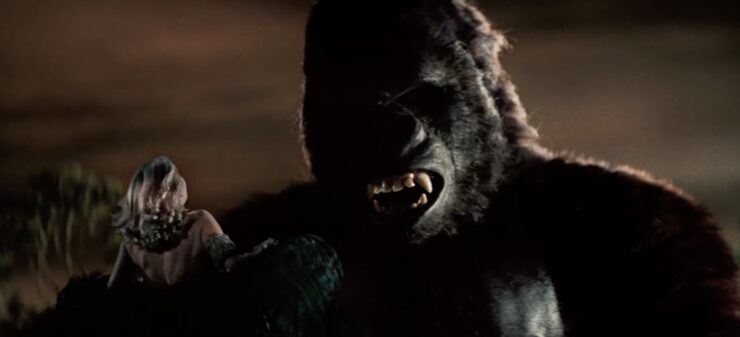
Over the course of the film, the relationship between Dwan and Kong does indeed become more touching. The original film portrayed its title character as little more than a monster, and Fay Wray’s Ann Darrow pretty much screams her way through the movie and wants nothing to do with the big ape. The 1976 version takes a different approach (which Peter Jackson also adapted to some extent for his 2009 iteration), having the empathetic Dwan launch a running monologue with Kong that the gorilla finds unendingly amusing. Although there has always been a vaguely unpleasant sexual subtext to every version of this tale, the 1976 Kong treats Dwan with genuine affection and care, as when he washes mud off her in a waterfall then blow-dries her with his breath. There’s something child-like about him, as well as her efforts to calm him, that adds far more pathos to their relationship than the original movie mustered up.
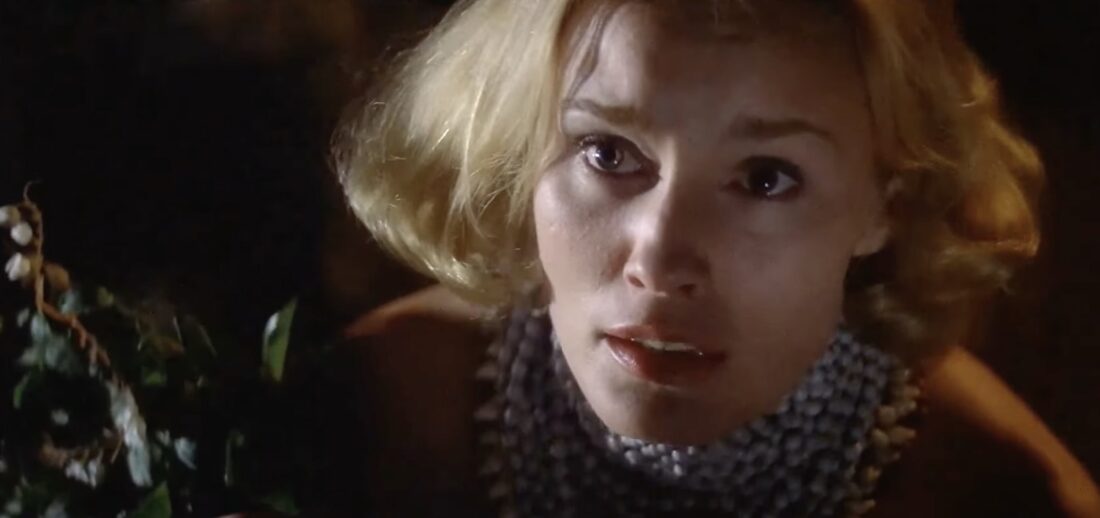
Dwan yearns for fame and success, but ends up devastated by what that fame wreaks on the innocent Kong. Her grief over Kong’s death at the end of the film is sincere, while Kong’s demise itself is far more heartbreaking. “No one cry when Jaws die,” Dino De Laurentiis told Time magazine. “But when the monkey die, people gonna cry.” If the 1976 King Kong has one major advantage over the 1933 version, it’s that Kong in this film is a much more sympathetic and tragic figure. The moment in the film’s finale when he gently deposits Dwan on the roof of one of the Twin Towers—almost as if he knows that this will sentence him to death in a hail of bullets from a squadron of helicopters—is genuinely moving.
As for how Kong himself was brought to life, De Laurentiis was adamant from the start that he did not wish to use the same stop-motion techniques pioneered by Willis O’Brien in the 1933 film. Yet his plan to build a walking, moving, fully animatronic 40-foot version of Kong which could interact with the sets and cast proved to be a disastrous one. Despite the best efforts of special effects legend Carlo Rambaldi, the much-hyped full-sized Kong is only seen for less than 30 seconds in the scene where Kong is unveiled at Shea Stadium. The huge robot merely stands in its cage, barely moving at all, and is never seen again. Much better are the jumbo Kong arms and hands that are used to pick Dwan up or put her down in a number of sequences.
Most of what we see in the film of Kong is a collaboration between Rambaldi and makeup wizard Rick Baker on both a detailed, man-sized ape suit and a series of hydraulically-controlled masks meant to give Kong a wide range of expressions. Baker wore both the suit and the masks, and while the full costume never quite conquers the “man in suit” effect that hampered many a Japanese monster movie before this, the masks go a long way in conveying Kong’s emotional state and making the gorilla seem like a living being. It’s not the digital magic that has given us characters like Gollum, Thanos, and the Na’vi in the past 25 years, but—with the help of some skillful editing, John Barry’s resonant, haunting score, and the flexibility of the masks—it’s enough to counteract the often-crude compositing of the full suit into scenes with the actors.
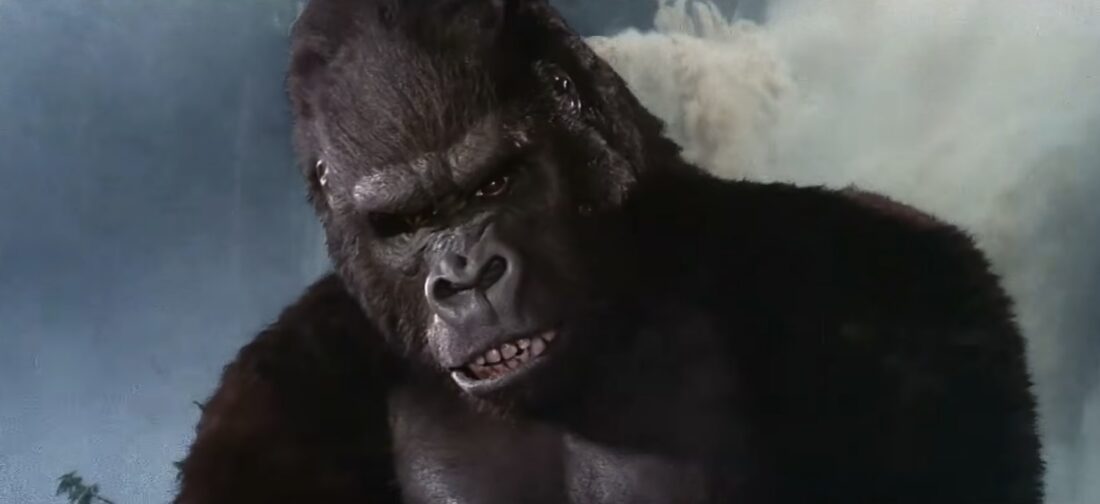
In the end, Dino De Laurentiis’ King Kong is a film with a lot of issues, but is nowhere near as bad as some critics have suggested over the years. It benefits from some solid performances, great cinematography, fantastic location shooting in and around the Hawaiian island of Kauai, and that underrated score. Semple’s script is both cynical and humane, if still falling into tired tropes (the characterization of the tribe on Kong’s island is hopelessly racist, a problem that all three versions of the story failed to solve), while managing to be entertaining and even a credible improvement in some ways on the original.
Even with the efforts of Baker and Rambaldi, the visual effects are perhaps the film’s biggest letdown, missing the surreal quality of the original’s stop-motion animation and falling far short of the motion capture wizardry that gave full reign to Andy Serkis’ uncanny acting abilities in the Peter Jackson version. Yet I would argue that this Kong is lighter on its feet than the Jackson film, which takes a good hour to get to Skull Island and retains the Great Depression backdrop. And while Naomi Watts is perfect in that film as Ann, Jack Black and Adrien Brody are miscast as, respectively, Denham and Driscoll (the latter of whom is turned into a playwright).
The 1976 King Kong is probably the first one that audiences of a certain age and generation saw, and like the Star Wars prequels, the one that defined their vision of this timeless tale. It may not be as iconic and historic as the 1933 original—which remains the definitive version, even with its own shortcomings—and it may not be as visually overwhelming as the 2009 edition, but this version of Kong can stand tall next to its cinematic brethren.
