






Disney executives watched the success of the Pixar films with mingled joy and alarm. On the one hand, the Pixar films—particularly Finding Nemo and the two Toy Story films—were bringing quite a bit of money into their coffers, both in box office receipts and ancillary merchandise revenue. On the other hand—well, after the late 1990s, most of the Disney produced animated films were losing money, and only Lilo & Stitch was bringing in anything close to the ancillary revenue generated through sales of little Woodys, Buzz Lightyears, Monsters and Nemos.
Pixar arguably was overtaking Disney on what had been their exclusive, lucrative domain. (Arguably, since other studios had also produced financially successful full length animated movies, and the Disney issues had more to do with the quality of their films than with their rivals.) And, far more alarmingly, relationships between the two companies were slowly but surely disintegrating, even as Pixar animators showed Disney executives concept art of talking cars.
Wall Street executives and journalists alike were later to blame this disintegration on the crashing personalities and egos of Disney CEO Michael Eisner and Pixar CEO Steve Jobs. But their egos were only part of the problem. The two had very real contractual fights as well. Eisner, for instance, had insisted on treating Toy Story 2 and the proposed Toy Story 3 as mere sequels to Toy Story, instead of two separate films that would count towards the five films that Pixar had promised Disney—forcing Pixar to produce two more films.
More alarmingly, from the point of view of Steve Jobs, Eisner had attacked Jobs’ other company, Apple, during testimony in front of the United States Senate, blaming Apple for encouraging internet piracy—which to Eisner, was the same as attacking Disney and ABC revenue. Jobs was outraged, and after allegedly yelling at a number of Disney executives who had not testified in front of the Senate, he much less allegedly reached out to Roy Disney, announcing that once Pixar had fulfilled its contract—with either six (five films plus Toy Story 2 in Pixar’s version of the contract) or seven (five films plus Toy Story 2 and Toy Story 3 in Disney’s version) or eight (all of those plus a sequel to Monsters, Inc., also in Disney’s version) the company would completely sever its ties with Disney. Roy Disney, who had his own issues with Eisner, began making moves to force Eisner out.
In 2003, Jobs took things still further. After meeting with various Disney rivals, Jobs offered Eisner a revised deal where Disney could still use Pixar’s characters in its theme parks and on its cruise ships—an ongoing lucrative arrangement—but would no longer share ownership in Pixar films. Instead, Disney would receive a distribution fee. Eisner noted that Disney had the rights to make sequels to the existing Pixar films, and had Roy Disney forced out from the Disney board. Steve Jobs responded by making very mean (if accurate) comments about the various direct-to-video Disney sequels.
By early 2004, Steve Jobs announced that he was ending negotiations with Disney, and that once Pixar had delivered the two pending films, he would stop working with Disney until and unless Eisner left the company. Pixar delivered The Incredibles in November 2004. Only one more film, and then finally the Pixar/Disney relationship would be over, finito, ended, completely over. Jobs contacted various Hollywood distributors. Disney executives not named Eisner tried to keep polite cover faces. Even the announcement, in early 2005, that Eisner would step down before his contract expired did not calm Jobs: he announced that Pixar would be delivering its last film—a small thing about talking cars—and that would be it. This did not create a smooth relationship between Pixar artists and Disney executives, and added to the usual tensions of film development.
Much worse was to come, when Cars co-director Joe Ranft was unexpectedly killed in a car accident midway through production, at the too young age of 45. It was a major loss for the company: Ranft had worked on all of Pixar’s films, as a concept artist, storyboard artist, story writer, director and/or voice actor, while continuing to work with Tim Burton’s various stop-motion films. It also put Cars back into the distracted hands of John Lasseter, busy with the tense Disney/Pixar negotiations and concerns about what Disney would do to his beloved Toy Story and Monsters, Inc. characters if the studio exercised their right to make sequels, and less concerned with talking cars.
All of this background drama, and Lasseter’s inability to focus on this film as much as he had on previous Pixar efforts, probably helps explains why Cars is regarded by most fans as one of the weakest of the earlier Pixar films, with a select few naming A Bug’s Life instead. Pixar had, of course, produced films under equally stressful conditions, with Toy Story essentially a Hail Mary pass for the studio, and Toy Story 2 reaching the point of giving animators repetitive stress injuries and making them wonder what that odd thing called “sleep” was. And in some ways, Pixar’s position had never been stronger. At the same time, these sorts of contractual disputes and background drama were more distractions than motivators—and Pixar definitely needed motivators.
Especially when trying to create a convincing world populated by sentient cars.
However distracted, John Lasseter did come to Cars with a lifelong love of cars and driving. Pixar’s success had allowed him to slowly build a collection of classic cars, and as production started, he felt he knew cars. But that did not exactly completely bridge the gap between “car knowledge” and “creating a world inhabited by sentient cars.” For inspiration, Lasseter and other story artists, including Joe Ranft, drove along Route 66 and visited various car shows and auto body shops, learning about things like car paint. Most of the characters were modeled on various classic cars, updated to include eyes and mouths.
Left out was exactly why these cars had gained independence and sentience, not to mention why they had then chosen to imitate American culture. To be fair, no one at Pixar had bothered to explain how, exactly, toys had become sentient, or why human-fearing monsters had built a world that mirrored the human world so closely.
Though at least some people at Pixar did put a little bit of thought into this. Eventually. And by eventually, I mean years later—2017, to be exact— when Jay Ward, the Creative Director of the Cars franchise, told Matt Singer of ScreenCrush that the cars had simply decided that they didn’t actually need humans, and got rid of them—but not before taking on the personality of the last person who drove them. I’m assuming that the personalities of former rental cars are somewhat fragile and easily disrupted, though no one at Pixar has confirmed this.
For now, we’ll just have to take it for granted that the cars of the world all leapt forward as one and destroyed every human on the planet, along with cows (replaced, apparently, by tractors), bugs (replaced, apparently, by flying Volkswagen Bugs), and, well, apparently all other organic life forms, in a process so smooth and fast that it didn’t even disturb U.S. highway systems.
I recommend caution when you next enter a motorized vehicle.
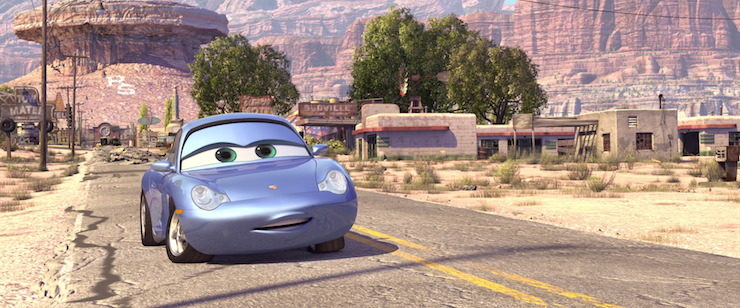
Anyway. Lasseter didn’t just want to create a new world: he also wanted Cars to follow the now-classic Pixar tradition of upping the computer technology with each and every film. In this case, he decided that Cars would include ray tracing—a rendering process that simulated the movement of light, which in non-technical terms meant that the cars would reflect the light properly. The process required another classic Pixar tradition: updating the computer technology. Pixar’s new computers, Lasseter excitedly explained, were about 1000 times faster than the computers used in Toy Story. Despite that speed, it still took Pixar about 17 hours to render each frame of Cars. The results were undoubtedly worth it—some of the shots of the American Southwest are breathtakingly beautiful—but the time consuming process meant that once again, Pixar artists found themselves scrambling to meet Disney’s deadlines, and spending less time on story development and jokes.
Which meant that throughout development, Cars struggled with background tensions, rendering issues, and world development issues. To all this, the film added another Pixar first: a protagonist who is not, initially, at all easy to like. Oh, Lightning McQueen can be charming enough, and a number of cars are more than willing to flash their headlights at him. But both in and out of the spotlight, he quarrels with his road crew and is obnoxious to his fans, his sponsors, and his main driver, Mack. Not surprisingly, he doesn’t have any friends, unless we count his agent, and we probably can’t since we never even see the agent and since the agent confesses that he didn’t even watch Lightning’s big race.
This is all, of course, a setup for that great movie cliché: Lonely, obnoxious protagonist Learns the True Meaning of Friendship and What’s Important in Life. And it helps that for all his bravado and arrogance and insistence that he’s too good for his sponsors, Lightning McQueen is self-aware enough to know that he’s lonely, and needs friends. Indeed, a good part of his quest for new sponsors seems to be the hope that with new sponsors will come new friends. And despite his immediate attempt to ditch out of his well-deserved punishment for wrecking the road in a small, economically failed town, and his tendency to hit on any attractive car within honking distance, he quickly becomes almost kind to the not overly bright and shiny Mater, a tow truck who has definitely known better days.
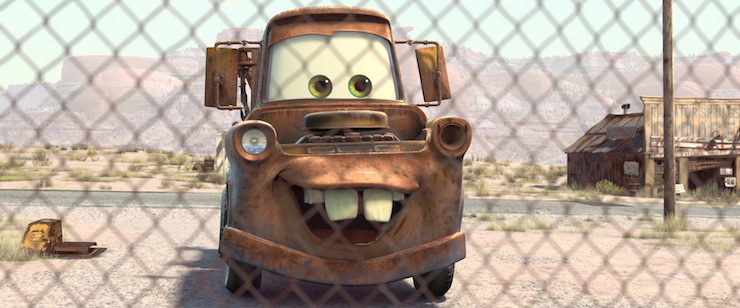
The movie contains several things that we probably don’t want to consider too closely, like, isn’t rolling into the container part of a sentient truck just a little like rolling into the body of a sentient being? I know trucks in real life change their containers all the time, but still, this is fairly icky—cool though the idea of constantly body-changing trucks is. (I may have watched a little too many Transformers cartoons as a kid.) And several things that just make no sense whatsoever—like, why are these tractors all resting out in the fields, and what exactly are they doing during the day? (Apart, of course, from rather conveniently resting around for a cow tipping joke.) If they’re part of the food/energy production system for cars, shouldn’t they be over in Texas trying to find more oil?
In some ways, though, perhaps the worst part of the film are not the questions of “how does this work?” but rather all of the sly in jokes and references. This was nothing new for Pixar, of course, who had practically started their studio with in jokes about various toys, and continued to add different references to all of their films. And to a certain extent, the movie’s focus on car racing almost demands a few in jokes, like, say, having Richard Petty voice a race car—a Plymouth with the number 43, naturally.
(Not at all coincidentally, while Cars was in production and during its release, Walt Disney World just happened to be hosting the Richard Petty Driving Experience; the attraction eventually closed down in 2015.)
And if Bob Costas was perhaps not the first name to come to mind with car racing, given his association with other sports, the use of a well-known color commentator during the car races was also probably inevitable. As were the “Lightyear” blimps and the tiny Volkswagen “bugs.” Also inevitable: Tom Cochrane’s “Life Is a Highway,” here covered by Rascal Flatts.
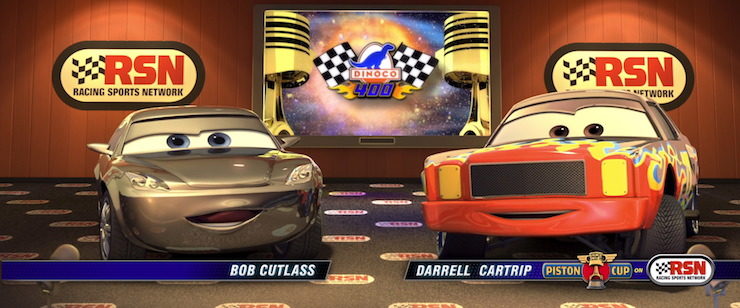
But after a time, all of this, including all of various cameos from various celebrity voice actors including Jay Leno, Michael Keaton, and the hosts of Car Talk, not to mention additional race car drivers (I sorta recognized Michael Schumacher and Mario Andretti; if IMDB is to be trusted, Dale Earnhardt, Jr. also voices one of the cars), becomes almost wearisome. Part of the problem is that the jokes feel expected, and also lack the sense of wonder that laced the similar in-jokes and references in Monsters, Inc. and the two Toy Story films. Indeed, a sense of wonder is arguably the greatest thing Cars lacks—gorgeous as some of the shots of the car-filled American Southwest are. It doesn’t help that the arguably best jokes are all saved for the end credits, particularly for a moment involving John Ratzenberger that if not quite worth the cost of admission, is certainly worth watching the credits for.
All this said, Cars remains watchable for any number of reasons: the gorgeous animation, the growing friendship between Lightning McQueen and Mater, and pretty much all of the racing, right down to the moment where Lightning McQueen realizes what’s really important about racing. If I’m kinda underwhelmed by the romance, I do enjoy the grudging respect and friendship between Lightning McQueen and Doc Hudson, not to mention the chance to hear the legendary Paul Newman—also an avid race car driver—in what was sadly to be his last film role. And let’s face it: it can be rather satisfying to watch the obnoxious, wealthy guy forced to personally fix things he’s broken, while risking his own career. Sure, we’ve seen it before, but that doesn’t remove the satisfaction here.
Small viewers had no complaints. Cars did well at the box office, bringing in $462.2 million in worldwide sales, well past any recent Disney animated release, if behind that year’s Ice Age: The Meltdown (which, I was surprised to learn, brought in $655.4 million. Seriously?). But the big thing, once again, was the ancillary marketing and the toys: kids loved Lightning McQueen, and they particularly loved the little Mattel versions of Lightning McQueen and other friends. The Disney theme parks added various Cars attractions, and if you pay very close attention to the end credits, they include assurances that Cars merchandise could be bought at Disney stores. That merchandise included the now-standard clothing, mugs, trading pins and more, along with household items for kids who were willing to give up Buzz Lightyear bedspreads for Lightning McQueen bedspreads.
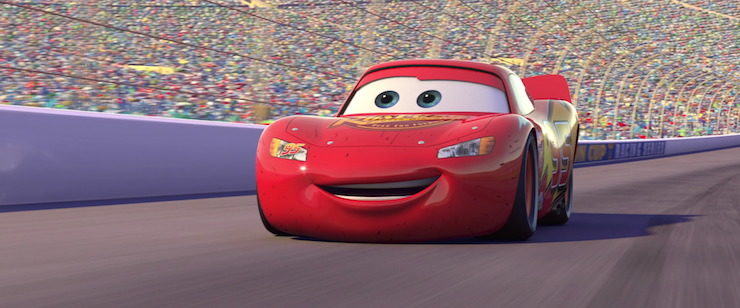
This all proved even more lucrative than the film, bringing in an estimated 1 billion in ancillary merchandise sales even before the sequel came out. This was, along with ancillary sales for Finding Nemo and the Toy Story films, one major reason behind Disney’s more recent decision to add a Pixar-focused area to their Hollywood Studios theme park, and later expand that, along with a Star Wars area—opening in 2018 and 2019, we’re assured.
But back in 2006, with the release of Cars, the Pixar/Disney relationship had come to an end. It was time, Steve Jobs felt and said loudly and publicly, for Pixar to release a film on its own—possibly with Disney distribution, or possibly not.
Ratatouille, coming up next month.
Mari Ness lives in central Florida.

The thing that got me most about Cars was that it was the exact same plot as the Michael J. Fox movie Doc Hollywood.
I wrote a four-issue Cars comic for BOOM! Studios about seven years ago, and the hardest thing to manage was to find a way to write for characters who are basically just faces and wheels. As you say, the world-building here is just weird…….
—Keith R.A. DeCandido
So basically, Cars is a sequel to Stephen King’s Maximum Overdrive.
Never watched this. Couldn’t be less interested — or so I though before reading this post, whereupon I did become less interested, on account of the deeply creepy worldbuilding.
I’d kind of like to hear the Click & Clack cameo, though. Sounds like it could be highly amusing.
I will come back and read this more closely but I wanted to pop in (surprisingly, Cars is actually one of my favorite Pixar movies and I’ve probably watched it a hundred times, thanks to my boys, and it’s a movie I’ve actually grown to appreciate more on rewatching).
I think trying to dwell on the realism or how/why the Cars are sentient, while kind of fun and the kind of thing college students would spend way too much time talking about (and there are many funny YouTube videos about it), does in a way miss the point. Like, it’s a fun premise, let’s just go with it. That said:
“Jay Ward, the Creative Director of the Cars franchise, told Matt Singer of ScreenCrush that the cars had simply decided that they didn’t actually need humans, and got rid of them—but not before taking on the personality of the last person who drove them.”
WHAT.
WHAT.
I can’t watch the movie the same way again, lol.
It also irked me that for the sequel they didn’t recast Doc Hudson out of alleged respect for Paul Newman, but had no problem recasting Fillmore. What, George Carlin doesn’t deserve the same respect as Paul Newman? Bleah…..
—Keith R.A. DeCandido
My favorite Pixar movie. Actually the only Pixar movie I really like.
@1 this makes so much sense, I loved Doc Hollywood as well but never made the connection
Come on, the concept isn’t that weird. Disney had done shorts about living cars and planes before. Besides, is a world of talking vehicles without humans any stranger than a human-sized talking mouse who owns a dog who can’t talk but has a best friend who is a large, talking, anthropomorphic dog-man? Disney (and Pixar) have always been weird.
Mickey is much cuter than any of the cars in Cars, and to give Mickey the credit that he deserves, he has never tried to live INSIDE THE BODIES of his friends.
Though one of his duck friends does make a habit of carving up the neighbors for Christmas dinner, so….ok, point to Cars here.
In my head, I can’t help but reimagine the Cars/Planes franchise as a Transformers setting. Perhaps some lost colony or a reinvented (and more geographically-diverse) Velocitron.
I feel like this review misses the point of the movie. It does not mention the town of Radiator Springs and its residents (besides Mater), which is the very heart of the story. Lightning gets a new outlook on life by slowing down and reevaluating what is truly important. Radiator Springs is a fun place, and all of the quirky cars who live there are wonderful. I don’t care how the world of Cars came to be any more than I care where Mr. Incredible got his powers.
Re: Doc Hollywood, it was a 1991 movie rated PG-13, so people born between 1978 and 2002 were not terribly likely to have seen it. Even for those who had, many details were changed, and I don’t feel like it is a ripoff. Tons of movies follow templates, but they don’t tend to get called out on it because there are so many. Think slasher films or buddy cop movies. Even Doctor Strange follows Iron Man quite a bit in story structure (thanks, Honest Trailers!).
Hi Ness, I was wondering if you could name one movie which totally truthful to logic, history, and physics?
Yeah, Cars… I guess that’s one of the few instances where the sequel was actually way better than part one. I loved “Cars 2” (even though the worldbuilding stays weird), but while Cars is cute… Well, it’s no more than that and becomes kind of tedious on rewatches.
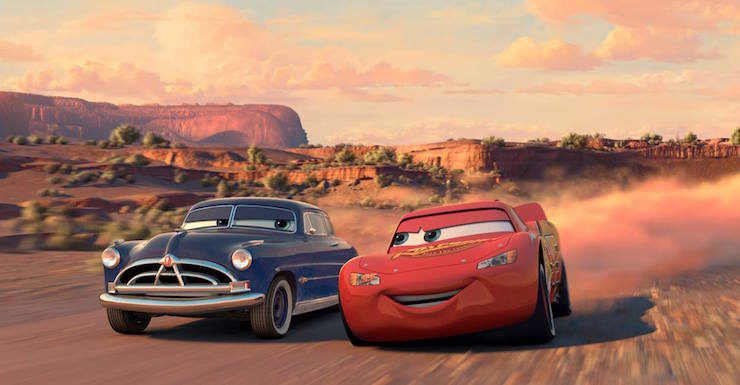
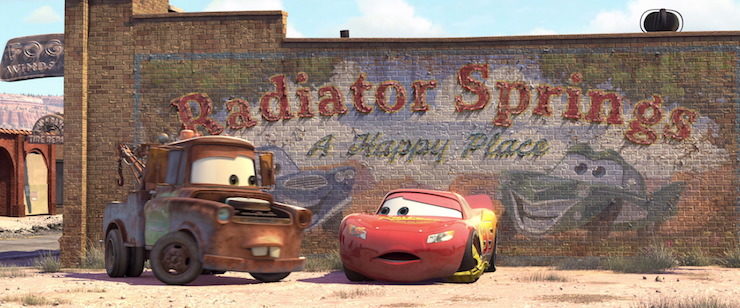
On a slightly more serious note, yes, this has never been one of my favorites, but good heavens it’s gorgeous, and I love the attention to detail (like the car-shaped buttes as shown in the first picture). And I had no idea about all of the internal machinations between Disney and Pixar at the time.
I haven’t seen Cars 3 yet, but I’m sure I’ll catch it on home video when the time comes.
While not one of my favourite Pixar films, I feel Cars is consistently underrated by reviewers and is quite charming; possibly that is the car enthusiast in my speaking. The car-inspired details of the film are fun to catch, and some of the real world cars are modeled beautifully (I especially’s like Paul Newman’s Hudson Hornet).
The one thing I’m conflicted about is the car stereotyping. What I mean is things like:
Mazda Miata – stereotypically “chick car” = Mia and Tia, two young groupies who “flash” McQueen
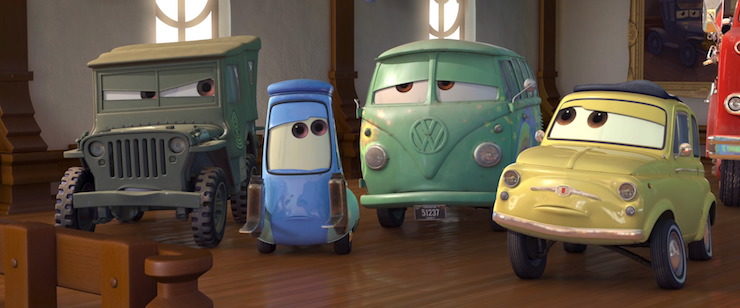
Fiat 500 = Luigi with thick Italian accent (and his assistant Guido)
Lowrider = Ramone (which I find difficult to believe would be found at a town like Radiator Springs in the first place)
I’m shocked they didn’t have Heidi Klum play Sally. I associate things like this with movies from the 1950s and 60s. Not the new millenium.
Back when John Scalzi was doing movie columns, he did one on ‘was Cars science-fiction- the cars took over, or fantasy- we have a world of sentient vehicles that just happens to resemble ours.’
Count me as one who really enjoys the Cars series. As others have said, I really don’t care how the cars became sentient; good grief, if we applied that kind of logic to all movies, we’d have nothing to watch! Likewise with the “it’s just ____ remade” – again, if film-makers couldn’t ever do anything like anything that was done before, we’d have nothing to watch.
I have to agree with Brandon @10 – Talking about the Cars movie without addressing Radiator Springs means avoiding the meat of the story. If you don’t grok the town and its people, you miss the best part of the movie, as well as losing half of the understanding needed for the 2nd and 3rd movies.
Having seen all three, it’s my favorite of all the series out there. Cars 3 was awesome – it went in a direction that I didn’t begin to see until half-way through, and even then the way it was played out was… superb.
(Also – Nathan Fillion!)
It’s clearly not just “the cars exterminated all humans” because all the infrastructure (stadiums, oil rigs, airliner cabins) fits car-sized beings. And terraformed the landscape to resemble hood ornaments.
The “Cars” world gets progressively more difficult to understand with “Cars 2” (they use gasoline and eat ice cream and wasabi? use restrooms? there are duplicates of every country in Europe?) and the two “Planes” movies (their history parallels ours at least back to WWII in the Pacific? some of them are food trucks? others believe in reincarnation as tractors?). Clearly, there must be automated factories, beyond the ken of any ordinary citizen, that birth each model year, sometimes with flaws, and … nope, stop thinking. If the MST3K mantra were ever needed, it’s here and now.
I’m going to promote my own head-canon that they’re actually post-Daleks who, having successfully exterminated all other species in the universe, and suddenly at a loss for things to do, take up emotions and LARPing. Hence, there are Dalek-inhabited planets modeled after other entertaining species.
This movie inspired my mother to plan and execute a 3 week cross-country road trip with us her children. I was 16, my sister was 10 and my brother was 8. We drove in my dad’s loaded down pickup from Georgia to California and back, camping every chance we got and hitting stops like the Grand Canyon (both rims!), Cadillac Ranch, the Gateway Arch, Las Vegas, Hoover Dam, and finally the Pacific Ocean in San Diego. That trip opened my eyes to the splendor and beauty of my homeland, and I can only ever look on this movie with supreme fondness because of it.
“…isn’t rolling into the container part of a sentient truck just a little like rolling into the body of a sentient being? I know trucks in real life change their containers all the time, but still, this is fairly icky—cool though the idea of constantly body-changing trucks is.”
If the truck’s a flatbed, the container isn’t really part of its body, it’s more like a backpack. So Mack is essentially giving Lightning a piggy-back ride.
According to the Pixar Theory, Cars (and Cars 2) happened after machines helped humans win the war against animals, then took over the earth and forced humanity to evacuate, setting the stage for WALL-E. I might actually find that more disturbing than the worldbuilding proposed here.
“…to give Mickey the credit that he deserves, he has never tried to live INSIDE THE BODIES of his friends.” *smirk* I haven’t seen it, but I guarantee there’s vore fanfic somewhere in which he does.
I personally never cared why cars got sentient within the first place or maybe I did care, when I first saw it, but those feelings evaporated when I watched my own children go crazy over it. Cars has steadily been one of their favorite movies, Lightning McQueen being one of their favorite characters. They just loved it and I feel this critic is missing the purpose of the movie all together. This wasn’t made to please adult viewers, but to please children all over the world and please them it did. I’d have a hard time finding kids who do not enjoy this movie. Mind, the sequel was average, but the third movie was quite good. Our family really enjoyed it, kids and adults alike.
So yeah, long live to racing speaking cars and to them teaching our kids to never give up, to never let others tell you what your dreams out to be and to treasure friendship whenever you find it.
I love this movie.
Gepeto @21 – Hear! Hear! Very well said.
First of all, reading about all the ego clashes between the head players is sordidly fascinating.
Ah, Cars – by all rights, I should really dislike this movie. I hate cars in real life – I’m phobic enough that I don’t drive at all and even being a passenger for a long time is enough to get me riled up. Nor I am a particular fan of sports/racing.
But I still really, really love this movie. Part if it is having two young boys who were both obsessed with it at the 3-4 year old age. We’d watch it every day and even after hundreds of viewings there are still a bunch of details that are new time, and as I’ve read more about it and heard about all the little racing/car injokes that just makes me appreciate it more. The scenery animation is just gorgeous.
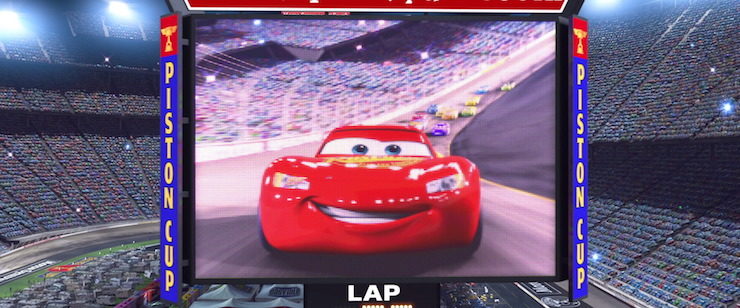
I like the general plot and theme – maybe it’s a little bit of a trope, but I think Owen Wilson really sells Lightning as a cocky (but insecure) guy who has to learn to slow down a bit and that winning isn’t everything – really, one of my favorite things about this movie is that he does NOT win the Piston Cup at the end; he gives up the chance to be the first rookiee to win it in order to do the right think, and the bad guy actually “wins”.
And I agree that you’ve done the movie a bit of a disservice by totally glossing over Radiator Springs, its history and its inhabitants as to me that is the heart of the movie. In fact, that might be a big part of what drew me in. My mom was always a big fan of road trips and vacations up north and while we never went out west, a lot of that Americana small town nostaliga reminded me of things in my own childhood. We’ve taken our own kids out to Yellowstone but when they are older we’d like to do a Route 66 trip as well.
As for the Cars worldbuilding – while I tihnk it’s best not to dwell on it too much, their culture even seems to have some semblance of religion. In the courthouse there’s a picture of what looks like a factory of some kind but it’s definitely a ‘reigious’ stype painting. Somebody says ‘for the love of Chrysler’ and in Cars 2 we also learn they have a Popemobile (and the expression ‘is the Poplemobile Catholic’ exists…). Which…if we believe what Jay Ward sad, I guess that means the Popemobile somehow disposed of the Pope in some sinister fashion. And then rides around in a larger Popemobile so I guess that brings up the cannibalism concerns.
I think if you do think about it too hard it cam become a little problematic in some ways – are cars destined to just be what they are made as? Can they change their chassis? How exactly do they ‘die’? We see ‘old’ Model Ts, but we also see little kid cars in the racing crowd. So are car models evolving? This kind of gets a little worse when you get to the whole ‘lemons’ sub plot in the next movie but I guess that’s jumping ahead.
Heh. “Driving without wonder” seems to be exactly the problem with the review. If you leave out all of the wonder because you’re too busy trying to figure out all the logistics, you’ve lost the whole point of the movie.
One of the things I loved about it – and it’s typical of the Pixar films I’ve seen – is that it’s intended to appeal to children, but much of the content is deliberately intended for the parents as well. If you don’t have the background to appreciate it, that aspect would fall flat, of course. One example is the times I’ve seen people hating on Mater because he’s too dumb or too stereotypical… but I grew up with Mater. Not the tow truck per se, but the kind of person he’s modeled on. Sure, they exaggerate the characteristics – that’s what a stereotype in a movie does. But I know him. He’s the country boy who doesn’t really understand all that city stuff too well, doesn’t pick up on innuendo or subtlety, but knows his people and his job, loves them, and has an absolute heart of gold.
And Route 66… I’ve followed some of the Yellowstone Trail, but haven’t been able to do Route 66 yet. Some day, I will. It’s part of our heritage, and too many people don’t know a thing about that era. “They just drive on by. They don’t even know what they’re missing.”
To me the Cars world is an alternate reality in the Transformer universe in which the Beast Wars never happened the right way. Something happened in the fight between Autobots and Predacons in prehistory that made animal life extinct, and probably killed all the Autobots and Predacons in the series, but some kind of spark made the rest of their ship alive and evolution resulted in cars from the Cars movies. They followed human history very close.
What? It’s a theory. And it’s less creepy than what the director of Cars 3 said (I hope he was joking).
On another note, boys love the Cars franchise. My nephews love them.
I’m kinda with @18. Our family lived in Denver for three years in the mid-70s as I was growing up, when my father was a traveling account rep; we took many trips with him as he drove around visiting customers. The evocation of the Southwest/West rang very, very true to me, bringing back memories of all the two-lane highways and small towns we drove through. (Wall Drug road signs! The Corn Palace! Dinosaur National Monument! Jackson’s Hole, to cross-ref this week’s Vorkosigan post!) Radiator Springs truly is the heart of the movie, and it hit home for me.
The closest thing I’ve seen to that recently is Boulder City, NV – the town built for the construction workers at Hoover Dam, which still retains that old Southwest feel – in direct defiance of near-neighbor Las Vegas? :)
We never went out west when I was a kid, but when I was in college, we did road trip to Wyoming (to visit my aunt) and we also went to Wall Drug and the Corn Palace :D Oh, and the Mystery Spot.
This article isn’t tagged with Pixar rewatch and doesn’t show up in that list, fwiw.
As entp88 has already observed in #28, what would make this article complete is a “Pixar Rewatch” tag.
@28/29 – Fixed, thanks!