






I’ve been thinking quite a lot about end-of-the-world stories over the last year (please, feel free to laugh, if need be!). I’ve been thinking about the kinds of hopes and anxieties that we’re expressing when we create and share narratives built around an apocalypse. So I wanted to take a look at a few examples—some relatively conventional, some less so—that may shed some light on why we’re drawn to these types of stories, and how they might help us through difficult times.
First of all, a quick etymology note, for the nerdiest among us, to help clarify the kinds of stories I’m thinking about: the word “apocalypse” comes from a Greek term which means to uncover or to reveal something hidden. To some extent, it’s more about the ways in which things change than the way they end, necessarily (but don’t those often feel the same when you’re going through them?). I’m drawn to end-of-the-world stories that aren’t just about big budget special effects wreaking havoc and grimdark cinematic escapades of inescapable doom—stories about how we face apocalyptic changes, and what comes after.
I do have friends who are binging horror movies and stories right now—the grimmer and darker the better—and have been for the past year, in a kind of cathartic masochism I can barely wrap my head around. Then again, I have other friends who want nothing to do with anything dark or frightening, who seek comfort and the gentlest of escapism, who are avoiding scary stories like the… well, you know. Both are equally valid reactions: it’s been a strange time—probably the strangest year in most of our memories! But personally, I find that there’s a kind of catharsis that comes with these types of survival-in-dark-times stories that you can’t quite get anywhere else.
I admit that I love The Day After Tomorrow mainly because one group of protagonists takes shelter in a library (and then proceed to ponder the inflammatory properties of different philosophers)—as a librarian, I enjoy those scenes more than I necessarily care for the movie’s plot or believability. But there is something interesting about watching various characters grappling with the weather and its impact, as superstorms wreak havoc like never before. They (just like those of us watching at home) can’t help trying desperately to stay ahead of the next twist—the human brain is always scrambling to figure out what’s next, based on patterns and situations that we’ve seen before, or imagined we’ve seen. It’s a good mechanism for survival when it works: that’s why we do it.
Buy the Book
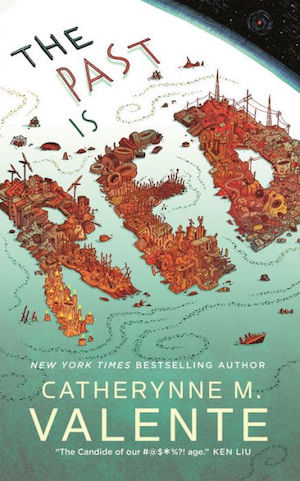
The Past Is Red
And that right there gets at the heart of the appeal of these stories: they give our brains practice runs. They let us mentally and emotionally prepare for the worst in a relatively low-stakes way. (Literally? Rule #1: Cardio.) Hands up, everyone that has at least joked with their friends about their zombie apocalypse survival plan. (Go up the stairs—and then destroy the stairs!) And while there are certainly works in which no one survives, that kind of nihilistic horror is relatively rare and generally seems to sink out of the pop culture psyche fairly quickly; as a general rule those types of stories are emotionally impactful, but they ultimately don’t give our minds anything to work with. We need the stories that show us that there’s a light, however small, at the end of the ordeal. We need the sense that there might be some solution to the overwhelming problem or crisis facing the protagonists. Fiction gives us practice dealing with huge paradigm shifts, which, notably, are much more fun to grapple with when they’re fictional…
Let’s take a look at a less conventional apocalypse story—one which nevertheless shines a light on some of the same ideas. Jojo Rabbit, if you haven’t seen it, is a story of a young German boy who, in the midst of World War II, wants to be a Nazi for reasons he himself is not entirely clear on. The framing of most WWII stories allows us to address them from a historical perspective, but Jojo Rabbit gives us Elsa, a Jewish teenager hiding in the walls of Jojo’s family home—a character who is clearly facing the end of her world, struggling to understand why she is still here and what to do with herself if she survives. Rosie (Jojo’s mother and Elsa’s rescuer) stands defiant in the face of overwhelming odds, and she teaches the two young people in her care how, even when you think you can’t survive, you can and must still plan for survival. She teaches them to focus on what lies beyond this dark and fearful moment, to live for the time when the skies finally clear and you see a new day.
And we need that. Whether facing something like an overwhelming global crisis or a more intimate, personal disaster, our minds have to be able to reach into a version of the future when we survive. That kind of thinking is a muscle, and it takes practice, especially when you’re afraid… but it’s something that you can, again, practice safely within the bounds of fictional stories.
Cory Doctorow’s novel Walkaway, again, isn’t a standard apocalypse narrative. In the book, the ultra-rich enjoy lives of extravagant luxury, and in response, more and more people have embraced the “walkaway” lifestyle, turning their back on “normal” behavior and refusing to participate in the economy, capitalism, or any part of the social structure that’s become so grossly oppressive. The rich are threatened with their own extinction, flipping the script and giving us a chance to see the changes from the other side, or underside (where I think, after all, most of us reside). If these people can turn their backs on the system and live happily with no one at the top of the food chain, then how can the ultra-rich prove that they deserve to be where they are? The status quo is irreparably broken, and the paradigm shifts are coming for “default reality.”
Doctorow’s writing leans heavily into thought experiment, which seems to drive the story more than plot at times, but that’s useful for our purposes because the characters’ philosophies are upended time and again, through massive shifts in technology as well as shifts in the cultural mindset. Doctorow also chooses to move away from conventional, pessimistic apocalyptic storytelling tropes and instead borrows from sociological studies that show that people generally *don’t* turn on each other during disasters. In fact, disasters tend to bring out some of our best behavior, a phenomenon that has surprised people again and again. That’s the best and brightest part of Walkaway: it’s a vision of the world in which, over and over, no matter what changes, people have each other’s backs, people rebuild communities, people choose forgiveness and altruism over greed. Most of the time, people help each other.
Even so, sometimes terrible things happen. Uncontrollable, huge events occur and leave us reeling in their aftermaths. Naomi Kritzer’s story “So Much Cooking!” is the coziest, scariest story I’ve read recently. (I discovered it after her post about it early last year and have compulsively reread it several times. It might be the perfect case for comfort-reading disaster stories!) Lots of apocalypse stories are about flash and bang, filled with events hurtling forward at insane speeds. “So Much Cooking!” gives us something else: a focus on the mundane, the endless waiting, the preposterous (okay, not so much anymore) notion that a lot of survival is…boring. It’s a continuous slog of day-to-day, monotonous endurance when you find yourself sometimes coping, and sometimes sinking into despair, and mostly just coasting and dazed. That should be a relief compared to facing flood or fire…but that daily grind is damn hard, too! Kritzer’s story acknowledges that even the “easy” parts of getting by can be difficult.
The found family that protagonist Natalie creates in “So Much Cooking!”, though, provides a solution to that difficulty. By keeping the kids fed and entertained, she finds a way to get herself through her own boredom and fear.
The thing that connects all of these works—and, in my opinion, ties all the best apocalypse-focused stories together—is the importance of the bonds that we have, or make, with each other. We can’t predict the future (or even the weather, some days, no matter how advanced the technology gets). But we can make plans for survival—not with the goal of being the last man standing, but with the hope of building a community with each other. Hard times are inevitable, but the one thing that remains consistent are the sparks of hope we get from each other, and the family we find or make.
Perhaps at this point you can already see the light coming back; from my far northern latitude here in Alaska, it’s more than a metaphor as the days finally lengthen. What will you uncover? Perhaps with some luck and a little wisdom, we’ll learn and grow more than we imagined we could at the start of this long year. Keep thinking your way through, keep planning for survival, and hold tight (even if the hugs are virtual for now) to the people who spark your hope. And of course, please share any stories that bring you comfort along the way…
Rachel Ayers lives in Alaska, where she writes cabaret shows, daydreams, and looks at mountains a lot. She has a degree in Library and Information Science which comes in handy at odd hours, and she shares speculative poetry and flash fiction (and cat pictures) at patreon.com/richlayers.

Dystopian and apocalypse stories seem to be most popular with the young adult audience. They are more mental primers for dealing with disaster and adulthood than actual events and offer a sense of hope in this survival.
The older I’ve become, the less interest I have in these stories. As a Boomer who lived through the Cold War by hiding under school desks during bomb drills as well as every other disaster or probable disaster since then, I have faith that we will survive. The current insistence that we’re going to die because this is the absolute worst thing in history just makes me sigh and offer up history. COVID, for example is nothing to polio, yellow fever, small pox, the plague, etc., etc.
Link to So Much Cooking! http://clarkesworldmagazine.com/kritzer_11_15/
It’s only been the last month or two that I was finally able to read “Station Eleven” which is a pandemic apocalypse novel. Well done, too. More sensible than “Dies the Fire” series, which was nevertheless vastly entertaining through several volumes (in the years following 9/11). Still, I was one of those avoiding any difficult reading until the actual news of the world improved. Nice job noting those different reactions.
@1
That’s nice but we have plenty, and I mean PLENTY of examples throughout history of whole cultures failing and/or disappearing out completely due to cataclysmic events far beyond their control (Iain Banks would call it an ‘out of context problem’).
Statistics says that while humanity may survive, there is no guarantee your people, your culture or anything you understand as ‘normal’ will.
I cite the entirety of the Americas prior to European settlement, Viking adventurism in the West, various Polynesian catastrophes, various European cultures prior to the crises of the third and seventeen centuries, and finally the fall of the Cambodian (Khmer) empire – where Angkor was once the city-state that held around 5% of the world’s human population, prior to a fall that wiped both its population and culture off the face of the Earth.
I’ve been compulsively re-reading most of my plague/apocalypse fiction and non fiction for the past year. It’s comforting to see how people came through the black death and how they might come through a nuclear disaster. So Much Cooking was a great find and probably the most accurate non fiction.
@@.-@ Since I didn’t specify “we,” moot point. Humans will be fighting the cockroaches for last survivors because that’s what we do.
Are past civilizations really a good guide for how to deal with the Big Doom when and if it comes? After all, they didn’t know how to deal with what was happening, we would and have the technology and knowledge to hopefully solve the problem.
Also, in the wake of the recent shootings here in the US, we need to remember that disasters can still bring out the best in people.
I read a good quote in the book, “Why Indigenous Literatures Matter”. Basically it said that white people write about apocalypse because they’ve got this idea of creating a perfect post-apocalyptic world. But indigenous people don’t, because they’ve already experienced it, and it doesn’t lead to anything good.
@8/Carla: Sweeping statements like that baffle me. For one, “white people” have already experienced it too: the fall of Rome, the black death, Viking settlements in Greenland,… And not every apocalypse written about by “white people” leads to a perfect post-apocalyptic world. The counterexamples are too many to enumerate, so I’ll just mention Nevil Shute and Kurt Vonnegut.
The horror podcast The Magnus Archives has become my comfort listen for the last year. There is nothing obviously comforting about The Magnus Archives. The catastrophes are decidedly NOT cozy. Except, when I was enraged or grieving, the podcast reassured me that I was not alone in my rage or my sorrow. That others felt these feelings, that it made sense for me to feel that way, that it was just and right that I should feel rage and grief in the face of so much disaster. Scary and apocalyptic stories right now make me feel seen and understood.
The Magnus Archives is going to be ending in less than three days. However it ends, horrifically or hopefully (… probably horrifically), I will NOT be ready. But I will always be grateful.
@9 well, I was paraphrasing – the writer might have said ‘modern Americans’ or ‘modern Europeans’. In any case, I don’t think you can compare the story of the Vikings from hundreds of years ago to something that happened within living memory. In Australia, the Indigenous people still living remember being taken from their families and never seeing them again, never hearing their language spoken ever again, without any hope of revivial because there are no longer any living speakers. That’s a bit different from learning in history that the Vikings invaded the top of France.
@11/Carla: You’re right, that isn’t the same thing. I was mostly uncomfortable with the idea that European and European-descendant people generally see an apocalypse as a chance to build something better. Lots of them don’t. But since you were paraphrasing, perhaps the writer said that some of them do, whereas no indigenous person would ever think of such a thing. (Apologies for nitpicking.)
Whenever I hear of an apocalypse in fiction, A movie parody from, I think, Cracked (Mad’s younger, less-refined, competitor) that mashed up Jaques Cousteau and Francis Ford Coppola. “Apocalypso Now” , with Cousteau piloting Calypso up the Mekong. I was 12 or so, and it was very funny.
If you want to read about civilizational collapses in real life, read up on the Late Bronze Age Collapse. Almost all of the civilizations in and around the Mediterranean fell apart in a few decades. So completely that very little is actually known about them.
For example, were a novel pandemic to occur, the nations of the world would have no problem orchestrating a lockdown, steps to prevent the spread, and economic measures to mitigate the financial impact. OK, sure, back in the 1980s the AIDS crisis was bungled because it happened those in power did not much mind if the demographics most affected by AIDS were allowed to die, but that could never happen again.
One of my favorite works of historical fiction is Jane Smiley’s Greenlanders, which covers the slow decline and ultimate collapse of the settlement.
Also recently listened to audio of EM Forster’s classic story, The Machine Stops. It definitely stands the test of time for a work written over 100 years ago.
@3 I was coming here to sing the praises of Station 11! I bought the book and started reading it right as the horrifying 2014 Ebola outbreak was ramping up and the idea of a disease apocalypse was TOO MUCH for me then, so I put it down. I picked it up when, uh, certain people were inaugurated a few years ago, and when I read it then, it was the book’s defiant joy in resistance, culture, storytelling, community, etc., that hit home and gave me hope during the long years that followed.
I’m not a huge YA fan, but I dip a toe into the genre occasionally. Most recently I read The Pox Ward, an e-book by Kendra Griffin. It’s about a pandemic, and what happens when the government starts profiling young people who have it. Highly recommended. Especially as it illustrates how disaster indeed brings out the best, and the worst, in people.
I haven’t read Station 11 yet, it’s in the pile, but after seeing these comments I’ll have to move it up.
I read Dies the Fire some time ago, thought it was okay at the time but didn’t ready any of the sequels.
I remember reading in some scientific magazine that if we ever really did have some kind of civilization busting apocalypse, it was unlikely that humans could rebuild, because most of the easily accessible mineral deposits (iron, copper, tin) have been mined out, and what remains is deep and requires specialized equipment. Don’t know how true that is but it is food for thought.
I think the writer is close. The brain wants to play out dangerous scenarios in advance, which prepare us and numbs us. In order to trick us into playing these scenarios out in our mind, the brain makes it pleasurable. So you are an early human living in the jungle, and you wonder what will happen if you head down to the watering hole during daylight. It helps prepare you to anticipate possible events, and this is what gives humans the advantage. So you go over it in your mind. First, you’ll want to look around for lions. In none are seen, proceed to the water and scoop some carefully, keeping an eye around you…and on the water. Any ripple might be an approaching crocodile. If you see a herd of antelope, be especially on guard for lions, and if they cross the water, watch out for crocs. But if they cross a distance away, that’s good, maybe they’ll draw the crocs. As you play all this out in your head, it titillates you. You are very alert, hyper stimulated. This makes it in a way enjoyable for your brain.
Why apocalyptic? Because it falls under the category of “something that could happen”. Not so much zombies, but since the dawn of the nuclear age, or even the technological age, we know it could all come crashing down. So when we think about that, it’s scary. And our brain has evolved to enjoy that kind of mental stimulation.
Maybe another factor is that there seems to be some utility in trying to plan for this scenario. It’s probably more realistic that the technological world might come to an end than the possibility you will encounter a clown in a sewer. Our minds have incentive to wander down these roads, as the writer mentions with the example of destroying the stairs.
I loved Station 11 when I first read it, shortly after it came out in paperback, and was thrilled to attend a virtual session held with author Emily St John Mandel at Writers Week, part of this year’s Adelaide Festival here in Australia. Come COVID lock-down last year, it immediately came to mind as a topical re-read. Another book I revisited hasn’t been mentioned by anyone else on this thread, namely M.K. Wren’s A Gift Upon the Shore, about two women surviving in a post-apocalyptic world of the near future. I found it even more compelling this second time around.
I adore dystopian/apocalypse stories. Always have, especially as a goth teen when I first discovered them. My reason is that I like the reminder that it could always get worse than what I am living. It’s the same reason I read a lot of historical fiction. Most of us have pampered lives in comparison to what it could be like and so the reminder for me helps me focus. Also I love a hero persevering story; be it in our world like Station Eleven, or a hobbit in Middle Earth.