





Fantasy books and music became inextricably linked in my head one summer in the early 90s. My middle brother gave me his old Walkman, so I could finally listen to music wherever I wanted. My other brother got a job at a nearby bookstore, and brought home piles of Terry Brooks and David Eddings at my request. Walkman+books=happy place for nerdy young Sabaa. To this day, I associate Nirvana, Alice in Chains, and Stone Temple Pilots with Druids, Elves, and Murgos (not in that order).
Finding books that pay homage to music is easy. Finding fantasy books that do the same—a bit trickier. But when I do find them—oh, bliss.
The Naming—Alison Croggon
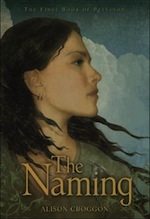 This young adult fantasy novel is the first in a quartet by Australian poet Alison Croggon. The main character, Maerad, is a slave and lyre-player who has grown up almost entirely without friends or family. That changes when she’s discovered by a famous bard named Cadvan. In The Naming, music is deeply connected to magic—and life. Those who practice magic are referred to as bards, and musical storytelling is a valued skill. Croggon sprinkles the book with poems that read like snippets of epic songs. But what I love the most is how much the characters value music—it is as important to them as a family member or a limb. To the wanderer Cadvan, who feels as if he doesn’t truly belong anywhere, it’s more than that, even. When speaking to Maerad about loneliness, he offers this line: “Music is my home.” Four words that perfectly sum up my feelings about music, too. Thanks, Cadvan.
The Name of the Wind—Patrick Rothfuss
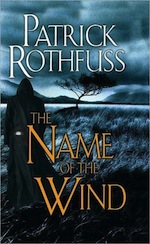 If you read fantasy and you haven’t experienced Patrick Rothfuss’s Kingkiller Chronicles, stop reading this and go buy it. The Name of the Wind is the first in that series and it follows the Kvothe, a musician, wizard, and tortured hero. Kvothe is the son of traveling players, and enormously talented in his own right. During a period in the book when he is too poor to afford a lute to play, the reader can genuinely sympathize with how bereft he feels. When he gets it back, it’s like watching a superhero activate his power. You rest a bit easier, because you feel like he can conquer anything. Kvothe lives and breathes music, and of all the loves he has in the book—friends, family, women—this is the one that I found the most powerful. (Tidbit: Vi Hart sang one of Kvothe’s songs as part of a Worldbuilders fundraiser in 2014. You can find it here.)
Dragonsong—Anne McCaffrey
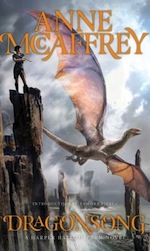 This fantasy is the first in Anne McCaffrey’s wonderful Harper Hall trilogy. All show a deep appreciation for music, but Dragonsong is my favorite. It follows Menolly, a fisherman’s daughter whose father forbids her from pursuing her interest in music, despite her clear talent. In response, Menolly runs away from home. In Dragonsong, music offers Menolly solace in the most difficult of times. It’s a tool she uses to survive the situations she is thrust into. It is also the device through which she self-actualizes. In the same way that I root for two characters to end up together, I spent most of Dragonsong hoping that Menolly got to continue to be with her one true love forever: her music.
The Wishsong of Shannara—Terry Brooks
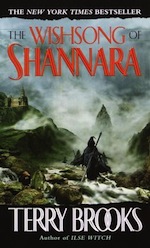 In the third book in Terry Brook’s original Shannara trilogy, a young woman, Brin, along with her younger brother Jair, find that they can do remarkable things with their voices. They call their magic the “wishsong” and its presence in their lives leads (gasp) to a quest to save the world. There are no lyrics or songs in this book, nor do the characters ever express a deep love of music, like in the other books on this list. But what I like about Wishsong is that the music IS the magic—and it can be used for good or evil. In a way, the wishsong is reflective of the characters’ personalities. Like the humans who wield it, it can create and heal, destroy and obstruct. The fact that there are two versions of the wishsong—one that can physically change things, and another that’s only an illusion—makes its role in the book even more powerful and fascinating.
Seraphina—Rachel Hartman
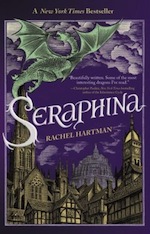 Rachel Hartman’s young adult fantasy gets double points because it’s got music and dragons. Seraphina is a court musician in the kingdom of Goredd, where dragons (who can pass as human) have an uneasy alliance with humans. After a murder in the royal family, the dragons are blamed and the kingdom falls into turmoil. Seraphina must try to stop a war—and keep her own secret while doing it. Seraphina’s musical skill is, in great measure, due to her secret, which makes the music in the book a source of both comfort and confusion for her. But still, she has a deep reverence for music. Though she is exposed to it daily, it still has the power to awe her—and that resonated with me. It helps that Hartman has a clear technical understanding of music. Probably because, according to her bio, she “played cello and lip-synched Mozart operas with her sisters.”
Sabaa Tahir grew up in California’s Mojave Desert at her family’s eighteen-room motel. There, she spent her time devouring fantasy novels, raiding her brother’s comic book stash, and playing guitar badly. She began writing An Ember in the Ashes while working nights as a newspaper editor. She likes thunderous indie rock, garish socks, and all things nerd. Sabaa currently lives in the San Francisco Bay Area with her family. Follow her on Twitter @SabaaTahir.


In Sara Douglass’ Wayfarer Redemption series, music is the path of magic, and you eventually learn that the music of the stars is pretty much a sentient creature.
And as we’ve been discussing in the Dragonlance reread, the way music and songs are used to convey narrative information without falling into exposition dumps, in a way makes the music and poems the omniscient narrator.
Interesting post . . . It’s got me thinking about music in LOTR/Tolkien’s works in general (didn’t see the movies, btw) . . . reflective, walking, memorial, commemorative, praise songs . . . need to reread!!!!
Orson Scott Card’s Songmaster, which contained many elements that would later show up in the novel version of Ender’s Game.
Jack Vance has Gastel Etzwane, the musician protagonist of the Durdane trilogy.
Ellen Kushner’s Thomas the Rhymer, which also gives a starring role to The Famous Flower of Serving-Men. Pamela Dean’s Tam Lin — well, does that actually have much music in it?
Alex Bledsoe’s Tufa novels. Manly Wade Wellman’s Silver John stories.
Hmm, a couple of standards listed and a couple more I think I might have to read. However, there are loads of other great musical fantasy books! The first two that jump to my mind are Charles de Lint’s The Little Country and Emma Bull’s War for the Oaks. Both feature musicians as lead characters and make music central to the plot.
Then of course there’s Wellman’s John with the silver guitar, too. (Must get back in work instead of just listing everything that pops into my head here…)
Gossamer Axe by Gael Baudino. Soul Music by Terry Pratchett. Song of Sorcery and The Unicorn’s Creed by Elizabeth Scarborough. Those are off the top of my head, there’s probably a lot more I could think of, had I the time.
I forgot War for the Oaks! I hang my head in shame, and as penance offer Steven Brust’s The Gypsy.
WAR FOR THE OAKS. I’m glad somebody else mentioned that in the comments because it’s the first thing I thought of when I saw this post. Charles de Lint, too. ? As someone who loves music and books, I think it’s nice to see so many suggestions combining the two.
TINTAGEL by Paul Cook, set in a near-future where an engineered virus causes people to become physically transported to whatever “dream-world” they can imagine when listening to music. Each chapter is named after an orchestral composition and involves a “visit” to that “world.”
How about Allen Dean Foster’s Spellsinger? I read this many (many) moons ago, but the protaganist is a musician from our world who goes to a land where music is magic. What I remember best is that Jimi Hendrix songs end up being particularly potent!
Diamond Star by Catherine Asaro has a whole soundtrack sung by the author. She performs it at conventions. Granted it is more scifi than fantasy. However, it is does have some fantasy elements.
If you squint a bit, you can also make a case for The Silmarillion — at least, the Ainulindale when Eru and the Ainur sang the world into existence and Melkor tried to make the song his own …
Elizabeth Haydon’s The Symphony of Ages.
@@@@@hoopmanjh, it’s okay, I completely forgot Thomas the Rhymer until you mentioned it. The Gypsy is based on a (great) song cycle, but is music really a key point in the story? I don’t remember it having much of a presence other than quotes from the songs, but it’s been at least a decade since I read it, I may have forgotten.
One of my favorite books, SPACEMAN BLUES by Brian Francis Slattery.
We’ve sort of drifted into SF as well here (I blame the page title), but I have to say that this made me think mainly of one of the stories from S.P. Somtow’s Mallworld…
George R.R. Martin’s Armageddon Rag.
@15 — Y’know, it’s been so long since I read it that I’m honestly not sure any more; I do remember that it opens with an extended description of playing the tambourine, though.
Speaking of books it’s been so long since I read … Wasn’t there a musician in Tanith Lee’s Kill the Dead?
(And we haven’t even started getting into the whole rock ‘n’ roll/horror subgenre …)
L.E. Modesitt’s Spellsong Cycle — The main character is a singer, music powers the magic system, and the whole orchrestras and choirs are fielded in battle. Then there is Roger Inn, the warded man’s Fiddler in Peter V. Brett’s Demon Cycle.
Charles de Lint and Emma Bull are the first two that pop into my head too, as mentioned above. Music is intertwined in much of their fantasy.
There is also Stephen Lawhead’s Song of Albion, especially The Paradise War, which combines Celtic mythology with literal song stones hurled at an enemy.
Greg Bear of hard SF fame has the wonderful duology of the Infinity Concerto and The Serpent Mage, all about Coleridge and Mahler and the Sidhe.
L. E. Modesitt has the Spellsong Cycle, starting with the Soprano Sorceress, in which a music teacher from our world is transported to a world where music is magic, and her knowledge of harmony makes for a powerful ability.
Michael Scott Rohan has The Singer and the Sea, where the lays of a mastersmith draw him to the Powers of the Sea.
Sharon Shinn’s Samaria series. Of course it’s sorta scifi rather than fantasy, but is very music centric.
Jack Vance’s “The Moon Moth”. Music is used as a sort of language/expression enhancement, with different instruments used for different conversations/inflection/meanings.
Soul Music has already been mentioned, but there’s also Pratchett’s Maskerade. Opera may be ridiculous, but it’s powerful!
Fire and Hemlock, by Diana Wynne Jones, is based on traditional ballads, has a musician as one of the main characters, his musician friends as supporting characters, and music winding through the story.
To switch genres, music is important in Partick O’Brian’s Aubrey-Maturin novels. Jack and Stephen meet at a concert, almost fight a duel over proper concert etiquette, while away the hours at sea playing violin-cello duets or listening to the foremast jacks singing shanties.
I could make a case for Jane Austen’s novels, while we’re in that period. How a young lady played the piano, and how a young gentleman listened to her, spoke volumes; from Mary’s complex and tediously correct concertos, to Elizabeth’s lively but error-prone performances, to Mrs Elton “determined to neglect her music” while professing her undying attachment to it. And that whole thing with Jane Fairfax and Frank Churchill and the mysterious gift of a piano… yeah, definitely, Austen.
War of the Oaks was already mentioned but the other I think of off the top of my head is Patricia McKillip’s Riddle-Master trilogy.
@20, 21 I can’t believe I didn’t think of the Spellsong cycle.
Mercedes Lackey has a lot of music based fantasy.
@24 Kudos to you on the Diana Wynne Jones. F+H uses T.S Eliot’s Burnt Norton as a structural guide as well.
And her first book of the Dalemark Quartet, Cart and Cwidder show what perhaps it might be like to be young and isolated/empowered by your musical genius.
What about Soul Music by Pratchett?
How about the Old World (Abhorsen) series by Garth Nix?
The most recent book (I can think of) where music is definitely, if not a character, the raison d’etre of the story, is Anna Smaill’s “The Chimes.” I’ve been todding up whether it’s fundamentally Fantasy or SFF & have opted for Fantasy because I don’t think the speculative elements work, except ‘magically’, when extrapolated out from what we know of science… Either way, however, it’s a fascinating concept.
The most recent book (I can think of) where music is definitely, if not a character, the raison d’etre of the story, is Anna Smaill’s “The Chimes.” I’ve been tossing up whether it’s fundamentally Fantasy or SFF & have opted for Fantasy because I don’t think the speculative elements work, except ‘magically’, when extrapolated out from what we currently know of science… Either way, however, it’s a fascinating concept.
James Blish’s short story “A Work of Art” features a recreated Richard Strauss musing on the nature of creativity.
In Julian May’s sci/fi fantasy Saga of the Exiles & Galactic Milieu books, telepaths each have their own musical mind signature, and when they mesh minds with another telepath a ‘metaconcert’ is created. In one book a telepath is talking to his girlfriend and says their metaconcert sounds like Bach, but when he has a metaconcert with his brother, it sounds like Wagner.
There is also Janny Wurts’ Wars of Light and Shadow series, where music is intertwined with the world itself in terms of the Prime Chord.
Dawn brings a heartbreaking note as the sunlight streams across the land.
Not to mention Arithon’s status as a gifted masterbard.
@27: Thanks for reminding me of Cart and Cwidder. I kept thinking there was something else I should be mentioning.
On the darker side, HPL’s “The Music of Erich Zann”: music as battlefield between unfriendly alien forces and an isolated violinist.
Charles Stross’ next “Laundry” series book, “The Annihilation Score”, looks like being very much in this theme.
It isn’t evident in the beginning, but music is definitely a defining characteristic of Peter Orullian’s The Unremembered. By the end the reader realizes that music is all that is holding back the evil. [No, I don’t think this is particularly spoiler-y as it is certainly obvious enough as you begin the journey – it is just spelled out in bold letters by the end.]
I got The Riddler’s Gift by Greg Hamerton as a free Kindle novel, and I really enjoyed it. It also has a musical component, like Elizabeth Haydon’s Symphony of Ages Series. The main character, Tabitha, is the only one in generations to be able to wield the music as magic, and has the power to save the world.
A bit tangential, but if you fancy the idea of dance as magic, Ursula Vernon’s two-book Black Dogs saga is well worth a look.
On a similar note, Russell Hoban’s picture book The Dancing Tigers, a tale of supernatural rebellion in which a hunter’s vulgar music proves the last straw for his prey.
An older one, The Harp of Imach Thyssel, by Patricia C. Wrede.
And seconding Shinn’s Samaria books.
No “War for the Oaks”? Emma Bull nailed Music as Magic.
Some interesting input from authors like Liz Hand and Seanan McGuire on this topic here, too:
http://www.sfsignal.com/archives/2015/04/mind-meld-intersection-music-fiction/
Patricia McKillip’s Song for the Basilisk certainly should qualify, since it has (in addition to the titular sorcerous music) everything from rustic folk music to an opera which functions like an unintentional musical version of the play-within-a-play of Hamlet. And there are some wonderfully deadpan descriptions of really bad singing (“She opened her mouth. A page, entering the room with his arm full of scrolls, stopped dead at her first note. He shivered, hunched over the scrolls, and backed out, making small, birdlike noises.”)
Don’t forget Soul Music by Terry Pratchett where the music really is another character!
In Barbara Hambly’s Dragonsbane series the names of dragons are music and you can enslave a dragon if you know its name. And dragons are addicted to the music of gold.
And how could you possibly forget Salman Rushdie’s The Satanic Verses, where one of the main characters, Saladin Chamcha, sings both the other main character Gibreel Farishta and himself down to safety from a airliner that’s just been blown up? And turns them into caricatures of themselves while doing so?
Bledsoe’s The Hum and the Shiver. Music is vital to the plot.
Thomas M. Disch’s 1979 novel On Wings of Song. Music is banned by the right-wing government in part of
America, and used to assist in astral projection in other regions. The main character is also a professional singer.
http://en.wikipedia.org/wiki/On_Wings_of_Song
Greg Bear’s Infinity Concerto was the first book that popped into my head when I saw the article title, and I was suprised it wasn’t on the list.
Oh good, at least people in the comments mentioned War for the Oaks and Spellsinger. Those were the two that instantly popped into my head when I saw this article. Of the 5 in the Article I’ve only read DragonSong, so perhaps I have some good suggestions to go look for now.
I want to second the love for Bledsoe’s The Hum and the Shiver (and the sequel, Wisp of a Thing). Also, going back a little further, music was central to Manly Wade Wellman’s Silver John stories.
Piers Anthony’s “Apprentice Adept” series is one of the first ones I ever read. It’s a really awesome series where magical and scientific words coexist in a juxtaposed state across a magical boundry. The lead character stumbles across the border into the magical realm and has to survive both there and in his other world. He soon finds that power he builds in one world carries over to the other and not to give anything away, but music is a huge part of one characters magical power. The better you play, the stronger you magic is. It’s featured pretty heavily throughout the series.
Music becomes a crucial (forgotten) art/magic in Kristen Britain’s Green Rider Series. It seems to be gearing up to be explored more in upcoming books.
I thought of Under the Never Sky, by Veronica Rossi, a YA Fantasy where music is an essential part of (the main character) Aria’s identity, her link to her mother and ultimately to her humanity.
Alan Dean Foster’s Spellsinger sequence was my first thought. Anne McCaffrey (a trained singer) also used music in the Crystal Singer sequence, and who can forget the Ship Who Sang!
As Mayhem said, in Janny Wurts’ Wars of Light and Shadow series music and sound play a very important role as it’s part of the energies’ system governing the world of Athera. Most of the description are simply overwhelming!
Ahh, I can’t beleive I didn’t think of Shinn’s Samaria books :) Third-ing that!
And I dont think you have to squint at the Silmarillion to make that fit :) The music of the Ainur is still in the Sea to this day :)
Name of the Wind is awesome :)
Drum and bass is integral to the plot of Mieville’s urban fantasy King Rat.
Isobelle Carmody’s fantasy trilogy The Legendsong also has a very strong musical theme, connected to one of the main characters.
If you want to hear more they do have a three in audio. Dragonsong, Dragonsinger, and Dragonsdrum http://www.audible.com/series/ref=a_lib_l__vsml_1_1?asin=B005NAMI2U took me a while to find them.
Anne McCaffrey’s ‘Crystal Singer’ trilogy?