






While skimming the news, I saw a tweet about the popularity of MILFs. I didn’t have time to read the article itself but the headline didn’t surprise me. After all, MilSF—military science fiction—is very popular within science fiction, while fantasy generally outsells SF, so it stood to reason that military fantasy books—thus, MILFs (no need to google it!)—would be popular as well.
In fact, the problem wasn’t coming up with five fantasies about war. The problem was narrowing my list down to just five.
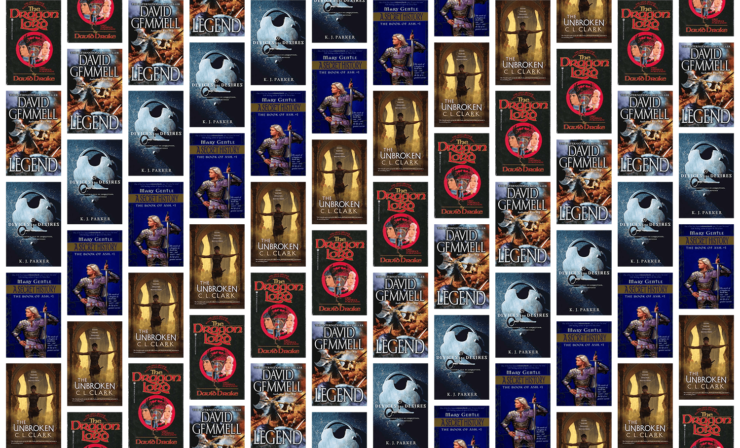
The Dragon Lord by David Drake (1979, rev. 1982)
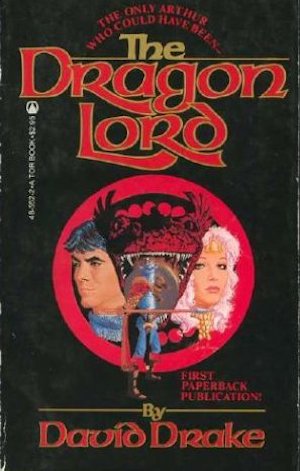
Arthur Pendragon has a simple dream: crush the Saxons, force them to acknowledge Arthur as King, then draft Saxon warriors into Arthur’s legions. He has a grand scheme to unify Britain under the Pendragon banner. To crush the Saxons, Arthur needs a dragon. Inconveniently, the key to Merlin delivering a dragon—a monster’s skull—lies in Ireland. A legion invading Ireland would guarantee resistance from the Irish clans. However, a single soldier might infiltrate enemy territory and return with a skull. If he fails? Well, Arthur can stand to lose a single soldier.
Irish mercenary Mael mac Ronan seems an ideal candidate. Being Irish himself, his presence in Ireland would not raise the questions a Pendragon warrior would. Having publicly embarrassed Lancelot, Mael is at the top of Arthur’s expendable list. And best of all? Mael’s best friend, the Dane Starkad, is a perfect hostage to ensure that should Mael succeed in his quest, he will return with his prize.
Legend by David Gemmell (1984)
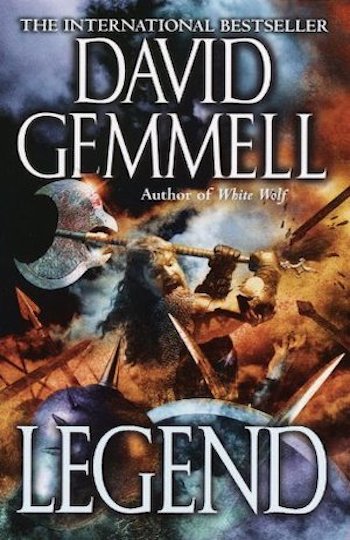
United under the warlord Ulric, the Nadir tribes have carved out a grand kingdom for themselves. The Nadir lack many virtues but it cannot be denied that under Ulric, they have a rare talent for war. To resist Nadir conquest is to die. This is a matter of great concern for the Drenai empire, next on Ulric’s shopping list.
To conquer the empire, the Nadir must first reach it. Between the Nadir and their goal lies a narrow pass spanned by the great fortress Dros Delnoch. If Dros Delnoch can hold back the invading horde for three months, the empire can bring up an army to defeat the barbarians. However, as impressive as the fortress is, the army within it is undermanned. They are convinced that defeat looms. Nevertheless, soldiers like the legendary (and rather elderly) Druss the Ax will do their best before falling.
The empire’s best hope is a slender one.
Devices and Desires by K. J. Parker (2007)
The city of Mezetia is the queen of all the industrialized cities. This is due in no small part to its relentless and ruthless protection of its intellectual property. The mere appearance of having filched a Mezetian secret or two is sufficient to ensure a swift and painful death for the thief and anyone with whom they may have shared the secret. Exterminating whole nations is a small price to pay to maintain dominance… or so Mezetia would assert.
Mezetian wunderkind engineer Ziana Vaatzes is led by his curiosity into heresy. Innovation is synonymous with heresy in Mezetia. He eludes execution but is forced to leave his beloved wife and child behind. All is not lost! Vaatzes has a Plan to reunite with his family.
Step one: offer his services to Ermia’s army, knowing the mere fact that he is supporting Ermia (and possibly sharing industrial secrets!) will be enough to provoke a horrifying response from Mezetia. Vaatzes is as much a sociopath as he is a brilliant engineer and doting husband—his Plan involves oceans of blood and the deaths of thousands of innocent people.
Ash: A Secret History by Mary Gentle (1998)
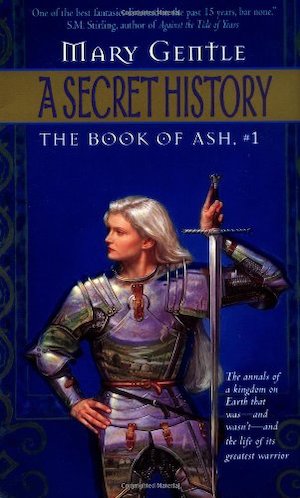
Ash is no mere soldier in the ranks. Guided by infallible voices in her head, the talented mercenary has gained her own army. She dreams of more: a title and lands to call her own. This goal is within reach, if she agrees to marry the odious Fernando. There could be a problem: The legal system grants all power to the husband and very little to wives. No problem at all, really—this wife has a sword and unwanted husbands can always suffer fatal mishaps.
Luckily for Fernando but less so for Ash, Visigothic Carthage is determined to expand their empire into Europe. Worse, their army is led by a woman who could be Ash’s twin, a woman guided by her own infallible oracles. For Ash to prevail, she needs to discover:
- the nature of the connection between her and her duplicate;
- the true nature of the voice;
- why Carthage is so obsessed with Burgundy.
The Unbroken by C. L. Clark (2021)
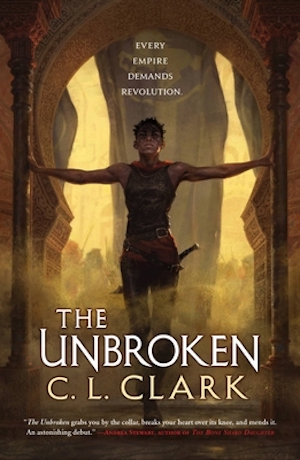
The Balladairans took Touraine from what they regarded as a life of superstition and barbarism in her native Qazāl. Brutal discipline has civilized Touraine. Now she is asked to serve as a Sand, a conscript soldier. Well, less “asked” and more “ordered.”
The Balladaire empire does not lack for confidence. Convinced that Touraine and her fellow Sands have been brutalized into unquestioning obedience, Balladaire dispatches Touraine and her company to Touraine’s native Qazāl to suppress a rebellion in El-Wast. It is unthinkable to Balladaire’s ruling class that their slave-soldiers could consider rebellion. As it turns out, unthinkable and impossible are two entirely different things.
***
Of course, these are only a few book from a very large field. No doubt you have your own favourite examples of military fantasy. Feel free to mention them in the comments.
In the words of Wikipedia editor TexasAndroid, prolific book reviewer and perennial Darwin Award nominee James Davis Nicoll is of “questionable notability.” His work has appeared in Publishers Weekly and Romantic Times as well as on his own websites, James Nicoll Reviews and the Aurora finalist Young People Read Old SFF (where he is assisted by editor Karen Lofstrom and web person Adrienne L. Travis). He is a four-time finalist for the Best Fan Writer Hugo Award and is surprisingly flammable.

The Deed of Paksennarion and the sequel series Paladin’s Legacy, by Elizabeth Moon.
Ilona Andrews doesn’t write military urban fantasy, but one of the two writers has a military background so I’m always impressed by how well the fight scenes, battles, and wars are written. I always recommend the Kate Daniels series as a master class in the subject.
Eaters of the Dead by Crichton is fantasy adjacent.
C
the Nadir tribes
Can David Gemmel go any lower?
Be happy the good guys weren’t the Zenith.
What about the “Temeraire” books by Naomi Novik? Dragons + Napoleonic War = Good Times
Or…”A Wizard’s Guide to Defensive Baking” by T. Kingfisher (ok, maybe not military, per se, but castle defense!)
_The Black Company_ by Glen Cook (and other Glen Cook titles as well).
The March North by Gaydon Saunders is a really excellent operational level military fantasy.
“The shadow campaigns” series by Django Wexler is great and fits here nicely!
Re: David Gemmel
Rejoice that he didn’t use other directions, so it wasn’t the Orientals versus the Occidentals.
Well, bother. This was pointed out to me on rasfw: David Drake is retiring.
https://david-drake.com/2021/newsletter-123-the-last-one/
Steven Brust’s Vlad Taltos normally deals in hand-crafted, artisanal violence rather than the mass kind but in Dragon he spends time in a military unit on campaign.
The swordsmen in Dave Duncan’s Seventh Sword trilogy also normally deal in violence on a small scale, but the protagonist has to figure out how to organize them into an army. (They have institutional knowledge about how to do this, but it’s sort of the equivalent of having old training manuals which everyone had to read and sign off on when they were hired, but never thought about again.)
And we know why you said not to google it…
How about Steve Erikson’s “Malazan Book of the Fallen”? Ten volumes of epic military (and other) fantasy. The first volume is incredible and it doesn’t let up.
Unlike certain other long series of doorstops I could name but won’t.
David Weber’s Oath of Swords series have some big scale and small scale military stuff. I enjoy the series a whole lot, for the characters, I hope the military stuff is enjoyable for those that like it.
The Daniel Abraham five-parter “The Dagger and the Coin” is partly war, partly war-by-other-means (e.g., economics), partly covert war, and all interesting. Premise: wouldn’t it be nice if someone could tell truth from falsehood? Answer: not the way it works here.
Most of K. J. Parker involves war in some form — usually from the viewpoint of military engineers rather than sword-wielders, but war nonetheless. Perhaps the least-obviously warlike is Sharps (~”We’re just going for a fencing competition!”), but Sixteen Ways to Defend a Walled City is exactly what its title says. (Unlike the Abraham, there’s no overt magic — but the world-that-doesn’t-exist line commonly gets treated as fantasy, and “Parker” is a long-standing humorist fantasist under his own name.)
Stephen Donaldson’s two-parter “Mordant’s Need” has some of Donaldson’s tics, but it is a lot better than either Covenant or the Gap books; most of the story is the preparations for the battle that takes the almost-last ~100 pages.
Hell, the Silmarillion is more than a thousand pages of war, tragedy, deeds of great valor, disastrous defeats, undaunted courage, sieges usually ending in wholesale slaughter, with a few drowning of continents thrown in. A few MILF too, which I am positive Tolkien didn’t notice slipping in.
The Shadow Campaign books by Django Wexler. Such a great underrated series
No mention of The March North by Graydon Saunders?
18: I believe it was mentioned by a commenter in the comment immediately before this comment of mine.
In terms of martial stories, my thoughts run to Jim Butcher’s Codex Alera, especially in the middle section starting with Cursor’s Fury (where the protagonist is hiding out an an Legion junior officer and then has to lead men into battle).
Pratchett’s “Monstrous Regiment”, of course.
There is a big difference between MILF and MILSF. Please don’t confuse the two.
Linda Nagata – Red Series universe – great characters & plot
Red is near future MilSF imo.
How about the last book of the Belgariad?
Drake and Flints Belsarius series?
Flints 1632 books?
Lord of Light by Roger Zelazny has some great battle stuff. It’s old but a classic.
Re: David Gemmell and the Nadir – he never intended to publish the book. It was a writing exercise to distract him from a false cancer diagnosis, with the Nadir literally being a metaphor for the cancer he thought was killing him.
Also suggest the Deeds of Paksennarion by Elizabeth Moon. And while it is more sci-fi, and there is no actual war though lots of fighting, the Murderbot Chronicles by Martha Wells.
And I LOVE, LOVE, LOVE Mary Gentle’s Ash: A Secret History. Glad it is getting some love here.
How about Sherwood Smith’s Inda series- with armies and navies and pirates!
Another great Mary Gentle MILF is her novel Grunts. Orc Marines, what’s not to love?
@29 Also, Mary Gentle’s side eye at the ‘niceness’ of halflings in that book. Um, nope.
@30, is that with a herb and garlic sauce?
@29 Complete with probably the most politically incorrect comment in SFF ever… I won’t quote it as it will probably get me in trouble with the mods.
Um. Rohan had come at last.
What, no mention of Elizabeth Moon’s “Serrano” books? I am of the opinion that they’ve withstood the test of time fairly well.
I’ve actually been reading a more recent series that sort of defies genres. Glynn Stewart’s Starship’s Mage series. The first one isn’t entirely MilSf, but most of them are. It’s a fascinating mix of sci-fi and fantasy.
I can’t believe no one mentions Brent Weeks: The Black Prism (Its book one in the Black Prism series).
The Battles are pretty epic and the magic system is the coolest I’ve ever read. Believe it or not I read the first three books in the Black Prism series before stumbling on Warbreaker by Brandon Sanderson (which was my favorite Sanderson book) which in inevitably lead to The War of Kings of course.
Joe Abercrombie is worth a mention. For a stand alone try The Heroes, which has characters first found in the First Law trilogy. The Heroes is quite light on fantasy, I think, but has a few mages doing their stuff. The story is basically the build up to and fighting of a single battle in the First Law world, and is a very fast paced story with memorable characters. There is a particularly memorable chapter which i can’t say anything about without giving away spoilers, but if you read the book you will know the one I mean.
As an aside, the Age of Madness trilogy carries on in the world of the First Law featuring the children of some of the original characters, as industrialisation affects the world.
The Black Company series by Glen Cook is some of the best military fantasies ever as far as I’m concerned
I still love Tanya Huff’s Confederation series, starting with Valor’s choice. Fun military scifi – though have to admit the covers are a little off-putting, especially the early ones