






In February 2022, when I wrote the first season version of this article for this site, I felt more of a need to introduce Severance, a dark satire of corporate life that was watched by a small but loyal fan base. In the three years since I wrote that last article, Severance has broken records for AppleTV, and the popularity and water cooler conversations about the show have been remarkable. It also has a 96% critical score on Rotten Tomatoes, and many critics called it the best show on television.
Severance stars Adam Scott as Mark Scout, an office worker at Lumon Industries. The work at Lumon remains mysterious and important to the members of Macrodata Refinement. The employees working in an underground complex at Lumon undergo an experimental procedure called severance: A chip in their brains divides their lives and memories of work and home into separate realities. Once Mark and his co-workers enter the elevator, the switch happens. The “innies” and “outies” do not know each other. The second season picks up the story after MDR innies manage to trigger what is called “The overtime contingency,” which allows them to gain a glimpse into their outies’ lives.
The second season also goes deeper into the backstory of Lumon, and expands on many of the themes that science fiction viewers have identified as Phil Dickian. Dan Erickson, the creator of Severance, has never listed Philip K. Dick as an influence, but as one of the most prolific and adapted SF authors of the 20th Century, his influence is sometimes found in second and third degrees of separation. We have to start at the beginning…
The PKD Formula and General Themes

“I can sense the questions made you feel afraid or disoriented. Well, the good news is, you’re at an orientation.” —Mark S. (“Good News About Hell,” S1E01)
Perhaps the most Philip K. Dick moment of the series occurs during the opening scenes, using tactics PKD outlined in his personal formula for novels. It was intuitive, used to write and publish around a dozen novels before he articulated it. This was in a five-page letter to fellow Berkeley writer Ron Goulart, who asked him for advice when he was starting his first novel.
This letter was mentioned in the Philip K. Dick Biography Divine Invasions (1989) but it was not studied in detail until a few years ago when Ron Goulart was dying and sold the letter to a collector Randall Radin. Fans and scholars have begun to study and experiment with the formula now that it has become available. I devoted an entire chapter of my forthcoming book Unfinished PKD to the formula and have experimented with writing my own novel guided by the formula.
Severance, as a series, unintentionally opens using the PKD formula as laid out in the letter:
Ch i. First character, not protagonist but <<subhuman,>> that is, less than life. A sort of everyman who exists throughout the book but it is, well, passive, we learn the entire world or background as we see it acting on him; he is <<the guy who has to pick up the tab,>>the <<Mister Taxpayer>> etc. Okay. Dramatically we get little him, but, more important, we see the world we are going to be inhabiting[…]
The series opens with Helly R. (Britt Lower) waking up on a table, being the ultimate subhuman. The innies represent what PKD called chapter one subhumans, and he used this method to do subtle world-building. We learn the world of Severance by how it is acted upon Helly R during the first scene, but also how the team of Macrodata Refinement is treated through the first few episodes.
Helly doesn’t know who she is, how she got there. This sets her up to question reality throughout the first season; after orientation, Helly is never passive, inspiring her co-workers even as she is forced accept what life she is given. In one of the most PKD moments, Helly has to watch a video recorded by her outie who tells her she is not human: “I am a person and you are not.” This is a very Phil Dickian nightmare where the characters’ reality and their very humanity are questioned by versions of themselves. One of the best examples of this is the 1969 short story The Electric Ant, a piece about a man who discovers he is a robot, and is disturbed that no one seems to care. It is so common a theme in PKD’s work from Imposter (1953) to A Scanner Darkly (1977), it is almost impossible to develop a complete list.
Mrs. Cobel (Patricia Arquette) and Milchick (Tramell Tillman), through their representations of Lumon and cult-like belief in Keir Eagan, represent what Philip K. Dick considered the protagonist:
Ch ii. The protag. Here he is. Mr.(as Bob Gilbert would say) Stonecypher; The character with the two-syllable name (as contrast the subhuman in ch I, who is named Al Glunch some unlikely short type name. What in reality the phonebook is full of… and for good reason; this is the <<other half>> of the world). Ah. Tom Stonecypher. He works for—and here comes the institute or organization or business[…]
According to the PKD formula, the characters introduced in chapter two generally have an arc that melds their story with the subhuman. In the case of Severance, we unintentionally see the PKD formula at work. The innies/employees of Lumon spend most of the first two seasons at odds with the protags who work for Lumon. Cobel and Milchick slowly realize that they are also pawns.
Part of the PKD formula is for the story to contain both personal and world-sized themes. Each of the innies storylines has a personal arc, while connecting them to larger conspiracies. The innies in the main cast each have arcs that run parallel to their outies. In the PKD formula, the novel would draw the subhuman and protags stories together starting in the third chapter:
Ch iii Now. We switch tracks, and begin to develop in a manner forbidden to a short piece. We continue with both Mr. S and the subhuman Mr.Gulch… in a sense. But in another sense, although technically we carry on with Mr. S, we are in another dimension; that of the super human. This is the huge They problem, for instance, an invasion of Earth, another sentient race, etc. and through Mister S’s eyes and ears, we glimpse for the first time this superhuman reality[…]
The arcs of Mrs. Cobel and Milchick are as personal as innies. They begin the series as foils, with the job of maintaining the simulated reality of the corporate workplace. As the PKD formula describes, “He works for—and here comes the institute or organization or business…” After the chapter three track switch, the storylines of subhumans (severed employees) and superhumans (corporate management) come together. Cobel was raised in the Keir cult and is revealed to be the mastermind of the severance process. Milchick begins to have a change of heart when he is given a racially insensitive gift by Lumon’s upper management. These personal arcs connect to a larger science fictional tale of Severance, or what PKD calls a “They” problem as a larger sci-fi issue, in this case, the severed workforce and the mission of the Kier cult.
And so in a sense at the latter part of the book the two worlds or problems or dramatic lines fuse […] This encounter of the Atlas domain with the personal-problem of Mr. S. is the summa of the book, because the long-maintained division between the vast They problem and the purely personal Mr. S problem has ended; the book all at once achieves a unity, the threads form one Gestalt.
The series has at least one remaining season, and how the threads form one gestalt remains to be seen, but the seeds of this ending are forming. It is at this point accidental, and a function of this type of well-composed storytelling, but Severance appears to fit the PKD formula nicely.
Simulated and Manufactured Realities

“Isn’t a miserable reality better than the most interesting illusion? Or is it illusion?” —The Three Stigmata of Palmer Eldritch (1964)
In my article about season one, I dived deep into memory manipulation, a theme PKD most famously explored in the short stories “Paycheck” (1953) and “We Can Remember It for You Wholesale” (1966), both of which were made into Hollywood films. Illusions can be the backbone of stories set in a personal cosmos, like the 1959 setting of Time Out of Joint (1959), or just a world-building detail, like the 3D California vista projected on the wall outside of Joe Fernwright’s Cleveland apartment in Galactic Pot-Healer (1969).
This was a major theme of the first Severance season, and continues in the second, but the mystery and separation with outies have been shattered by the overtime contingency.
The opening episode of season two is about Lumon trying to reestablish the simulated realities they built. Micro-reality or personal cosmos concepts is one of PKD’s favorite tropes to play with—he explored simulated realities in the novels Eye in The Sky (1957), Time Out of Joint (1959), The Three Stigmata of Palmer Eldritch (1964), and A Maze of Death (1970), although many consider his best novel on the subject to be UBIK (1969).
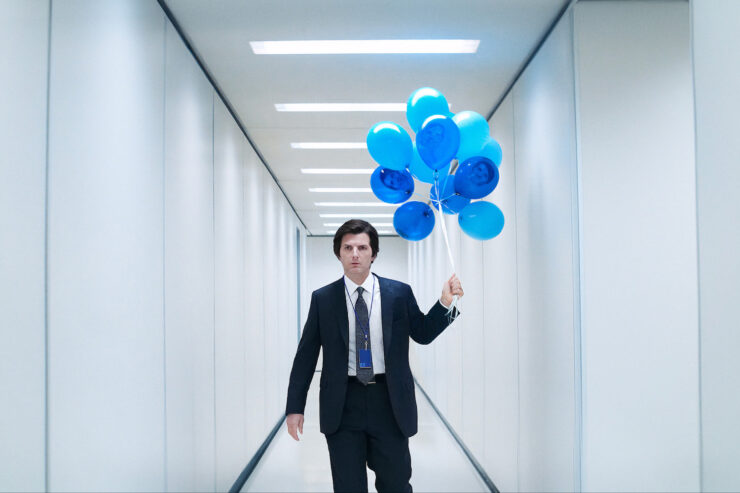
The first episode of season two, “Hello, Ms. Cobel” opens with Mark S. awakening in the elevator for the first time since his glimpse into the outie world. He steps off the elevator, and instead of going to Macrodata Refinement, he begins searching for his outie’s wife, the woman he knows as Ms. Casey. The seemingly endless run feels like a time loop. Eventually, Mark S. realizes he can’t escape, and Milchick gives him balloons to celebrate his return, claiming that his outie begged to be back at work.
This reminded me of the fifth chapter of The Three Stigmata of Palmer Eldritch when Leo Bulero is first given the drug Chew-Z and is unable to escape the drug-created reality. No matter how many times he thinks he escaped, he is still in the simulation.
I know what’s going on, he realized. This is Palmer’s way of gaining domination over my mind; this form of what they call brainwashing.
Mark S. is introduced to a new MDR team and given a newspaper with a fake headline that comically shows the old MDR team in a ticker tape parade as the face of severance reform. The headline on the paper reads, “Innies Blow the Whistle.”
The amount of propaganda, manipulation, and brainwashing is similar to the PKD novel Time Out of Joint. Ragle Gumm notices things being out of place when a soda stand is not where it is supposed to be, replaced by sign with block letters that simply say SOFT DRINK STAND. The sign was marking where the soft drink stand was supposed to be in the manufactured reality. He begins to see little hints that this version of 1959 is off: “We have a hodge-podge of leaks in reality.”
Like Time Out of Joint, Severance is filled with little clues that suggest a manufactured reality even for outies. One of the best examples are the cars; the newest car seen on screen is from 1996, and does not have a state but Kier license plates, which read “Remedium Hominibus,” meaning “a cure for mankind,” with the face of Kier Eagan at the center. In season two, more than one calendar says the current Lumon Year is the “Year of Vision.”
It doesn’t matter if the environment is a computer simulation or manufactured by a corporation; the experience of the innies is a fake reality meant to create slaves out of living people. One thing that makes them compliant workers is they know nothing about the outside world. This is highlighted in “Woe’s Hollow” by Dylan reacting to the team’s outdoor retreat: “Holy shit! Out-fucking-side. Oh, my God. I mean, I knew there was no actual ceiling, but this is fucking insane.”
The 1952 short story “The Defenders”—later expanded into The Penultimate Truth (1964)—is set in the ashes of a devastating war, and might not seem to share much in common with Severance, but the human survivors live in the Undersurface (anthills in the novel) while robots called leadies fight on the unlivable surface. At least, that is what the workers building weapons underground are told. They do this because of cult-like devotion to an almost mythological president, Talbot Yancy, who is also a robot. The devastation is false, making the war itself a simulated reality meant to give the Earth time to rebuild.
Many Philip K. Dick short stories are about characters who are forced to confront or question their own humanity. “Imposter, Human Is,” and “The Father-Thing” are short stories from the early fifties with characters who have family and friends who don’t recognize them. When the MDR team discovers that Helly R. never returned and was replaced by her outie in season two, they feel betrayed and rattled. Only Irv (John Tuturro) sees through her deception: exposing her is worth it to Irv, even if he knows once he is terminated by Lumon, he will no longer exist. This is a contrast to Helly, who goes from wanting to end her life, to fighting for it.
“Whatever this life is, it’s all we have. And we don’t want it to end. Can you understand that?” (“Cold Harbor,” S2E10)
When Burt “retires” in season one, Irv is unable to celebrate because he knows innie Burt will no longer exist. This is similar to PKD’s A Maze of Death (1970), the story of the crew of a spaceship heading to a colony world, Delmak-O. They discover they are living in virtual realities, unsure if they are insane, being used in experiments, or already dead. Seth Morley, the main character of the novel, makes a similar decision that he would neither live in the illusion or be nothing; he makes a very unique choice. (Spoilers for A Maze of Death ahead…)
“Intercessor said, “I am here to take you away. Where would you like to go, Seth Morley? What would you like to be?”
“An illusion, you mean?” he said. “like Polyencehalic worlds?”
“No,” The Intercessor said. “You will be free, you will die and be reborn…”
“I’d like to be a desert plant, Seth Morley said. “That could see the sun all day. I want to be growing. Perhaps a Cactus on some warm world. Where no one will bother me.”
Seth chooses to become a cactus instead of living in the illusion. In the episode “After Hours,” innie Dylan attempts to resign from Lumon Industries after his wife tells him she can’t visit him, because his outie is jealous of their time spent together. In the next episode, “Cold Harbor,” his outie responds with a letter thanking his innie and expressing a desire to be more like him. This reversal gives meaning to a life Dylan considered an illusion. This prevents Dylan from the nothingness and non-existence that Irv accepts. Outie Irv also decides to get on a train at outie Burt’s suggestion to escape Lumon, in a sense leaving everything in his life behind.
“This desk used to have four seats. Our friend Irving is gone, and they want our whole department gone. If he gets out, we’re dead. They’re gonna turn us off like fucking machines. You’ve seen them do it. I know you’ve lost friends, too. And you could be next.” —Helly R. (“Cold Harbor,” S2E10)
The artificial realities of Severance break down as more is revealed, but the PKD trope of fractured or manufactured realities comes into play in almost every episode.
The Work is Mysterious and Important
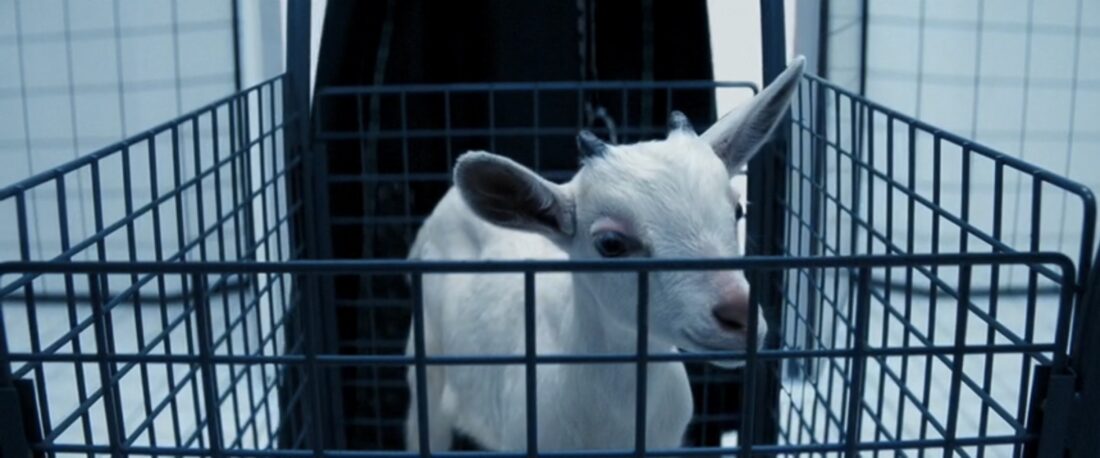
In the first episode of Severance, Helly R. calls the work of Macrodata Refinement bullshit and Mark S.’s response has become a meme: “The work is mysterious and important.” The mystery of what they are doing is not solved until late in the season. This is similar to Ragle Gumm in Time Out of Joint: His job involves doing work without a clue about what it is he is actually doing. Gumm daily fills out a crossword-like word puzzle in a national newspaper contest called “Where Will The Little Green Man Be Next?” The reader learns that he is predicting the sites of enemy nuclear strikes. The idyllic illusion is meant to protect Ragle Gumm from the stress of responsibility.
In The Zap Gun (1967), there is a shift from destructive open conflict to a Cold War maintained by designers who create increasingly ridiculous weapons to scare world leaders from going into open warfare. One character, Surley G. Febbs receives a letter: “Greetings! Said the letter, delivered by ‘stant mail. You have been selected out of millions of your friends and neighbors. You are now a concomody.” This position is the office of chief consumer representative. The subplot of a man chosen because he is “average” has lots of workplace humor that is similar to Severance.
This occurs to Seth from A Maze of Death, who doesn’t see any purpose for what they are doing:
“I want to contribute something; I don’t want to be just a consumer, like the rest of you.” His tone was hard and flat and very earnest. “We live in a world created and manufactured from the results of the work of millions of men, most of them dead, virtually none of them known or given any credit. I don’t care if I’m known for what I create; all I care about is having it be worthwhile and useful, with people able to depend on it as something they take for granted in their lives. Like the safety pin. Who knows who created that? But everyone in the goddam galaxy makes use of safety pins… It wouldn’t matter, if this whole colony, everybody in it, died. None of us contribute anything. We’re nothing more than parasites, feeding off the galaxy. The world will little note or long remember what we do here.”
Early in the series, the innies are motivated by ridiculous and meaningless perks like finger traps, the ultimate being the coveted Waffle Party. Milchick says at one point, “Hey, I know this has been a tough quarter. I’m gonna see about rustling you up some special perks. That sound good?” Inspired by Helly’s rejection of the workplace life, the innies begin to seek more meaning.
Bardo and Half-life

“Let not weakness live in your veins, cherished workers, drown it inside you. Rise up from your deathbed and sally forth, more perfect for the struggle.” —Keir Eagan
A novel in the PKD catalog that captures much of the Severance blend of weird, satire, and mystery is UBIK. The novel started life as an idea about corporate espionage. The characters in the novel work for an “anti-talent” agency called Runciter Associates that is supposed to nullify psychic powers and protect corporations from telepaths and precogs. Years before he wrote the novel, Phil wrote a 17-page outline for a novel he intended to call “Anti-Talent.”
The outline introduces what, at the time, Phil considered a secondary theme of communication with the dead, during a Bardo-like time called Half-life. The Oxford definition of Bardo is “(in Tibetan Buddhism) a state of existence between death and rebirth, varying in length according to a person’s conduct in life and manner of, or age at, death.” Half-life only lasts a week, but the freezing process can extend the time for years, and each half-life call eats into the limit. There are funny details of world-building in the outline:
At Christmas time, traffic at the suspension lockers is especially heavy. In your will you can specify when you will be brought back for news of the world; continual news-drums repeat summaries of recent history like the telephone time-lady does.
This outdated mode of technology is woven throughout the worldbuilding of UBIK under the name ‘Cold-Pack.” In a very Phil Dickian way, there is a bill attached. He explains that it is an expensive process, that the body is required, and if the bill is not paid, the body is buried.
Fans of UBIK will know the Bardo connection—Severance’s seventh episode of season two was called “Chikhai Bardo.” The literal translation of the episode title is before death. The Bardo Thodol is better known in the west as The Tibetan Book of the Dead. The Tibetan text is intended to guide one through the experiences that the consciousness has after death, in the bardo, the interval between death and the next rebirth. In UBIK, people are assigned the text to prepare for Half-Life. Glen Runciter talks to his dead wife Ella in Half-Life about the book:
“I was dreaming,” Ella said. “I saw a smoky red light, a horrible light. And yet I kept moving toward it. I couldn’t stop.”
“Yeah,” Runciter said, nodding. “The Bardo Thodol, the Tibetan Book of the Dead, tells us about that. You remember reading that; the doctors made you read it when you were –“ He hesitated. “Dying,” he said then.
The “Chikhai Bardo” episode is told in flashbacks, through the point of view of Gemma Scout, who is going through a series of experiences that test the severance chip’s ability to shift between many different innies. The title is meant to invoke a Half-Life.
There are more thematic connections to UBIK: A major part of the novel is that the characters don’t realize they have been killed and are living in Half-Life, until a series of clues start to break down the illusion. This mystery, and the way the characters solve it, is similar to the first season journey of the innies. Eventually, Runciter’s boss, just tells them, “Jump in the Urinal and Stand on Your Head. I’m the One That’s Alive, you’re all Dead.” This is done by graffiti on a bathroom wall. Much like the innies in Severance, the employees of Runciter associates are exploited and misled to keep working: “We’re in half-life. Probably still on Pratfall II; we’re probably on our way back to Earth from Luna, after the explosion that killed us—not Runciter.”
The Outie Family Visitation Suite which connects the outies to the innies certainly had the feeling of the Beloved Brethren Moratorium which runs the Cold-Pack.
One possible connection, although still a theory and unconfirmed, is that The Board and Kier are in Half-Life, and that the weird mechanical Kier could be the best available avatar they have for him. The souls of innies also become an issue in “Attila” when Burt’s (Christopher Walken) husband Fields (Jon Noble) explains why Burt worked on the severed floor. The sermon at their church said that severance made innies with full souls, judged separately from the outie, so Burt’s innie could go to heaven to be with Fields “whilst the outie burns.”
Cold Harbor, Doppelgangers, and Artificial Humans

One of the best mysteries of Severance was the meaning of the Cold Harbor file, the work that the MDR team was doing in the second season. It was finally revealed in the last episode of season two that the Cold Harbor file was connected to the creation of the last innie for Gemma Scout after she visits multiple rooms (the names of the rooms matching the names of previous MDR files: Billings, Lucknow, St. Pierre, Cairns, Zurich, and Wellington), each with a different innie personality for Gemma. In each room, the innie is subjected to trauma or pain, and the world-changing achievement of Lumon’s “grand agendum” appears to use the severance chip to free users from pain. The Lumon PR person, Natalie Kalen (Sydney Cole Alexander) says, “I’m here tonight to tell you that we are on the verge of a revolution. A kind and empathetic revolution that puts the human being at the center of industry.”
The idea that the severance technology can erase or manipulate emotions is a very PKD form of metaphysical technology. It reminds me of the Penfield Mood Organ in Do Androids Dream of Electric Sheep? In the novel, a dial can be set to hundreds of emotions for the user to experience. If you dial 888, for example, you will feel a desire to watch TV, but of course, if you are having a negative thought or pain, you can just dial it away. The Dr. Smile therapy AI briefcase in Three Stigmata of Palmer Eldritch measures ten levels of Freuds, of course named for Sigmund Freud. Pain is connected to a device in Severance as well: the WoeMeter is an electronic device that measures a person’s level of misery or woe. This helps the Lumon team measure if Gemma is experiencing pain.
One element added in season two is hinted at in “Hello, Ms. Cobel” when Mark, for just a moment, sees a copy of himself in the hallway. This is expanded in “Woe’s Hollow,” when each member of the MDR team sees a twin of themselves. The themes of twins and dopplegangers is personal one for Philip K. Dick. He used the theme in three novels: In Dr. Bloodmoney (1965), seven-year-old Edie Keller has a psychic connection with a vestigial twin, Bill, who lives near Edie’s appendix. Flow My Tears the Policeman Said (1974) has a police officer named Felix Buckman who has a mental collapse after his twin sister Alys dies of a drug overdose. The Crack in Space (1966) has conjoined twins who run a space brothel. (For a great article on PKD and twinning, here’s one by David Gill, published here on Reactor in 2022.)
According to the Lumon mythology, Dieter Eagan is the twin brother of Kier Eagan. His story is told in the Fourth Appendix of the Lumon Handbook. The location of the outdoor retreat in “Woe’s Hollow” is called the Dieter Eagan National Forest. Irv reads in the story from the Fourth Appendix that this forest is where Keir and Dieter went to become paupers. But Dieter pleasured himself in the woods until “becoming an instrument of nature, spilling his lineage upon the soil.”
When the MDR team see their twins, Milcheck makes a statement that Philip K. Dick would have related to. “Kier’s twin was always with him.” The symbolism of the Eagan twins appears to represent the innies and outies: Kier represents the restricted inner life, and Dieter represents the wide-open outside world. There are many fan theories about the doppelgangers, but it remains an open mystery.
The Whole Mind Collective (WMC) is the only known activist group openly opposing severance. This is a minor detail, but reminds me of the type of group that PKD would throw into the worldbuilding of his early ‘50s stories. Part of the casual dehumanization of innies happens in very subtle Dickian ways: When Dylan interviews for another job, the fact that he has been severed is a dealbreaker. PKD did not like the idea of artificial people and found the concept to be frightening. I think he would also have found the idea that your body was off living a life that he knew nothing about frightening as well.
“The impression you’ve left on me is indelible, though I’m unaware of it on a conscious level, and… I will never forget any of you, even though sitting here right now, I have no recollection of actually ever meeting you and no idea of your names or any of your physical characteristics or even how many of you there are.” —Burt Goodman (“Defiant Jazz,” S1E01)
The Cult of Kier

Philip K. Dick’s first attempt at a novel in 1948 was a gnostic fantasy called Earthshaker. He didn’t finish it but, interestingly, his last completed novel (The Transmigration of Timothy Archer, 1982) was also religiously themed. It shows a lifelong interest in exploring religious concepts. Much like the Cult of Kier, PKD created fictional religious belief systems in many novels and short stories. Some of the best examples are found in VALIS (1981), Do Androids Dream of Electric Sheep (1968), Deus Irae (1976), Galactic Pot-Healer, The Divine Invasion (1981), and the short story “The Turning Wheel” (1953).
One of the most Dickian ideas presented in Severance is the Lumon Cult of Keir. Irv, the devoted innie, initially shows a fanatical belief in Keir, as most of the employees of Lumon do. Keir as a character reminds me of Three figures PKD wrote about: Talbot Yancy (“The Mold of Yancy”/The Penultimate Truth), Elron the Bard in “The Turning Wheel,” and of course Wilber Mercer in Do Androids Dream of Electric Sheep?
Consider The Four Tempers, the fictional philosophical framework developed by Kier Eagan:
“In my life, I have identified four components, which I call tempers, from which are derived every human soul. Woe. Frolic. Dread. Malice. Each man’s character is defined by the precise ratio that resides in him. I walked into the cave of my own mind, and there I tamed them. Should you tame the tempers as I did mine, then the world shall become but your appendage. It is this great and consecrated power that I hope to pass on to all of you, my children.”
In 1953, a twenty-six-year-old Philip K. Dick wrote “The Turning Wheel” as a reaction to his mother telling him that she was interested in Dianetics and Scientology. In the story, Elron Hu the Bard, a religious figure from the “Time of Madness,” inspires the beliefs of the Holy Arm. The Basic Catechisms of Elron Hu—Ten Catechisms taught by Elron as outlined across his seven books of teachings—are laid out just as the Four Tempers.
The comparisons don’t end there. In “Sweet Vitriol” Ms. Cobel goes to a rural, miserable factory town called Salt’s Neck. Much like miserable Mars in Three Stigmata of Palmer Eldritch where colonists take drugs like Can-D and Chew-Z, the residents use drugs as escape and devotion. Ether, the product of the now-defunct factory and current predominant recreational drug, was known in the Kier cult as the “sweet oil of vitriol.”
One of the most important fictional religions in all of the PKD universe is Mercerism in Do Androids Dream of Electric Sheep? In the novel, we find followers of Wilbur Mercer, a Christ-like figure who represents suffering, resilience, interconnectedness, and empathy as the ultimate virtues. His followers connect with a simulation of him climbing and falling down a hill through a device called an Empathy Box: “Because Wilbur Mercer is always renewed. He’s eternal. At the top of the hill, he’s struck down; he sinks into the tomb world, but then he rises inevitably. And us with him. So we’re eternal, too.”
The memory manipulation and the questions of what is reality or human are the most obvious of Dickian themes in Severance, but so is the exploration of belief in a higher power through fictional religions or gods in the form of powerful drugs and technology that connect his characters to a higher truth.
The popularity of Severance is deserved, but I am surprised by the degree to which the show has become universally embraced as a water-cooler show. The work of Philip K. Dick is that good, and I hope that viewers looking for more Severance-like stories and themes will find his novels. If you are looking for a place to start, I suggest A Scanner Darkly, UBIK, or Time Out of Joint as good introductions that play with similar themes.

Great article.