






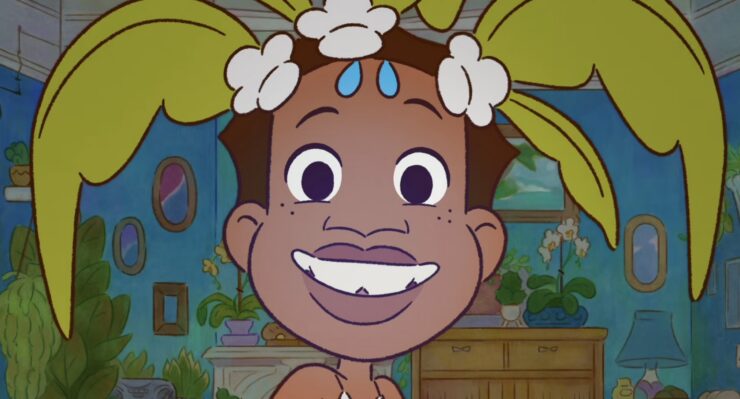
It’s always exciting to see a new film from Cartoon Saloon, the Irish animation studio behind Wolfwalkers, Song of the Sea, and The Breadwinner (the good one, not the Nate Bargatze one). Their latest, Julián, is something special even by the studio’s high standards. Based on the children’s book Julián is a Mermaid by Jessica Love, the story follows an imaginative mermaid-obsessed boy (voiced by Knyght Darius Jack) over an unforgettable summer with his Abuela (Milcania Diaz-Rojas), exploring issues of identity with a light touch and a dose of magic. It’s a movie I can’t imagine being made by any of the Hollywood studios right now, and it’s one that could change and possibly even save gender-nonconforming kids’ lives.
Ahead of Julián’s world premiere at the 2026 Annecy International Animation Film Festival, I got to speak with the film’s director, Louise Bagnall, on developing the characters and setting, the importance of telling this story now, and how Hayao Miyazaki movies inspired the film’s use of fantasy.
Reuben Baron: Julián is a Mermaid is a very short book. How did you approach adapting the concept with enough drama and character development to make it a feature?
Louise Bagnall: It is quite a slim book, but I think what’s interesting about the book is, firstly, I think the characters themselves are quite believable. There’s something expressive and sensitive about the way they’re drawn and the way they express themselves, and I think the way the story’s told also has a depth underneath the surface. Even though there’s only a few words, I think it leaves room for the reader to project a lot of interpretation or bring a lot of their own understanding into the book, and I think for me, that showed me that there was potential there to go into a bigger deeper story and expand.
But it was a big job, looking at what would work, because we didn’t want to break the tone or lose the appeal of the characters when we expanded it. First thing we did was we took what was one afternoon and put it across the whole summer, so rather than one short time frame, we had a longer timeframe to get to know our characters. The other thing was we had Julián arriving at Abuela’s doorstep at the beginning of the film. That allowed us to get to know him, but also get to know her as they get to know each other, so it allowed us as the audience to come into the story in a more organic way, and as their relationship is developing, we get to see that.
So that was some of the things that we did to make that work, and of course expanding the scope, so we get to dive into Brooklyn a little bit more. We get to see who’s on the block, we get to meet the community that lives there in the neighborhood, we get to explore the deli nearby and stuff like that. What was nice about that was getting to make Brooklyn sort of a character in the film as well.
RB: I’m speaking to you from Bushwick. This is a great Brooklyn film. Did you come here a lot for research? I assume a lot of the authenticity comes from the screenwriter, juliany tavernas.
LB: Absolutely. So juliany obviously grew up in Brooklyn with Dominican heritage, so that did inform a lot of how the scenes played out and what we would see of Brooklyn and things like that. But also we did do a research trip there in 2019, which was only a few days but we got to explore a little bit of Brooklyn. It wasn’t long enough at all to explore Brooklyn, but then COVID came, so that was the end of being able to go over and explore in person. So we did a lot of research online and we talked to people, we had cultural consultants who were able to talk about growing up in New York and as part of the [Dominican] diaspora.
We were trying to not just look at Brooklyn in isolation in terms of architecture or anything like that, but what is it like to live in? What do the plastic bags look like that you get from the shopkeeper? We were trying to look at all the mundane details as well as the impressive obvious details. We were trying to get what it feels like to actually live there and try and bring that into the film.
RB: Between this and Robot Dreams, there’s like a mini-trend of the best New York animated films coming from Europe.
LB: (laughs) I think you need a few more animation studios in New York, that’s what you need.
The reason we set it there was primarily because that’s where the book was set, but it’s a very rich and wonderful place to set a film.
RB: So you’ve been working on this since before COVID. In that time, it feels like things have gotten more dangerous for kids like Julián. The book’s one of the most banned picture books in America. Has the darkening cultural climate impacted anything about the production of this film, which is really such a ray of sunshine we need?
LB: It didn’t really change what we were trying to achieve with the film, because I think we always felt this could be a really exciting film to have out in the world no matter what the climate was. Also, a really interesting, fun, and meaningful film. It didn’t really change how we thought about the film or what we did with the film, but I suppose it underlined that more than ever we wanted to get this film made. Even more than I thought before, I really do want this film to exist for kids and for everybody else as well. And it is a film that is trying to talk about something that’s more joyful and hopeful, and I think that’s helpful, actually. I think people need that too.
RB: Cartoon Saloon and all your co-production partners were supportive of this, right?
LB: Yeah, they’re very much on board.
RB: I think of what happened to Elio, where big changes were made to the main character because the studio feared him appearing too gay.
LB: With a film like what we were making, it’s pretty clear what the film is gonna be like based on the book, so I don’t think there was ever any ambiguity about what we were trying to achieve. And being in Europe and working with co-production partners including in Canada, it also means that there’s a lot of interest in telling these kinds of stories. I think people also just really wanted a positive story that wasn’t as heavy. I think that’s needed.
RB: So there’s a lot that people can read into the character of Julián, and it’s kind of brilliant how the film’s able to speak to so much without necessarily the need for labels. So now I am going to do something silly and ask about a label.
LB: (laughs)
RB: Did you envision Julián as autistic or neurodivergent? I ask because I’m autistic and the way he approaches his special interest in ocean life reminded me a lot of how I was with my special interests at that age.
LB: I’m gonna resist the label because it would be doing a disservice to the film to label Julián in any particular direction, but I know that for a lot of people on the crew, they also felt this connection to Julián on the same basis. I think a lot of kids do have very special interests, hyperfocusing on things like that. I wouldn’t define it one way or the other, but I definitely wanted the film to be something that was accessible for a lot of people, but also that they could see themselves in Julián’s journey in a lot of different directions. I think there is a lot of relatability there across a lot of different cohorts. He’s really a kid who’s trying to express himself the best way he can and trying to figure out who he wants to be in the world and how he wants other people to see him, so I think for a lot of us, a lot of people, that’s something we’ve all been through as kids and in some way, shape, or form. I want the film to connect across a lot of people and see themselves in him.
RB: So how many times did you watch Ponyo when designing the underwater fantasy sequences?
LB: Well, I do love Ponyo, I will be honest. The other film I thought about a fair bit in terms of Miyazaki’s work was Totoro, even though it’s less obvious in the visual style and motifs, but in terms of the storytelling; I thought about how to tell a story without a villain, how to tell a story that’s got complex characters. We did look at Ponyo in terms of something people might not think about as much, but to me, Ponyo has quite an interesting style that’s different from a lot of the other Ghibli films. There’s this very pastel-y crayon-y look to the world, as well as the kind of flat cel-shaded kind of characters, so we actually looked at how to combine more textural elements in our backgrounds with more flat cel-shaded elements. If you look at some of the backgrounds in Julián, you’ll see very marker/colored pencil objects next to something that’s very “animate-like”—it looks like it might be animated even if it doesn’t move. That’s just getting into the details a bit, but I do love Ponyo and the creatures [and] the magic you can feel in Ponyo, and I really wanted Julián’s journey to include magic and adventure.
RB: Now that you bring up Totoro, I’m thinking the other similarity is how the magic works, where it’s ambiguous whether it could be real or in the kids’ imagination at first, but by the end, it doesn’t make sense if it’s not real.
LB: Exactly. I thought about that quite a bit with Julián where his imagination is part of the world we’re seeing, because the film is his point of view in terms of his perspective on the world, his feeling about the world. He’s excited about discovering Brooklyn, he’s curious about it. He sees the world in a very colorful way and his imagination is part of how he sees the world. Even though parts of it are more clearly imagination, while some are more ambiguous if they’re real or not, I wanted it to be something that for him, it’s real. It’s all real, whether it’s imagination or magic, it’s real for him. I wanted that to be there for the audience too.
RB: How did you approach the Abuela’s story? Her story is interesting because we don’t know a lot about her past, but we know enough that what we see is emotionally impactful.
LB: One of the really wonderful things in the film was looking into Abuela’s life and trying to figure out how we were going to tell her story onscreen and how it would relate to Julián’s story, so we would have this back-and-forth. It’s not one way or another, it’s informing one another, and they’re learning and growing because of their relationship together. I love her backstory because we tried versions where we got into much more detail about her history, but we found that actually by giving the impression or evoking the feelings that she felt about her past, as an audience, you connect more with how she feels about it. You don’t need to know all the details, and I think a lot of us would take a good guess at what’s going on with her. For me, a wonderful part of it was being able to look at her as a character and dive into her world a little bit and how that informs Julián and how he understands who she is.
RB: What has Zoe Saldaña’s involvement been like?
LB: It’s been great to have Zoe come onboard. Considering her and her sisters’ backgrounds growing up in America with Dominican heritage, and they also spent some of their teenage years in the Dominican Republic, having her come onboard was really fantastic as a way of understanding that we had connected with the audience we wanted to connect with. She could see in the writing and the way we were telling our story that we were trying to tell a sensitive story, but one that was also culturally authentic, so it was really wonderful having her come on and basically just lift up the project. She felt that it spoke to her and to her sisters and they felt that it was something they could connect with and they could recognize people that they knew within the characters. It’s not like we were looking for approval, but it’s been a wonderful way of uplifting the project and giving it that extra support that we need for the film.
