






I never read Howard Pyle’s The Merry Adventures of Robin Hood when I was a kid, but my partner adored it, and so I’ve leafed through their tattered copy many times. The book is largely considered a cementing point in the status of Robin Hood as a folk hero rather than the morally flexible outlaw who often stole for his own gain, as the early ballads dictated.
The epilogue of the book contains its own version of “Robin Hood his Death,” one of the oldest ballads on record—in it, Robin is betrayed by a prioress, his cousin, who deliberately botches the medieval blood-letting remedies of the time so that he slowly weakens and bleeds out. By the time Little John realizes something has gone wrong, he’s too late to save his friend. Robin asks for his bow and shoots a final arrow, telling Little John to bury him where it lands.
The Death of Robin Hood is an adaptation, of sorts, of this ballad, and the idea of having a whole film dedicated to this story for the first time was an exciting prospect. That it was written and directed by Michael Sarnoski, who made a (deserved) name for himself with 2021’s Pig, was another vote in its favor. A star-studded but thoughtfully assembled cast certainly didn’t hurt either. So it’s a shame that the film paints an utterly morbid picture that reads like nothing so much as “what if Unforgiven and Logan were grafted onto Robin Hood”?
It feels relevant to note that none of the more recent imaginings of the character hold up very well; the MGM series that premiered last year tried to zero in on Norman-Saxon tensions and keeps hoping Sean Bean’s Sheriff of Nottingham will legitimize their attempts; the 2018 film was a pointlessly grimmed up affair with A Knight’s Tale-style anachronisms it never earned; Ridley Scott’s “historically realistic” 2010 version was trying to capture the same vim Scott seized with Russell Crowe on Gladiator to decidedly damp results. It’s fair to say that there hasn’t been a truly great Robin Hood adaptation since Men in Tights. That’s over three decades of hoping and not much to show for it.
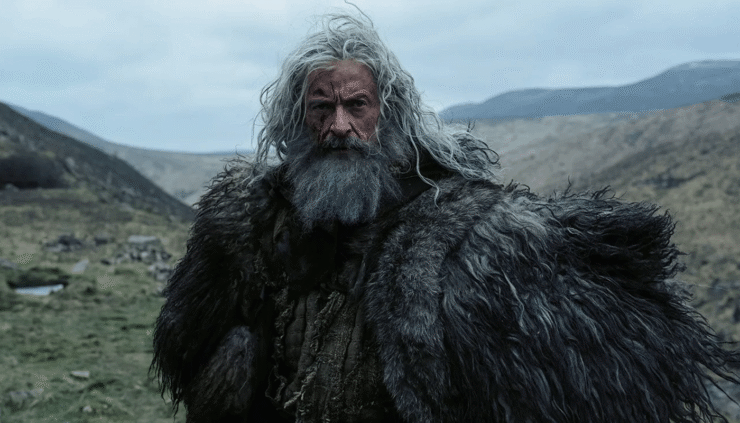
The film opens with another attempt on the life of an elderly Robin Hood (Hugh Jackman). While stories have grown over the years, this Robin has no qualms about who he is: a brigand and a thief and a murderer, who only ever acted for this own gain and currently has nothing to show for it, hunted by the kin of the people he’s killed. He’s found by Little John (Bill Skarsgård), who used to run with him many years ago and is now living a completely new life—in a turn of luck, he had the chance to take over the life of a man he killed, and has been living as Edward, a farmer with a good wife and daughter. But some of the men who knew them have found John’s patch of peace and wrestled it from him. He needs Robin to help him get it back.
This goes about as well as you’d expect, and Robin’s injuries from the fight lead John to drop him at the doorstep of an island priory run by Sister Brigid (Jodie Comer), who is so good at healing that she’s rumored to be a witch. Brigid is a young woman who came to the island in the wake of losing her family, and has devoted her life to helping others. The island seems to have a pull all its own, across many generations and faiths. As Brigid helps Robin (who gives the name Randolph), they grow closer, and he also develops a friendship with the leper (Murray Bartlett) who tends the priory orchards after being saved by the sisterhood. But then John’s daughter, Little Margaret (Faith Delaney), shows up on the island without a father, and Robin knows that someone is likely to come after the girl to end the blood feuds once and for all.
I found myself asking “Why does this need to be Robin Hood?” more than once during the film’s runtime, and I don’t think that the movie itself does a very good job at answering the question. This could have easily been a story about any outlaw of the period, and the suggestion that it inspired the ballads of Robin Hood later on might have been more riveting if the character were simply some guy. There was a way to make this connection deeper and get to the heart of key thoughts in the film’s script—namely questions surrounding the meaning of stories and who they serve—that didn’t require something so plain as “Yeah, so Robin Hood was absolutely real, but he was an asshole.”
Half the purpose in making Robin Hood such an awful guy appears to be in service of pointing out how disgusting the past was. The fight sequences are built for dragged-out carnage, blood and bile and mud spilling out in all directions. The acknowledgment that killing before the advent of slick weaponry and sterile surgery rooms would be a nasty affair is a prolonged piece of the film’s worldbuilding. It’s aggressively fine, but also overplayed—once we’re aware that this is the reality we’re occupying, it stops being interesting to watch in a hurry.
One of my greatest annoyances at films like this, the “Violent Man Comes to Terms With His Terrible Past and Either Makes Peace With It or Dies Trying” genre, is that there’s often very little reasoning or background given to who that man used to be. We’re dropped into the end of his story and supposed to care because… well, we’ve been conditioned to think that those sorts of men’s stories are important and that sometimes it even :gasp: takes a toll on him. But does anyone go to a Robin Hood story for that kind of twist?
There are moments when it seems as though the experience might come together, when the script makes a beautiful or cogent point on occasion. One of those points is wrapped around the spirituality of places, the power of the land on this vast and beautiful planet we cling to. (The paganism in the film runs right alongside the Christianity, and I’m not sure how I feel about it mostly because I don’t think the film is doing nearly enough with that aspect. Robin Hood stories are tied up in Green Man mythologies, too, and I dearly wish that would come into play more often if we’re going old school.) And then there’s Murray Bartlett, casually being the MVP of most projects he wanders onto, there to be a friend, but also to let Robin know that we don’t often remember our own stories as accurately as we claim to—which makes tying ourselves too tightly to them a mistake.
I do appreciate that most of the film is a ponderous, slow-moving affair—I just wish it had given itself better questions to ponder. (Honestly, dealing with personal mythologies and who stories are for and the pitfalls of narrative interpretation in a two hour film is a pretty tall order while Interview With the Vampire is tackling that same stable on television with agony, pathos, devastating cleverness, and a better runtime to do it in.) There are simpler complaints I’ve got, too, like the fact that Little Margaret is very much mirroring the relationship Wolverine has with X-23 in Logan, or the fact that there’s an aggravating suggestion of attraction between Robin and Brigid when Jodie Comer is a quarter century younger than her co-star.
There’s a replication of Robin Hood’s final moments in the ballad here, reimagined with a prioress who is not his cousin and a little girl replacing her father at Robin’s side. And all the while, I was wondering why Robin needed to die at all—there doesn’t seem to be a reason other than that he would prefer to. Which is unfortunate because there is a moment further back in the film that suggests the title might be a sort of ruse… that Robin Hood might die, but a man named Randolph could go on living and help to raise the daughter of Edward the farmer in peace.
But then I remember that in this story, Little John is called that because he joined Robin’s gang of brigands when he was a boy—he was literally little. And I realize that the choice to reinterpret such sharp little detail of an age-old tale with something so banal isn’t going to offer up such an interesting premise. We’re here for realism.
For some reason, we often forget that realism is not the antithesis of story.
