







In 1984, William Gibson published Neuromancer, blending crime fiction, science fiction, surrealist literature, and a forward look at bleeding-edge technologies to give birth to the genre known as cyberpunk, an aesthetic movement and genre that has influenced countless books, video games, movies, music, and even clothing styles.
Except that’s not quite accurate.
While Neuromancer certainly mainstreamed cyberpunk, it was far from the first title to explore the moody, cynical, and noirish world that Bruce Sterling famously described as high-tech and low-life. Most of the originators of cyberpunk came well before Gibson wrote about the sky above the port and circling cranes. Far from a few scattered works of “proto-cyberpunk,” these early works prove there was a thriving genre even before it was codified as such in the 1980s. With that in mind, here’s a selection of works that were cyberpunk before it was cool…
The Stars My Destination by Alfred Bester (1956)
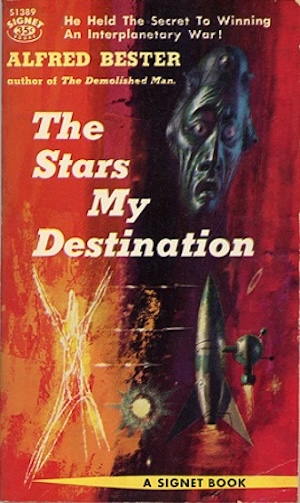
Best described as “The Count of Monte Cristo meets The Ascent of Man meets Neuromancer on very strong drugs,” Bester’s 1956 novel begins with Gully Foyle, a man who’s little more than a beast, working on a ship called the Nomad when it gets attacked and then abandoned. Swearing revenge on those who left him for dead, Foyle duct-tapes the Nomad back together and launches himself into a web of intrigue involving asteroid cults, the criminal underworld, a mysterious substance, a starship-manufacturing corporation, and a radioactive corporate hitman. The Stars My Destination contains within it all the things we’ve come to know as cyberpunk: a morally ambiguous (at times outright monstrous) antihero, cybernetic and genetic enhancements, elements of crime novels, megacorporations, and a cynical but optimistic view of scientific progress and the effects it might have on humanity.
Simulacron-3 by Daniel F. Galouye (1964)
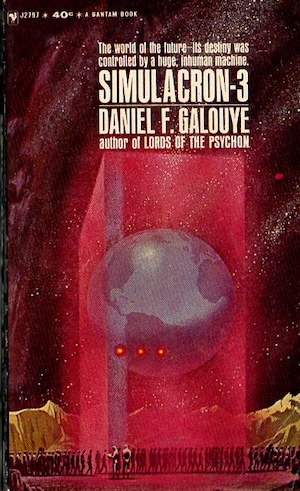
Galouye’s novel isn’t as well-known in the modern day as some of these other works, but given that it’s had two movie adaptations that made a much bigger impact in the cyberpunk canon (World on a Wire in 1972 and The 13th Floor in 1998), it’s hard to say it’s unworthy of inclusion. The book begins when a scientist dies under mysterious circumstances and a high-ranking member of the REIN corporation, set to launch their fully simulated virtual world Simulacron-3, suddenly vanishes into thin air in the midst of a party, along with any trace he even existed. The cyberpunk elements are all already in place—noir elements courtesy of the detective novel plot, virtual reality, weaponized market research, highly advanced tech—but it kicks into high gear when Hall, the executive trying to unravel the mystery, discovers what was being kept secret and why, calling into question the nature of both reality and virtuality with each uncovered secret.
Do Androids Dream of Electric Sheep? by Philip K. Dick (1966)
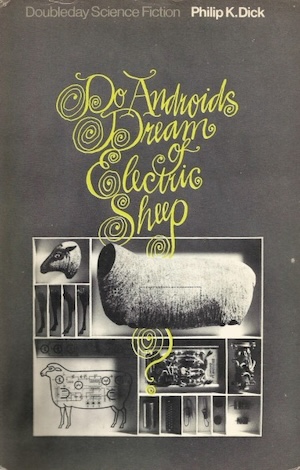
Dick’s work practically helped invent the canon all on its own with his blending of pulp-crime plots, a cynical eye towards technological progress, hallucinatory imagery, and existentialist discussions. While some of Dick’s other books might arguably be more representative of cyberpunk (The Three Stigmata of Palmer Eldritch for example), none have been as influential to the genre as Electric Sheep, a book that frames an argument about empathy within a detective story about a policeman named Rick Deckard sent to “retire” (kill) five highly advanced androids—almost indistinguishable from humans—who have escaped to Earth. If this sounds familiar, you’ve probably already seen the defining cyberpunk movie Blade Runner, where Harrison Ford plays Rick Deckard in a perpetually rainy future Los Angeles. Electric Sheep is more mind-bending than its movie adaptation, but also more incisive, exploring what it means to be human in a society where humanity is eroded almost entirely. You’d be hard-pressed to find something that’s more quintessentially cyberpunk.
Stand on Zanzibar by John Brunner (1968)
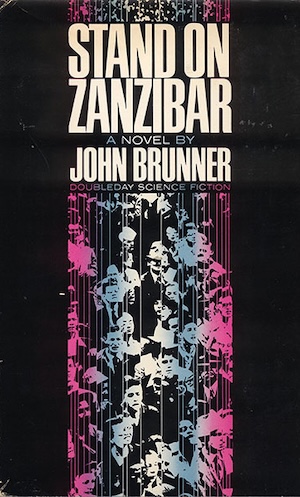
Brunner is a writer whose work feels like it could be contemporaneous with authors like John Shirley and William Gibson, if it weren’t for the fact that he had to wait about twenty years for the science fiction world to catch up with him. Zanzibar uses a documentary-style approach (complete with in-universe TV commercials, transcripts, documents, and “man on the street” profiles) to trace a series of interlocking conspiracies centered around AI, mind control, and geopolitical manipulation. It’s a book that manages to be brutally funny and straight-up brutal in equal measure; it never stops being an unnerving, thorny, timeless exploration of the clash between humans and human progress that takes no sides, but also takes no prisoners.
Nova by Samuel R. Delany (1968)
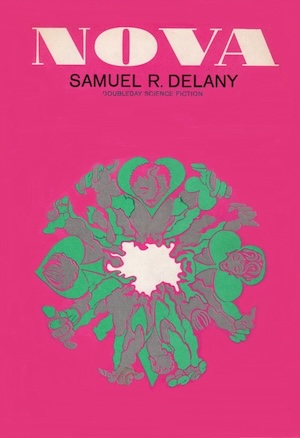
Delany is a name that continues to resonate in multiple genres and movements, as his hyper-literary style and imaginative take on science fiction and fantasy are pretty much the original brick tossed through the window of modern science fiction, fantasy, and in some cases, horror. Nova is a worthy addition to that literary canon, a space opera where neo-feudal corporations war over starship fuel and cybernetically enhanced spacers consult tarot cards before making risky business maneuvers. Notably, it’s a work in the genre that portrays human failings, not technological, drawing from the characters’ tragic flaws rather than the technological erosion of humanity. It also prefigures the use of mysticism and mythology in cyberpunk works (for example the tarot motifs in Simon Ings’ Hot Heads, or Neuromancer’s use of Zen mysticism), setting the stage for what would become genre conventions by the 1980s. If The Stars My Destination was the first completely realized work of cyberpunk, then novels like Nova were the codifying force.
The Nova Trilogy by William S. Burroughs (1961 to, you guessed it, 1968)
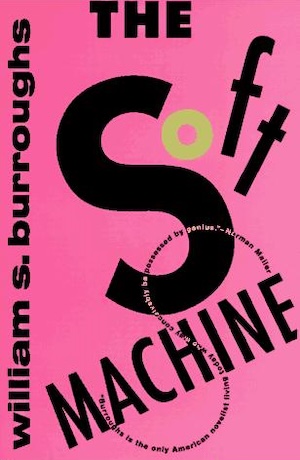
A series of works Burroughs wrote and revised using a technique he’d developed in collaboration wth an artist with an interest in the occult and a computer programmer (Burroughs apparently being so cyberpunk that even his writing methods aligned with the genre’s themes): The Soft Machine, The Ticket That Exploded, and Nova Express. This trilogy (which is just begging for an omnibus edition) details in rather confusing fashion the fight between Agent Lee and the Nova Mob, a criminal syndicate dedicated to spreading chaos and violence throughout the known universe. In particular, The Ticket That Exploded deals with the more technological, science fictional, and psychological methods employed by the Nova Mob, using terraforming and other technological means to create chaos and drive planets into perpetual war. While admittedly Naked Lunch was the Burroughs book that inspired Gibson’s writing more directly, it’s the intense focus on technology and techno-mysticism as a form of societal control that earns the trilogy its status as a major influence on cyberpunk as a genre.
The Girl Who Was Plugged In by James Tiptree, Jr. (1973)
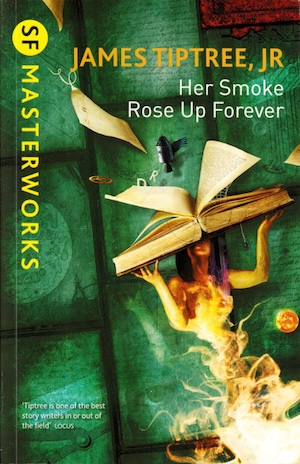
Tiptree’s novella takes a decidedly modern and feminist approach to cyberpunk and thus holds a key place in the canon (even being featured in The Big Book of Cyberpunk). It follows a teenage girl press-ganged with the threat of legal action into becoming the cybernetic operator for a vat-grown Marilyn Monroe-esque influencer, created and controlled by a megacorp in order to get around anti-advertising laws. It all goes tragically wrong in a number of ways of course, but in ways that are exceptionally prescient for 1973, with its plot predicting the modern culture of internet influencers, parasocial relationships, grotesque capitalist materialism, and sinister corporate manipulation of demographics. It also spends its time issuing thunderous broadsides against feminine beauty standards and the vapid nature of celebrity culture, making this not just a quintessential work of cyberpunk, but one of the most vicious and enduring.

But surely the go-to Brunner for this is Shockwave Rider? Which features no end of computer shenanigans (and also marks the beginning of a five-year hiatus for Brunner, and the demarcation line between his most interesting material and Late Brunner).
Just about to post this! Thank you.
The Shockwave Rider may be the most filmable of Brunner’s proto-cyberpunk works; The Stone That Never Came Down and The Sheep Look Up might also qualify.
It came down to preference, running gag, and a desire for people to read Club of Rome in order. Shockwave Rider is fantastic but ultimately I have a harder time getting my hands on it these days and would need a refersher, whereas I love Stand on Zanzibar and want people to experience the brainwashing sequence firsthand.
“I have a harder time getting my hands on it these days”
Shades of the time I discovered Doorways in the Sand had been out of print for 15 years. Or the time it took me three tries to get my hands on The Snow Queen.
Shockwave does seem to be in print, although with the wrong cover art. And I see I missed the very affordably-priced Centipede Press editon.
I got lucky with The Snow Queen, a mass market paperback has been in my family for decades. Shockwave I have trouble not finding the MMP, which is unfortunate because I hate buying new MMPs, I have very stupid fingers these days.
I have a Snow Queen paperback old enough to have the Dillon cover but all the words have shrunk. Tor doesn’t seem to have a hardcover of the Whelan cover, so I gave up and tracked down a used copy of the Dillon.
I scrolled down to suggest exactly this. Shockwave Rider actually gave birth to computer hacking terminology (the concept of a worm) and inspired / was inspired by phone phreaking (and early form of hacking).
Thank you. I was thinking that picking Stand On Zanzibar was a real swerve.
I mean.
If I wanted a real swerve I’d have suggested The Jagged Orbit and reminded everyone the book even exists.
I think Web of Angels by John M Ford deserves an honorary mention. It’s often referred to as proto-Cyberpunk, and while I don’t think that’s quite right, it’s not wrong either. The main character is a webspinner (master hacker) in an intergalactic collection of societies where one’s proficiency with the system affects their place, and he goes up against powerful corporate and government forces. It’s not noir, but there’s plenty of intrigue and investigation to go around. The writing is rich and even the more fanciful parts feel a real part of the world.
Joan D. Vinge also had a proto-cyberpunk, 1978’s Fireship. American with a neural computer link to a supercomputer, being blackmailed into an ill-fated heist.
Great list, but I would have included Alan E. Nourse’s book “The Bladerunner”. Very ahead of its time in creating a technologically advanced dystopia with an atmosphere of building paranoia.
Solid list. I plan to read Simulacron-3 soon. I recently reviewed the Nova Trilogy @SpeculativeReader https://youtu.be/p3_E_YwUH_M?si=5cEw8tbXEBRbweZg
Don’t forget K.W. Jeter’s ‘Dr Adder’ and ‘The Glass Hammer’.
Dr Adder was a pretty seminal cyberpunk work – Jeter wrote it in 1972 but didn’t get it published until 1984 so while Neuromancer got across the line first, Jeter’s work explored similar territory much earlier.
I know, but I went with publication date. As I’m intimately aware, it’s not the person who writes the idea, but the person who gets it published, unfortunately.
The Stars My Destination is one of my favorite books of all time, thank you for including it!!!
I own and have read about three-quarters of the books listed here. (I own over 3K books, mostly paperbacks, mostly SF/F, mostly 80s and earlier.) I worked in a library and I’m a lover of books in general.
I’m downsizing, so my son and I are going through the books to decide what to sell off. I’m not ready to part with my Phillip K Dick books yet.
I read Stand on Zanzibar back in the day and remember it blowing my mind. None of my friends had read it. I had no one to talk to about it. :( It might be time for a reread.
I know I have the Bester book and others by him.
And I love the Snow Queen! It has to be one of my favorites of all time.
I could argue that Vonda McIntyre—with “Cages” (1972) and The Exile Waiting (1975)—was foundational to cyberpunk. It would be great to see her contributions acknowledged. (And yay for the comments on The Snow Queen!)
I’m more than a little surprised that Vernor Vinge’s True Names (1981) was not on this list. Virtual reality, hacking, AGI. It contains the technology side of cyberpunk, but doesn’t have much street violence, drug use or “noir” in general.
I can’t believe not one mention for David Bunch’s masterpiece, Moderan. Literature is a cruel world.