






In this column, we’re looking back at the 1980s as their own particular age of fantasy movies—a legacy that largely disappeared in the ’90s only to resurface in the 2000s, though in many ways, the fantasy films of the Eighties are far weirder and less polished than what we got in the aughts. In each of these articles, we’ll explore a canonical fantasy movie released between 1980 and 1989 and discuss whatever enduring legacy the film has maintained in the decades since.
For a more in-depth introduction to this series of articles, you can find the first installment here, focusing on 1981’s Dragonslayer. Last time we looked at John Boorman’s flawed but enduring sword-and-sorcery epic Excalibur. This time we’re lowering our sights quite a bit in order to discuss the 1982 Conan-inspired cash-in Sorceress, produced and distributed by Roger Corman.
This is another film which I watched specifically for this column, having somehow missed it during my college days spent seeking out intentionally schlocky dreck. Basically, all I knew about it was its utterly fantastic poster. The poster has it all—a second-rate attempt at a Boris Vallejo-style illustration of a scantily clad woman, a phallic snake poised to strike at her genitals, what feels like a vaguely racist caricature of an ape-man wielding an axe, and a winged lion roaring in from above. It’s the perfect decor for any dorm room wall or the side of a stoner’s van.
The evil sorcerer Traigon, who is said to possess three lives, each of which must be taken in turn, attempts to sacrifice his firstborn child to the goddess Caligara only to be thwarted by (1) the steely resolve of the infant’s mother, (2) the timely intervention of the wizard, Krona, and (3) the fact that there are, in fact, two infants—twins!—and it would spell disaster if he killed the second-born by accident. Traigon mortally wounds the twins’ mother, but she manages to impale him with a spear before she dies, ending the first of his lives. Krona imbues the infant girls with magical powers and leaves them with a goatherd to be raised in secret.
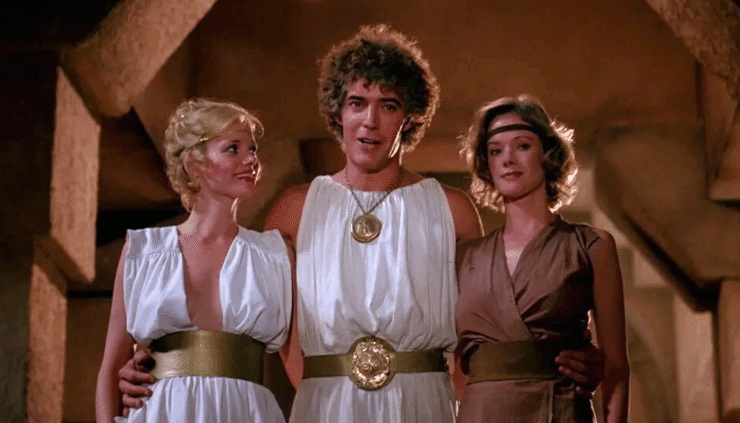
Twenty years later, Traigon is resurrected and the twins have grown into mostly nude young women, Mara and Mira, who possess the powers of illusion and fighting prowess. When Traigon’s soldiers kill their adoptive parents and Krona sacrifices himself to the pyre, they set out with the help of Viking warrior Baldar, handsome barbarian prince Erlick, and a perpetually horny Satyr named Pando on a quest to kill the evil wizard and fulfill their destiny. There are bizarre misadventures along the way: Delissia, the sultry Queen of Kshaltriya and Traigon’s ally, promises that the second-born twin will be given as a reward to Hunnu, one of her trained apes; there are exploding fruits that get you high and an attempted execution by rectal implement; at one point Baldar explains the birds and the bees to the twins, and later the twins’ psychic connection to one another is explored during one of the cringiest sex scenes in cinematic history.
Finally, Traigon (rather inscrutably) attempts to orchestrate Mara’s impregnation by Erlick so that they can produce a child of royal blood, giving Traigon another infant to sacrifice this his dark gods. When the rest of the party shows up to rescue them from his nefarious, still very opaque scheme, Baldar fights some mummies in the crypts, and the twins save the day at the last moment by invoking the name “Vital” and summoning a winged lion-centaur monster from space. Traigon sacrifices Delissia in desperation and summons his goddess, who fights the lion, while Pando leads a peasant rebellion by summoning the goats of the local shepherds. Traigon is finally killed by his daughters (apparently he only had two lives?). Erlick announces that he and the twins are in a throuple, everyone has a hearty laugh, and the film ends.
Sorceress made a paltry 1.3 million dollars at the box office, allegedly ended director Jack Hill’s friendship with Corman, and quietly disappeared into the back-alleys of cinema’s red-light district. But does it accomplish anything beyond its lurid premise? Is there anything of value here?
The film is, by almost every metric, unrecommendable. The production looks cheap and lazy. Hill apparently wanted to work in Italy but Corman had a deal with a much cheaper studio in Mexico. Hill explained that the team “worked their hearts out… [but] this production had the most problems of any movie they had ever been on—all kinds of things went wrong. The Mexican film vault on the studio lot even blew up.” Given that the majority of the cast was also played by local actors (likely because they were non-union), the whole film has been redubbed by Americans, lending every scene a veneer of bad ADR.
But by far its biggest sin is the fact that the film is a rape-y, horny sleaze-fest. The twins are introduced swimming nude while Pando spies on them from the bushes. Traigon tortures their mother with a device called “the talons” that appear to just be spiky metal bird talons used to rake at her pelvis. The twins wear what looks to be a Spirit Halloween version of a Cossack costume. Erlick stumbles through orgies as he flees city guards. The film also features one of the more graphic on-camera sexual assaults I’ve ever encountered. Look. I’m no prude. There is room for the titillating and erotic in cinema, and I’m sure soft-core pornography keeps a lot of hard-working folks employed. But this is bottom-of-the-barrel dirtiest-old-man worst-taste grotesquerie. It’s the male gaze at its most jaundiced and bloodshot. Sorceress is the kind of film that gives rise to thoughts like “Maybe Valerie Solanas had a point!” Towards the end of the movie, Traigon turns to Hunnu and chastises him, saying “Filthy beast, I have no time for your disgusting desires now.” He might as well be talking to Corman, Hill, and everyone in the audience.
In its occasional fun moments, Sorceress is campy and silly. Traigon reappears from the void, sauntering and throwing back his shoulders with all the misguided, queer-coded menace of Rob McElhenney’s Nightman. Caligara looks like a cheap fright-mask version of the Norse goddess Hel. A man walks a very confused-looking jaguar through the background of a crowd scene then bends down to pet it. The lion-monster, who may or may not be named Vital, flaunts one of the weirdest and most baffling foam rubber suits ever devised. And, if rumors are true, Jack Hall wanted horror film icon Sid Haig to play Pando; when Corman refused to pay Haig’s requested salary, Hall appears to have simply crafted a prosthetic mask that vaguely looks like a mean caricature of the actor. If not for everything mentioned in the previous paragraph, this so-bad-it’s entertaining absurdity might have been reason enough to watch. Alas.
So what is Sorceress’ legacy? Despite causing a rift between Corman and Hill, there was just enough of a market for Corman to make two more sleaze-and-sorcery epics: Deathstalker (1983) and Deathstalker II: Duel of the Titans (1987). And, alongside other pop culture low points like Fire & Ice, it feels like part of the inspiration for some of the squirmiest, cringiest excesses of early 21st-century patriarchy: booth babes at E3 and Comic-Con, petitions for Korgoth of Barbaria to get a full season order, Zack Snyder’s Sucker Punch, etc. Its existence detracts from the otherwise delightful schlocky legacy of campy ’80s fantasy. Cannon Films are bad. The Beastmaster is bad. They also feature women in bikinis and awkward flirting and dumb dick jokes. But there is also charm to be found there, which explains why audiences have a certain amount of affection for those films. Movies like Sorceress give them all a bad name.
But what do you think? Am I being a killjoy in finding Corman’s late-career midnight movie output too gross for human consumption? Am I giving this film too much of a hard time? Can anyone tell me why the film is called Sorceress when there are two sorceresses in it? Tell me what I’m missing or agree with me wholeheartedly in the comments, and be sure to join us next time when we go from chauvinistic dreck in the mystical past to charming dreck in the near future when we take on Cannon Film’s American debut: 1980’s sci-fi musical The Apple!


This one is fairly typical of Roger Corman’s R-rated fantasy output in the ’80s. I can name several others with at least as much nudity, sexism, and exploitation — notably including Warrior Queen, in which essentially every speaking female character in the film is raped (though they get their revenge), and David Carradine’s The Warrior and the Sorceress. That film features a female lead (Maria Socas) who spends virtually the entire film topless, and nearly every other female character is just there to be decoratively semi-nude. It has a sequence where the villain, whose court Carradine’s antihero has infiltrated, drowns a nude woman in a glass-walled tank for entertainment (as water is scarce and he’s showing off that he has enough to waste). The villain asks Carradine’s character if she should be spared, and Carradine, our theoretical hero, just shrugs and lets her die while the camera repeatedly ogles her flailing and ultimately motionless nude body. There was a lot of casual misogyny in ’80s movies, but that scene was one of the most striking examples.
Although one interesting thing Corman did: He took action footage from several of his R-rated sword-and-sorcery sleazefests, including The Warrior and the Sorceress, and cut them together into a PG-rated, family-friendly film called Wizards of the Lost Kingdom II (with no relation to the first Wizards), bridged together by a new story in which Carradine and several other returning actors from those films played characters with the same costumes and character names as their roles in the original films, so the footage would match. So, typically of Corman, he found a way to recycle the same footage into movies aimed at two very different audiences. (Also, most of these films recycled the same James Horner score over and over.)
Fun fact of the day: Leigh and Lynnette Harris (both Playboy models and the twin leads of the movie) were convicted of tax evasion for not reporting gift money from a wealthy suitor who dated them both off and on over several years (as a throuple). They were convicted, fined, and sent to prison; they appealed, and had their cases overturned by the appeals court, thus establishing in case law that cash transfer to mistresses are not taxable income:
https://law.justia.com/cases/federal/appellate-courts/F2/942/1125/282570/
https://en.wikipedia.org/wiki/United_States_v._Harris_(1991)