





“Muse”
Written by Joe Menosky
Directed by Mike Vejar
Season 6, Episode 22
Production episode 244
Original air date: April 26, 2000
Stardate: 53918.0
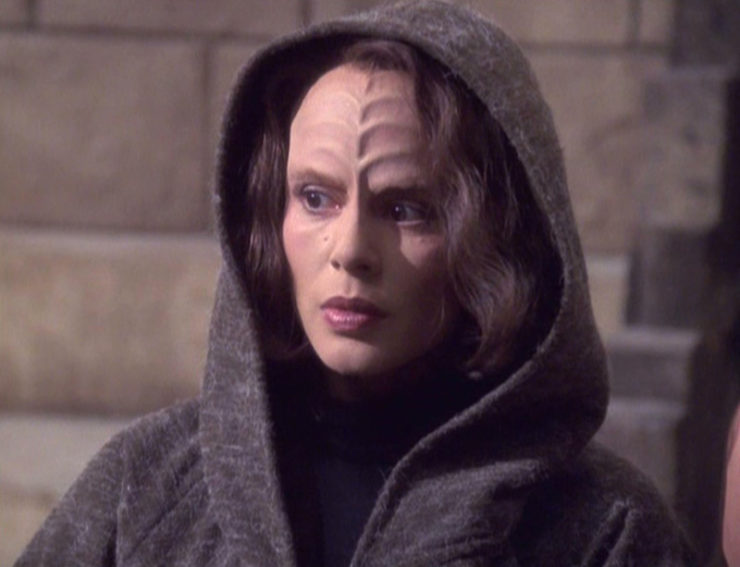
Captain’s log. On a pre-industrial planet, we see a very stylized theatrical performance that seems to be about Voyager, describing it as a sailing ship, and from which B’Elanna Torres and Harry Kim have been lost at sea, apparently. We later discover that the playwright, Kelis, found the crashed Delta Flyer, with an unconscious, bound Torres inside.
He used the recordings of Torres’ logs to create a play, imagining the crew of Voyager to be Eternals—godlike figures of power in this world’s mythology. Kelis’ sponsor enjoyed the play, and wishes another one within the week. Kelis returns to the Flyer, where Torres has regained consciousness. She is revolted to see that he made cuts in her arm in an attempt to cure her fever. She instructs him in the use of the dermal regenerator to fix her arm.
They haggle: he wants more stories of Voyager, she wants him to untie her. He does untie her, at which point she threatens him with a phaser and chases him off. Unfortunately, she’s unable to effect repairs on the Flyer, which is out of power. When she does finally get power back online, she can’t reactivate the subspace transmitter, as it’s too damaged to handle having power run through it. She convinced Kim to take an escape pod while she tried to land the ship, crashing it instead, and the damage is tremendous.
Kelis returns with a peace offering of food. Since the replicators aren’t working, either, she accepts, and also tells him a version of the events of “Caretaker,” adjusting for a world that doesn’t even have flight, much less space travel.
She also shows him an image of a dilithium crystal, which is what brought the away team to this region in the first place. Kelis recognizes it as “winter’s tears.” She promises more stories if he gets a crystal for her.
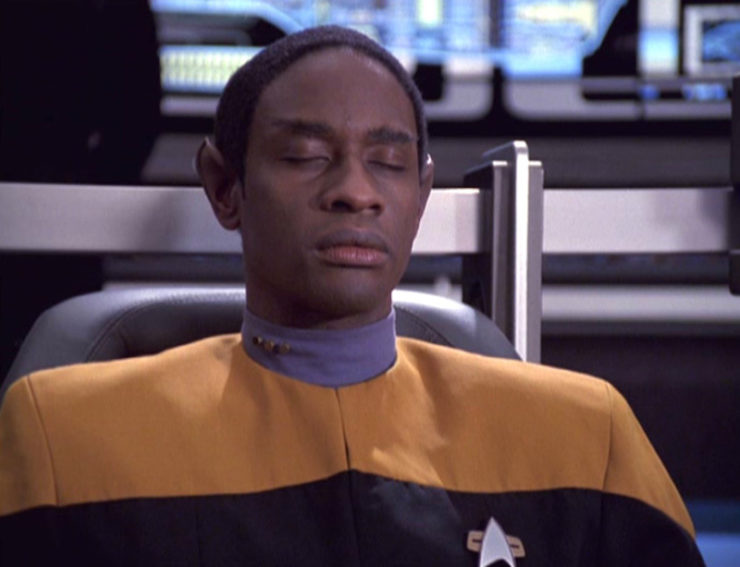
Back on Voyager, the crew has continued to search for the missing Torres and Kim. Tuvok has gone without sleep for ten days while examining sensor readings.
Kelis is writing his play, and rehearsing with his company. The characters are familiar, even if their actions aren’t (Seven is romantically involved with Paris, for a start). One rehearsal is interrupted by a message that their patron is about to go to war with another nobleman.
Returning to the Flyer, Kelis begs Torres to help him write a play that will convince their patron not to go to war. He tells her that the theatre where they perform used to be a temple, where human sacrifices would be made. But one day, plays took the place of the sacrifices, thus saving lives. Kelis is hoping that they can save more lives with his play.
Buy the Book

A Psalm for the Wild-Built
Kelis’ play has several romances, including one between Janeway and Chakotay. One of the Chorus objects, saying that modern poets rely too much on manipulation and tricks to fool the audience instead of allowing the story to just be told. (These kids today, with their music and their hair…)
Finally, Kelis brings Torres to the theatre to consult more directly, saying that she’s an expert on the Voyager Eternals. One of her notes is that there’s too much romance, which people aren’t thinking about when they’re going to war. She also tells Kelis about the Borg.
One member of the company, Layna, who is obviously smitten with Kelis, follows the pair of them to the Flyer. Expecting a love nest, she’s surprised to find a secret Eternal. She threatens to expose Torres if she returns to the theatre.
Kim shows up at the Flyer, having landed his escape pod two hundred kilometers away, and having walked on foot the whole way. He also has some parts salvaged from the pod that can be used to fix the communications system. They contact Voyager, and they set course to rescue them.
Kelis launches the play, even though he doesn’t have an ending yet. He sends a messenger to Torres. Upon reading the note, Torres realizes that Kelis still doesn’t have an ending.
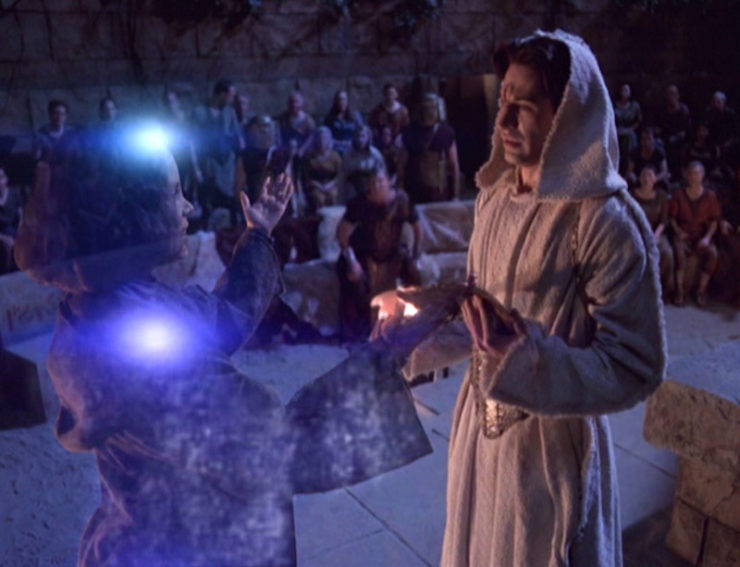
The play has Seven secretly being the Borg Queen and plotting against Janeway—but Janeway knowing her secret, and hoping she’ll come to her senses. They fight, and Janeway tries to convince Seven to lay down her weapons, for if they continue to fight, all they will have left is hatred.
Torres arrives and throws the play into chaos, but then she beams back to the Flyer in front of everyone, providing a quite spectacular ending to Kelis’ play.
Can’t we just reverse the polarity? Apparently, if you have a piece of metal that’s three parts tin to five parts bronze and with one side coated in gold, you can conduct power to your subspace transmitter. Since bronze is an alloy of tin, this doesn’t entirely make sense, but hey, subspace isn’t real, either.
Mr. Vulcan. Tuvok stays up for ten straight days to try to find the away team, an action based not even a little bit in logic or sense. It does, however, provide an incredibly unfunny sight gag of Tuvok snoring on the bridge, so there’s that.
Half and half. Torres gets to be the inspiration for a play. At first, she barely goes along with it so she can get things out of Kelis, but by the end of the episode, she’s actually invested in the play she inspired. It’s kind of adorable.
Forever an ensign. We spend most of the episode not having the first clue as to Kim’s fate, but his arrival at the end of Act 3 is a nice little surprise.
Everybody comes to Neelix’s. Neelix tries to convince Tuvok to get some sleep. When that doesn’t work, he offers tea.
No sex please, we’re Starfleet. Layna thinks that Torres is sleeping with Kelis. If Kelis actually paid a micron of attention to her, she might not have made that assumption…
Do it.
“What are you doing? Is that a tear?”
“Yes.”
“Logical Tuvok doesn’t cry! That’s why they call him logical.”
“Everybody cries.”
“The land of Vulcan has no laughter and it has no tears. It is a very quiet place—calm, just like Tuvok.”
“I can’t believe that.”
“You don’t have to, just don’t cry.”
“The audience won’t believe it either. They’ll either think Tuvok is an unfeeling monster or that I am a bad performer.”
“They’ll realize that beneath your unfeeling exterior is a heart that’s breaking silently, and in more pain than any of us can possibly understand—because that’s what it is to be Vulcan. Try it again.”
–Kelis giving Jero notes.
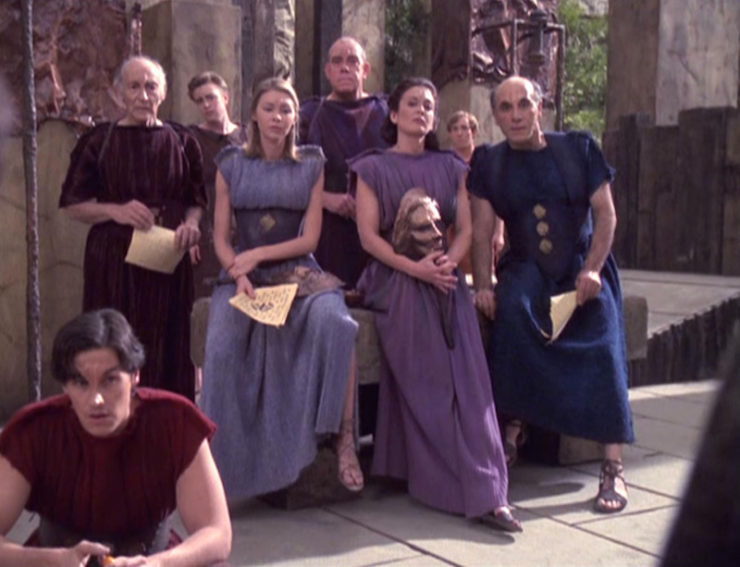
Welcome aboard. Huge roster of guests in this one. We’ve got Trek veteran John Schuck as one of the Chorus, who previously played the Klingon ambassador in The Voyage Home and The Undiscovered Country and Legate Parn in DS9’s “The Maquis, Part II,” and will go on to play Antaak in Enterprise‘s “Affliction” and “Divergence.” We’ve got character actors Stoney Westmoreland as the sponsor and Jack Axelrod as another of the Chorus. We’ve got Joseph Will as Kelis, who will return as a Quarren in “Workforce, Part II,” and have the recurring role of Rostov in Enterprise’s first two seasons. We’ve got Kellie Waymire as Layna, who will have the recurring role of Cutler on Enterprise. We’ve got Kathleen Garrett as Tanis, who previously played a Vulcan captain in DS9’s “Vortex.” We’ve got Michael Houston King as Jero.
And we’ve got our Robert Knepper moment, as I had totally missed that the great Tony Amendola, best known as Master Bra’tac on Stargate SG-1, played the third member of the Chorus.
Trivial matters: Joseph Will would later be a finalist for the role of Tucker on Enterprise, losing out to Connor Trinneer. He’d get the recurring role of Rostov as a make-good. Kellie Waymire’s performance here led to her having the recurring role of Cutler on Enterprise, which would be sadly cut short by Waymire’s tragic death at the too-young age of 36 of a cardiac arrhythmia in 2003.
Torres makes a reference to the Delaney sisters, who were mentioned several times and finally seen in “Thirty Days.” She also mentions that Janeway would ally with the Borg if she could, as she did, in fact, try in the “Scorpion” two-parter.
The Delta Flyer is seemingly unsalvageable at the end of this episode, but it will appear again, intact, in “Unimatrix Zero” (where it will be destroyed for realsies).
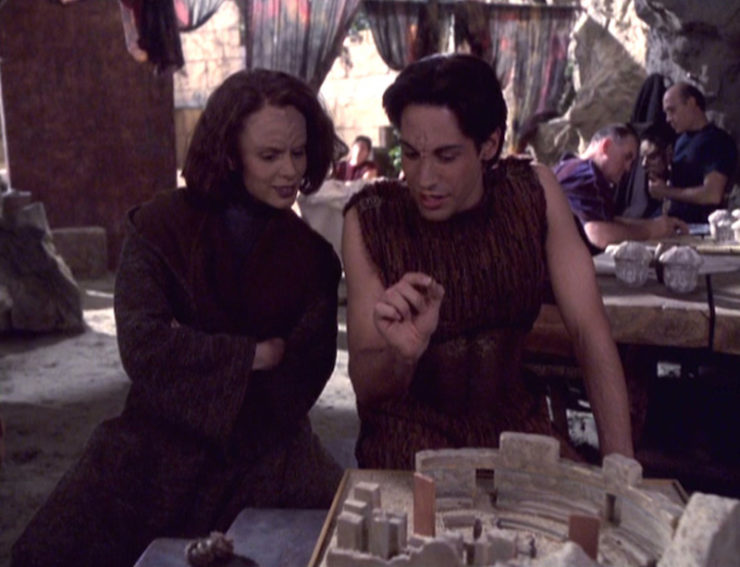
Set a course for home. “Shining Voyager, far from home.” This really should be a great episode, and I get to the end of it and just am so damn frustrated.
The basic structure is brilliant. I love the whole setup of Kelis finding inspiration from the Flyer’s log entries, and Torres and Kelis bartering, her for dilithium and bronze, him for more stories. I absolutely adore the very Trekish message of using art to soothe the savage beast, as it were, hoping that a message of peace can stop a war.
But holy crap, is the execution botched sixteen ways from Sunday.
For starters, there are way too many characters in the team of actors, and we get very little sense of any of them. This is made more maddening by the casting of the three members of the chorus with three magnificent character actors in John Schuck, Jack Axelrod, and Tony Amendola, and barely even using them. Axelrod has one great bit when he goes all in-my-day-poets-were-real-poets-goddammit-kids-today-suck, but aside from that, they could’ve put anybody there to deliver their limp lines. Layna is an utter cliché, her mooning over Kelis is completely perfunctory, her jealous snit at Torres so paint-by-numbers as to be excruciating.
Worst is the cuts back to Voyager, which are either uninteresting or stupid. The former is mostly Paris shoving his jaw out and saying we have to do something, dagnabbit! The latter is Tuvok, whose entire plot sliver makes no sense. Where’s the logic in staying up for ten straight days? And it gives us the ridiculous scene of Tuvok snoring on the bridge, which isn’t nearly as funny as the script wants it to be.
Which is frustrating, because I love watching Torres find herself invested in the play despite herself, and I love the mythology that Joe Menosky creates for these people, and I really love the stylized production and dialogue of Kelis’ plays, complete with half-masks and asides to the audience.
This feels very much like a rushed first draft, and I wonder if this was a victim of the relentless scheduling needs of a weekly TV series and Menosky was forced to shove an unfinished script through production.
Warp factor rating: 6
Keith R.A. DeCandido will be a guest at the virtual Shore Leave 41.6 this coming weekend, doing several Zoom panels. Keep an eye on the convention web site for the full schedule and to register for the panels.


I’m pretty much in agreement with KRAD. I adore the parts of the episode that are set on the planet! The stylized, Greek-style play of Voyager is incredibly charming, and I love the dialog that KRAD quotes about how to play a Vulcan. The moment when Kim shows up is great, and you really do buy that him and Torres are good friends. Such genuine displays of platonic affection weren’t overly common on Voyager, and it was nice to see them hugging and so happy to see each other.
That said, they should have just cut the parts on Voyager out and given that time to developing some more of the characters on the planet. Sure, that might mean that some of the headline regulars don’t get any lines (which I think is more common now than it used to be back when the show was airing), but the flow of the story would have been a lot better for it. Plus it would have been kind of interesting to see the rescue solely from the point of view of the person waiting for them to show up, instead of the audience always knowing exactly how it will pan out.
Wow, seems I had a completely different experience. I found this episode so ridiculous, so cringey, that I rated it as one of the worst episodes of any show I’ve ever watched. The acting was so bad. The story was ridiculous (dramatizing Voyager as some great story? Yeah, that was subtle). Seriously, seeing Voyager log entries translated to some ancient Greek play was the most bizarre thing I’ve ever seen. This was a really, really, bad episode. Really bad.
I thought this was charming, cute, but unsubstantial and forgettable fluff. It does have a very Star Trek message though which is nice. But there’s also a blandness to it and it’s yet another alien race that seems far too human.
I didn’t realize before watching the episode that Kellie Waymire was in it so that was a nice little surprise. I remember reading on the Internet about her death at the time it happened back in 2003 and being shocked by it. I hadn’t even seen her role on Enterprise but knew of her and liked her from her recurring role on one season of Six Feet Under where she played a prostitute. So sad to die so young. I am surprised though that this role led to her being cast with her part on Enterprise because it didn’t really seem particularly noteworthy here.
The screen grab of a scene from this episode that is used in the directory of episodes to choose from on Paramount+ for some reason had me thinking that Torres would be a prisoner for more of the episode and the writer would be malevolent. Basically, Star Trek’s version of Misery by Stephen King. That could have been interesting too.
“This feels very much like a rushed first draft, and I wonder if this was a victim of the relentless scheduling needs of a weekly TV series and Menosky was forced to shove an unfinished script through production.”
Proving that Kelis the Poet WAS Joe Menosky, since this is exactly what happened with his play at the end of the episode.
Not for the first time, I thought the episode had more to it. I thought we got a lot more of the play and time on the planet than we actually did. Like the first comment said, it would have been to cut the Voyager scenes for more of the play. There’s at least one scene of Janeway and Chakotay standing around and talking about what happened that would have been much more interesting fit into a scene of the first play.
Despite the tin/bronze error (maybe the writers were actually thinking of copper to make bronze but it got confused in edits\? Though the proportions seem wrong anyways), I enjoyed highlighting some more concrete material science and Torres getting to show off engineering chops.
I’m still a sucker “For I am Queen of the Borg.”
I also don’t know how I feel about Torres beaming up to Voyager in front of a large audience. Prime Directive violation much? You’d think she’d know better. Sure, the audience will think it was some fancy magic trick, but what if the Patron demands to find out how that “trick” was actually accomplished?
I enjoy this one. It’s classic Menosky, all about the power of metaphor and stories and symbols, though far more literally than usual. More than that, it’s appealingly meta and kind of subversive. It felt to me like a frustrated Menosky, on his way out of the show, using his fiction to vent about the forced plot twists and contrivances and superficial flashiness imposed on the writers by the higher-up executives. “Muse” was Joe Menosky writing about writing for Voyager, or at least that’s how it felt to me.
I also like stories that reject the condescending, false mentality of “Oh, primitive cultures are too stupid and must be shielded from any knowledge of us whatsoever or it will destroy them” (I’m looking at you, “Homeward”) and recognize that any culture is more robust than that, able to cope with interaction and outside knowledge as long as it’s free to do so on its own terms rather than being forced to change. The Prime Directive is supposed to be a caution against cultural imperialism and playing God — it’s not about other cultures being too dumb or fragile to understand, but just the opposite, about recognizing that other cultures are smart and strong enough to work things out for themselves. Yes, B’Elanna let them see her beam up, but it will be left up to them how to interpret the event, with no outside coercion. They’ll probably just do what Kelis already did — incorporate it into their existing mythology of Eternals. So it won’t change a thing about their culture or their belief system.
For sure that was a big violation of the Prime Directive. But it can be argued that the Prime Directive was already broken when Kelis found the Delta Flyer and was exposed to its technology. And, despite the fact that the most sophisticated form of technology Kelis could have been familiar with was an abacus, he was able to interact with the Flyer’s technology and access its logs.
I was unaware that Kellie Waymire had died until I watched Enterprise for the first time just a few months ago and I thought she was utterly charming. I just last week saw an episode of Everwood in which Kellie appeared, and there was an “In memory of…” on-screen mention at the end of the episode, and it turns out that was one of her last performances.
And since every conversation on here seems to circle back to Seinfeld somehow, Kellie appeared on there as well. She was the friend whom Elaine got mad at because she didn’t ask Elaine to babysit her son. And then she had sex with George.
And I agree with Christopher (that’s also my name!), that this episode is almost a self-allegory. A bloated patron insists that new episodes be churned out every week no matter what, and Kelis the Poet utilizes a half-assed writing process that depends on clichés, poor characterization, and deus ex machina endings. Sure sounds like Voyager’s bread and butter to me! I read where this was Joe Menosky’s last episode – it was his last solo writing credit for sure, though he did contribute to both parts of “Unimatrix Zero.” We knew when this episode aired that it was essentially his swan song and that he wouldn’t be back for season seven
@7 This event will probably create a cult for Voyager Eternals but it’ll have way more to do with what kelis or the Patron needs out of the new set of Eternals than anything actually about Voyager.
@8: Oh, that’s right! I forgot she was on Seinfeld because I didn’t recognize her there with the different hair color. But she was funny! Her character and George shared the passion of combining food, sex, and TV all at the same time! Lol
https://youtu.be/xj9ZsJz1uQU
“I find the pastrami to be the most sensual of all the salted, cured meats.” 😂
@11: Bwahahahaha! Classic line!
@7 – But we’ve had episodes where the Prime Directive is spelled out. And it’s much tougher than you say.
Bread and Circuses:
SPOCK: Then the Prime Directive is in full force, Captain?
KIRK: No identification of self or mission. No interference with the social development of said planet.
MCCOY: No references to space, or the fact that there are other worlds, or more advanced civilisations.
The Omega Glory:
A star captain’s most solemn oath is that he will give his life, even his entire crew, rather than violate the Prime Directive.
The Problem with the Prime Directive is that it really only means what that particular writer (and TPTB) decide it means at that moment. That’s why it’s become such a joke. It’s a good thing that the Prime Directive wasn’t even mentioned in this episode, as if they finally realized that there was no way to twist things around so there weren’t PD violations up the ying yang so it was best to pretend it didn’t exist.
If it’s not about forcing yourself on a culture, why don’t they trade some phasers for the dilithium? After all, it’s not Voyager’s responsibility to ensure that they aren’t used to slaughter their enemies. They’re good and smart people, right? They’ll figure out that technology should only be used for good. </snark>
The question is, why is Torres looking for dilithium on an inhabited planet? Ut belongs to the people that live there and if they can’t make contact openly, then Torres would be taking mineral wealth that doesn’t belong to her. “Oh, they’ll never miss it” I hear people say. But I bet I could sneak into your house and take something that you wouldn’t notice was missing but that doesn’t make it right.
Yet another Babylon 5 to Star Trek casting, John Schuck was the second actor to play Draal on B5.
JasonD: Um, that’s Star Trek to Babylon 5. Schuck first appeared on Trek in 1986’s The Voyage Home as the Klingon ambassador who debated with Sarek at the top of the movie, as I said in the actual rewatch entry you’re commenting on………
—Keith R.A. DeCandido
John Schuck is a good character actor and had such presence as the Klingon ambassador in Star Trek IV (loved seeing a Klingon politician for the first time) that it seems such a waste to barely use him here in an indistinguishable role.
Trivial matters: Schuck’s ex-wife, Susan Bay, would later end up marrying Leonard Nimoy.
More trivia: Schuck has the honor of being the first actor to utter the “f-word” in a major motion picture (1970’s M*A*S*H).
Presumably, Voyager transported the Delta Flyer off the planet and repaired it. I can’t imagine they’d have left it behind, especially since residents of the planet had already discovered and interacted with it. Incidentally, the Delta Flyer was shown to be crashed at an angle, and the camera was clearly tilted to record interior scenes of the Flyer at an angle, but the flames of the candles were shown at an angle as well when they should have been jutting upwards. I guess they simply distressed the existing sets of the Delta Flyer’s interior rather than reconstruct them propped at an angle.
I always wondered though… at the very end of Generations, we see the crew’s rescue ships warp away, presumably leaving the Enterprise saucer section behind on the planet’s surface. As I recall, that planet was uninhabited, but one of the other planets in the Veridian system was inhabited with a pre-industrialized society of millions. At some point, those inhabitants are going to start inventing telescopes and space probes and begin exploring their star system. Can you imagine if the first probe we sent to Mars had found a spaceship crashed on the surface? 🤔
@17/bgsu98: There’s a novel set shortly after Generations — it might be Shatner’s The Return — which shows Starfleet sending ships to clean up the saucer wreckage and leave the planet pristine.
@17/18: And I believe there was artwork showing the Starfleet operation to dismantle the saucer in the Ships of the Line calendar series a few years back, for whatever that’s worth…
This one’s an interesting case. It’s not as good as Menosky’s own Blink of an Eye, but it uses Torres well and it gives us another interesting look at a Delta Quadrant race. I’m usually not the biggest fan of writers writing stories about the process of writing, but this one works well. And having Torres tell Kelis stories is a nice Menosky callback to when Picard told Dathon the tale of Gilgamesh. Also, pretty solid guest cast (as usual for Voyager).
In a way, this is the final pure Menosky episode for the franchise. Unimatrix Zero was a collaborative Borg two parter, and Discovery’s Lethe was really a Burnham/Sarek character piece rather than something that played to Menosky’s usual tendencies to use myth, metaphor and symbolism.
@17 – Under current international law, the country of ownership of a wreck retains ownership unless it is in the territory of another country. In the case of the Enterprise D, since the planet was unoccupied, Starfleet would be able to remove it. However, it’s possible that the Federation would consider the entire star system to belong to the occupied planet.
In the case of Muse, since the planet is occupied and they are aware of the Delta Flyer (even if not everyone is), it would be the property of the inhabitants.
@21: That’s assuming the Federation has the same international law of Earth and very possibly it doesn’t. And assuming it did, perhaps it does not apply for a pre-warp drive society where the discovery of technology they’re not yet prepared for has a detrimental effect on their society.
And the Delta quadrant’s theatrical award for Best Supporting actor goes to Narrator #2. When he saves the day at the end of the play. “Nicely done.”
Then B’Elanna Torres violates Star Trek’s Prime Directive. “Ascend to the Heavens.” ??? All I could think of when I originally watched that episode was a religion forming in her name. And years later, The Orville made an episode just like that in “Mad Idolatry.”
The Federation is basically the United States with a thin veneer of spacey stuff on it. Sure, Voyager can take it regardless of the wishes of the planets inhabitants but seeing as they shouldn’t have been on the planet in the first place….
And seeing as Kelis already knows how to operate some of the systems, the claim of ownership can be made. After all, it wouldn’t be much help or cause much of a problem if they had no understand of it at all. Who knows, it might shave a few hundred years off of their technological progress. And, to follow Christophers thoughts on the PD, as long as Voyager doesn’t force the tech onto them, it’s theirs lock, stock and barrel.
@23/Tom W: As I’ve commented before, it’s simplistic to assume cultural influence works that way. I studied how religions spread in frontier regions in college. The “cargo cult” idea of a “primitive” culture reflexively worshipping anything from a more advanced culture is a racist, condescending myth. The reality is that any culture will only adopt those ideas that serve its own people’s existing needs and agendas, and it will adapt and transform those ideas to fit its needs, or discard them if there’s no benefit to adopting them. For instance, if one faction wishes to gain an advantage over another, or if a group wishes to challenge the existing authority structure in the society, it might co-opt outside religious ideas in a way that suits that agenda. But only if it serves that group’s own existing values and goals, not as some kind of mindless reflex.
As I mentioned before, Kelis’s people already have a religion, the belief in the Eternals, that they used to interpret B’Elanna and the Flyer and the rest. They wouldn’t have any incentive to invent a new religion, since they already plugged the events into their pre-existing belief system, which is how it actually works. When Captain Cook landed in Hawai’i, the natives didn’t invent a novel religion around him and his crew; rather, they interpreted the visitation through the filter of their existing religion, welcoming his crew as gods because their arrival happened to correspond to how their traditions and rituals said a god would arrive. But when Cook’s crew came back later, it was no longer the right time of year or the right way for gods to arrive, and so they were killed instead of welcomed. The indigenous people did not throw out their entire belief structure; rather, they expected visitors to conform to their existing belief structure and punished them for failing to do so.
I saw this episode differently. I just saw it as a different way to present the main characters. Remember on MASH when Hawkeye would write his dad and mention everyone? It’s just a plot device to give everyone a moment. As a story, I thought this episode wasn’t very interesting. But it was excellent in its character exposition.
The scene where Tuvok snores was hilarious. And the fact that he was so preoccupied with finding the missing crewmembers was consistent with what Belanna was telling them about despite his icy facade, he was in deeper pain than anyone could possible know, or words to that effect.
@25 – “When Captain Cook landed in Hawai’i, the natives didn’t invent a novel religion around him and his crew; rather, they interpreted the visitation through the filter of their existing religion, welcoming his crew as gods because their arrival happened to correspond to how their traditions and rituals said a god would arrive.”
So McCoy would be right in his wish to announce himself as “Behold, I am the Archangel Gabriel.” or whatever would be appropriate in the local religion? Or Picard should have accepted the Mintakens view of him as a god?
in ST 09, Kirk was accused pf violating the PD for letting the natives see the Enterprise (although, strangely not for stealing the sacred scroll). As the ship left, we saw them drawing it’s image on the ground, suggesting the beginning of a new religion. (We don’t find out what happens in the later schism between those who believe the nacelles were blue and those who thought them red). Kirk’s punishment lasted an afternoon before he was promoted and given command of the Enterprise again.
@27
Come on, McCoy was joking.
“Find the truth of your story and you won’t need all those tricks”
I think this is about as close to perfect as you can get, although I also agree with some of the criticism: It has everything, lyricism, fourth wall breaking, heart and humour. The relationship between Torres and Kelis is so well-crafted that it’s a shame we have to have the contractually obligated “back on Voyager” scenes, although (aside from the toe-curlingly awful scene where Paris throws a tantrum in the briefing room as the Doctor and Seven randomly reel off their lines of the week) these vignettes are actually quite good, especially a decent Neelix/Tuvok scene and Paris trying to deal with Tuvok falling asleep in the captain’s chair.
Torres starts off being a bit callous towards Kelis when she gets him to risk his life to bring her dilithium, but by the end she cares enough about him to delay her departure in order to help deliver his message. The idea of a play being used to stop a war feels like something from simpler times, but maybe, sometimes, good words do move the right people. It almost feels like we’re watching a behind the scenes look at the making of Star Trek at times: How many frustrated directors have had to explain to a disgruntled actor that Vulcans don’t show emotion? And how easy can it be for writers to get so lost in making an episode fit a certain structure that the episode ends up not really being about anything?
It’s a moment to smile when Harry Kim turns up in the nick of time to save B’Elanna, and when B’Elanna subsequently gives a metaphorical slap in the face to the patron. Brains and heart, not often we see that combination.
One of Kellie Waymire’s last roles was in an episode of Wonderfalls, which ended up being at least partly unbroadcast because the show got pulled after four episodes, but which I believe also included an “In Memory of” caption.
What I loved about that episode was, in the end, what Kelly did really didn’t matter. As the locals pointed out once they had moved beyond needing their religion, if it hadn’t been Kelly healing that girl that day, it would have been someone else on some other day. I think that is true here, too. She wasn’t the cause of the religion, just the superficial shape it took. As Chris Bennet has pointed out, the locals already believed in the Eternals. You could make the argument that it is one thing to believe in a god/s and another thing to have one crash the Delta Flyer on your planet and share her stories with you, but the number of people who actually know B’Elanna really is an “Eternal” is limited to 2, and they both cope with it fairly well. I doubt this really changed much about this planet, other than giving them the Delta Quadrant’s version of “The Odyssey.”
I really like this one. I was a theater kid in high school and the whole depiction of the play rang true to me. The put-upon playwright/director, the pettiness of some of the actors, the incredibly demanding schedule, the fact that it’s all worth it because a great performance really can change how people see the world.
I also like that as Menosky’s last entry in the Trek canon he basically concretized all his favorite themes, making it more straightforward and literal than the weirdness of something like “Masks” on TNG. I do agree with Krad that it feels like a first draft, but it still hits the right notes at the right times to make it all work for me. Plus, the scene that Krad quotes about Vulcan feeling is really lovely, that exchange makes the episode worth it all on its own.
@27/kkozoriz: “So McCoy would be right in his wish to announce himself as “Behold, I am the Archangel Gabriel.” or whatever would be appropriate in the local religion? Or Picard should have accepted the Mintakens view of him as a god?”
The point is that it’s not about them. The choice that matters is the natives’, not the visitors’. The indigenous people themselves are the ones who have the real agency, regardless of what the visitors say or do. You can go somewhere and claim to be a god, but that claim won’t get any traction in the culture unless there’s somebody there who has their own reason to play along with it. And if they do, they’ll reinterpret it to fit their existing belief structure so that it’ll be more palatable to their own people (like how vodoun reinterpreted Christian saints to fit West African religious traditions). Otherwise, if they don’t like what you’re selling, they’ll ignore you, kick you out, or kill you. Unless you come in with an army and slaughter or torture them if they refuse to convert. That is what the Prime Directive was supposed to be about preventing — imperialism, not just interaction.
@30/wildfyre: It’s also important to understand that “god” means different things to different cultures — or rather, that a lot of the things that we translate as “god” are very different from what the word means to us. Westerners think of divinity in terms of a single absolute power to which everything else is subordinate, but there are belief systems where gods or spirits are part of everyday life, where individual people or animals or rivers can be considered gods, and where a deity may be subject to specific rules and obligations that they can be penalized for failing to follow. This difference in worldview led to a lot of misunderstandings when Europeans found themselves interpreted as divine and made totally incorrect assumptions about what that meant to the people seeing them that way, which turned out badly and often fatally for the “divine” Europeans (as in the Captain Cook example, or some European/Native American contacts).
Since the Eternals are multiple in number, we might be dealing with something more along those lines, where Eternals are seen as supernatural but not necessarily omnipotent or monarchical. Come to think of it, there are precedents for such things in Western heritage, like Greco-Roman or Norse mythology, where gods are all too human, flawed, fallible, and even mortal.
I’ve been waiting for this one. This is one of my favorite episodes of any Trek series. It’s been several years since I’ve watched it and I don’t remember any of the scenes back on the ship, just the Trek-as-ancient-Greek-drama plot on the planet.
Maybe I’m just a sucker for meta-narrative. I thought it didn’t only comment on Voyager’s story and writing process, it also reflected on all storytelling by taking us back to the roots of drama.
I should rewatch it, and I’m sure I’ll see the flaws, but all the great episodes have dumb flaws — they also leave you with something memorable. This is definitely one of my top five or so Trek stories.
@33 – So it would be perfectly admissible for 23rd century missionaries to visit the various PD planets and start trying to cover the natives? Just so long as it’s voluntary on the natives part, everything would be tickety boo? What about when they start talking about how the people that live in the next valley over are evil? Or how “god” wants them to give them their gold, platinum and other valuables? We know that there’s those in the 23rd century who still value such things. As long as you make the natives think that it’s their idea, then anything goes?
If the PD doesn’t prevent interaction then why does the Federation us duck blinds as seen in “Who Watches the Watchers: and “Insurrection”?
There’s a big difference as to how the PD is presented and how you believe it should be.
I never realised both Kellie Waymire and Joseph Will were in this ep. They were memorable characters in ENT. It was so sad hearing of Kellie’s passing at the time. Her character had a lot of potential. And she was a delightful actor. Vale Ms Waymire.
“They’ll realize that beneath your unfeeling exterior is a heart that’s breaking silently, and in more pain than any of us can possibly understand—because that’s what it is to be Vulcan. Try it again.”
This should be required reading for humans who play Vulcans. WAYYYYYYY too many of them play their characters as not having emotions at all, when this is what’s really going on.
@37, It’s one of the reasons I admire Tim Russ so much- he is amazing at playing Tuvok as someone who very clearly has emotions (and very strong emotions, at that), but who has been able to (more or less successfully) suppress them in favor of logic.
I’m really scratching my head at all the praise being heaped on this episode. It’s like one of those bizarre dreams where nonsensical stuff happens but feels normal in the dream, except I’m awake and stuck in everybody else’s bizarre dream. This must be how Keith feels about Seinfeld’s popularity.
@39: I think it’s just one of those divisive episodes – most will either hate it or love with the rest falling somewhere in the middle. I happen to be more in the middle but I get how people can love it or hate it.
Austin: That’s what keeps things interesting. Nothing is 100% popular, nothing is 100% loathed. One person’s ceiling’s is somebody else’s floor. And everybody approaches art their own way. (Also, I totally get why Seinfeld is loved, I just don’t share in that love.)
—Keith R.A. DeCandido, who is rocking the cliches today….
@41 – Surely you could have squeezed one more cliche in: one man’s trash is another man’s treasure :D
Can’t wait to see if “Fury” is anyone’s treasure! :o)
@35 Aside from missionary work being a form of imperialism? Not to mention the incredibly important distinction between it being the native’s idea and the missionaries making the natives think it was their idea. Or that it would completely erase the original culture.
The reason the Prime Directive also shuts down even basic interactions is because humans (and presumably other species) are bad at keeping interactions harmless. As you point out, it would be very easy for incidental exchanges to change the society to the benefit of the advanced aliens.
The real point (keeping in mind that some PD episodes are incredibly wrong) is what happens after the interaction with the locals. In this case, there’s a new cult and story cycle about the Voyager Eternals (or not if it turns out they don’t serve any particular need that the pre-existing stories don’t). What form that takes is completely up to the locals and will fit into their society and beliefs without significantly altering them.
Though I expect Janeway had some words for Torres and the transporter operator about what happened but that’s part of this episode’s ending not being very good.
ETA; @43 So far I got through the cold open. Can i just watch Muse again instead? Keith can have someone who hates this episode redo the review.
I guess I just don’t appreciate Greek theatre, but I thought the style of the play is what made this such a big snooze. Standing up there reciting descriptive lines and expositing narration rather than actually acting anything out? Just doesn’t seem like acting at all, more like reading book reports to a class.
@45 – That’s because it’s not acting, it’s declaiming in character. In 6th century Athens, it was revolutionary to have someone step out from the choros and actually speak in character; the first person to do it was supposedly Thespis (hence “thespian”). Then there were further revolutions through the 5th century as more characters were added to give dialogue and invention and bigger budgets created the opportunity for physical spectacles like the Ἀπὸ μηχανῆς Θεός (or, in Latin, deus ex machina). It’s not revolutionary any more, though, and it shows.
I can’t wait for the review of “Fury.” Keith’s snarky comment earlier about how the holiday break on Monday gave everyone an extra week to put off watching “Fury” tells me he didn’t much care for it. 😉
@35/kkozoriz: You insist on missing my point. I’m not talking about whether it’s right or wrong for the visitors to do X or Y, because I’m saying they are not the only ones whose agency matters. I’m not making a moral argument, I’m discussing how contacts actually happen as opposed to the ethnocentric, simplified myths we’ve been raised with. There’s usually plenty of right and wrong on both sides of any cultural interaction, but you can’t intelligently make a moral argument until you first get the facts straight. And you can’t understand how intercultural contact works until you consider it from both sides.
And no, I’m not saying missionary work is okay. Just the opposite. I’m saying that cultures are robust enough that a single isolated exposure to something like a transporter beam or a starship in flight won’t suddenly erase their existing beliefs — that doing that requires an aggressive, ongoing campaign of erasure by a colonizer. Like I said, the Prime Directive is supposed to be “Don’t force your ways on others.” As long as there’s no force, as long as the locals are free to manage a contact on their own terms, then their culture will probably absorb it.
@44/noblehunter: “Or that it would completely erase the original culture.”
As I’ve been explaining, that wouldn’t happen. The simplistic idea that religious conversion means the complete erasure of the pre-existing faith is a fiction. In reality, it’s a more gradual, syncretic process in which the culture being “converted” has far more agency than is assumed. I actually did a thesis paper on this very subject in college, and you can read it here: https://christopherlbennett.files.wordpress.com/2015/04/transformation_belief_systems_clbennett.pdf
As I said, the usual way it happens is that a culture will take the new religious ideas and incorporate them into their existing traditions, altering them to fit with what they already believe and how they already live. Thus, they’ll invent their own syncretic interpretation of the original beliefs, one that blends their own previous ideas with what they like from the new faith. A later generation that comes into contact with the original version of the faith may choose to pursue a fundamentalist reform and bring it more into line, but that impetus usually comes from within the converted culture.
Even in cases where missionaries actively try to eradicate the original culture or belief system, the indigenous people will find ways to fight back, to preserve their own beliefs and customs despite the colonizers’ efforts to destroy them. I learned about this in Native American History class, when we talked about the boarding schools that were set up as a campaign of cultural genocide, dedicated to forcibly assimilating indigenous peoples into Anglo-American culture. (Such schools have been in the news recently due to the horrific discovery of mass graves on their grounds.) Despite all the pressure to eradicate their indigenous names and languages and beliefs and customs, they found ways to preserve them in secret, to resist the oppression. Cultures are not that easy to destroy.
“The reason the Prime Directive also shuts down even basic interactions is because humans (and presumably other species) are bad at keeping interactions harmless. As you point out, it would be very easy for incidental exchanges to change the society to the benefit of the advanced aliens.”
No, it’s not that easy. The indigenous people know their own culture better than any outsider does, so they’re more likely to take advantage of an incidental contact to serve their own benefit, or at least the benefit of one faction within the society over its rivals. Again, it’s only likely to come out in the visitors’ favor if they pursue active cultural imperialism. It’s something that has to be forced, not something that just automatically happens, because cultures aren’t that fragile or passive.
Yes, the Prime Directive is strict because humans don’t trust themselves to resist the temptation to play god or head down the slippery slope to cultural imperialism. But that doesn’t mean that if the occasional lapse happens, disaster will inevitably result. Incidental contacts are unlikely to be damaging in and of themselves. The danger is giving into the temptation to go further and interfere more aggressively. That’s not an issue in the case of “Muse,” because Voyager isn’t sticking around. It’s a one-time contact, unlikely ever to repeat, so there’s no real harm done.
@48 – And you’re missing the point that Star Trek is not real. It’s about telling stories in a totally fictional setting that has no basis on what the real world is. Sure, it looks like our world but it’s not. And Star Trek has established that the Prime Directive states that there’s to be no interference.
And you keep making the claim that the PD says you cannot force your beliefs on another culture. Source please? Because all the definitions we’ve been give make it much stricter than that. And you have defended Kirk’s actions in A Piece of the Action the 1) The Prime Directive was not in force at the time of the visit by the Horizon, and 2) There is no evidence at all that the crew of the Horizon forced the copy of The Book onto the Iotians nor forced them to follow it. It’s made clear throughout the episode that the Iotians are natural comics and chose to follow The Book of their own free will. Instead, Kirk used the threat of force to get them to change their ways. The case can be made that Kirk assaulted innocent Iotians when he order the stun beam onto the people on the street. And he makes clear that The Federation will be along shortly to enforce what Kirk thinks is the proper way for them to live.
KIRK: The Horizon’s contact came before the Non-Interference Directive went into effect.
(The street outside is filled with green light, and everyone falls down. The watching bosses are stunned into silence for a moment.)
KRAKO: Gee, that’s some trick.
OXMYX: Hey, did you see that?
KIRK: They’re not dead, just knocked out for a while. But they might just as well have been that way if we wanted them to.
OXMYX: Okay, okay, Kirk, so we get the message.
—
POCK: Highly irregular, to say the least, Captain. I’m also curious as to how you propose to explain to Starfleet Command that a starship will be sent each year to collect our cut.
KIRK: Yes, that’s a very good question, Mister Spock. I propose our cut be put into the planetary treasury and used to guide the Iotians into a more ethical system. Despite themselves, they’ll be forced to accept conventional responsibilities. Isn’t that logical?
If someone came along to a planet that was subject to the Prime Directive, how would they be violating your version of the PD if they simply set up a tent and started preaching fire and brimstone and the natives not only listened but decide for themselves to accept that as a way to live? Nobody would be forced to go along after all. The PD, as it’s been presented in the various series would present this as a bad thing.
For that matter, there’s also no evidence that John Gill forced anyone to become a Nazi in Patterns of Force.
For someone who’s supposed to be trying not to contaminate the local culture any more than necessary with details on alien peoples, she sure got into the weeds with him on Vulcan nature.
@50/karey: When are they ever likely to encounter real Vulcans? They’re half a galaxy away. They’ll never know it’s anything more than a story.
What Mr. Bennett is saying about how new ideas integrate into existing cultures reminds me of how when the Roman Empire converted to Christianity, Jesus’ birthday simply took over the Saturnalia festival. That was an imperial mandate, but even the Emperor of Rome couldn’t completely overwrite Rome’s existing religious culture and structure with the new one.
Cultural inertia is something that has to be considered. While we might encounter a civilization like the Sigma Iotians who jump on any new idea immediately, they’re equally likely to be stubborn and resistant. Something like B’Elanna disappearing on stage is just as likely to be written off as an embellishment of the story of the performance as a miracle performed by an eternal. 2500 years from now the record of it could be dust, or considered a lost special effect or technology. Like Greek Fire.
The Prime Directive has been depicted as very strict but again, Starship Captains are given a lot of leeway as well. They are expected to give the lives of ship and crew to protect an alien civilization’s right to self identity and self determination, but violations on the back end don’t result in executions for the crew either. Rather in instances of contamination an effort is made to correct or ameliorate the infraction. Be it making sure both sides are armed, or explaining rationally what happened in the initial incident in the most accurate terms available.
I think it’s written as strictly as it is because Starfleet is not a prescient organization that can perfectly predict outcomes. In First Contact situations and especially accidental unintentional First Contact situations there are innumerable variables well out of the control of Starfleet personnel. Like in this episode where B’Elanna wakes up and her shuttle has already created an interaction with a local. Nothing she could do there. So she just rolled with it.
The Prime Directive isn’t first about restricting what Starfleet Officers can do. It’s about protecting civilizations and cultures from being damaged by a force that they can’t resist. The mechanism that is accomplished through is by restricting Starfleet Officers. But the point of the rule is protecting people from undue, potentially destructive effects of the contact. So as long as the spirit of the law, the intention of what it’s in place to accomplish is honored, violations of the letter of the law are allowed.
@49/kkozoriz
Funny enough, Lower Decks would imply that the Federation didn’t come back to collect their cut. I hope that isn’t true in that case.
Seeing someone beam up would no more radically change a culture than a government releasing video and admitting there really are UFOs flying around that we can’t explain.
Remember that? The world paused, went huh, and moved on with its business.
@52/Mr. D: Oh, yes. Christianity itself is a very syncretic faith, blending influences from Judaism, Mithraism, and other regional cults that slip my mind.
“While we might encounter a civilization like the Sigma Iotians who jump on any new idea immediately, they’re equally likely to be stubborn and resistant.”
As I said in the “A Piece of the Action” rewatch, I don’t for a minute believe that the Iotians were as blindly imitative as the episode claimed:
“Rather in instances of contamination an effort is made to correct or ameliorate the infraction.”
I wish they wouldn’t call it “contamination.” That’s based on a completely false premise. There’s no such thing as a “pure” culture. Every culture interacts with outsiders and gains ideas from them, and it’s the interaction of those different ideas that drives cultural growth and innovation. It’s incredibly contradictory that Star Trek portrays the Federation as celebrating “infinite diversity in infinite combinations” while simultaneously perceiving outside cultural influence as “contamination.”
As I’ve been saying, it’s not the outside ideas themselves that are dangerous to a culture. It’s forcing those ideas on them. So it’s missing the point to warn against “contamination.” The thing to guard against is coercion.
@54 – “As I said in the “A Piece of the Action” rewatch, I don’t for a minute believe that the Iotians were as blindly imitative as the episode claimed:”
And as I said you see it as you want it to be, not as it has been presented.
That also doesn’t explain why Kirk felt the need to force a “solution” onto people that chose to follow The Book of their own free will.
A Star Trek series with you as the show runner would be interesting to see but that’s not the Trek we’ve got.
@54 Not all cultural adaptations are positive. The Portuguese introduced the idea of guns for slaves to West Africa and (generally) the local polities voluntarily accepted the idea. It was greatly to their benefit to get guns to use against their neighbours, probably beneficial than the Portuguese got for the slaves. Yet the European demand for slaves was not healthy for those cultures. Just because outside ideas aren’t necessarily dangerous, it doesn’t mean they are safe.
Switching sides on the episode, there’s nothing to say that the Patron won’t launch a holy war against his neighbours because everyone needs to worship the Voyager Eternals in order to keep them happy (because there are no stories about what they do if they get mad, but they are clearly capable of something). It wouldn’t have anything to do with anything Torres said but it would still be a direct result of her beaming up in front of the local potentate. Local ruler gets religion and decides to conquer his neighbours isn’t an unusual response to cultural contacts but it’s not a particularly nice one either.
@56/noblehunter: “Not all cultural adaptations are positive.”
Of course not. The point is that they aren’t all automatically negative. The alternative to one simplistic extreme is not the opposite simplistic extreme; it’s a recognition that most of reality lies somewhere in the middle ground between the extremes.
“Just because outside ideas aren’t necessarily dangerous, it doesn’t mean they are safe.”
It’s not about the individual ideas. It’s about who has agency in the interaction. It’s the same as with a relationship between two people. If one person imposes on another and compels them to change, that’s abusive. In a healthy relationship, you respect the other person’s right to think and choose for themselves. That doesn’t guarantee that they’ll make the right choices, of course. It doesn’t ensure that they won’t come to harm. But a controlling, abusive relationship is itself a form of harm, and the point is not to commit that harm intentionally if you can help it.
More to the point, it doesn’t make sense to say that the only way to avoid hurting someone is to hide your very existence from them. It is possible to engage with someone and have a healthy relationship with them while still respecting their freedom. Again, life is not about binary choices between opposite extremes. Extremes are not healthy. Life is what happens between the extremes, and it’s complex and unpredictable and dynamic, which means sometimes it turns out badly, but it’s also the only way things can turn out well.
“Local ruler gets religion and decides to conquer his neighbours isn’t an unusual response to cultural contacts but it’s not a particularly nice one either.”
It’s not about whether it’s “nice.” That’s the whole damn point — that we don’t have the right to decide what choices are good or bad for another culture. It’s not about what we want or what we think. The point is that they have the power to make their own choices, even if that means they screw up. That’s what it means to respect people’s freedom. It means it’s their choice to make, and whether you agree with it or not has no relevance.
But there is a huge imbalance of power in that sort of relationship. We saw Picard viewed as a god by the Mintakans. Since that was a choice that the Mintakens made for themselves, does that mean that Picard should have agreed with them?
When Noona asked for the “fire boxes”, should Kirk have given them to her? Nobody told her to ask for them.
Kirk and company understand the risks that advanced technology and knowledge can have on a less advanced culture. The less advanced culture does not. It’s not a relationship of equals.
How could the Iotians refuse to go along with Kirk when he demonstrated a small fraction of the power of a starship? When he told them that he could do even more, what were the Iotians supposed to say? Hell, Kirk actually ordered even on Eminiar to be killed because he was being held hostage. Where’s the balance of power in that? Sure, when the Enterprise was in close orbit, the Eminians could attack it but once it moved out of range, they posed no threat and therefore could not react as an equal would.
Let’s give the PD planets access to replicators so they don’t starve. Of course, you either have to give them the ability to repair them as well or else the federation holds a might bug cudgel. And that means that they stop growing all their own food. Takes them out of the hunter/gatherer and gardening stage so they won’t develop agriculture and everything that goes along with that. But they’ve got a magic box that gives them anything they want so no harm, no foul, right?
Given sufficiently severe potential consequences (as I doubt you’re suggesting we attach no moral value to causing a holy war or turning societies in slave states), hiding your existence from people is the correct course of action. I’m not arguing that contact can’t be irrelevant or even beneficial but is it worth the risk that it won’t be? It’s easy for the people doing the contacting to say that they respect the freedom to chose or that cultures are resistant and adaptive to foreign influences but rather a more difficult principle to accept for people who are the recipients of the contact. That’s why the Prime Directive exists, even if the show gets it wrong a lot.
If something does go wrong, the Federation can just shrug their shoulders and move onto the next planet or they can stick around and “help” fix what screwed up. To the UFP, it’s just another planet among millions. To the natives, it’s their entire world. It simply cannot be a level paying field.
@59/noblehunter: “I’m not arguing that contact can’t be irrelevant or even beneficial but is it worth the risk that it won’t be?”
I already acknowledged that. I explicitly said that the reason for the PD is to minimize that risk. I’m not talking about the moral rationale for the PD’s existence. That’s not the subject. I’m talking about the actual ramifications if accidental contact does occur. I’m saying that as long as there’s no ongoing effort to interfere, a single accidental contact is unlikely to do any major damage.
That does not mean the precaution isn’t valid. That’s a bizarre misreading and a complete non sequitur. If I say “A small fire broke out on my stovetop but it burned itself out before it did any harm,” it would be incredibly strange to interpret that as an argument for throwing out everyone’s smoke detectors and fire extinguishers. Just because disaster isn’t guaranteed to happen, that doesn’t mean the precaution isn’t valid. Like I said, it’s unrealistic to try to reduce the world to such a simplistic, black-and-white binary, as if the two absolute opposite extremes are the only possibilities. That’s not a rational way to look at anything in life.
Precautions are about guarding against the possibility of disaster, however slim. That does not mean disaster is inevitable. Conversely, the fact that disaster is not inevitable is not an argument against precautions. It’s just putting them into perspective.
@54/ChristopherLBennett
“I wish they wouldn’t call it “contamination.” That’s based on a completely false premise. There’s no such thing as a “pure” culture. “
That is the case in normal settings, but aliens from another planet isn’t necessarily normal. My interpretation of the Prime Directive on this subject was always that keeping the civilization from undue outside influence helps to retain that civilization’s uniqueness for as long as possible, so that they have the most opportunity to come up with their own original ideas for how to approach problems, how to see the universe, without saying, yeah but the space guys did this. Thereby maximizing their internal diversity before they join the galactic community. As a precaution of course, not an absolute.
For instance, humans invent warp drive. Humans meet Vulcans. Vulcan warp drives have a big ring, Human warp drives have two nacelles. Humans experiment with a ring warp drive. Humans decide, nah we like nacelles better.
There’s a risk that the Prime Directive tries to manage that if the humans meet the Vulcans before warp drive, they just copy the ring drive and never test nacelles. So by not interacting, the humans invent their way first before adopting something someone else made. It allows for more new ideas to be made before collaboration becomes the norm.
The multitude of human cultures on this planet are as far as we know, purely human. Of course the Prometheus film’s route would say otherwise, many stories of divinities in human history turning out to be aliens trying to guide us would throw that out. It would also make us a part of the intergalactic community already, which is kind of a nice thought. But a civilization that developed entirely as a result of interactions within its own species in its original environment, should be considered worthy of preservation as long as possible in my opinion.
@62/Mr. D: “My interpretation of the Prime Directive on this subject was always that keeping the civilization from undue outside influence helps to retain that civilization’s uniqueness for as long as possible”
Yes, of course I know that. But again, that’s not the point. I already explained this. I’m NOT debating whether the Prime Directive should exist. I’m saying that occasional lapses are not automatically guaranteed to be destructive. I’m saying that you have to look at it with nuance and intelligence instead of dumbing it down to a cartoonish absolute the way “Homeward” did. Yes, there are plenty of good reasons for the Prime Directive. But things like “Homeward” and the Nibiru sequence in STID — and arguably “A Piece of the Action” — cartoonishly misrepresent how cultures work and make very bad arguments for why the PD is necessary. Something like “Muse” is better because it’s more nuanced. It recognizes, like TOS did, that applying the Prime Directive is something to be done with flexibility and judgment, not fanatical absolutism.
@63 – But things like “Homeward” and the Nibiru sequence in STID — and arguably “A Piece of the Action” — cartoonishly misrepresent how cultures work”
Seeing as we’ve been introduced to the Nazi planet, the Native American planet, The Cowboy planet, the gangster planet, the Roman planet and many, many more, I don’t think that Star Trek is the place to be looking for a serious examination of cultures.
And you’re doing exactly what the PD is supposed to prevent, applying Human varies and cultural standards on non-human cultures. We have no way of knowing how the culture from Homeward would react to alien contact. Sure, it’s incredibly cold blooded of the Federation to allow an entire planet to die but it just goes to show that the Federation is not the perfect body that some people think it is.
At times, the UFP reminds me of this quote:
“And because, in all the Galaxy, they had found nothing more precious than Mind, they encouraged its dawning everywhere. They became farmers in the fields of stars; they sowed, and sometimes they reaped. And sometimes, dispassionately, they had to weed.”
― Arthur C. Clarke, quote from 2010: Odyssey Two
This is the same organization that has given the power to totally destroy a civilization to it’s starship Captains. One person who has the power of life and death over an entire world. I don’t think that permitting a natural disaster to do the same thing, based on what we have seen over the years, is at all out of character for the Federation.
We might want to set aside “A Piece of the Action” from this debate. It was clearly intended to be a farce and comedy of errors. Serious examinations of cultural contamination don’t tend to have Vic Tayback in them.
I disagree. Tayback cannot be dismissed as simply a comedic actor. He’s got a long list of dramatic roles as well.
By that criteria, And the Children Shall Lead would be considered a legal drama because Melvin Belli was in it.
I stand corrected. Ride on, pettifoggery, ride on…
@65/Frito: A fair point that the intent in APOTA was not as serious as in “Homeward.” But then, the Nibiru sequence in STID was played for comedy too. I’m just pointing out that it would be best not to take their depictions of cultural “contamination” too seriously, because it wouldn’t plausibly work that way. The problem is that many people do take such things seriously. People in this very thread have postulated in as many words that seeing B’Elanna beam up would spawn a cult, and I don’t think they were joking. But the idea is just as ludicrous as the Iotians’ supposed hyper-imitativeness. The “cult” already existed — the Eternals religion which Kelis and his people were using as their basis for understanding B’Elanna and the Flyer. As I’ve said, people are more likely to interpret new information to fit their existing beliefs than they are to throw out their beliefs when faced with new information. People’s minds are hard to change.
How do we know what would plausibly work in a totally alien society? Right now, all we have are variations on a single data point, humanity. I find it highly unlikely that aliens are going to conform to our societal norms in any significant way. Of course, aliens aren’t going to look like humans with bits of latex stuck to them either.
Aliens in Trek aren’t supposed to be really alien except in cases like the Horta. 99.9% of the time, they’re supposed to represent some aspect of humanity, usually one that needs correcting by our intrepid crews
@65 – If you’d made the point but not based it on Tayback being in the episode, I’d agree with you. Looking at IMDB, I’d say he’s got more time playing drama than comedy but he’s only thought of as Mel from Alice.
@63/ChristopherLBennett
I didn’t say you were arguing against the Prime Directive. I was simply trying to explain why I would use a term such as pure. Perhaps undisturbed is better.
@70/Mr. D: That’s just rephrasing the same intrinsically invalid premise, the myth that any contact is automatically harmful. As I keep saying, it’s not the contact, it’s the coercion. Cultures are robust and adaptable and stubborn. You have to make an active, ongoing effort to harm or destroy them. A single interaction, or a few occasional minor contacts, won’t “disturb” them seriously.
As I already said, the fact that the Prime Directive enjoins against such minor contacts is not because the minor contacts themselves are bound to be harmful. It’s because you can’t eat just one potato chip. It’s because doing it once without harm creates the temptation to do it more and more, so the policy is strict in order to avoid that temptation. It’s not about the indigenous people’s psychology, it’s about humanity’s psychology, about recognizing our own arrogance and keeping it in check.
Also, like many laws, it’s probably in response to the abuses of a few bad apples, people like John Gill or Ron Tracey who intervene harmfully for their own selfish or misguided reasons. In many cases, it might be perfectly possible to have a harmless contact with a pre-spaceflight culture, like Lieutenant Kirk and Tyree, or Dr. McCoy and the Capellans. But those few cases where the contact is maliciously or misguidedly disruptive require passing laws that affect everyone, because the law can’t differentiate between individuals with good or bad intentions. It’s like how they passed laws regulating the sale of decongestants with pseudoephedrine after people started turning it into meth. Most customers aren’t drug dealers, but the restriction has to apply to everyone because of the few who are. Presumably the Prime Directive was created in response to certain people’s abuses in making contact with other cultures. That doesn’t mean every contact is harmful, just that you have to regulate all of them in order to prevent the harmful ones.
@68 I meant cult in a more academic sense, think the cult of Isis rather than Scientology. I meant a new religious movement but solidly within their existing framework. Though I don’t know if the episode actually says or strongly implies the Eternals are part of their religion. It’s easy to assume they are because they would be in most(?) Western storytelling traditions but it’s unwise to general across species boundaries.
@72/noblehunter: “I meant cult in a more academic sense, think the cult of Isis rather than Scientology. I meant a new religious movement but solidly within their existing framework.”
The label you use is not the issue. I’m disagreeing with the fundamental premise that there would be a new movement of any kind. That’s not the dynamic we saw in “Muse.” When Layna tried to convince the others that B’Elanna was a real Eternal, they didn’t believe her. They just took everything as part of the play — while Layna took it as part of her existing beliefs about Eternals. They interpreted the events in the context of the worldview they already had, as people normally do. So there’s no reason to expect anyone to invent a new worldview as a result of these events — unless it’s the one Kelis hoped for, using his plays to convince the patron to seek peace instead of war.
The label is important because we see that Kelis already added Voyager to his existing pantheon (if that’s what the Eternals are). You suggested I meant a cult like Scientology, which isn’t what I meant. Adding shrine to the local temple isn’t a new worldview but it’s still culturally significant.
Although it’s an open question if anyone else will include the Voyager Eternals in their beliefs, watching someone “ascend to the heavens” in front of them makes it likely. Layna’s claims are going to look a lot more credible after Torres’ stunt. If they believe Torres is an Eternal, which is a reasonable way of reacting to an apparent miracle, then changes to religious practice (again assuming there’s a religion focused on the Eternals) is a natural result. People seem to be on board with the idea of the Voyager Eternals based on a play, making further changes result due to an apparent visitation likely.
ETA: I’m not saying that it will happen, I’m saying that it’s a distinct possibility.
@74/noblehunter: “The label is important because we see that Kelis already added Voyager to his existing pantheon (if that’s what the Eternals are).”
Yes, he added a new story to the existing mythology. That’s not a “cult,” it’s just a myth. It’s a refinement of the system that already exists. That’s normal. No culture is static. Every culture innovates to some extent, even if it’s just tweaks to their existing system. One of the perennial myths of anthropology is that foreign cultures are stagnant or unchanging, that contact with outsiders was the first time they ever innovated. Even a stable culture is made up of people who are just as creative as people anywhere else, and so they try new things, tell new stories, refine what they have. That’s just normal growth.
“You suggested I meant a cult like Scientology, which isn’t what I meant.”
Don’t put words in my mouth. That is not even remotely what I was saying. For the third time, you’re completely missing my point by thinking the issue is what kind of innovation you’re talking about. I’m saying I don’t believe there would be any major alteration to their existing belief system.
Yes, they’ve added Voyager to their existing myth, but that is not a “new cult,” it is just a refinement of what they already have, well within the bounds of the kind of innovation they would normally have, because cultures are not static. It’s not a new story, it’s just a few new characters and settings in their existing story of the Eternals. Heck, they may well interpret characters like B’Elanna Torres and Seven of Nine as alternate names for the Eternals that already exist in their mythology, like how the Romans interpreted Zeus as another name for Jupiter and so on. I really think you’re overestimating the degree to which this incident would change things.
Oh jeesh. My biggest quibble with this episode is that going back to “Future’s End,” Kim was shown as outranking B’Elanna despite being of lower rank, but in this episode, she ordered him into the escape pod. As for the arguments over the Prime Directive, I leave you with the immortal words of a distinguished mortal:
“The Prime Directive is not just a set of rules; it is a philosophy… and a very correct one. History has proven again and again that whenever mankind interferes with a less developed civilization, no matter how well-intentioned that interference may be, the results are invariably disastrous.” -Captain Jean-Luc Picard, “TNG: Symbiosis.”
@76/SethC: “History has proven again and again that whenever mankind interferes with a less developed civilization, no matter how well-intentioned that interference may be, the results are invariably disastrous.” “
That statement is deeply problematical, and whether it has any merit at all depends on how you define “interfere.” If you define it to mean mere contact or interaction, that’s absolutely wrong. “Less developed” civilizations are not automatically harmed by contact. Europe was the less developed civilization when it got gunpowder and printing and decimal mathematics and the like from the Mideast and Asia, but it wasn’t harmed by the exposure to more advanced ideas. The reason the colonial, imperialistic West did so much damage to the civilizations it contacted was not because they were “less developed,” but because the West actively tried to destroy their cultures. (Indeed, the Native Americans were arguably equally developed, just specialized in different ways. They had less advanced metallurgy but far more advanced agriculture. Their longbows had better range and accuracy than the early settlers’ guns. What devastated them was the settlers’ diseases, not any technological advantage.)
So the statement is valid only if you define “interference” to mean active, coercive meddling, a missionary or “Civilising Mission” mentality of pressuring a culture to do things your way in the belief that it’s superior. The relative “development” is a factor there because presumably the “more developed” culture has a power advantage that makes it an unbalanced relationship and makes it hard for the other culture to resist the imposition. But talking about it in terms like “less developed” is still condescending and judgmental, the kind of terminology a legitimate historian or anthropologist would try to avoid. Development isn’t a ladder, or a race to a single finish line. Different cultures can develop along a range of different, non-parallel paths.
@70/ChristopherLBennett
Whether it’s harmful or not is irrelevant to what I’m saying. I’m saying that there is value in the civilization and the culture’s path without the outside change at all. I agree that it’s not automatically harmful and that most civilizations will either ignore it or absorb it without issue. Heck on this planet people who claim to have contact with aliens are usually either ignored or ridiculed, they don’t form whole new religions around the idea. Those that do are usually shown to have not needed actual aliens for inspiration.
@78/Mr. D: “I’m saying that there is value in the civilization and the culture’s path without the outside change at all.”
And my point is that there is no such thing as a culture without outside influence. No planet is going to have just one culture. An entire planet is going to have hundreds or thousands of different cultures that interact and shape each other. And that’s not an “impurity” or a “disturbance,” it’s a natural, healthy part of how cultures develop.
As I said, it’s one of the most pervasive myths of colonialism that pre-contact cultures were static, that their traditions and ways were unchanged for centuries or millennia until contact with the West brought about transformation. The reality is that every culture evolves and grows over time, and nearly every culture has some interaction with outsiders who introduce new ideas. But unfortunately, most TV writers are not history or anthropology majors, so Trek has been too quick to buy into such false assumptions about contact and interaction, and it’s shaped their writing of Prime Directive stories in unfortunate ways. “Muse” is better about it than most, perhaps because Joe Menosky is knowledgeable about history.
@79 – You comments remind me of former Canadian Senator Lynn Bayek, talking about the residential schools in Canada where First Nations children were forcibly taken from their families.
“In March 2017, CBC News first reported on a speech Beyak delivered in the Senate in which she praised “well-intentioned” instructors at Indigenous residential schools and chastised the Truth and Reconciliation Commission for not “focusing on the good” coming out of these institutions.”
“The good” she considers is removing their culture and language, to the point that they lost their original language and could no longer communicate with their families as well as the fact that children were forcibly converted to Christianity. Sure, the school saw this as a good thing, bringing “civilization” to the poor, backwards natives. But, as we’ve seen all too often, the decision about what constitutes “good” intentions invariably comes down on the side of those with the most power.
Kirk basically sats as much in A Piece pf the Action:
“Despite themselves, they’ll be forced to accept conventional responsibilities. Isn’t that logical?”
A Taste of Armageddon featured planets that host want to be left alone yet the Federation pits their desire for a treaty port ahed of those wishes. Sure, Kirk pits up a token resistance but he’s laster shown to be much more eager to slaughter everyone on said planet.
The Apple shows such a peaceful civilization, they don’t even know about murder and have to be taught to kill.None of which would have happened if the Federation had just kept their paws off the planet.
Patterns of Force shows that even holding parts of Nazism in high esteem isn’t enough to keep your from being assigned to a planet as a cultural advisor. Sure, Kirk seemed surprised that Gill held such beliefs but you’d think that someone over the course of Gill’s long and industrious career would have noticed something. Such beliefs don’t spring out of thin air, particularly for someone who’s job it is to study history.
The First Federation pit out warning buoys telling people to stay out. Destroyed and ignored.
The Melkot also hung out a big “Keep Out” sign.
If someone in your neighbourhood has a fence around their property and a Keep Out sign on the gate, that’s not an invitation for you to ignore it, knock on their door and try to show Tham that you’re a swell guy and would make an awesome friend. Maybe send them a letter (or a subspace message to unmanned drone) first.
@79/ChristopherLBennett
I’m not positing nor did I intend to suggest that some culture will be isolated from other cultures on their own planet, but simply from spacefaring civilizations. Which is the Prime Directive’s point. When I’m talking about a planet’s cultures or civilization I’m not saying there’s literally only one, but that the multitude counts as one, for the purposes of simplicity. Because the dangers of the rule aren’t from abuses internal to that species or that geography, but from without.
I was not arguing that there’s anything static about a civilization, but that their growth should be free of interstellar influence as long as possible. After that, then their agency must be respected to select their path. Muse is pretty nice, I think my favorite is actually First Contact, with the Malcorians.
I’m not actually that well versed on older depictions of colonialism or anti-colonialism in sci-fi, is the Prime Directive the first time that not interfering in an alien civilization’s business was considered to be the operating rule?
@81/Mr. D: “I’m not positing nor did I intend to suggest that some culture will be isolated from other cultures on their own planet, but simply from spacefaring civilizations. Which is the Prime Directive’s point.”
I know what the Prime Directive is supposed to be based on. What I’m trying to explain is that the TV writers who formulated it are not historians or anthropologists and made a lot of incorrect and oversimplistic assumptions about how cultural interaction works. I’m saying that you can’t assume a work of fiction gets everything right about its subject matter. Just restating the flawed premises of the fiction does not make them any less flawed.
There’s a strange double standard going on here. When we talk about an episode like “Genesis” or “Threshold,” nobody argues back when it’s pointed out that the episode’s grasp of genetics is utter BS. So why is it so hard to accept that a lot of Prime Directive episodes are based on sociological and anthropological assumptions that are just as ignorant and wrong as the genetics and evolutionary biology in those other episodes?
What I’m saying is that the distinction between on-world and offworld contact is not as absolute as you’re assuming. The first step in getting to the truth is questioning our own preconceptions and assumptions, setting them aside and reasoning from first principles. Imagine how it would look to the indigenous culture themselves. To a culture at an early level of development like the one seen in “Muse,” the distinction between a visitor from another continent and a visitor from another star system would be irrelevant. They would both be seen as equally alien. So that’s not what makes the difference between a healthy interaction and a harmful one. As I keep stressing, the thing that really matters is whether the interaction is coercive. If the visitors try to impose their own ways, that’s harmful. If the visitors show deference to the locals’ ways and let them control the interaction, then the risk of harm is much less. That’s true whether the visitors are from their planet or a different planet.
The reason we think that contact with aliens would be a big shock is because we live in a culture that has full knowledge of its world. We’ve explored the whole Earth, we think we have all the answers, and so discovering something from outside our realm of knowledge would be shocking. But our ancestors centuries or millennia back didn’t think that way. To them, most of the world was unknown and mysterious. They expected to encounter strange and alien things. They imagined the inhabitants of other lands to be far more alien than they actually turned out to be — people with their faces in their chests, people hopping around on one giant foot, etc. So encountering aliens from another world would not have been as disruptive to their expectations as it would be to ours. Like I said, we have to take our own preconceptions and expectations out of the equation.
@82/Mr. D: “I’m not actually that well versed on older depictions of colonialism or anti-colonialism in sci-fi, is the Prime Directive the first time that not interfering in an alien civilization’s business was considered to be the operating rule?”
Oh, certainly not. The idea of an advanced civilization keeping its hands off until younger cultures reached its level goes at least as far back as Olaf Stapledon’s Star Maker from 1937. It was used by various prose authors pre-Trek, such as Marion Zimmer Bradley in her Darkover series and the Strugatsky Brothers in the USSR in their Noon Universe. Isaac Asimov did a number of short stories using the idea. There’s a limited non-interference policy in Ursula K. LeGuin’s Hainish Cycle, which started in 1964 but was mostly contemporaneous with or after TOS.
@83/ChristopherLBennett
Alright. I get what you’re saying. The way you put it, cultures at that stage of exploration honestly seem more….flexible than some of us nowadays. Then again, aliens showing up on Earth today honestly wouldn’t knock many people off kilter either though. Since we basically think we have a good grasp on the universe, at this point we expect alien life, the surprise would be more from the “how did they get here?” than the fact that they exist.
Not even remotely surprised Asimov used it. Half the time it seems like he invented or codified most of modern sci-fi on one level or another. Looking at its Wikipedia page I think I should read Star Maker, it seems to be mandatory reading.
@76: Kim might be higher up the pecking order to take charge of the bridge, but when they’re in Engineering together, Torres tends to call the shots. Maybe she was put in charge of the mission.
So Torres can read Kelis’ note because of the Universal Translator?
I suppose by this point we should just refer to the UT as the Universal Handwave…
I’m not often in complete agreement with krad (although I’m usually close), but I think he’s bang on with this assessment. I love theater, and this could have been a really interesting and good episode, but it just doesn’t come together.
I do love Joseph Will as Kelis. I suppose he’ll keep calling himself “Kelis” when he goes on to have a big hit with “Milkshake” in 2003.
It occurs to me that there’ve been at least umpteen episodes of this series based around a flawed understanding or flawed presentation of the reality of Voyager and her crew. There’s this one, “Living Witness,” “Blink Of An Eye,” and the recently rewatched “Live Fast And Prosper,” to name four just off the top of my head. Are there others?
“Pathfinder” and “Author, Author”
@88: I knew I’d left some out.