









Welcome to Seeds of Story, where I explore the non-fiction that inspires—or should inspire—speculative fiction. Most weeks, I’ll dive into a book, article, or other source of ideas that are sparking current stories, or that have untapped potential to do so. But occasionally we’ll do a “retro edition,” looking at a seed where the science has moved on, or just moved in new directions. What was so appealing—and is there anything left to mine?
This week, I talk about the Sapir-Whorf hypothesis, and the idea that describing ideas as ungood stops thoughtcrimes.
How It Started, How It’s Going…
In the 1930s, linguist Edward Sapir and insurance agent-turned-linguist Benjamin Whorf developed linguistic relativity: the hypothesis that the language(s) you speak affects how you think about the world. Whorf drew on his experience with insurance claims: for example, a warehouse fire started by someone throwing a cigarette into a barrel marked “empty.” It was, indeed, empty of gasoline, but unfortunately highly flammable fumes remained—but the word, he felt, kept people from thinking through the safety implications.
Ironically, linguistic relativity is itself relative. Researchers have treated it on a spectrum ranging from weak—“language has effects on thought”—to strong—“you can only think about things for which you have words.” The first is so basic as to be uninteresting, while the last is demonstrably wrong and yet deeply appealing to researchers, writers, and conlangers. In between these two extremes sit nine decades of research on color perception, future planning, gender, and anything else that varies between human languages.
As a young psychologist, Sapir-Whorf was everything that made me go “Ooh, shiny!” There’s a dragon-hoarding satisfaction in learning which languages conjugate by when something happened and which by whether you saw the thing happen, which divide the world by animacy and which by ownership status. Not to mention all those awesome “untranslatable” words (inevitably accompanied by a translation).
And as a writer, the idea that words have incredible power is irresistible.
The actual post-Whorf research is both fascinating, and inconveniently nuanced. It’s easier to perceive color differences for which you have words—but not impossible to pick up the ones not covered by your language. In general, this is true of every way that language divides the world—you’re more practiced at thinking about the distinctions you talk about. Languages with strong time markers tend to be associated with stronger future planning, with the major caveat that researchers who strongly value future planning may be just a wee bit biased against cultures that don’t obviously share their priorities.
Languages that mark the evidence for a statement do not, alas, inoculate you against disinformation. In fact, it turns out that people will use “I saw this myself” markers for things told to them by authorities, or just people they need to flatter.
The biggest problem with the strong Sapir-Whorf hypothesis is that humans make shit up. Specifically, new words, whenever we find ourselves in serious need of them. Prescriptivists may complain about changes for decades, but neologisms swiftly grow cromulent. Meanings shift and expand. New forms of grammar or punctuation add nuance to sentences. In short, you cannot 🤐 linguistic change, no matter how hard you try.
Stories of Old Science
One of the most well-known uses of strong linguistic relativity in speculative fiction is, of course, George Orwell’s 1984. Oceania controls its people by teaching Newspeak, a limited version of English that tries to both reduce the bounds of what can be said and make it impossible to talk about revolution without treating it as doubleplusungood. 1984 is many people’s first encounter with this idea, and linguists therefore like to use it to illustrate the way language doesn’t work. And yet. We have a lot of psycholinguistic research on Russian color words, but little on the way authoritarians actually do use language as a method of control. Sure, revolutionaries can make up new words to support their revolutions—and do. But it’s also true that people use a Party’s preferred terms to signal loyalty, and that talking in those terms changes how people think. Arguments over neopronouns (or pronouns that have been around since Shakespeare) aren’t disinterested academic debates, for example, and they aren’t irrelevant to how trans people get treated.
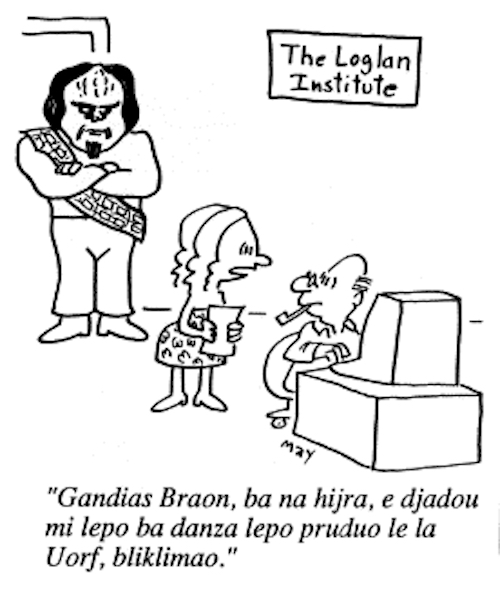
Linguistic relativity hit its science fictional heyday in the 1950s and ’60s, trickling off over the rest of the 20th century. Stories like Jack Vance’s The Languages of Pao and Samuel R. Delany’s Babel-17 have languages deliberately created as tools to foment rebellion or develop superpowers; Heinlein’s Stranger in a Strange Land has the organically developed (we assume) Martian language helping humans achieve superpowered enlightenment. Both parallel real-world efforts to create languages-for-a-purpose, ranging from Esperanto (created in the 1800s to facilitate international community) to Loglan (created in the 1950s to test Sapir-Whorf).
Not all Whorfian stories are quite so “But what if ubermenschen???” Suzette Haden Elgin’s Native Tongue trilogy includes alien languages that destroy human minds and bodies if learned, plus a human conlang intended to better represent women’s experiences. I knew Elgin on Livejournal and had something of a love/exasperation relationship with her writing. It seems unlikely that even the most alien languages would cause learners to explode with the cognitive conflict, which she in fact knew in real life. And her idea of women’s experiences and mine were very different—I was not the only one, and she remained frustrated to the end that Klingon had so many more speakers than Láadan. (But every time someone goes on about government waste, I do think of her media gasping over Linguist families’ entirely-imaginary gold faucets.)
More recently, the Sapir-Whorf hypothesis plays a central role in Ted Chiang’s “The Story of Your Life,” and in its movie adaptation Arrival. Is non-linear time perception, like fine divisions among colors, something that can be opened up by the right language classes? Depending on your view of clairvoyance, it might well fit into the category of being possible without linguistic tools, but easier with them. At the same time, learning shrimp language wouldn’t give you new types of photoreceptors, any more than learning human languages causes parrots or ravens to think like us. Language is an attentional filter, not a sensory receptor.
At least, that seems to be the way it works in our universe. I could write a whole separate essay about fantastical languages that enable sorcery, or open the human mind to things mortals weren’t meant to know. But frankly, I’m not sure most of these are even thinking about Sapir and Whorf. I once attempted to learn Hebrew from a teacher who believed that it was, in fact, the divine language used to create the universe, and many fantasy languages seem to draw on that kind of older mystical belief. Languages that feel wrong are a trope in weird fiction, and as far as I can tell draw about equally on said mysticism and on H.P. Lovecraft’s distress at hearing Yiddish on the streets of New York.
Digging for Salvage
Chiang’s story more than proves that there’s still room for linguistic relativity in modern science fiction. At the same time, the space for non-eye-rolly extreme effects is diminishing—Chiang makes it work, but Chiang also manages science fiction about the Tower of Babel and tiny cellular homunculi.
However, the space for stories about nuanced linguistic relativity is wide open. Authors could explore the cross-species perceptual insights that are—and aren’t—available to therolinguists. You could make a whole, and extremely timely, epic about the neologism-creating rebels against Newspeak. Interstellar anthropologists oversimplifying “primitive” cultures and languages are out there, but could be even better informed by real-world experiences. We know a little now about how decades of tightly-focused study impact people who are still, supposedly, isolated from the rest of the world—and how study can be warped by ridiculous answers to ridiculous questions.
New Growth: What to Read
Benjamin Whorf’s own Language, Thought, and Reality is still a good introduction to the Sapir-Whorf approach to linguistic relativity, if for obvious reasons well out of date. More recent coverage includes Deutcher’s Through the Language Glass: Why the World Looks Different in Other Languages. Everett’s Don’t Sleep, There Are Snakes talks about the experience of study with a specific—extremely linguistically popular—Amazonian tribe, though I have since heard many researchers question the claim that the Pirahã have no number words.
Going further afield, but giving a good sense of how flexible language and thought really are, Gretchen McCulloch’s Because Internet is a terrific discussion of online language shifts. I learned a lot and became very anxious about my use of periods while texting. David Peterson’s The Art of Language Invention gets into modern conlangs, while Arika Okrent’s In the Land of Invented Languages covers more historical ones, how they succeed or fail, and what they do and don’t do to the cognition of speakers.
If you want to try your own hand at language building, and playing with the relationships between language and culture, the Dialect role-playing game is an enjoyably intense way to spend an afternoon with a table of fellow nerds. My family built an abandoned Martian settlement with a subculture of brave desert truckers. Wishing you a full liter and a strong seal!
What are your favorite sorta-untranslatable words, from conlangs or organic languages? What do you wish we had better ways to talk about? Share your thoughts in the comments.


Oh, Dialect! I got to play a round of that at Gen Con some years ago – the word I remember our colonists developing was the all-purpose swear “perk” or “perking” from the omnipresent perchlorates in the soil…
Reminds me of the Striders (asteroid-dwellers) in my Troubleshooter series (the novel Only Superhuman and various stories), who use “vack” (short for vacuum) as their substitute for the f-word, because that word got used so casually for so long that it lost all profane value and to them it’s just a vernacular word for having sex. It may sound a bit euphemistic, but I’ve found you can construct some pretty nasty-sounding cusses, like “Vack you out a very small punkhole, you vack-sucking hull-punker!” (“Punk” = puncture, as by a micrometeoroid.)
In Gene Wolfe’s Book of the New Sun, the Ascians can only communicate through quotes from the approved texts of their totalitarian government; something like Orwell’s Newspeak, in that heterodox opinions could not be formulated. But Wolfe had an Ascian manage to convey a fairly complex story through nothing but quotes from Correct Thought, and beyond that, to express his desire to be considered as a suitor to his Commonwealth translator.
I heard a story about a primarily English-speaking person visiting a Slavic-language country and using nearly exclusively Bible quotes to communicate.
I remain sad that people in future generations won’t get The Simpsons‘ “embiggen/cromulent” joke because they’ll think of them both as real words.
“(or pronouns that have been around since Shakespeare)”
If you mean singular “they,” that dates back to Chaucer at least.
“I once attempted to learn Hebrew from a teacher who believed that it was, in fact, the divine language used to create the universe, and many fantasy languages seem to draw on that kind of older mystical belief.”
In Diane Duane’s wizardry universe, the Speech is the ur-language that the Powers used to create the universe, is understood by every living and nonliving entity when they hear it spoken, and is used by wizards to politely persuade entities or reality to behave in a certain way. Every spell requires inserting detailed descriptions of the participants, and if you get a person’s description wrong, you can inadvertently change their nature to conform to how you described them (or so the narration frequently warns, though Duane never really depicted such an accident). I never really thought about how Sapir-Whorfian that is.
A Wizard Abroad, chapter 10.
I think I see what you mean (though I had to go back and check my print copy, since the updated e-book edition leaves out some chapter breaks and lists it as chapter 7 out of 9 in total). But as I read it, that isn’t a case of someone being transformed accidentally by a typo in a spell, but rather being bound to behave in a certain way by her inclusion in the spell, so that she can’t back out of it later. Which is something that also happened to Nita in Deep Wizardry.
What I’m talking about is the implication that, for example, if the wizard mistakenly enters someone’s height in a teleport spell as 7’5″ instead of 5’7″, they’d come out of the teleport much taller.
You’re right, that never does happen! Wizards are fundamentally copyeditors, I guess, or just really good at not making typos. Wait until the smartphone versions of the manual get (literal) spellcheck, I fear…
I think Dairine’s laptop manual “Spot” does automate a lot of the syntax checking and such, but is far more sentient than a phone’s spellcheck. As, indeed, are the print manuals and the other forms of the knowledge. Not to mention Wizardry itself, whom Nita eventually has conversations with and calls Bobo.
The manual being resilient to enshittification just might be the best possible proof of the Powers that Be’s benevolence. A whole new potential direction of attack for the Lone Power?
The Pirahã language debate is interesting. Some of the rejection comes from those who follow Chomsky and his generative grammar who think that recursion must be a basic inherent capacity (otherwise their reductive account of language would fall apart). When you look closely at what is orgainsed by the notion of recursion it is not clear that it is a cohesive field.
A lot of mathematicians are quite comfortable with the lack of number in languages. Louis Kauffman in a little piece used the example of a shephard who used notches on a staff to count sheep. The shephard doesn’t need numbers to keep a tally, and not everybody has to keep a tally.
But how does he keep track of how many notches he has if he doesn’t have the idea of numbers? I mean, when I’m counting things, I’m mentally going, “One, two, three, four,” etc. to keep track of how many I’ve counted. If I had no concept of numbers, how could I know how far I’d counted, and how could I compare “more than a few” notches to “more than a few” sheep and know if they were equal? The only way to know if the quantity of notches matches the quantity of sheep is if you have the ability to distinguish one quantity from a quantity one greater or less than it, and what else can that be but numbers?
Put a sheep into the pen, slide your finger down a notch. Once all the sheep are in the pen, is your finger in the last notch? If no, commence search for missing sheep… (Did your finger reach the last notch before all sheep were in? Rejoice at your newly acquired sheep!)
Yeah, but what if your finger slips and you lose count? Also, though I’ve only seen sheepherding in film and TV, my impression is that a herd tends to move in a clump rather than in an orderly line of individuals. It seems a very inefficient and unreliable way to count, and applicable only in a very limited situation. I would also think that the concept of numbers is implicit in the understanding that you need to keep track of how many sheep you have, and that you can do so by analogizing their quantity with a quantity of notches on a staff.
Kauffman aside, do we have any actual examples of herding cultures without numerical words? The Piraha are foragers, which seems like it ought to cut down on the need for counting large numbers of similar fast-moving objects. Which doesn’t resolve the acrimonious debate over whether they have such words, but does remove one of the arguments.
I recall a discussion of this in Harvard psychologist Roger Brown’s social psychology class; one of his students, Terry Au, categorically clobbered Alfred Bloom’s “proof” of the Sapir-Whorf Hypothesis – in brief, Bloom had concluded that Chinese speakers had a harder time with counterfactual statements than English speakers because we have the subjunctive and they don’t, which he saw as a confirmation of the Sapir-Whorf Hypothesis. Au demonstrated compellingly that this was nonsense, and his findings were a result of inadequate translation – not only was she able to use better Chinese herself, but she had native Chinese speakers translate the exercises into English, and got precisely the same results in reverse with native English speakers. I have maintained a very strong skepticism about it ever since – which doesn’t mean it doesn’t offer ideas for SF, of course. As a motivational psychologist myself, I am often having to deal with the language issues in implicit motive using thematic analysis – but at the end of the day not having the word does not mean you can’t have the concept and use it.
Has anyone explored the impact of grammatical structure on thought? This might go deeper than the availability or unavailability of particular words. For example, in English, and all the other human languages that I know of, all sorts of concepts are made into nouns. Perhaps putting “rock” and “intelligence” into the same grammatical category has interesting consequences for our thoughts.
The comment above gives an example, though one that was later disproven. Lots of work on tenses in general, as well as on evidentiary markers. I know of work on noun categories – the infamous “women, fire, and dangerous things” – but I’m not aware of linguistic relativity work on what concepts map to what part of speech, and how that affects cognition. It would be awfully interesting – anyone encountered this? Kimmerer certainly seems to think it makes a difference!
I submit “Baji-Naji” from C.J. Cherryh’s “Foreigner” series. We can intuitively understand it as used in the novels, but pinning it down to a “translation” doesn’t do it justice. But, then, the entire Ragi language, the adult form and the child form are from brains with an entirely different wiring than our Earther brains (though to me, it reads a lot like Oriental languages here on planet Earth).
Of course, Heinlein’s “grok” (as sort of pointed out in this essay’s “Stranger…” sentences) definitely means “understand” – but a LOT more than just simple understanding.
The question of “how does a species’ neurological structure affect their language” is a whole other thing – we need more data points! African grey parrots seem to be able to pick up some aspects of human grammar along with the vocabulary; bonobos can do a very little and other great apes can do vocabulary at best. I would put in a bet on parrots in the wild having their own language-equivalent that does things human language can’t do, but no bets on what those things are.
Samuel Delaney’s Babel-17 offers a great story about a language that when used transforms the user…
And Suzette Elgin’s Native Tongue suggests ways people would like a language to be a tool of change (though the sequels get just flat out weird).
Even Janet Kagan’s Hellspark, with the description of a language that automatically conveyed degrees of certainty in each statement, and Eleanor Arnason’s Ring of Swords, with its meticulous discussions of how to discuss gender across language and culture, play with these ideas.
All of these books start with some of the Sapir-Whorf ideas abut words allowing people to name and understand their realities, but they’re also interested in grammars–how different language grammers shape relationships, actions and possibilities that go beyond perception.
Hello, I think that China Miéville’s Embassytown would have been a very good addition to your analysis. How the language you (cannot) speak affects the way you think and behave is a major theme of that wonderful work!
Yes I was about to suggest Embassytown! I’m not sure where the book would be placed amongst the others in this genre. It has so many layers I feel like I need to read it again. I love how the alien language required two humans to “speak” it, and even then no one was sure if they were connecting.
All that Enochian in Charles Stross’ Laundry books. Plus mathematics being a language that can get one awfully close to drawing the attention of the Old Ones in the same series.
Outside of SF, partisans of Lisp and APL speak of the way it changes ones thought structures, an experience i’ve had glimmer of, when it comes to APL.
And now I’m earwormed by “God Wrote In Lisp Code.”
My wife says I should, in fact, mention that I also wrote a story about the Language Man Was Not Meant to Know, and the poor grad students studying it. Slightly less cataclysmically alarming than Stross’s version, but not healthy either.
Thanks for that link. Great story, and I appreciate the dual meaning in your characterization of it, here.
But quantum mechanics (“matrix mechanics” when formulated by Heisenburg) shows you that God wrote in APL.
In a 100-level First-Year Seminar on Philosophy at Mount Holyoke College decades ago, my professor (who is British) was starting to teach the section on epistemology, and introduced it by writing the word “Know” and then “Sknow” on the board. He said, “We’re going to talk now about how we know things, and I have to introduce a made-up word to you, because you Americans have this weird idea that you can know something that’s false, and a lot of what you’re going to read can’t include that concept, so you need the word ‘Sknow’ which means you can only know something if it’s true.”
We all collectively tilted our heads and tried to figure out why you couldn’t know something that was false. (Not that a thing is false, but that we can know a false thing.) We tried to defend that you could, in fact, know a thing that was false.
Eventually, after a lot of questions and confusion (on our part) and resignation (on the professor’s part) one of my classmates asked, “Wait, do you mean can we grok something that’s false?”
Immediately the light came on. “Oh! Of course you can’t grok it if it’s false!” I said. The professor was nearly hopping with glee, going, “Yes, yes that’s it! You can’t grok it if it’s false!”
Needless to say, no one else had been sci-fi readers, and therefore had NO idea what we were saying.
I have found, every time I’ve told this story, Americans immediately start to figure out why you can only know true things, because the idea that we can know a false thing seems so self-evident to Americans for some reason. And whenever I tell it with sci-fi fans, and hit the word “Grok” it’s like lightbulbs appear above people’s head.
But it’s also always made me wonder, if Heinlein had been British, if Stranger in a Strange Land could even have been written.
It was an epistemology class. In my encounter with epistemology “knowledge” was defined as “justified true belief”, and then the rest of the semester was spent wrestling with “justified”, “true”, and “belief”.
(Well, “justified”, mostly. Is it knowledge of you believe something that is true, but you believe it
as a result of an invalid argument?)
No. “Know” implies awareness of something objectively true. If you think you know something but it isn’t actually true, then it’s belief, not knowledge. The definition of the word is not exclusively about the mental state of the observer, it’s about how well their perception of the world aligns with its objective reality. It’s “justified” because it fits the facts. Facts, to paraphrase Neil deGrasse Tyson, are the things that remain true whether or not you believe in them, so consistency with the facts is the decisive measure of whether a belief is justified.
Trying to reduce everything to a question of conflicting beliefs and perceptions, subtracting objective fact from the equation, is very, very dangerous. The spread of that kind of “facts don’t matter, only opinions” ideology is why so many people today believe the Moon landing was faked, vaccines cause autism, and other such lies.
As I said, the bulk of the semester was spent on “justified”. Samuel Johnson’s “I refute it thus”, and kicking a stone may be one sort of justification about concrete things, but more abstract beliefs (about justice, say, or freedom, or even the interpretation of sense data (is the dress white and gold or blue and black?, perhaps)) might require a bit more thought.
If there’s no objective answer, then it’s not knowledge. Or rather, the only thing you know is what you believe. There’s “I know in my heart” and all that, but that’s still ultimately a belief, not a learned piece of objective data.
You’re kind of begging the question. What constitutes an “objective answer”? Where does objectivity end and subjectivity begin? Answering these questions gets at the “justified” in “justified true belief”.
The universe has existed for over 13 billion years. Humans have been around for a tiny fraction of that. It is the height of narcissism to think that the universe is shaped by our subjective belief or perception. The objective universe is what exists with or without humans around to be aware of it. Defining the question of reality solely in terms of human perception is sheer self-absorption. The universe is not about us. We’re just passengers for this part of the ride.
What constitutes an objective answer? A scientific one. The entire point of the Scientific Method is to cancel out subjective perception or bias altogether by requiring that every result be independently verified by different observers and test methods at different times and places. We subtract ourselves from the equation entirely, cancel out our individual perceptions and prejudices and influences, and thereby leave only the stuff that’s physically real. The objective truth is what’s left when subjectivity is erased. In other words, “I refute it thus.”
I think we’re talking at cross purposes. You’re talking about reality, I’m talking about knowledge. There is a distinction. We happen to agree that there is an objective universe, we even agree that we can know things about that universe with some amount of certainty.
Epistemology is about understanding what we can know, and how we can know it, which involves looking at what it means to “know” something, and not assuming that we know everything there is to know about “know”.
“I think we’re talking at cross purposes. You’re talking about reality, I’m talking about knowledge. There is a distinction.”
Not at all. Reality is what distinguishes the word “knowledge” from the word “belief.” Knowledge is awareness of something real, as opposed to something unreal. That’s not about philosophy, it’s about the definition of the word. As a writer, that’s all I care about. You can’t claim to “know” something you’re aware is untrue. If someone tried to pass that off in a manuscript I was copyediting, I’d substitute a different word.
I mean, how can you even have a meaningful discussion of philosophy, or any other topic, if you don’t at least start by agreeing on what words mean?
95% of philosophy is figuring out what words really mean. You’re so close.
What is it about “reality” that helps us turn a belief into knowledge? What is the nature of that connection? What are the ways we can get that connection wrong? How do we gain confidence that we are getting the connection right?
“What is it about “reality” that helps us turn a belief into knowledge?”
The fact that it exists and can be directly observed, of course. My philosophy is Mark Twain’s: “Supposing is good, but finding out is better.” Although I think Twain was being overly generous toward supposing.
Besides, what I’m responding to is the bizarre line of that philosophy professor, “you Americans have this weird idea that you can know something that’s false.” That is not an American belief that I, a lifelong American, have ever heard of. Just like any other English speaker, if an American says they “know” something, it means they believe it to be true. So if that professor believed this was something Americans thought, then he was not someone I’d trust as an authority on the definition of knowing stuff.
I am asking you again to respect other people’s disciplines. You have gone from describing the scientific method to arguing against the existence of epistemology as a field, and against the ability of philosophers to use and debate the jargon of their field. Epistemology is, in fact, part of the reality of human culture that you can observe. You are welcome to discuss how your fields use language, but I am calling a moratorium on the question of “Is it reasonable for philosophers and linguists to have deep dive debates about the definitions of words?”
I do also regret to say that I have encountered the confusion over definitions that the philosophy professor described.
Is this form of knowledge in matters of faith? Is hard for me to see where else such a notion of knowledge might take hold.
But if it’s a matter of faith, doesn’t that mean the person believes their “knowledge” to be real? So it still doesn’t count as “this weird idea that you can know something that’s false.” I still can’t figure out what that sentence even means.
In general, I’ve encountered it as an overly-relativist way of respecting the “knowledge” of others. The idea is that additional respect should be given to things that one personally thinks are false, but that someone else “knows.” It’s usually in a political context, where I would prefer the word “believe.”
Another, less fraught context is where people (not any particular sort of expert) are using “know” to describe level of confidence regardless of actual underlying evidence. This is sometimes a genuine difference in how someone understands the word, but it can also be a form of hyperbole (e.g., “I know she loves me and would never betray me” where a more literal word would be “trust.”).
Oh, so it’s not that you can believe you know something that’s false, but that you can believe someone else “knows” something even though it’s false. That makes more sense. It’s basically like saying “I believe it’s real for you.” I get the concept now, but that’s an unfamiliar way of putting it.
Though I agree, that is overly relativist. It’s one thing if it’s something unfalsifiable, like whether there’s some kind of afterlife or creator to the universe, but another if it’s outright false, like “vaccines cause autism” or “Kubrick faked the Moon landings.”
Thanks for this elaboration. Basically, it sounds like the professor was kick-starting the recognition that there is a distinction between “knowledge” and “belief” on the first day of an epistemology class.
This is an excellent answer for physics class – but once you get into philosophy, or even into the experimental psychology of how observation works, the finicky questions become more worthwhile. We can’t actually subtract ourselves from the equation, because 1) we are actually part of the objective universe, even if a small one, and 2) all the different observers and test methods are still (so far) human. You describe the ideal, but even if all the scientists didn’t share the same general brain structure and processing heuristics, real-life science is messy and constantly working to overcome assumptions that researchers didn’t even know they had.
I am not in any way suggesting that science doesn’t help us know things, or get ongoingly better ideas of what we can know – but our high confidence that vaccines work, the earth goes around the sun, etc., doesn’t mean there’s no value in epistemology. Among other things, that field has a good history of helping us better filter out the supposed “evidence” for things like racial differences in intelligence, or the “obvious” patriarchal structure of lion prides.
I would ask my commenters to be both firmly attentive to the value of objective evidence, and respectful of the many disciplines we use to make that evidence more valuable.
“We can’t actually subtract ourselves from the equation”
Not completely, but we can strive to come as close as we can. Science works through successive approximation — we can never arrive at perfect understanding, but we can keep working to get closer. And that requires understanding that our subjective perceptions are not the measure of reality, but merely an imperfect way of perceiving a reality that would still be there without us. That’s how you define objectivity.
Look, I think you can trust the professor to have accurately described their experience introducing American college youth to a technical discipline. I can’t say I’ve encountered this attitude myself, but then I’ve not discussed the nature of knowledge with that many people, especially not the finer points where “belief” and “knowledge” might part company.
I apologize for not coming up with an example of someone believing a true thing for the wrong reason, because in epistemology it’s not sufficient that a belief be true for it to be knowledge, the true belief must also have a justification. Maybe Aristotlean mechanics (“objects in motion come to rest (because it is the nature of things to stop moving unless pushed by an outside force)”, “solid things fall down and hot gasses rise (because they seek their rightful place in the universe)”). Up to the parenthetical “becauses” these are true beliefs but the incorrect justifications keeps the true beliefs from being knowledge.
I suppose the Bush era “we create our own reality” (https://en.m.wikipedia.org/wiki/Reality-based_community) story might be why the professor wryly characterized the notion as “American”.
I do think you can know something true without grokking it. I definitely know some basic facts about quantum physics that I don’t grok. But I (an American) would also agree with your professor about the nature of knowing – you can believe you know something that turns out to be false, but you would be wrong.
Do you know if your Mount Holyoke class was one of the streams feeding into the Hampshire class on New Ways of Knowing? I always regretted not taking that one.
Yes, that seems obvious to me — you can’t “know” a false thing, you can only believe it. And I don’t see what’s American about it — I’ve been an American all my life and I’ve never come across the idea before. Certainly there are plenty of people convinced they know things that are objectively false, but they believe them to be true, so that doesn’t qualify as using the word “know” to, err, knowingly refer to something false. So I have no idea what that professor was talking about.
John McWhorter’s The language hoax does a decent job dismembering the Sapir-Whorf hypothesis. It was written in response to Deutscher’s Through the language glass, which I haven’t read.
If one steps back from grammar to notation (e.g., in mathematics or programming languages), I think there’s a much stronger case to be made. That’s kind of how I look at Babel-17 now. I wonder if The glass bead game might count?