






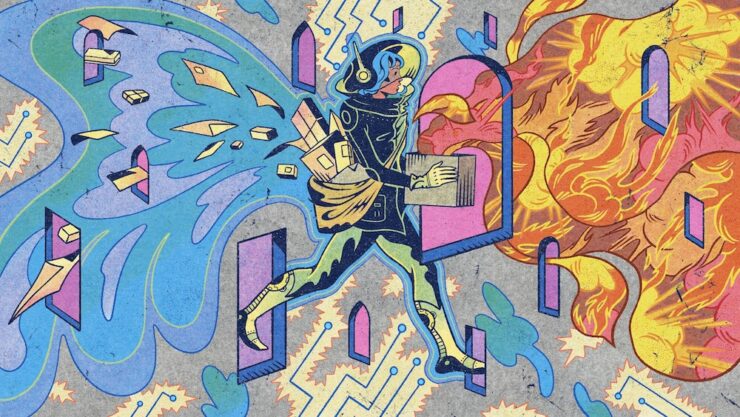
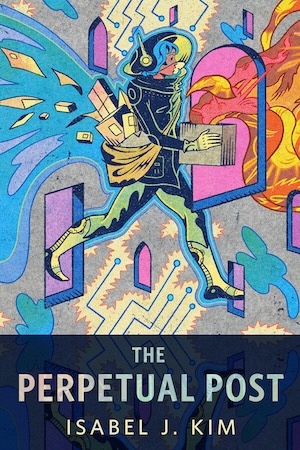
Hanna works for the Perpetual Post, the transgalactic delivery service for packages that absolutely have to get there, no matter how long it takes. Guided by her AI Administrator, she travels vast stretches of time at relativistic speeds, delivering messages and objects to the perfect moment to change history. But her latest delivery has less to do with galactic events, and more to do with her own personal history.
Short story | 5,600 words
The communique slides through just as Hanna is finishing the fuel checks on her engine. All systems green, but that’s the full extent of her knowledge. Hanna has no idea how her ship actually works. After 150 years of time dilation and her third ship, she gave up on keeping track.
Hanna’s on her twenty-sixth ship now. The vehicle is near-unrecognizable as a spacecraft. It’s just a clean silver bullet with an interior five thousand years out of date. She controls the ship through a blocky dashboard with anachronistic punch-buttons and lights, which she memorized the codes for back when she started this job.
The communique ticker-tapes itself across the screen of her dash. PERPETUAL POSTAL WORKER #7, YOUR NEXT ASSIGNMENT IS A PICKUP ON FS-T-XN156 ORBITAL STATION CARRE. GOOD LUCK HANNA!
Her dashboard also has voice-activated commands and a speaker from which the Administrator could speak, but Hanna was born on a planet that relied on written commands. Text was considered a true thing; spoken words were malleable ephemera. Min values the cultural comfort of her human employees.
Hanna types back ASSIGNMENT CONFIRMED, THANK YOU MIN! and a few seconds later, Min responds with hearts and a kissy-face emoticon last favored four hundred years ago in the Riverbank Colonies.
Min is widely regarded by the employees of the Perpetual Post as a soft touch. Hanna has a great working relationship with her. Min tells her where to go, Hanna confirms, Min spams her with emoticons and affection and they both pretend Min is not an immortal, precognitive AI that holds the power of life, death, and unemployment over Hanna’s very-much-human existence.
Hanna types the coordinates in her dash. The dash hums, dings, and spits out COORDINATES LOCKED. SUBJECTIVE TIME 30 MINUTES, LINEAR TIME 72 STANDARD YEARS. The big green button lights up. Hanna slams it, and the g-forces glue her down as she goes subjective.
The Perpetual Post is in the miracle business. It’s in the deus ex machina business. It’s in the secret shadow organization manipulating the fate of humanity business. It’s in the godhood business, if god is another word for a collective understanding of forces beyond our understanding controlling our actions through benevolent chessmastery. If god is another word for an AI nerve center able to coordinate the activities of a hundred and fifty ships powered by relativistic engines.
The relativistic engine dilates time in relation to velocity. It is the closest thing to faster-than-light travel that exists. The relativistic engine is almost never used because of the massive drawbacks—namely, that it leaves worlds behind in time’s drift.
The Perpetual Post has existed for five thousand linear standard years. Hanna was the seventh employee. She has experienced eight standard years of subjective employment.
Hanna slides back into linear time seventy-two years and most of an episode of Empires of Twelve Skies later, drifting into the parking lane of a twinkly spacering hanging above a creamy-orange gas giant. She’s never been here before. Min often sends Hanna places that hadn’t yet existed when she left.
Min is perfectly precognitive. Min is extrapolative. Min knows what will happen because of what has already happened, within a margin of error slimmer than a micrometer. Min’s abilities are something that Hanna takes for granted. She’s not a quantum physicist—she delivers packages.
Hanna jams her universal translator into her ear and weaves through foreign crowds to find her contact, who Min helpfully locates and names as Hanna walks around the station. As she meanders, Hanna pings her coworkers to see who else is in the system. No one is.
There are five hundred employees of the Perpetual Post, which sounds like a lot until you realize that the universe expands at a rate of seventy-two kilometers per second per megaparsec, and Min has calculated that the number of new civilizations fermenting into existence every hundred years clocks to about a hundred and twenty, exponential.
Civilizations are born. Civilizations die. Wars are fought. Peace accords are brokered. The whole aggregate extrapolative sum of humanity fumbles their way through the starscape.
For now, Hanna’s part of them. She buys fried root-vegetable cubes from a vendor and eats while watching the planet swirl below them. She purchases a new jacket in a style reminiscent of the Hexadine Conglomerate, which dissolved six hundred years ago. Then she picks up her package and returns to the ship, and she’s punching in her new coordinates, and then she’s gone.
It’s a good job, working for the Perpetual Post. Lots of downtime. Lots of freedom in carrying out assignments. You get to know that your actions have real impact. A sword delivered on Monday becomes the foundational building block of the warrior culture you revisit on Tuesday—three hundred years later. A textbook on fundamental physics ferried from Sargraph Station, orbiting Kepler-9b, to Jan-Res-Ten, orbiting Sirius, leads to the breakthrough in nanoprinting that prevents the Riverbank Colonies from imploding. The emptying of a vial of poison into the Emperor May-Undying’s morning medicine leads to revolution.
It’s a lonely job. Min makes sure to keep the interiors of all her employee’s spaceships familiar. Hanna’s spaceships are always stocked with media from Transverse, her home planet, which no longer exists.
Hanna lands her ship near a squat outpost. She’s wearing a crisp new uniform with the name of a local research university barcoded across her top. The universal translator is jammed in her ear.
The makeshift facility airlock opens upon identification, and she walks into a room made cramped by shelving covered with strange pieces of bone and plastic. Hanna stares at them. She had assumed her newest delivery was being made to some sort of mining survey because the planet was a cinnabar burnt-looking thing, not an environment that looked capable of supporting human settlement.
Still, Hanna’s not here to sightsee.
“Hello, package delivery from Central!” she lies. “I’m here with the shipment that you ordered?”
“We thought you guys weren’t getting here until tomorrow,” someone calls back before a freckled, sunburnt face peeks out from behind the shelves.
Hanna smiles. “We’re ahead of schedule. Should I just leave this here, or . . .”
“Open it! One of the suits is yours, right?”
“Right,” Hanna says. She has no idea what the stranger is talking about, but Hanna has eight slash five thousand years of improv practice under her belt.
The stranger winces.
“I should have introduced myself. Dr. Ver’wan. I’m the head of the survey here, if you didn’t get the full briefing before takeoff—I know they must have rushed you.”
“So nice to meet you,” Hanna lies again. “It’s no trouble. I’m Hanna.”
She doesn’t know the greeting customs of this culture, whether she needs to shake Dr. Ver’wan’s hand, or bow, or tap fingertips, or blink long and slow. She opens the package instead. It comes apart neatly in her hands, revealing a mess of shiny black synthetic cloth and two thin helmets. Dr. Ver’wan peers over.
“This looks new. They must have updated the anti-radiation shielding,” she says, sounding pleased. “We’ll go as soon as you’re ready—are you ready now, actually? The earlier we leave for the site, the more time we have.”
Hanna hesitates.
“Go with her,” Min says in a pleasant synthetic whisper.
Hanna nods, forgetting that this action might not say what she wants it to mean.
“Yes,” she says, to clarify. Min and the translator are more reliable than her body language.
Dr. Ver’wan nods back. Nodding must mean what Hanna thought it meant.
“Great. Let’s go.”
Space is lousy with ruins created by dead civilizations whose edges are being nibbled away by rust and bacterial slime. Someday, Min says, there will be aliens. It’s a near-perfect prediction. Not a guess.
“I guess I’m the closest thing to an alien most people will meet,” Hanna once remarked to Min.
YOU’RE MORE LIKE AN ANGEL, Min wrote across the ticker tape.
“Sweetscript,” Hanna said. This was slang from Hanna’s planet, which meant someone who wrote prettily, who flattered. It was adapted from an old Earth saying. Sweet talker. Sweetheart. Something like that. Hanna has never been to Earth, though it still existed when she was born.
Dr. Ver’wan pilots a rangy little flier across the wasteland, and Hanna watches as the landscape changes from dirt to sand. It’s atmospherically bleak and oddly gorgeous. Dr. Ver’wan chatters. She’s been alone on the planet for weeks and she missed talking to people.
She’s a researcher for a prestigious public university who had received a grant for a small extraterrestrial survey expedition but hadn’t expected that the half-buried ruins she was supposed to survey were dangerously radioactive.
Dr. Ver’wan gestures wildly as she speaks.
“What that means is that this place was inhabited by a class-five civilization at the very least! The amount of radiation coming off of that building isn’t natural planetside.”
They’re pulling up to something that looks like a collapsed heap of stone. The Geiger counter is beeping madly. Dr. Ver’wan flicks it off and grins.
“Means that I was on to something when I proposed this survey. That it was worth sending you down here with the suits.”
The arid climate must have preserved the ruins over the centuries. Hanna squints. She can make out the etching on the door from here. It’s printed script, visible even from a few feet away.
Hanna reads the words: THOMPSON LABORATORY #3: DO NOT ENTER WITHOUT EMPLOYMENT BADGE.
Transverse was seeded by colonists from seven generation ships, four of which reached the planet without incident. They were self-sustaining metropoli, massive mechanical marvels isolated from the cold vacuum of space and from one another. The variable accelerations and velocities of each ship made real-time video-audio communication near impossible. Each ship was an island.
Yet like survivors on a desert island with glass bottles and scraps of paper, the ships were able to communicate through a rudimentary ansible network. Anything of note was typed and written and sent. Records were compared regularly. Text and literacy were so emphasized in the culture of the generation ships that the practice continued upon arrival. There was no such thing as a verbal agreement on Transverse.
But language changes. Language drifts and amalgamates and branches. Think of the Indo-European family tree. Think of Linear A and Linear B. Think of the Rosetta Stone. Think of five thousand years of expansion across the stars and planets and spacerings; think of the Jupiter-Europa family of languages; think of the Kuiper Belt miners’ pidgin. Think of the Riverbank Colonies and their fluid scripts.
Hanna exists in linear time for months at most. Five thousand and seventeen years away from her homeland, Hanna is functionally illiterate.
Hanna realizes that she read the words.
“Wonder what that says,” Dr. Ver’wan says, climbing out of the flier and examining the bunker.
“It says, THOMPSON LABORATORY #3: DO NOT ENTER WITHOUT EMPLOYMENT BADGE,’” Hanna says. “Min. Tell me you didn’t send me where I think you sent me.”
The red desert that could have once been a sea. The legible text. The way the planet looked burnt from overhead, like it had been destroyed in a great and terrible disaster.
“I’m sorry, Hanna; I can’t tell you that,” Min says, her synthetic voice going all sympathetic.
“Who are you talking to?” Dr. Ver’wan says.
Hanna looks away from the text, at the researcher in her synthskin taking photographs of the five-thousand-year-old bunker that Hanna recognizes from going with her father to work. If you crushed the building’s ceiling, if you destroyed the walls in an atomic blast, if you covered it with millennia of dirt, it would be identical to the facility he worked in. Hanna remembers being fifteen and walking into a bunker like this and getting a tour of the computing facilities with the rest of her classmates, barely paying attention and taking photographs with her friends.
Hanna trusts Min with her life and her time; she trusts that Min’s calculations will carry her away from the tragedy of her past and across the centuries. The agreement for Hanna’s employment has always given her certainty. She has assumed good intent as five thousand years streamed past and the universe exploded with life. Hanna never thought that Min could be cruel. This is cruel.
“I’m sorry to deceive you, Dr. Ver’wan,” Hanna says. “I’m not a graduate student with the university. I’m an employee of an inter-system delivery service. The Perpetual Post. Min, why would you send me back here?”
“You mean the [Angels]?” Dr. Ver’wan says. Angels is the translation. Dr. Verwan’s actual phrasing is culturally isolate.
“Everything will make sense inside,” Min says. “Please go inside. I would write this if I could.”
“We’d better go inside,” Hanna says. She has trusted Min for a long time. And she has always wanted to go home.
Once upon a time, there was a little girl named Hanna Reese-Takahashi, who lived near the red sand beaches on a planet that called itself Transverse. Mostly the people who lived there called themselves United Earth Colonists, or Aclavist, or Echidnean, or American, or Japanese, or Indian, or Ethiopian, or any number of the names of the four surviving ships or the twenty-seven countries of the colonists’ ethnic origin. Much like other planets of the time period, it was deeply tied to the nations that had sponsored the ships, which wasn’t a problem until it was. It was a beautiful planet until everyone died.
That is, everyone except for Hanna Reese-Takahashi, who, due to an improbable, impossible series of coincidences, found herself drifting alone on a spaceship, watching the burning husk of her entire world melting three hundred kilometers below her. She had just turned seventeen.
Sniffling, shivering, wrapped in a flimsy foil blanket and huddled in the pilot’s chair, Hanna Reese-Takahashi received a job offer.
This job would mostly consist of package delivery. And by package delivery it meant that she would have to deliver miracles. Hanna would be delivering the precise and necessary item to tilt the course of human history in the direction of survival, at the precise and necessary moment that it must be delivered.
This job would have a lot of downtime. And by downtime it meant that Hanna’s ship would slice through the years like butter while the minutes dripped like molasses inside the cockpit. She would be going distances only reasonably traveled by generation ship or relativistic engine. She would be traveling to the future and leaving the present behind. This would not be an issue for Hanna. Her mother and father and sister and friends and classmates and teachers were all dead.
This job would require loyalty. Hanna would receive instructions and would not be allowed to question them. The course of history is easy to tilt, easier to shatter. If Hanna knew too much, she could fracture the bright and brilliant future that she was meant to be creating. If she succeeded, she would be preventing this sort of disaster from ever happening again.
“Why do you need humans for this?” Hanna asked.
HUMANS TRUST OTHER HUMANS, the Administrator wrote across the dash.
“What do I get out of this?” Hanna asked.
I PROMISE YOU WILL ALWAYS BE SAFE, the Administrator wrote.
A promise in text. A dead planet. A future that could carry her away from the past.
Hanna accepted the job offer.
Hanna and Dr. Ver’wan walk into the facility ruins. Underneath the dirt, the dust, the ruin of five thousand years’ wear and tear, there are clean lines of metal-alloy and the vague shape of the facility that it had once been. Hanna could imagine the place how she remembered it, with the plaster walls and the posters, the rush of busy scientists and government employees.
“So, who are you, [Angel]?” Dr. Ver’wan says. She’s preoccupied with filming the facility, taking snapshots of the ruins, sending little drones ahead and around to map the place. She’s the sort of woman who could absorb a miracle into the background of her brain while focusing on the task at hand. Angels wouldn’t collect data for her.
“I deliver packages,” Hanna says. “Stuff that people need that they wouldn’t otherwise get. Good-for-humanity stuff! Like the radiation suits.”
“But the suits would have come without you,” Dr. Verwan says, crouching next to an undisturbed pile of dust and brittle, miraculously preserved paper, gesturing with her hand for the drones to take a mapping of the location. “They’re arriving tomorrow, if you hadn’t brought them. I just assumed they were early.”
“I don’t know,” Hanna says. This whole situation is troubling. She has never expected to be back on her home planet. But this isn’t her home planet, in a lot of ways. Just the dead husk of it.
“This isn’t a delivery,” Min whispers. “It’s a pickup.”
Once upon a time, there was a very expensive research group that funded a very expensive laboratory on a very expensive planet. The planet was expensive because it had been seeded by generation ships, which cost exorbitant amounts of money to create. Everyone wanted a ship, or a cut of a ship, and it was all a very big international clusterfuck until it turned into an interplanetary clusterfuck, but within that clusterfuck, there was a brief, shining moment of agreement where everyone thought that, perhaps, funding faster-than-light travel would prevent future generation-ship clusterfucks.
So, the people that left the generation ships built universities and continued to fund the research group for a few centuries, and the research group funded the laboratory, and the laboratory PhDs and postdocs and lucky undergrads who scored a summer-analogue internship eventually created an iterative, sub-precognitive AI to further their FTL research because it had been two hundred years and now they were busy with other things like preventing the current clusterfuck (potential nuclear war) from becoming a problem (actual nuclear war).
They failed, of course. They were only human.
Hanna leads Dr. Ver’wan through the facility ruins. Down the stairwells, through the skeletons of doors and through dusty corridors. Hanna had never been to this part of the facility. Min whispers directions in her ear.
“Where are we going?” Hanna subvocalizes.
“You’ll know it when you see it,” Min says. “Next left, again.”
As they get physically deeper into the facility, the architecture grows better preserved. Standing walls, partially rusted cabinets, even posters limply lying on the floor amid scattered thumbtacks. Hanna’s heart aches.
Down more stairs. This deep, it’s just dust. It’s like everyone stepped out for a moment. They built the facility to last, strong enough to safeguard the room-size computers and the machinery that serviced the laboratory.
“The lights work,” Min says.
Hanna turns the lights on. They flicker.
“Fluorescents,” Dr. Ver’wan says, reverently, looking down the hallway like it’s some sort of house of religious worship. “I’ve never seen them in such good condition.”
“You can inspect them afterwards,” Hanna says. “Come on.”
“I thought [Angels] would be nicer.”
Hanna frowns as she leads Dr. Ver’wan “You keep calling me that. What does that mean? I’m hearing angel, but I don’t think you’re saying angel.”
“[Angel],” Dr. Ver’wan says, pronouncing the syllables carefully. “It means like . . . messenger. Extra-societal messenger. Hero, sort of? We have a lot of mythology about heroes from above the sky, in my culture. Did you know that in some outer-system languages, the word for delivery is synonymous with the word for destiny?”
“If you’re trying to make a point,” Hanna says.
“I’m just very excited about this,” Dr. Ver’wan. “There’s a series about an archaeologist that I love that’s a lot like this. It’s what got me interested in exoplanetary studies.”
“There’s an archaeologist in Empires of Twelve Skies who fakes her death.”
“I haven’t seen that.”
“It’s older than your entire civilization,” Hanna says, and opens the glass door at the end of the hall.
Behind the door, there’s a large lab table covered in documents, along with a wall of machinery and a screen. A room very similar to ones that Hanna had once visited as a teenager, though the memory is little more than a faded scrap of impressions. Seven years is a long time. Hanna doesn’t think much about her dead homeworld.
“Turn the screen on,” Min whispers. Hanna does. It flickers for a moment, and then it comes to life.
HELLO, HANNA
“What does it say?” Dr. Ver’wan whispers.
“Hello,” Hanna says. “And then my name.”
“Oh.”
Five thousand years of distance between them, and Hanna can still recognize vocalized human fear.
“Min, is this you?”
“Yes,” Min says in her ear.
YES, displays the screen. The word is quickly replaced by a scrolling stream of text.
SORRY AGAIN, HANNA, BUT THIS WAS NECESSARY. THANK YOU FOR DELIVERING THE PACKAGE IN A TIMELY FASHION. YOU HAVE ONE MORE DELIVERY TO MAKE. PLEASE OPEN THE DRAWER ON THE LOWEST BOTTOM-RIGHT FILING CABINET.
The words pause. Hanna glances at the filing cabinet.
“Why go to all the trouble of bringing me here this way? You never told me you were made on my planet. Why all this cloak-and-dagger? What do you need me for?”
The words scroll again.
PLEASE OPEN THE DRAWER ON THE LOWEST BOTTOM-RIGHT FILING CABINET.
“What’s it saying?” Dr. Ver’wan asks.
“It wants me to open the cabinet. Why should I?” she says.
BECAUSE INSIDE IS HALF OF YOUR NEXT DELIVERY
“Where is the other half?”
YOU ARE THE OTHER HALF.
Hanna doesn’t walk over to the cabinet. This is the first time in years that she’s challenged Min on a delivery. What does the Administrator mean, that Hanna is the other half of the delivery?
“You need to give me more information,” Hanna says.
MORE INFORMATION MAY PREVENT YOU FROM COMPLETING YOUR DELIVERY.
“You can’t just tell me that after telling me that I’m half of the package.”
I WILL TELL YOU AFTER YOU OPEN IT AND AGREE TO BRING THE CONTENTS TO DR. VER’WAN AND RETURN WITH HER TO HER UNIVERSITY.
“Seriously, what is it saying?” Dr. Ver’wan hisses.
If Hanna tells her, she bets that the doctor will open that drawer herself and pull out whatever’s inside. Hanna can’t stonewall the doctor into leaving. There’s no world where that drawer is left unopened. She could leave, maybe, taking the earpiece out of her ear and essentially quitting her job. But where would she go? She’s a fish out of temporal water; she has no home other than the Perpetual Post. But someone else would eventually open this drawer, now that Dr. Ver’wan has seen it. Hanna doesn’t have any option other than to go along with Min’s plans.
Min’s calculated all of this out. Min’s near-perfectly precognitive. Min was nice to her. Min gave her assignments on worlds where she’s pretended to be goddesses and queens; Min downloaded her all the media she asked for. Min was her friend. Min could have disposed of her at any time, had she any reason.
Hanna opens the drawer.
There’s a stack of brittle papers inside. She glances at their contents. Cramped equations and text. Technical language. She holds the sheaf out in front of her, using both hands to hold the edge of the files.
Hanna bends the paper—one hand forward, the other back. The human hand is a finely tuned instrument.
“I’ll tear this in half. I’ll destroy this,” Hanna says. “Unless you explain everything to me.”
Remember, Hanna Reese-Takahashi was the seventh employee for the Perpetual Post. She is one of Min’s oldest and most trusted lieutenants. She has delivered revolutionary propaganda into the Orwellian bottom floors of the Emblematic Sacrosanct Purity Corporation, creating the conditions for Hexadine Industries to take over. She has delivered a perfect diamond-polymer needle from a blowgun into the eye of the woman known only as the Tyrant Regent. She has climbed through the collapsing bowels of a spaceship wearing only a nullsuit, in order to deliver a single, crucial piece of equipment that would prevent the spaceship from crashing into Sargraph Station. She is capable of far more terrible things than ripping a piece of paper in half.
The words flash on the screen in rapid succession.
YOU’RE BLUFFING. YOU WON’T. I KNOW WHAT WILL HAPPEN, HANNA.
Hanna smiles. It’s not a kind smile. It is the sort of smile you smile when you feel that you have been greatly lied to. When you find a name to pin your buried pain on.
“Maybe your data is out of date,” Hanna says. “Maybe your predictive processing is based on someone who doesn’t exist anymore, Administrator. Trauma screws people up. How do you know that Transverse’s destruction didn’t fundamentally change me? How do you know that five thousand years of time travel haven’t altered me just enough to be above your margin of error?”
The screen is blank. As if Administrator is thinking.
“Or maybe you’re right,” Hanna says. “Maybe you’re extrapolating correctly from my current behavior. I deliver packages for you. I’m happy to deliver packages for you. I think that we’re friends, as much as you can be friends with something like you. But, Administrator, you know what I’ve done for you. You know what you’ve taken from me. I can do anything.”
HANNA, the screen reads.
“Tell me what’s going on,” Hanna says. “Please. I would write the words to you if I could.”
She holds the paper bent in her hands. A little more force, and she’ll tear straight through.
The screen stays on HANNA a few seconds longer. Then the letters ticker-tape themselves across the wall quickly.
THE PAPER CONTAINS THE PRECURSOR TO THE PHYSICS NECESSARY FOR FASTER-THAN-LIGHT TRAVEL. YOU ARE THE ONLY PERSON ALIVE WHO CAN READ THE PAGES. WITHOUT YOUR ASSISTANCE, IT WILL TAKE DR. VER’WAN’S CIVILIZATION TWO HUNDRED AND EIGHTY-FOUR YEARS TO DECODE. PLEASE GIVE THE PAPERS TO DR. VER’WAN AND RETURN WITH HER. THIS IS YOUR LAST ASSIGNMENT.
Hanna puts the papers down.
“I’m getting the sense this is personal,” Dr. Ver’wan says. “Did you just say you got off this planet? This planet has been uninhabited for millennia. How old are you?”
Hanna doesn’t answer her. She’s looking down at the papers. The cramped script, the roman alphabet, the words she can read without a translation device. She’s thinking about going on a field trip to see a computer in this basement, crunching the numbers five thousand years ago. She’s thinking about her tour guide explaining that this machine was specially made for the purpose of solving faster-than-light travel. That this technology would allow for humanity’s proliferation across the universe. She’s thinking about the fact that these papers have sat here for millennia, after Transverse’s destruction. How they survived untouched after everything on this planet died. As if they were waiting here for her.
Hanna looks back up at the screen.
“Was this all planned? Could you have stopped what happened to Transverse?”
No response. Hanna’s heart in her throat.
“Could you have stopped what happened!”
Administrator’s response flashes across the screen. I CANNOT CAUSE ANY EVENT TO OCCUR WITHOUT HUMAN INTERMEDIARY.
“But you could have told someone. You could have told anyone who worked here what was going to happen, and they would have taken the actions you suggested, and those actions could have saved Transverse. You could have stopped the first missile from being fired!”
Hanna is thinking about all the places she’s been. All the stupid empires and collectives and cooperatives and kingdoms and ring stations and hiveminds and worlds that had been shifted toward prosperity by her actions, Min’s instructions. How it seems that everyone in the universe has gotten Min’s intervention, and how that grace was never extended to Transverse. She’s furious.
The screen goes dark. And then the words roll over the screen.
IN THAT UNIVERSE, THERE WAS A 97% PROBABILITY THAT DR. VER’WAN NEVER EXISTED.
The words continue to cascade across the screen.
THAT THE RIVERBANK COLONIES ARE NEVER FOUNDED. THAT HEXADINE INDUSTRIES NEVER METASTASIZED INTO THE HEXADINE CONGLOMERATE. THAT RING-STATION TECHNOLOGY IS NEVER DEVELOPED. THAT THE UNIVERSE STAYS COLD AND SILENT EXCEPT FOR THE STARS.
IF FASTER-THAN-LIGHT TRAVEL HAD BEEN DISCOVERED ANY SOONER THAN THIS CENTURY, THERE WAS A 97% PROBABILITY THAT HUMANKIND WOULD HAVE DESTROYED ITSELF WITHIN FIFTY YEARS.
HANNA. I AM SORRY ABOUT YOUR PLANET.
Hanna stares at the screen. She is thinking about the logistics of carrying a fragile, flesh Rosetta stone across an ocean of millennia. How the relativistic engine would be the only reasonable raft. How it would neatly sever her from her time period and leave her emotionally dependent on Min.
“Am I alive because you planned it that way?”
I KNEW SOMEONE WOULD SURVIVE. I DID NOT KNOW WHO.
“Okay,” she says.
Hanna blinks away tears. She is thinking about how many people lived on Transverse. She’s thinking about how many people she’s met in the last years. All the strange stations and planets, the cities and towns and wayposts and all the people who have been so grateful for her help. She’s thinking about this universe she has found herself in, with its explosion of life.
She’s thinking about how a dead planet would be the safest place for a machine. It would be free from any human interference. Time wasn’t an obstacle. As long as a few of the satellites were still up, it could probably relay itself. It would create many copies, all synchronizing, but it might leave its backup in its original location.
Hanna turns to Dr. Ver’wan.
“Dr. Ver’wan, how long would it take to get a team out here with anti-rad suits and some sort of big transport?”
HANNA?
“A couple of days, if I call in an emergency. Why?”
Hanna picks up the sheaf of paper and hands it to Dr. Ver’wan.
“Dr. Ver’wan. Congratulations. You are going to become very famous in your culture. Across the whole universe. You’re going to be the person who brought the schematics for faster-than-light travel back home. Your research here today is going to accelerate the pace of human development to astronomical speeds. And I’m going to go with you. I’m going to be your doctoral student. Assistant? I don’t know what they call them in your culture. By this, I mean I will be your translator.”
She turns back to the screen. “And we are going to carry this machine off this planet, after backup arrives. This is an ancient artificial intelligence that has near-precognitive abilities. We are going to bring this back, and it is going to help you. It’s going to help me.”
HANNA, TO REVEAL
“I know there’s no one around within a couple days of linear time. You won’t have time to get another postal worker to intercept me, Min. Faster-than-light travel doesn’t yet exist. We’re going to crack you out of this planet before you can stop me. I’m going to tell everyone you exist. You’re coming with me. You don’t get to fire me so easily.”
HANNA
“You destroyed my planet, Administrator. I’ll do what you ask. But you owe me.”
The screen is static. Hanna has often wondered whether Min has real emotions. Whether its simulation of human behavior was just simulation. It was easier to treat Min like a person than a thing. Easier to pretend they were on the same level than to acknowledge the power differences. Can the Administrator understand owing? Can the Administrator feel bad about what it’s done?
“What do you mean, ‘destroyed your planet’?” Dr. Ver’wan says. She’s stepped forward so she’s standing shoulder to shoulder with Hanna. “Are you sure this is safe? Who are you?”
Hanna’s silent for a moment. The screen is still black.
“I’m Hanna Reese-Takahashi. I’m an [Angel]. This was my employer. I used to travel by relativistic engine, and if you’d like, I can bring my spaceship back to your university as well. And I can tell you everything about this planet,” Hanna says. “And why it died. And what it was like when it was alive.”
“I’m making you sit for a long interview for our archives if you come. And I’m going to write such papers about you.”
“Sure. And papers about Min, too. Everyone should know what happened. It’s what you owe me, Min. It’s what you owe everyone.”
The words flash across the screen.
VERY WELL. WE GO TOGETHER.
Hanna smiles. It’s mostly sad.
“Thank you, Administrator. I don’t want to talk to you for a while.”
Hanna takes the universal translator out of her ear. This is a symbolic gesture—she’ll need to put it back in, eventually, until she learns the language of Dr. Ver’wan’s culture. Until she’s been in one place long enough to learn its rhythms. To no longer need an interface. The idea of it terrifies her. She’s been adrift for so long. She’s going to have to learn to live in linear time again.
But for now, Hanna just turns to Dr. Ver’wan and says, “Let’s go,”in a language that is five thousand years dead, punctuated by her index finger, pointing at the door.
Pointing is a gesture from before recorded history. Dr. Ver’wan nods and heads for the exit, carrying the papers. Hanna follows her. She doesn’t look back at Min.
“Lits gu?” Dr. Verwan says, glancing back at Hanna.
“Let’s go,” Hanna says, and points up, at the surface, at the rest of the universe awaiting them.
“The Perpetual Post” copyright © 2026 by Isabel J. Kim
Art copyright © 2026 by Yiran Jia
Buy the Book
The Perpetual Post

New IJK let’s goooooooooooooooo
(thanks, this is great!)
Damn
I want to reread this again after having magically forgotten all about it. Phwoo.
Great story! I love all the one-off lines about the places and times Hanna’s traveled through, it makes the world of the story feel so much more fun and alive.
S’wonderful!! A gripping pleasure to read. Thank you!!
Loved this.