






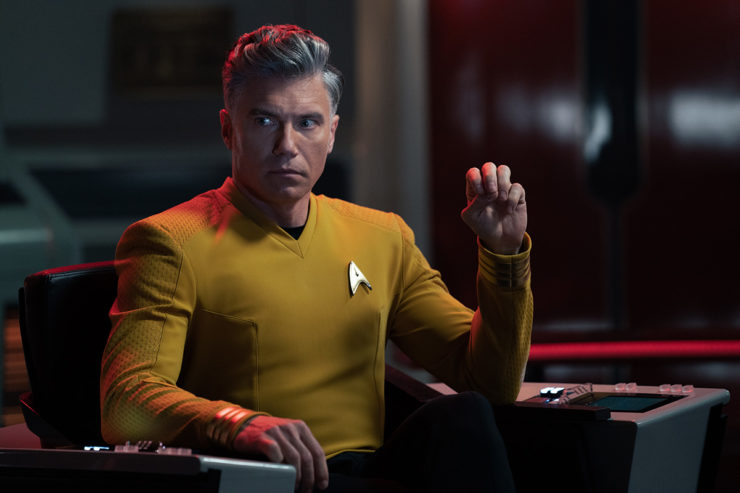
The Anson Mount/Ethan Peck/Rebecca Romijn iterations of Pike, Spock, and Number One debuted in Discovery’s second season, with Spock missing, Pike put in temporary command of the U.S.S. Discovery, and everyone chasing the Red Angel. At one point, in the episode “Through the Valley of Shadows,” Pike takes possession of a time crystal, one of many housed in a monastery on the Klingon world of Boreth. By doing so, he committed himself to the vision of the future that he saw when he first touched it: his saving the life of many cadets, but in doing so, suffering from brutal radiation burns that would leave him immobile, mute, in constant pain, and only able to signal “yes” or “no” through an interpretive computer, as seen in the original series’ “The Menagerie” (the episode where Pike first appeared to audiences). “If you take the crystal, your fate will be sealed forever,” Tenavik, the Klingon monk, tells him. “There will be no escaping it.”
So, of course, Pike tries to escape it…
The Enterprise and the Cuyahoga are at the Romulan Neutral Zone, providing upgrades to the outposts that dot the Federation side of the border. These outposts were first seen in the original series’ “Balance of Terror,” and established as having been constructed following the end of the Earth-Romulan War a century previous. (Said war would’ve been the subject of Enterprise’s fifth season, had it not been cancelled.) This is far from the last reference to that episode we’ll see…
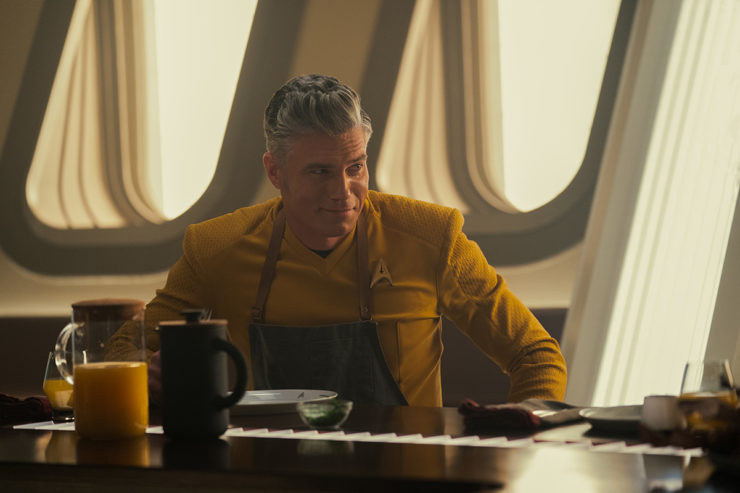
The Cuyahoga’s CO is Pike’s friend-with-benefits Captain Batel, last seen in “Strange New Worlds.” We see Pike cooking breakfast for her again, making use of leftover pasta and eggs to create a kind-of omelette and before she heads back to her ship, Pike offers to make her osso buco some time soon. Let me say again how much I love Pike the foodie…
Pike, Number One, and Spock meet with Commander Hansen al-Salah to discuss the upgrades. (As the episode progresses, it becomes clear that this is the same Hansen we met in “Balance,” re-cast from the very white Garry Walberg to Ali Hassan, a Canadian comedian/actor/chef of Middle Eastern descent, a casting move that will likely bring out the racists among Trek fans just as the casting of Adrian Holmes as Robert April did.)
The plot kicks in when we go from Number One outlining the upgrades—which Hansen has been requesting for five years—to Hansen’s son Maat entering the room. Pike goes ashen (as do Number One and Spock), because Maat al-Salah is one of the names of the cadets whose life was endangered when the baffle plate ruptured on the cadet ship. More specifically, Cadet al-Salah is one of two who didn’t make it. (That original mention in “The Menagerie” by Commodore Mendez, by the way, specifically said that Pike got out “all those kids who were still alive,” so we’ve known all along that he didn’t save everyone.)
Buy the Book

A Prayer for the Crown-Shy
Pike excuses himself, and goes to his quarters to compose a letter to Maat, telling him to not join Starfleet—this after Number One for the second time tells him that he should control his own fate, dagnabbit.
In the middle of composing that letter, an older Pike shows up in his quarters, wearing an admiral’s uniform from the movie era (seen in The Wrath of Khan forward, and established as being in use all the way until the mid-twenty-fourth century, as seen in TNG’s “Tapestry” and “Yesterday’s Enterprise”). Admiral Pike makes it clear to Captain Pike that writing that letter will be a disaster.
He proves that he’s really Pike by providing a traumatic childhood memory that he never told anyone about, mainly because it involved his first horse having to be put down, and the horse was named “Sir Neighs-a-Lot,” and tragic backstories and silly names are a bad combo. Then he opens up a time crystal. It was the very same Klingon monks who gave him the time crystal on Boreth in “Shadows” who sent Admiral Pike back to remind his younger self what “your fate is sealed” actually, y’know, means.
The bulk of the episode is Pike experiencing events seven years in the future as they would play out if he finishes that letter to Maat. Writers/executive producers Henry Alonso Myers and Akiva Goldsman and director Chris Fisher spend most of the rest of the hour re-creating “Balance of Terror,” but as it would’ve happened if Pike had written the letter, had not accepted the promotion to fleet captain, and had stayed as CO of the Enterprise.
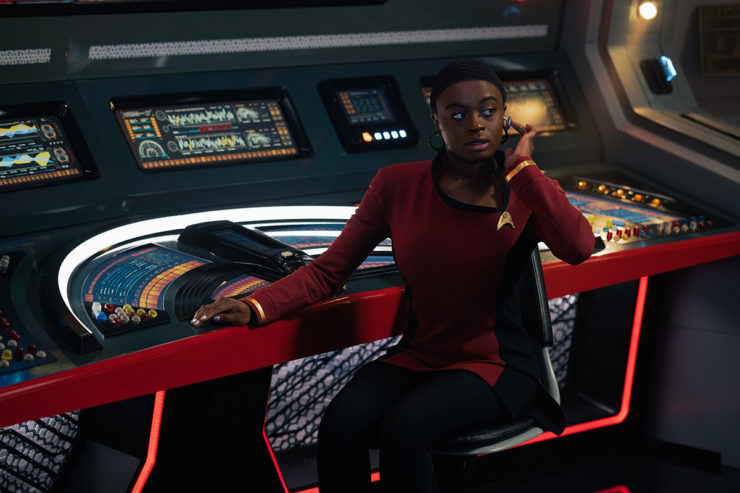
Some things are the same: Spock is still both first and science officer, Uhura is now a lieutenant and in charge of communications, Chapel is now in Starfleet and is head nurse, and the chief engineer speaks with a heavy Scottish accent. However, instead of Sulu and Stiles at the forward console, we’ve got (still) Ortegas and Mitchell, and M’Benga is still the chief medical officer.
As for Jim Kirk, well, he’s in charge of the U.S.S. Farragut instead of the Enterprise. And yes, we see him.
I gotta give the Secret Hideout folks credit. The announcement was that Paul Wesley would be playing Kirk is season two of SNW, and here he shows up as a special guest star at the end of the first. Did not see that coming.
Pike is dropped into the middle of a wedding ceremony—the same one between Angela Martine and Robert Tomlinson that Kirk performed at the top of “Balance”—which is interrupted by a distress call from an outpost along the Neutral Zone. This is one of several scenes from “Balance” that are painstakingly re-created, in some cases with Nami Melumad matching the music from the original episode as well. (In particular, the bit where they get a look at the Romulan bridge and discover that the Romulans are a Vulcan offshoot is shot-for-shot, beat-for-beat, and note-for-note a virtual re-creation of the like scene from 1966.)
But things play differently. Enterprise gets help from the Farragut, and they try to talk to the Romulans. Pike is more cautious than Kirk is, and is also unwilling to cross the border into the Neutral Zone. In addition, the trick of using a comet’s tail to reveal the exact location of the Romulan ship goes much worse this time, with the Farragut destroyed, though most of the crew, including Kirk and his first officer La’An, survive and are rescued by Enterprise.
In the end, an entire Romulan fleet—summoned against orders by the ship’s sub-commander—shows up, something the Romulan commander anticipated would happen in “Balance.” Pike tries to bluff with a “fleet” of mining drones from the outposts, a very Kirk-like bluff conceived and executed by James Tiberius his own self.
I was frustrated by one particular bit in this episode, where Sam Kirk—who is still serving on Enterprise under Pike—tells his captain about his little brother, and Sam’s litany is the same dumbshit misinterpretation of Jim Kirk that has dogged the franchise since 1984. The Captain Kirk of the TV series that aired from 1966-1969 was not a devil-may-care maverick who went his own way and disobeyed orders at the drop of a hat, and all those other clichés that accreted around the character after he disobeyed orders to save his best friend in The Search for Spock.
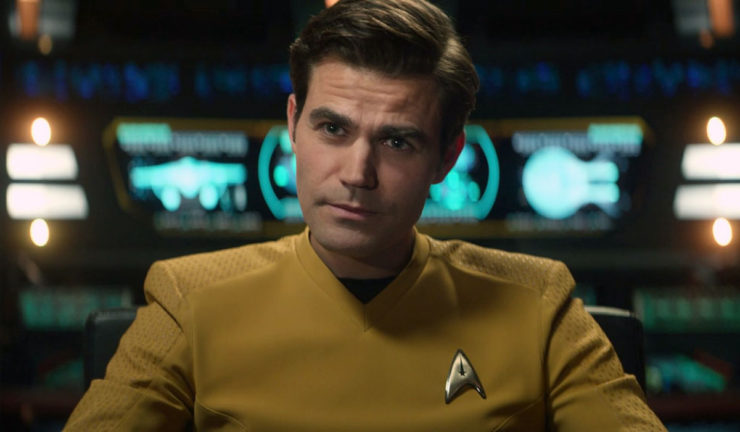
But after that, the Kirk that Myers and Goldsman wrote and Wesley portrayed was very much the Kirk of the original series—especially the bluff of using the mining drones as a “fleet,” on the logic that it’s been a hundred years, and the Romulans probably would no more know what a Starfleet fleet looks like now than the Federation knows what Romulan ships should look like…
It’s to Wesley’s credit that he doesn’t try to do a Shatner impersonation, especially given how caricatured Shatner’s deliveries have become over five-plus decades. He’s inspired by Shatner, but makes the role his own (in much the same way Mount, Peck, Romijn, Celia Rose Gooding, and others have done).
Other aspects of the re-creation of “Balance” are less successful. Ortegas taking on the hardline role of the racist Stiles in the original is a weak fit. While Ortegas generally seems to be way crankier in this alternate future than the one we’re familiar with, having her take on Stiles’ asshole role is just not convincing. Matthew Wolf’s Scotty impersonation over the intercom does wrong what Wesley and the others did right: it’s a caricatured impression of James Doohan, and is pretty groan-inducing. And while Matthew MacFadzean is perfectly fine as the Romulan commander, his performance is a pale imitation of Mark Lenard’s in the original. (Why is it that no one can do justice to Lenard? This is the third straight re-casting of one of his roles that hasn’t worked, following Ben Cross’ awful turn in the 2009 Star Trek and James Frain’s adequate-but-not-great performance in Discovery’s first two seasons.)
The endgame of all this is twofold: One is that Pike’s actions result in decades of war with the Romulans. The other is that Spock is among the many casualties, and he is very traumatically injured. (In a nice twist, it’s Martine who dies leaving Tomlinson without a fiancée, where it was the other way around in the original.) Admiral Pike later explains that Spock is the fulcrum. Every time Pike tries to alter the fate the time crystals showed him, the result is the loss of Spock, and Spock—as we’ve seen in so many TV shows and movies—has, as Admiral Pike puts it, “things to do.” Most relevant to the events of this episode, we know from Discovery’s third season that the mission that Spock undertook in TNG’s “Unification” two-parter to reunite Vulcan and Romulus will become successful by the thirty-second century. That doesn’t happen if he’s traumatically injured in 2266…
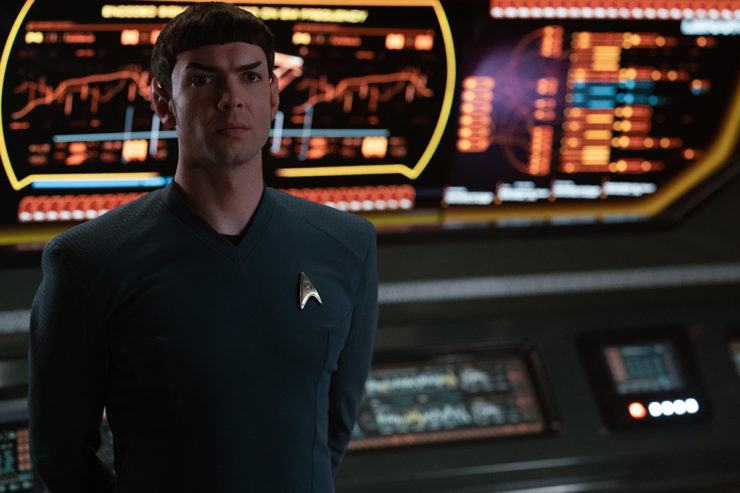
What I like about this episode is that at no point does Admiral Pike refer to the “proper” timeline, because in a multiversal setup like Trek’s (as established in the original series’ “Mirror, Mirror” and codified in TNG’s “Parallels”), there is no “proper” timeline. But what the time crystal’s vision for Pike shows him here is that trying to alter the future he saw in “Shadows” will inevitably result in a much much worse timeline, one in which millions in general and one of the most important people in Federation history in particular don’t die too soon.
And so Pike erases the letter, thanks Spock for everything, even though Spock doesn’t really know why, and he starts looking at Jim Kirk’s service record…
In my review of last week’s episode, I complained about the marginalization of Number One. As it happens, Una Chin-Riley barely appears in this episode, too, but here I’m okay with it. The best-case scenario is that by 2266, Number One would be going instead by “Captain.” The worst-case scenario is hinted at by La’An’s comment about how Una can’t have visitors, and it’s played out at the very end of the episode when Batel is ordered to arrest Commander Chin-Riley for violating the Federation laws on genetic engineering.
While Number One is philosophical about the whole thing—she was ready to resign back in “Ghost of Illyria,” after all—Pike is livid, and the look of fury he gives Batel when she takes Una away makes it clear that a) he’s not giving up his first officer without a fight and b) Batel ain’t gettin’ any osso buco…
However, that’s our cliffhanger, as this is the season finale. We have to wait for whenever SNW season two drops to find out what happens next. (The season is still filming in Toronto as I type this.)
Stay tuned next week for my season one overview…
Keith R.A. DeCandido really loves osso buco, which is a veal shank slow-cooked in spices and vegetables, though he has never learned how to cook it.

One thing I neglected to mention in the review, and only just now remembered I should’ve mentioned….
Anson Mount does a nicely understated job of playing his older self. His body language is tighter, his voice is a bit slower, and the makeup is nicely subdued — just a few more lines in his face. And, of course, he no longer has Johnny Bravo hair as an admiral……
—Keith R.A. DeCandido
I am not very familiar with original series timeline, pre movie 2, but how long does Pike have till his promotion and Kirk taking over the Enterprise? Discovery was 10 years prior to original series start. Pike appeared perhaps about 1-2 years later on 2nd season of Discovery. However, if I remember correctly by the time original series start, Kirk been captain of Enterprise for a while… So 5-7 years?
mashat: the first season of the original series (which is when Pike has his accident) is in 2266, which is also when “Balance of Terror” (the episode being riffed on this week) takes place. SNW season one takes place in 2259, seven years earlier. Figure Pike’s promotion to fleet captain and Kirk taking over the Big E happens five years hence.
—Keith R.A. DeCandido
I thought this episode was amazing from start to finish. I loved how they reimagined Balance of Terror. I’ve seen some complaints that this episode showed that Kirk was a better captain than Pike but i don’t agree. It just showed that in this one instance, Pike’s way was wrong.
I LOVE the cliffhanger since I was hoping for that to happen ever since we learned the truth about Una. My only complaint is it’s almost a retread of Lower Deck’s cliffhanger.
The main problem that I had with this one was that it felt too much like it was aping “Balance of Terror.” Ortegas in particular felt like she was playing the role of Stiles, rather than behaving in a manner that was true to her own character; and, while I would have been satisfied with the Romulan Commander (who I am shocked that they didn’t finally name here) delivering a message that echoed the one in “Balance,” having him deliver the exact same message just made him feel like an NPC.
I did, however, quite like the updated take on the TOS-era Romulan uniforms, and I’m amused that, even though Picard went out of its way to explain the different Romulan make-up designs, they still retconned the commander to be a “Northerner.” (Personally I like my Romulans with ridges; it looks dignified)
I took Sam’s less-than-flattering description of Jim to be simply a (slightly jealous) older brother’s idiosyncratic view of his annoying younger brother. It kind of reminded me of how Robert Picard saw Jean-Luc so differently from everybody else. I certainly didn’t take it literally.
I was originally unimpressed with Wesley’s performance, because he didn’t seem to have that Shatner spark (no one does); the more I think about it, though, the more willing I am to defer judgment until next season because I think that lack of spark was partially intentional. This is supposed to be a different Jim Kirk than we know, one who’s never had the benefit of his friendship with Spock or the awesome responsibility of commanding Enterprise. We’ll see what the 7 years younger Kirk is like in season 2.
I was delighted as always to see the “monster maroon” uniforms appear, but I didn’t particularly love the tweaks made for the show.
@5/jaimebabb
I just found that out today about the ridged Romulans being “Northerners” I must’ve missed that line when I watched Picard. Frankly, I hate it when they retcon things like that. So, TNG era Romulans had ridges, TOS didn’t. It’s just make-up design. Why can’t we just imagine that the ones in TOS looked like the ones in TNG? I don’t see why there has to be an explanation for it.
Sorry, just a pet peeve of mine. I hated the whole Augmented Klingon story in Enterprise too.
@7 I think that it makes sense to have an explanation for the Romulans because they’re canonically supposed to be the same species as the Vulcans and yet they randomly made them look different from TNG on up.
Yeah, a pretty good episode. Also the second Trek series in the last year to end a season with a command officer being arrested. Weird. We’ll see who resolves it better.
<angry Italian noises>
Pasta mama is amazing and is definitely not an omelette.
I really liked this episode, especially having just recently rewatched Balance of Terror. I agree that having Ortegas simply copy Stiles as opposed to extrapolating what she’d be like in 7 years wasn’t my favorite choice, but it’s a small nitpick. The Scotty cameo also bugged me, as even in an episode that recreated a classic episode, it’s the only element that felt really fan-servicey.
Regarding the arrest of Number One, to me it echoed Hemmer’s death last week, as in it wasn’t nearly as impactful as it should have been because so little has been done with the character this season. It worries me that next season most of the focus will probably be on Pike trying to get her back, and we’ll barely spend any time with her. Just feels like they really wasted that character this season.
@krad, as SOON as Sam started talking about how rebellious Jim was, my immediate thought was “Oh man, Krad is going to HATE this!”
flyingtoastr: Fair enough. Somehow, despite being a proud Italian-American for 53 years, this was my first exposure to pasta mama…..
—Keith R.A. DeCandido
I have enjoyed the episode. It was fun to see this alternate version of Balance of terror. Although I didn’t understand how Pike travels back in time or why he waits so many years to do it.
Also as always, I love when they use the uniforms from other eras when they are playing with the future/past.
About “What I like about this episode is that at no point does Admiral Pike refer to the “proper” timeline, because in a multiversal setup like Trek’s there is no “proper” timeline.”… if only this was the approach taken with the lit-verse and continue with the expanded universe instead of erasing it because Picard established a new timeline.
Well, first off, they really should’ve included the credit “Based upon ‘Balance of Terror’ by Paul Schneider,” because it’s largely a remake of that episode and quotes much of its dialogue verbatim. While they were at it, they should’ve credited Fred Steiner for the use of his Romulan motif. (Although TOS didn’t do so when George Duning cribbed it as Henoch’s leitmotif in “Return to Tomorrow.”)
This was a decent wrap-up to the arc of Pike’s concerns about his future, and a decent reinterpretation of “Balance,” though I’m tired of franchises rehashing their own past rather than telling new stories. (They promised us Strange New Worlds, not Familiar Old Worlds.) Still, it was interesting in a way to see the same scenes and lines interpreted by new actors, like watching a new performance of a play. And I loved it that they (or probably their science advisor Erin McDonald) finally came up with a credible explanation for “Balance”‘s hand-wavey “motion sensors” that let them detect the cloaked ship.
Other continuity touches: The date of Pike’s accident is placed six months before “Balance of Terror,” which would put it the better part of a year before “The Menagerie.” I would’ve thought it was more recent than that.
Using the TNG Romulan makeup here was a mistake, I think. Ortegas’s Stiles-like suspicion of Spock would’ve worked better if these Romulans had looked exactly like Vulcans. (Indeed, I’ve realized that Spock was probably originally intended to look more humanlike than full “Vulcanians,” since Harry Mudd recognized him as “part-Vulcanian” on sight; but they had to retcon that for the plot of “Balance” to work.)
We learn that the Romulan Praetor is female, while “Balance” referenced to the Praetor as male (“Perhaps we can yet save your Praetor’s pride for him”). That can be accounted for by the alternate timeline, unless there’s more than one Praetor (Diane Duane’s novel My Enemy, My Ally gave the Romulans a 12-member Praetorate), or unless this Praetor uses flexible pronouns.
We also discover that the Farragut wasn’t a Constitution-class ship as always assumed, but something more like a proto-Miranda. We also get confirmation that it survived the vampire cloud attack from “Obsession,” which was 11 years before season 2, so it would’ve been 3 years before this episode and wouldn’t have been different in the alternate timeline. “Obsession” never said the ship was destroyed, just that it suffered heavy casualties, but a couple of tie-in works have assumed it was destroyed.
I wonder if they were influenced by The Making of Star Trek‘s assertion that Kirk’s first command was a smaller “destroyer-equivalent” vessel. Though it was probably just done so it’d be easy to tell the two ships apart in the battle scenes.
We also get a mention of George Kirk Sr. serving on the Kelvin until he moved to Tarsus IV, though you can barely hear “Tarsus” as the audio fades out. I believe that’s our second Kelvin-timeline nod in the Secret Hideout series (after the mention of the time-traveling time warrior in DSC season 3). It implies that the Kelvin survived quite a few years longer in the Prime timeline, without Nero showing up to destroy it.
Leaving aside changes in set and costume design (which should really be no more of an issue than recast actors, since it’s all just dramatic interpretations), my main continuity issue is the same as Keith’s — that the episode persists in the modern mistake of characterizing Jim Kirk as a rule-breaking hothead. It’s ironic here in particular, since the original “Balance” had Kirk agonizing over the decision of whether to hunt down and destroy the Romulans and risk starting a war. But maybe it can be rationalized that he’s taking the more aggressive side to provide a counter to Pike, who’s taking the more peaceful side so Kirk doesn’t have to. Much like how Kirk and Spock tended to interact in Gene Coon episodes.
As for Paul Wesley, I found him unremarkable in the role of Jim Kirk. Hopefully he’ll improve if we see him again.
And why does nobody understand what a neutral zone is? They showed the rival fleets on opposite sides of a narrow plane in space, but the whole point of a neutral zone is that it’s a zone, a wide buffer between territories. It’s supposed to keep enemy ships from ever getting anywhere near firing range of each other. That’s why it’s neutral. (Also, how can ships on one side of a border have a ship on the other side “surrounded,” as the Praetor claimed?)
I also wish the Romulan fleet hadn’t shown up so soon. I’ve complained before about how modern Trek persists in violating Roddenberry’s dictum that interstellar travel should not be depicted as a quick, simple commute. “Trek” means a long, arduous journey, after all.
So anyway, the season ends with Uhura still at communications in 2259, suggesting that she decided to extend her tour, but La’an appears to have moved on, and Una is arrested. Hopefully season 2 will open with Pike doing something to get Una back, since she remains an underdeveloped character. And I’d guess that would somehow involve La’an coming back too.
(Also, 2266 Uhura had the same earrings Nichols wore in BoT, just about.)
I didn’t mind the Scotty impression in the Jefferies Tube scene, but including that scene at all was pretty self-indulgent. Though I guess it established Spock’s presence near phaser control to set up his injury.
I kept expecting Kirk to be the one who got killed, with the future going wrong because he wasn’t there to do all the things he did. But it makes more sense dramatically for it to be Spock, who’s one of this show’s regulars and someone close to Pike, whereas Kirk is a virtual stranger to Pike (and novice viewers of Trek).
Incidentally, why is the title “A Quality of Mercy” instead of “The Quality of Mercy”? The writers need to brush up their Shakespeare. Though maybe it’s an in-joke, since the only other TV episode called “A Quality of Mercy” is a Twilight Zone episode that featured Leonard Nimoy — as a character named Hansen, as it happens.
The Orville also had a good time travel episode yesterday.
Quoth Christopher: “The date of Pike’s accident is placed six months before ‘Balance of Terror,’ which would put it the better part of a year before ‘The Menagerie.’ I would’ve thought it was more recent than that.”
Actually, that’s accurate to what was established on TOS. “Balance of Terror” is a few episodes after “The Menagerie,” and Pike has already been crippled for several months in “The Menagerie.”
Mendez says to Kirk in Part 1: “You actually don’t know what’s happened to Captain Pike? There’s been subspace chatter about it for months. I’m sorry to have to be the one to show you. He’s upstairs in the medical section.”
So yeah, six months is consistent.
—Keith R.A. DeCandido
KRAD: Do you see these in advance? It was announced last week that production had wrapped on S2, but you say they’re still filming as you type this…
Regarding the episode, is there any significance to Ortegas and Mitchell switching posts?
critter42: I missed that announcement. Sigh.
As for the switch in posts, I suspect it was a blocking choice because Ortegas was saying all of Stiles’s lines, and that’s where he sat.
—Keith R.A. DeCandido
@16/krad: “Actually, that’s accurate to what was established on TOS. “Balance of Terror” is a few episodes after “The Menagerie,” and Pike has already been crippled for several months in “The Menagerie.””
“Balance of Terror” aired two episodes after “The Menagerie, Part II,” but it was filmed seven episodes before Part I. Since you did the TOS rewatch in production order, I’m surprised you’re going with airdates here.
@17/critter42: “Regarding the episode, is there any significance to Ortegas and Mitchell switching posts?”
Probably just meant as a cue to the passage of time, suggesting a slightly different bridge arrangement.
Christopher: I’ve pretty much given up the production-order fight, since you and I are pretty much the only ones paying attention to it. Myers and Goldsman probably looked at the release dates when working out the timeline for this episode, saw “BoT” airing after “Menagerie,” and figuring they were golden. Since every DVD release and streaming service is a slave to airdate order, it’s the way things are now (though the obvious exception there is “Where No Man Has Gone Before”).
—Keith R.A. DeCandido
Establishing shot of the Neutral Zone listening post: spinning around and around — I got dizzy; anybody else? My 65-inch screen surely contributed, but even so…
Both sides refer to “a hundred years of war,” and the Romulan commander to the cost in lives. But it’s not a shooting war, and it’s barely a cold war, so that motivation doesn’t scan. Have Romulans been testing the Zone for a century, and every time they get zapped? (FWIW, the voiced line is “a hundred years” and the closed captioning is “100 years” which, speaking as a copyeditor, should not be interchangeable; the latter should be read as “one hundred.”)
Kirk’s guess that “we haven’t seen the Romulan ships, so they haven’t seen ours” is flimsy: the UFP isn’t, so far as we know, paranoid-secretive. News of Starfleet could easily have flowed to Romulus through open transmissions, third parties and Romulans-undercover-as-Vulcans. (If scanned, mining ships might appear to have weapons, in the shape of excavation-phasers.)
Pike leaps from 2259 to 2266 and Enterprise’s crew and interiors are nearly identical — I’m not impressed. Apart from Una, La’an and the unseen Scotty, the top-line cast have been occupying the same roles for seven years, or at least returned to them after an unseen time away. In the TNG era, this kind of schtick (time travel, real or illusory) was visually emphasized by modifying the physical sets, graphics, uniforms, cast-mix and makeup. I wonder: in the HD era, is it more expensive (infeasibly so) to make such modifications?
Uhura gets a TOS-style collar added to her uniform, but she’s the only one (not Chapel, Ortegas, Mitchell, …). Pike’s movie-era burgundy uniform has been amended with leather sleeves (just one?), as with his apple-green shirt in the diplomacy episode.
Another issue I had with the VFX is that the shot of Outpost Four blowing up had it happening right in front of the Enterprise even though the dialogue said the ship was too far out of range to fire on the Romulans.
And come to think of it… Hansen is still in command of Outpost Four seven years later? You’d think people in such isolated, lonely posts would get rotated out more often. But then, in modern Trek, everywhere in the quadrant is just minutes away at warp, so I guess it doesn’t matter.
I loved the season. Really enjoyed this episode. It’s a more serious episode for Kirk even in TOS. My only nitpick is I wish they would have not just done a scene by scene or line for line at times of the original episode. I can look over it all, except for Ortega. Her taking on what’s his angry guy’s part. Could have done without it. Or put a new character on the staff to serve the role like TOS.
Still. It was awesome. Pike came extremely close to resolve the conflict his way. Was great to see two captains solve a problem their own way.
looking forward to Kirk joining the crew as either #1 or whatever slot he’ll fill during the Una in Jail Arc
@23/david: Per “The Menagerie,” the only time Kirk had previously met Pike had been when Pike took the promotion to fleet captain, which was presumably when Kirk replaced him as captain. This show has bent canon to some extent (the Gorn, Spock melding with a human, the transporter buffer thing), but having Kirk serve under Pike on an ongoing basis would be a pretty gigantic retcon. Indeed, the fact that they introduced Kirk in an alternate future suggests they intend to honor canon where he and Pike are concerned.
So I suspect that Kirk will just be an occasional guest star, like April or Captain Batel this season, and perhaps will interact with characters other than Pike. Maybe he’ll team up with Spock on a mission away from the Enterprise, and we’ll see how they first became acquainted. (Although then my novel The Captain’s Oath would be overtly contradicted. But I’m expecting that anyway.)
Honestly, though, I just don’t see Jim Kirk in Paul Wesley so far. Chris Pine convinced me he was Kirk, but Wesley hasn’t. That isn’t a dealbreaker; neither Jess Bush nor Babs Olusanmokun are anything like their TOS equivalents, but that’s okay because they’re even better. But Wesley is just kind of there.
Keith, I was a little surprised you didn’t comment more on Pike’s decision to condemn two cadets to death in service of Spock’s survival. Only four episodes ago he walked away from Omelas — excuse me, Majalis — because they sacrificed one person. Now Pike’s going to do double that, and, to judge by how Anson Mount plays the last few scenes, Pike’s okay with it. It’s… a swerve, is all I’m saying, and, while it makes for great drama — to be clear, I enjoyed the hell out of this episode — it’s not precisely the behavior I’d expect from the paragon of Starfleet Adm. Cornwall described him as back on Discovery.
(I was also a little surprised you didn’t touch on Spock learning that this is going to happen. You’ve talked before about how you found his actions in “The Menagerie” to be out-of-character, and this episode knocks it out of the park in terms of back-justifying that conduct.)
@6 – I agree with this assessment. Family do have the longest familiarity with each other, but because of this they’re often basing their opinions of each other on much earlier versions of their family members than any of their adult acquaintances ever met. This is particularly a problem for older siblings. In this case Jim was still a kid (well, teenager) when Sam went off to the Academy. Occasional socializing once they’re both in Starfleet isn’t going to easily overwrite years of being the responsible older sibling and having to explain to your creatively imaginative kid brother why it’s a bad idea to do X.
I was pretty meh about Paul Wesley as Kirk. His performance didn’t have any of the charisma of Shatner’s (or even Pine’s). I usually enjoy an actor taking over a role to make it their own rather than doing an imitation, but you have to bring something of the old part to the table or you might as well be playing a different character.
I didn’t really care for the whole rehashing of Balance of Terror. The story would have been more interesting if they had told a new story where Pike is still captain and somehow that screws up the future. I’m sure that the creative minds behind this show were up to it.
And anyway, why would Pike’s lesson from this be “I must sacrifice myself” rather than “I must blow up that Romulan ship when I have the chance.”
I gotta say, I really don’t need more Kirk. I didn’t care for him here and I don’t at all want him in season 2. That’s not a condemnation of Wesley, but rather a wish for SNW to get over its occasionally debilitating case of prequelitis.
@25/CWatson: “Keith, I was a little surprised you didn’t comment more on Pike’s decision to condemn two cadets to death in service of Spock’s survival.”
Well, Spock and millions of others in the Second Romulan War that would’ve broken out. I was just saying in the comments for Keith’s Timecop rewatch the other day that I’ve gotten tired of the whole “We have to let tragedies happen to preserve the history we know” argument, because it is very Omelas-like, accepting that some people’s suffering is necessary for the good of others. But this is a case where Pike was explicitly shown that trying to save those cadets would definitely make things far worse. It’s one thing to walk away from Omelas, but another to set it on fire.
I believe Keith did comment on Spock learning of Pike’s future fate, because that happened in the season premiere. And I don’t see how this episode did anything to backfill “The Menagerie,” since except toward the end, the Spock we followed here was from an alternate future that will never happen now.
@28/David: “And anyway, why would Pike’s lesson from this be “I must sacrifice myself” rather than “I must blow up that Romulan ship when I have the chance.””
I thought of that, but I guess it’s supposed to be covered by Future Pike’s line about how every other attempt to change things still led to Spock dying and horrible futures and so forth.
Incidentally, I wish they’d made it unambiguous that Spock died in the alternate future, instead of saying that he might live but “wouldn’t be the same.” We’re already stuck with the ableism of “The Menagerie,” the ugly message that life with disabilities is no different from death — I wish they hadn’t doubled down on it. Or tripled down, since they already reasserted it with Pike talking about his future as though it were terminal.
A decent episode and wrap-up to the season. However, I think I would’ve preferred if Kirk hadn’t been in this at all and Pike and Spock had to figure out what to do on their own. One aspect I enjoy about “Balance of Terror,” and submarine stories in general, is that they’re usually out there on their own, without the possibility of assistance from other ships or giant fleets. By the way, could we please move on from these visuals of fleets nose-to-nose and inches apart? It looks goofy.
Overall, Kirk was too much of a distraction for me. Just about every time Paul Wesley was on screen it pulled me out of the story. Who does this guy remind me of? Jack Lord? Rod Serling? Dick York? Casey Kasem? Jim Carrey? Well, he certainly didn’t remind me of James T. Kirk in any shape or form. Sorry.
As for the season, particularly the disappointing back half, I’ll echo the sentiment that they’d be better off coming up with stories that really are strange and new. I guess there’s a certain novelty in seeing them do remixes of old episodes or, as with last week, from other sci-fi franchises, but honestly, I’m not going to keep subscribing to Paramount+ to watch glorified fan films.
@31/Cayuse – Specifically, Jim Carrey as Captain Kirk in “The Wrath of Farrakhan,” a skit from the first season of In Living Color.
When Sam said that Jim liked to break rules all the time, I said, “That’s a total MYTH! TOS Kirk was a very dutiful captain most of the time!”
And my husband said, “Remember, this is the OLDER BROTHER talking. It’s the kind of thing older brothers say.” :-)
He made a good point, and I thought I’d pass that reminder along.
Ya know. That’s one area they need to retcon. There’s no reason Pike can’t have more than a blinking light. For the horror of the trauma he lived through in his leap forward that’s haunting him, ok… But when the time actually comes, SHOW that just because you can’t do what you did before exactly how you did it, it’s not the end. They can’t fully fix the Menagerie, but the door is at least cracked.
@15, shhhhh on the Orville talk. TOR has been ignoring it the whole season for some reason.
But I think I’m starting to crack. Whereas Pike’s fate may have seemed realistic in 1966; it’s not so much now in 2022. (technically decades before that too w/ Stephan Hawking) And whereas I’ve always seen it as a “quality of life” issue–sort of like when people are hooked up to machines, but that’s a bad analogy because Pike’s not brain-dead. He’s basically trapped in his own body. with no way to really communicate.
So, I think I’m starting to see the point lots of people are making. It’s not so much “We like our characters to have happy ending” as “We want to see someone live with a disability, rather than run away from it.” Which, the more I think about it, is a pretty important message.
But, you’re right. It would have to be done after the Menagerie because I feel that episoe is too important (regarding Spock’s loyalty to Pike)
For the longest time, I’ve been a canon-purist where it came to Pike. I was like “No, it’s canon. He HAS to have this fate in order to preserve the integrity of Spock’s actions in The Menagerie”
But I think I’m starting to crack. Whereas Pike’s fate may have seemed realistic in 1966; it’s not so much now in 2022. (technically decades before that too w/ Stephan Hawking) And whereas I’ve always seen it as a “quality of life” issue–sort of like when people are hooked up to machines, but that’s a bad analogy because Pike’s not brain-dead. He’s basically trapped in his own body. with no way to really communicate.
So, I think I’m starting to see the point lots of people are making. It’s not so much “We like our characters to have happy ending” as “We want to see someone live with a disability, rather than run away from it.” Which, the more I think about it, is a pretty important message.
But, you’re right. It would have to be done after the Menagerie because I feel that episoe is too important (regarding Spock’s loyalty to Pike)
I think they can come up with some good motivation for Spock in a reworked Menagerie and still update everything. If not, do we really lose much by erasing it from the timeline? Especially if we gain a Post-Accident Pike who can be positive representation of someone who is disabled. For showing Spock’s loyalty to him and how far he’d go for the man, well, we have a show that can do just that.
It’s not like him putting in an order for a better chair or prepare his medical staff (to super simplify this) a little before the accident messes with much established history. Right?
This episode also confirmed for me a theory I’ve had for a while: James T. Kirk from TOS is kind of a boring character on paper, and his iconic status is mainly due to the charisma and quirks of William Shatner.
Had they not shown Sam, I find it perfectly reasonable for James T to have served on the Enterprise as a junior officer and Pike not know it. But his familiarity with Sam makes that situation almost impossible in my mind.
In reference to Keith’s statement about the older Admiral Pike never referring to a “proper timeline”, I did notice that alternate timeline Spock did use the term, “prime timeline”, in reference to the one that Pike was trying to prevent from happening (the one where the cadets are killed and Pike is crippled/disfigured in the accident).
I’ve thoroughly enjoyed this show so far. Thanks for the thoughtful reviews. More and more what I’d like to see this series do is become both a prequel *and* a sequel to TOS — let it skip ahead in time to pick up threads like Uhura’s story arc (because although she’s a beloved character from TOS, she doesn’t get much development there) and Spock and Chapel’s friendship. I like this version of Kirk well enough to have him come back. And given that the Talosians have been shown to have a fondness for Pike, Pike living on Talos doesn’t have to be the end of his story. It’s a bit Star Wars-y, but having a telepathically-projected Pike around as a mentor figure would be fun. And that doesn’t preclude introducing medical advances that would eventually allow him to return.
@39/critter42: “Had they not shown Sam, I find it perfectly reasonable for James T to have served on the Enterprise as a junior officer and Pike not know it.”
The issue isn’t Pike’s knowledge, it’s Kirk’s. It was Kirk who said in “The Menagerie” that he’d only met Pike once. He wouldn’t say that about his own former captain.
And as we’ve seen, Pike is not distant from his crew. He pals around with them and invites them for dinner. If someone served on his ship, then he’d get to know them. And Jim Kirk certainly wouldn’t pass up an invitation to dine with the captain, because he’s both outgoing and ambitious.
And call me an awful person for this, but I prefer this version of Ortegas. I find her more interesting as a hardened jerk, rather than a walking book of quips.
@43 – We don’t know what happened in the intervening seven years that were skipped over in the time jump. Given Ortegas’ quippiness I can see her slotting in to the McCoy side of the McCoy-Spock exchange of barbs if the good doctor is never assigned to the Enterprise. Maybe the last straw is Spock being made first officer when she wanted and/or expected the post for herself. They’re both Lieutenants serving on the bridge crew in the “present” SNW continuity so that wouldn’t be an unreasonable expectation on her part. We can make all kinds of speculations to fill in the blanks.
#44 – That’s fine, but I’m not worried about any kind of blanks to fill. I just tire of her constant quips. Any kind of three-dimensional personality they could give her would be an improvement at this point, in my opinion.
How about giving her an episode next season? Even poor Una got one.
Maybe because I didn’t care for Matthew MacFadzean’s portrayal of the Romulan commander, I thought they should just have used Frain and Roderick McNeil as the subcommander (if you’re going to so closely recreate something, just go all the way 8-) Speaking of which, Uhura and Chapel needed wigs (Ortegas too?). Maybe not full beehive do’s but different styles like they gave La’an.
I am hoping the Kirk for season 2 is a slight of hand for his appearance here because, like @29, I think it’s a bit much to bring Kirk to Enterprise too early. He’ll miss some important formative stuff with his previous ship, plus if Pike infects Kirk too much, we’re back in the same boat with messing up the Balance of Terror.
Having said that, I’m guessing that the time Uhura spends going back to the Academy to finish her schooling will just be elided. Still, I’d love for us to see cadet Sulu do a tour of the Enterprise. The competition might give Ortegas something character development and why can’t the night shift have some talent as well?
As for characters that need to be in place, the loss of Hemmer does open the way for Scotty. I was thinking they needed to introduce Dr. Boyce, but then remembered that they’ve already visited Talos so his part to play has already happened.
So one thing I didn’t catch earlier in the season — was Number One born with her augmentations, or did she choose them at a later time? I assumed she was born with them, which made her arrest pretty disturbing.
@47/a_risch
She was born Augmented. Technically, she’s not even Human; she’s an Illyrian–a race that employs genetic engineering However, I believe she had herself biologically engineered to screen as fully Human since Illyrians are not allowed in Starfleet. (I’d think she would’ve had to since doctors never caught it)
@45, they confirmed Ortega gets an episode next season. :) I do wish they would have had time to have on for each of the main cast this season.
@48, she probably said she was human and no one batted an eye. The wiki says she had to hide her identity. I don’t think the episode went into it any. Its all hand wavy and odd it never came up in a medical exam. *shrugs*
I was somewhat disappointed that there’s one notable character from “Balance of Terror” who’s completely missing here: the centurion on the Romulan ship who’s the friend and confidant of the captain.
And a small typo: I assume that “is” in “The announcement was that Paul Wesley would be playing Kirk is season two of SNW” should be “in”.
A few observations and disagreements here:
1. I feel like a lot of die-hard Trekkies prefer to argue to their last breathe, about Kirk not being a rules breaking rebel but as was brought up in “The Drumhead”, PICARD is a Rules Breaking Rebel as being an effective captain on the frontier means that these things happen. He agonizes over breaking the rules and isn’t the Pine Kirk (who was a delinquent set straight by Pike) but he’s still someone who develops a “maverick” reputation. If nothing else, Kirk’s brother probably knows his brother cheated and “hates to lose.” Indeed, my irritation with this bit is it acts like PIKE isn’t the guy who breaks the rules flagrantly like we saw in “First Contact.”
2. I feel like going over Ortegas as the Stiles stand-in overlooks any interesting possibilities for her own character. Basically, the idea that in seven years, Ortegas loses her affectionate friendly cheerful optimism and snark to become someone colder as well as meaner. She saw Starfleet lock away Una for at least seven years, after all, and that has got to embitter a person. Also, unlike Stiles, she basically keeps her attitude in check and everything she says about “they started it” is 100% correct.
3. I’m surprised there’s not more commentary on how the fact that Pike’s attempts to find peace, understanding, and kindness are the absolute wrong moves. The typical Trekkian solution utterly fails in every way possible and violence really is the best solution.
4. The monks were clear that Pike’s fate was sealed if he accepted the time crystal. I wonder if this means that the crystals actually make a Stephen King-sort of effect that no matter how you try to change time or the past, it will always be worse so there’s really a malevolent Devil-like force at play here.
5. A reminder that “Balance of Terror” wholesale made up the idea that captains can marry people. This is something I always found amusing as it apparently resulted in a lot of people believing they could and it becoming a minor tradition.
6. That hug actually makes me ship Laan and Pike.
7. I also was annoyed Spock didn’t mention he knew Kirk. It’s one thing that he didn’t date Uhura but would have been nice if they established, “Yeah, I knew him from my days as a TA at Starfleet Academy. We had an altercation over one of my tests.”
I thought they gave Spock a pretty obvious motive for the Menagerie. When they were talking at the end Spock understood that Pike was now accepting his future because otherwise somebody else would be put in that position, and that the somebody else was Spock himself. Pike was very purposely going to be sacrificing himself to save Spock and Spock knew that. So to me it makes perfect sense that he would try to help this man have the best future possible after the accident.
Keith,
Great review as always. I do think however that you might want to re-read this bit:
“will inevitably result in a much much worse timeline, one in which millions in general and one of the most important people in Federation history in particular don’t die too soon”
To quote TPB, “I don’t think it means what you think it means”.
@51/C.T. Phipps: “I feel like a lot of die-hard Trekkies prefer to argue to their last breathe, about Kirk not being a rules breaking rebel but as was brought up in “The Drumhead”, PICARD is a Rules Breaking Rebel as being an effective captain on the frontier means that these things happen.”
I would say, rather, that frontier captains are supposed to have the authority to interpret the rules to fit the situation, because they’re often the only authority figures on the scene, and too many people misinterpret Kirk’s rightful exercise of that explicit duty as a rebellion against his duties. (Although that’s harder to justify in modern shows where every interstellar journey is a matter of hours at most.) It’s incorrect to call it rebellion when having the authority to bend or suspend the rules when necessary is built into your job responsibilities.
“I’m surprised there’s not more commentary on how the fact that Pike’s attempts to find peace, understanding, and kindness are the absolute wrong moves. The typical Trekkian solution utterly fails in every way possible and violence really is the best solution.”
That’s because it was “Balance of Terror” that explicitly defined those terms — failing to destroy the Romulan ship would lead to war. “A Quality of Mercy” is simply following that precedent, rather than defining it. So there’s not that much to comment on.
If anything, it’s a reminder that the perceptions we have of shows, or people, are often simplified from the reality. TOS did have its episodes that went for peaceful solutions, but it was a 1960s action show, so it also had its share of episodes where the solution was superior firepower. It wasn’t just one thing.
“A reminder that “Errand of Mercy” wholesale made up the idea that captains can marry people.”
Do you mean “Balance of Terror?” In any case, that myth was around long before Star Trek. Notable cinematic uses include The African Queen from 1951, and the idea was around early enough that the US Navy had to officially clarify it was forbidden as early as 1913. It probably dates back centuries, since naturally any custom (real or imagined) pertaining to ships would have arisen when travel by ship was common.
“I also was annoyed Spock didn’t mention he knew Kirk. It’s one thing that he didn’t date Uhura but would have been nice if they established, “Yeah, I knew him from my days as a TA at Starfleet Academy. We had an altercation over one of my tests.””
That was in the Kelvin timeline. In Prime, Spock came aboard the Enterprise in 2254 (Short Treks: “Q&A”), so he wouldn’t have been serving as an Academy instructor in 2258 as in Kelvin. Also, Kelvin Kirk was a fatherless delinquent who didn’t enter the Academy until 2255, while Prime Kirk was a “stack of books with legs” who graduated from the Academy in ’55.
@31. OMG Yes, Rod Serling! I was about to post as much when I saw you had said it.
It’s that kind of exaggerated 1950s Chesterfield ad thing. And the intensity of being kind of a smaller guy with big eyebrows who is not hunky, but has much magnetism, and wheels turning.
That said, I feel like Kirk needs to be blonde, more styled, more barrel chested, and above all, needs to have a kind of at ease kindness that is disarming and makes people around him feel more comfortable as he sizes them up. I feel like that is Kirk magic. But oops, I just described Pike magic, so I can see why they wouldn’t want to go quite that route.
I loved the idea that he went and got a bunch of drone ships, absolutely love it, but I really don’t believe that any Kirk I’ve seen outside of the Kelvin timeline is technically capable of doing that, with so many ships, so quickly. The Kirk (or Picard) I know would have had someone come with him who would handle the get-under-the-desk-and-tie-wires-together part.
The whole Una thing is nonsensical to me. That the Federation we know would have those laws, for a start. That our characters wouldn’t fight against it all immediately, that too. And that she’s basically been stiff and had so few lines, but I think this is at least the third time she’s gotten taken away and needed rescue. Who does she think she is, Penelope Pitstop?
Still enjoyed it. And agreed with most everyone’s above points,, to boot.
@55/jofesh: “The whole Una thing is nonsensical to me. That the Federation we know would have those laws, for a start.”
Established in DS9, unfortunately, so we’re stuck with it. But it makes sense that, as M’Benga said, we’d just discover new prejudices after overcoming the old ones. That’s the way it usually works — enlightenment comes one prejudice at a time instead of all at once. Like people such as J.K. Rowling being feminist but also transphobic. Or ’90s Trek being pioneering with the first black and female series leads, but utterly refusing to acknowledge that gay people exist.
@12/Krad: pure-blood Italian living in Italy, and I’ve no idea what “mama pasta” is!!! A kind of Carbonara without guanciale?!?!
I thought as Pike described it that that he was pulling together a type of carbonara.
@16 KRAD & @19 CLB — I rewatched TOS over the past couple of years in production order since that’s how the writeups here went (and since it makes sense to me), so you’re not entirely alone…
Regarding the meat of the episode itself: Why did the last of the season have to be the most disappointing by far? Ugh. Not cool. I love a good what-if / alternate-reality / possible-timeline story, for neat bits of business large and small — characters who might not otherwise have interacted, variations on uniforms, fates swapped out for one another. This was not a bad such example, broadly speaking; I just didn’t care for the details, mainly so little of the regular cast and Paul Wesley coming across as nothing like James Kirk. I know that it was James Kirk with a different recent past than at the same point in TOS, and I fully understand the dangers of trying to mimic the character as established by William Shatner, but as I mention here on occasion Anson Mount both physically resembles Shatner to me and has a lot of classic Kirk’s intensity and jocularity in his portrayal of Pike, so it’s all the more jarring.
A return to form from last week’s episode. I think it’s a fun and novel idea to basically remake a TOS episode but with enough variations and twists to make this alternate timeline just different enough. This episode also makes me want to rewatch “Balance of Terror” to more throughly see the differences in how events played out and Kirk’s command style.
The Scotty audio “cameo” was obvious fan service but I found it enjoyable. La’an is the first officer of the Farragut and yet we don’t see her in action or speak on that ship’s bridge at all. It’s obvious because she’s being hid until her dramatic reveal on the Enterprise transporter pad with her different look and acting as a more relaxed person. I thought Ortegas was acting so out of character just to make her fit into the Stiles role but it just stuck out like a sore thumb. She’s known Spock now for at least 8 years or so and now she’s going to act like he can’t be trusted after all of this time? Also, the Romulans as depicted, with the forehead ridges, don’t look exactly like the Vulcans, so she should immediately recognize that Spock doesn’t exactly equal Romulan.
I also thought it was unnecessary to revise the makeup of the TOS Romulans as Picard established there are both ridged and non-ridged Romulans.
I too am continually disappointed by the lack of use of Una, again in this episode as she only appears in the bookends. With her being carted off to Federation prison, I hope this doesn’t mean that she’ll mostly be missing in action in season 2.
I thought it was a missed opportunity to show Gary Mitchell as one of Kirk’s bridge officers. Canon has established Mitchell as having served with Kirk on a prior ship to the Enterprise in the Prime timeline and it would be kind of cool to show that in this timeline, the events of “Where No Man Has Gone Before” never transpired and Mitchell is still alive.
@59/garreth: “La’an is the first officer of the Farragut and yet we don’t see her in action or speak on that ship’s bridge at all. It’s obvious because she’s being hid until her dramatic reveal on the Enterprise transporter pad with her different look and acting as a more relaxed person.”
Or maybe they just wanted to keep their bridge camera angles tight on Kirk so that they wouldn’t have to redress the bridge set much.
@59 One of the things I found notable was that Ortega didn’t really replace Stiles, just filled his role. I kept expecting her to express more of the outright bigotry towards Spock that Stiles did, but she never did (probably for the reasons you stated). I saw her as having only Stiles’s hatred for the Romulans (which is probably not uncommon among human Starfleet officers anyway).
@54 That was how they met in the Kelvin timeline, but I think either Orci or Kurtzman said that they believed a similar meeting occurred with Prime Kirk and Spock. I never liked that idea, so every nail that can be driven into its coffin is welcomed by me.
@55 I’m glad I’m not the only one who noticed Kirk’s distinct lack of barrel-chestedness. Mr. Wesley has some work to do if he wants to be introduced with a gratuitous shirtless scene. I am eager to see how he performs as LCDR Kirk or whatever he is next season.
@61/Chase: “That was how they met in the Kelvin timeline, but I think either Orci or Kurtzman said that they believed a similar meeting occurred with Prime Kirk and Spock. I never liked that idea, so every nail that can be driven into its coffin is welcomed by me.”
Sure, they suggested at the time, 13 years ago, that the Prime backstory of most of the characters might correspond approximately to what happened in the movie prior to Vulcan’s destruction. But later productions have clearly chosen to do otherwise. SNW’s Spock and Uhura never met at the Academy and never had a relationship. Kelvin’s Pike was the first captain of the Enterprise when it launched in 2258, but SNW confirmed that Robert April was its first captain when it launched in 2245.
As it happens, this season of SNW took place in the same year as Star Trek Into Darkness. So Pike Prime has now officially outlived his Kelvin counterpart, proving that whatever grim future he’s glimpsed, it could always have been worse. Indeed, the only person who’s in the same place at the same time is Spock, although he’s at a lower rank and status here than he was in Kelvin, a lieutantant and science officer instead of the first officer. Uhura is in the same post, Enterprise communications officer, but as a cadet instead of an officer. And wherever the others are, they’re nowhere near the Enterprise.
Really, the suggestion that things happened the same way never made sense given that they bumped things forward nearly a decade. I still think the biggest flaw in ST ’09 was having the Nero conflict come right after the Academy portion. They should’ve put in a time jump of at least 4 years between those to let Kirk rise through the ranks (I pick 4 since that’s what it would take to align Chekov’s age correctly, but they could’ve easily made him a year or two older). It wouldn’t have altered the story materially.
KRAD: One minor correction. As a born and raised northeast Ohioan, I would be thrilled to have a Star Trek vessel named after our beloved crooked river, the Cuyahoga. But closed captioning showed that ship’s name as the Cayuga, which does make more sense given that the Cayuga are a real native American people, and the word “cuyahoga” is an Anglicized mutation of multiple native words that doesn’t really mean anything.
Zaku: I feel better now, thank you. 🤣
—Keith R.A. DeCandido
One thing that bugged me about this episode the more I thought about it (other than the fact that it’s time travel/alternate timeline and doesn’t make sense by definition):
I agree that this decision of Pike’s, at this moment in time, had to be changed. But as Keith said:
“Figure Pike’s promotion to fleet captain and Kirk taking over the Big E happens five years hence.”
So if the whole point is that Pike isn’t commanding the Enterprise when the Romulan incident takes place….then what’s to prevent him from throwing in a last-minute repair to that baffle plate so it doesn’t explode? Since Kirk is already on Enterprise and is going to destroy the Romulan ship.
What would that change? The events of The Menagerie wouldn’t happen a year and a half later? I still don’t know what that would have to do with the decisions Kirk makes about the Romulans.
Hm. I watched this ep twice, and while I of course heard Future Pike (rocking that really cool variation on the ST II-VI uniforms) talk about Spock dying every time, I came away more with the impression that Kirk is the Great Man of Star Trek History, or maybe that Kirk and Spock are the Great Men of it. I agree that the “Kirk was a badass rebel” reivision of Kirk’s character is dumb, but even MORE dumb is this idea, that started with the 2009 film, that Kirk is “destined” to be the Enterprise’s “real” captain. Yes, Spock told him commanding a starship was his “first, best destiny,” but I don’t think Spock meant in the cosmic, all-timelines-must-have-Kirk-as-captain sense that ST09 had him adhering to.
Nami Melamud even cued the Alexander Courage fanfare at the very first mention of Kirk’s name in this episode’s score.
Odd choice to remake “Balance of Terror” in a way that makes your series lead look bad for for your first season finale. I was underwhelmed, and wish Star Trek would leave the inescapable fates to Star Wars and the fixed points in time to Doctor Who. I am now actively hoping SNW finds a continuity-friendly way to bring Pike AND Vina back from Talos IV after the events of “The Menagerie,” because there’s no way in hell Starfleet medicine as it is portrayed in Trek these days can’t help both of them. For God’s sake, we saw Mr. Kyle beam a contact lens — a CONTACT LENS – onto Spock’s eyeball in the first SNW episode!
@59- agree that Ortegas’ instantly turning on Spock did not make sense at all to me, although I understand they were trying to draw a parallel between her and Stiles. I mean they catch a glimpse of someone else with pointy ears and suddenly everyone looks at Spock like he’s a monster or something. The romulans also have two eyes, noses, mouths, and hair stylists. Just like hooomans. But the pointy ears suddenly means Spock is in league with the mysterious bad guys? It was jarringly awkward.
@67: Yes, the reactions were all over the top. With Ortegas acting so out of character, I had the thought that maybe our Pike was actually brought by future Pike over to the Mirror Universe.
@66/mpoteet: “For God’s sake, we saw Mr. Kyle beam a contact lens — a CONTACT LENS – onto Spock’s eyeball in the first SNW episode!”
More than that — it was transporter-based gene therapy on the fly, actually altering the genetics of Spock’s iris to match the scan. Which makes it even harder to believe they can’t do anything for Pike.
But then, I’ve said for years that transporters should render conventional surgery obsolete. It should be possible to repair any organ by editing the transporter pattern. We saw transporters used to reverse aging in “The Lorelei Signal” and “Unnatural Selection.” Yet the true medical potential of transporters is usually ignored.
@16 KRAD & @19 CLB & @58 – I have changed over to TOS production order as I found the argument for it convincing.
@30: ”Pike was explicitly shown that trying to save those cadets would definitely make things far worse.” Was he? How does Pike conclude that the future, sans-accident, was any better or worse than what the future would be after his accident? He saw that without the accident, there was war and Spock was gravely injured. How would Pike be able to conclude that if he went through with his accident, the future would not involve the same war or worse, and Spock’s injury? Pike could guess that there’d have to be a new Enterprise Captain, sure. Maybe with even more terrifying results than what Pike saw. I mean, it wasn’t like Pike was shown an alternate future to the one he experienced. We the audience know the alternate future with Kirk as captain. But Pike was not given that alternate scenario.
@71: Beyond Spock’s bad injury, Pike was told by future Pike the the war with the Romulans would extend to future Pike’s time and there would be millions of deaths. So no he wasn’t shown, but he was told that this alternate time like would be worse than the one he’s destined to have.
I don’t think Kirk gets the “great man of history” thing, here, though Spock certainly is. Spock is shown to be the person who creates peace between the Romulans and Vulcans and that it will not happen without Spock’s influence. Kirk is needed to be on the bridge during the events of “Balance of Terror” but that’s the one specific ending. I doubt Kirk could have done what Pike did in the first episode either.
Also, I’m surprised more people are not interested in a darker and more serious Ortegas. Is this a hint of how she’ll develop? I mean, they’ll experience their first officer arrested by the Federation and presumably other tragedies in the future.
@73/C.T. Phipps: “I doubt Kirk could have done what Pike did in the first episode either.”
He absolutely could have. Kirk was not as simplistic a character as the modern stereotype of him. He was as much a scholar, philosopher, and diplomat as a soldier. His defining trait was not hotheadedness, but compassion.
What Pike did in the premiere was to reach the aliens by acknowledging his own species’s flaws. We almost destroyed ourselves, learn from our mistakes, do better. That’s not so different from Kirk saying “Yes, we’re killers, but I will not kill today.” Kirk was honest with himself about his own flaws and limitations, and that gave him the wisdom and humility to reach others.
@71 I got the impression that Future!Pike had either done extensive meddling in the timeline with The Time Machine-like results or the monks told/showed him that Spock would die if Pike changes his future.
I got Vulcan Hello vibes from this episode. Once again, the Federation impulse to try and talk results in a war. I know Star Trek has gone for peace through superior firepower in the past but I’m not sure I like this much more explicit rejection of diplomacy instead of shooting.
@75/noblehunter: “I got the impression that Future!Pike had either done extensive meddling in the timeline with The Time Machine-like results”
Are you talking about the Guy Pearce remake where he made exactly one failed attempt to change the past and unscientifically concluded from that single example that every attempt would therefore have to fail? That doesn’t exactly count as “extensive meddling.”
But yeah, Monster Maroon Pike did pretty clearly say that every possible future led to Spock dying or as good as dying.
“I got Vulcan Hello vibes from this episode. Once again, the Federation impulse to try and talk results in a war.”
That’s not really what happened in “The Vulcan Hello.” The Klingon fleet was already on its way, moments away from arriving, when Burnham gave the order to fire and Georgiou countermanded it. It was too late for either option to make a difference.
After all, the motives behind the two planned wars were different. The Romulan Praetor hoped the Federation would be weak enough to overpower, but backed down when Kirk established its strength. But T’Kuvma didn’t see the Federation as weak — on the contrary, he feared it was too strong, an aggressive force of cultural imperialism assimilating other cultures and stripping them of their identities. He believed the Klingons had to fight back in self-defense. So I don’t think a show of strength would’ve made a difference there.
Anyway, what everyone seems to misunderstand about “the Vulcan hello” is that it doesn’t mean destroying the other ship, it means making a token show of strength so the Klingons will respect you enough to be willing to listen and negotiate, like when animals bare their fangs at each other on their first meeting. In Burnham’s words: “Whenever the Vulcans crossed paths with Klingons, the Vulcans fired first. They said hello in a language the Klingons understood. Violence brought respect. Respect brought peace.”
So even though Michael’s strategy was to shoot first and Pike’s strategy was not to, they were both aiming for the same goal of convincing the other side to listen and negotiate. But they were both faced with leaders who’d already made up their mind to go to war.
I got “City on the Edge of Forever” vibes. Similar to Keeler, Pike had the right idea but not at the right time.
Seem to be in the minority but I didn’t like this at all. It was a well-paced, largely well-acted, decently written piece of television, but if there’s one problem I’ve had with SNW, it’s been the constant regurgitation of old ideas from TOS. Now they go one step further and don’t just fall back an idea from TOS, but actually do a recreation of an entire episode, with entire passages of dialogue lifted (and done so quite awkwardly in different contexts).
I also think they portrayed Kirk as far more aggressive here than he actually was in Balance of Terror, though it’s been a while since I’ve seen it. I don’t remember him talking about “blowing them out of space” or whatever in Balance of Terror, like he does here. I’m also a bit leery of the message – diplomacy fails (for a pretty contrived reason as well) and Kirk is seemingly vindicated in his desire to destroy the Romulan ship. I don’t necessarily object to that plot outline in itself, but something about the way it came across on screen really rubbed me the wrong way.
I just don’t understand why everything in the Star Trek universe these days has to revolve around ideas that were written decades ago, by different writers. Anything involving Kirk seems to be up for inclusion here – Pike meets the Gorn (despite it arguably making very little sense, especially after ep 9) because Kirk met the Gorn. Pike meets T’Pring because Kirk met T’Pring. Sybok appears because Kirk met Sybok. Uhura, Chapel and M’Benga are on Pike’s crew because they were all on Kirk’s crew, even though their collective presence here starts to strain credibility a tad. Oh, and Kirk’s brother Sam is there too, of course. Even one of the new crewmembers, La’an, has a connection to Khan, because Kirk met Khan. And now, at last, Kirk himself has appeared, in a recreation of a TOS episode.
The fandom at large seems to have loved this one so maybe I’m out of step. I just really really want to see something new. Let’s hope season two takes us to some actual strange new worlds, as the best moments of season one did.
@75
Ehhh, I’m a pacifist in real life but this may be the case of a “Family Unfriendly Aesop that is nevertheless true.” As history has proven time and time again, there are many cases of the fact that you cannot appease fascists or their historical forebearers. Because there’s a certain kind of society that reveres war and sees conflict as preferable to peace.
@krad and @CLB: I’ve only ever watched TOS in production order, as the episodes were (mercifully) aired that way on the local station that broadcasted TNG. When I bought the VHS and later DVDs ( way back when, anyway), they were in production order. I literally can’t watch TOS any other way.
This episode. I…it’s a perfectly fine episode. It’s super intense, and puts “Balance of Terror” in a whole new light.
I don’t know. I hope we actually get to some strange new worlds next season. This point is rife for storytelling. I mean, the Enterprise could at this point meet aantagonists we’ve never heard of (who maybe later become allies or even join the Federation), weird shit in space we never seen, it’s wide open. The series is limited to the kinds of stories it can tell for most of the characters (except Number One, but I’ll get to that), so let them have cool adventures in things and species we’ve never seen before. Y’know, the whole Strange New Worlds part of the series title?
I mean, we just don’t have to retell the same stories of characters we’ve known for years.
Speaking of characters.
It ain’t right how they did Number One this season. When we met her in “The Cage” and Discovery season 2 (which is also Strange New Worlds season zero), she was mysterious and cool and hyper-competent. Here, she’s completely sidelined. And she’s arrested to give us a cliffhanger, which means Pike will have to likely come to her rescue, again. Just…why?
Rebecca Romijn is the last name to appear in the opening credits, and it’s “And Rebecca Romijn”. I’m starting to wonder…
First half of the season? Great stuff. Second half? Most of it actively upset my wife.
We seem to be done with Pike angsting about his future (I hope), so at least there’s that.
So, Strange New Worlds, how about some strange new worlds?
@78/Descent: No, I’m with you on this one. I didn’t think we would close out the season like this. At least do this in the middle of the season and be done with it, so we could have a season finale that actually focuses on Number One, instead of her arrest at the end be a sort of afterthought.
@78 – I don’t think you’re out of step. You’re right, ideally, Strange New Worlds shouldn’t be just a title and a reference to something familiar Trekkies all know, it should be the actual concept of the show. Make it strange. Make it new.
What’s frustrating is they could so easily not make these references to TOS. This episode could’ve easily not involved Jim Kirk, nor Sam Kirk at all this season. La’an doesn’t need to be related to Khan to be an interesting character; there were more Augments than just him. Those hostiles aliens didn’t need to be the Gorn. The list goes on.
Well, to take this even further, an episodic show about a ship in Star Trek exploring the frontier didn’t need to be about the Pike, Spock, or the Enterprise, either. It could’ve just as well been about Una and her first command. She’s practically strange and new anyway.
Hey, and maybe we’ll eventually get that, fingers crossed.
@80/Dante Hopkins: “I hope we actually get to some strange new worlds next season.”
We saw a number of new worlds and species this season, don’t forget. Kiley 279; Persephone III, the comet, and the Shepherds; the Illyrian colony; Majalan; Ankeshtan K’Til; etc. We did get some revisitations of old canon, but alongside a fair number of new additions to the universe.
Let’s hope that in season 2, they have more confidence about the strange/new side of things and don’t feel as much need to rely on the crutch of continuity references. Although I doubt that will happen as long as Akiva Goldsman is one of the showrunners.
“Rebecca Romijn is the last name to appear in the opening credits, and it’s “And Rebecca Romijn”. I’m starting to wonder…”
That’s actually a prestigious billing, second only to the lead, if not equal to it. An “And” or “With” credit at the end is giving special attention to an actor in a way that sticking them in the middle of the list would not. Note that Brent Spiner was billed with a final “And” credit in Picard season 2 (and Santiago Cabrera with a penultimate “With” credit), and David Ajala got the “And” credit in Discovery‘s past two seasons.
So if anything, the credit implies that Romijn should be more central to the show than she is. Although I suppose it’s her prominence as an actress that warrants the high billing.
I thought the Sybok set-up earlier in the season would either a) have the finale to do with Sybok and/or b) the cliffhanger would have to do with Sybok. Of course neither happened and while I’m fine that the plot had to do with the alternate timeline/“Balance of Terror” variation, something to do with Sybok would have been more exciting than Una being whisked away to jail.
@84/garreth – Hear, hear! I would much rather have had a Sybok-centric finale than a retread of a TOS episode. As someone above said, the recycling of large swaths of dialogue from the original, and not a credit to Paul Schneider anywhere in the opening or the closing credits (I watched the closing credits twice to be certain), drew me out of the story, not deeper into it, because I just couldn’t not hear how those lines (especially Nimoy’s lines — Peck is OK as Spock, but he’s no Nimoy; and I actually think Quinto is better in the role than Peck) how those lines were delivered originally.
I also didn’t care overly much for the virtually shot-by-shot and musical note-for-musical note recreation of the big Romulan reveal scene. (No credit to Fred Steiner, either, for that matter.) (And, yes, I know this stuff is franchise property at this point, and no one is legally obligated to give Schneider or Steiner a credit. But would it have killed them or cost a whole lot extra time or money?)
I really thought, despite the presence of legacy characters, SNW would be a mostly standalone, “you can watch this if you’ve never seen any Trek before” kind of show. For most of the season, it was. But I found this an odd way to end the first season just all around.
My gripe with this episode I haven’t seen mentioned was having Pike’s FWB captain friend being the one sent to arrest Una.
Wouldn’t it have been more appropriate and impactful to have that done by Admiral April? Would have made a nice bookend for the season as we started with April dragging Pike back into space to save Una and ends the season arresting her. It also would have set up a nice season 2 conflict between Pike and his former Captain.
My gripe with this episode I haven’t seen mentioned was having Pike’s FWB captain friend being the one sent to arrest Una.
Wouldn’t it have been more appropriate and impactful to have that done by Admiral April? Would have made a nice bookend for the season as we started with April dragging Pike back into space to save Una and ends the season arresting her. It also would have set up a nice season 2 conflict between Pike and his former Captain.
@CLB: You’re right. I’ve been trying remember the new worlds and species we did encounter, but those stories feel so far away, they almost feel like an afterthought. Its like the writers went, “Yeah, lets get all that exploration stuff out of the way, then we can really lean into continuity stuff.”
@88/MMcKenzie: April isn’t Pike’s former captain, he’s Pike’s predecessor as Captain of the Enterprise. But I agree; bringing April back for the finale would have been a nice way to bookend the season, and added more stakes to Una’s arrest.
@89 DanteHopkins I think they established in that first Pike-April scene that Pike had been April’s first officer, when April explaining what the situation with Una was said “your first officer doesn’t handle downtime well, sort of like a former first officer of mine”
@89/DanteHopkins: Various tie-ins have portrayed Pike as April’s first officer prior to succeeding him as captain, which was apparently included in an on-screen display in Discovery Season 2.
@90/McKenzie and @91/cap-mjb: Oh, I did not clock that at all. When the season started (and for a good chunk of it), Paramount+ was super uncooperative. I had to watch those early episodes without subtitles.
Looking back, I can see that dynamic between April and Pike.
A Couple points/questions I had about the episode. 1) Did anyone else think that Kirk in this episode physically resembled Pike in TOS?
2) I didn’t understand why, if the Romulan Captain was portrayed as wanting peace and was weary of war with the Federation, why then was he out raiding and destroying Federation outposts to begin with?
@85/mpoteet: “And, yes, I know this stuff is franchise property at this point, and no one is legally obligated to give Schneider or Steiner a credit.”
Maybe not Steiner, but I’m surprised at the lack of a credit for Schneider. This was directly based on the plot of “Balance of Terror” and used much of its dialogue verbatim or nearly so. That makes it an adaptation of “Balance of Terror,” and it seems to me that should require giving Schneider a “Story by” or at least a “Based on” credit.
@93/Yoterryh: “2) I didn’t understand why, if the Romulan Captain was portrayed as wanting peace and was weary of war with the Federation, why then was he out raiding and destroying Federation outposts to begin with?”
Because that’s what he was ordered to do by the Praetor. Military officers follow orders, whether they agree with them or not. If he’d refused, he probably would’ve been killed, or at least imprisoned for mutiny.
I don’t know if a Sybok-centric finale would’ve been any better concerning retreads. We’ve already seen he’s in prison, so he’s already a religious radical apparently. So, what more can they do with the character but retread what was in Final Frontier? I mean, if they’re going to prequel-ize him, it’s probably best to show us how he became the radical, not the man who already has the wild haircut.
And I’m not sure they would have the discipline to avoid slipping in a bunch of references to Sha-Ka-Ree and curing the pain and all that. Oh boy, why Sybok? This is the big bad of the series? I sure hope not. Come up with something new.
It’s just me I guess but I would rather file my teeth down with a bandsaw then watch anything featuring Sybok. Insufferable zealot.
I have to agree with Fully Functional in 96. I never had any desire to see or hear about Sybok and would be quite happy if they forget they ever mentioned him again. We may have to suffer him to see more of Angel, who I did like. I do hope they are disciplined enough to use her sparingly; like Harry Mudd in TOS and Animated together; five seasons and three appearances seems about right.
Probably because he was ordered to for the Occam’s Razor response.
I think it wouldn’t be easy for this series to come up with a baddie that’s brand new being that it’s a prequel and set so close before TOS. Therefore it looks like they’re leaning into well-known individuals and races like Sybok and a reimagining of the Gorn. The Tholians seem like another good candidate to explore more.
I’m sure they could come up with a new antagonist for Pike. I mean, a prequel can do it. Better Call Saul did with Chuck McGill and it was excellent.
As for Sybok, I think the only reason I halfway liked the character was because he was played with gusto by Lawrence Luckinbill. The character on paper, like most fanatics, is not much to write home about. Not to say another actor couldn’t bring that sort of charisma, but again, said theoretical charismatic actor could just as well play a new antagonist.
As for Angel, I liked them a lot more before the turn when they were the Doctor character. Reminded me of Gul Dukat, a measured three-dimensional antagonist who then became a boring mustache-twirling Bad Guy.
@100/Cayuse: “I’m sure they could come up with a new antagonist for Pike.”
Heck, they already did. The “Gorn” here have nothing in common with the TOS Gorn besides the name and the reptilian design. As others have said, they could’ve simply changed the name and it would’ve been an entirely new enemy. There was no reason to make them the Gorn.
@101 – Oh yeah, I agree. But I was thinking more in the line of a singular persona, like a Khan, Sybok, Tomalak, Dukat, Seska, etc. Maybe it’ll be a Gorn captain, who knows. Or just the Gorn as a faceless menace like the early Borg.
I hope they take the criticisms into account if and when they bring back the Gorn. These monsters aren’t doing it for me.
@102/Cayuse: Does an episodic show really need a “Big Bad?” The only recurring “villain” in TOS was Harry Mudd. Okay, they tried to get John Colicos and William Campbell back as recurring Klingons, but the lack of a recurring nemesis didn’t hurt the show. (They did get Kor and Koloth back in TAS, though, the characters if not the actors.)
It seems to me they’ve set Captain Angel up as a recurring foe, though they’re more a foil for Spock than for Pike.
When Pike first appears in the future at the wedding, I wondered if the first words out of his mouth would be “Oh boy.”
First off, I have no problem with Ali Hassan playing Commander Hansen. But, the depth he plays the character after the Romulans attack his outpost is lacking. Garry Walberg acted as if he was very severely injured. This made it believable.
If Hassan played (dramatized) it the way Walberg did, it would have been more believable.
Just watch the two side by side and you will see what I mean.
#103 – Does an episodic show really need a “Big Bad?”
No, I don’t think so. I’d be fine with purely episodic, with only character arcs carrying over from story to story. Nevertheless, I imagine they will be using some Big Bad in the future. They sure seemed to be hinting at it with Sybok.
Just because some people want visual consistency in character portrayal that is no cause to call them racists or sexists or bigots.
@105 – first off, I have no problem with Ali Hassan playing Commander Hansen. But, the depth he plays the character after the Romulans attack his outpost is lacking. Garry Walberg acted as if he was very severely injured. This made it believable.
I agree with that. the Commander’s reaction was way too subdued in SNW. TOS was a lot better.
@107/Ken: “Just because some people want visual consistency in character portrayal that is no cause to call them racists or sexists or bigots.”
That depends on how they define inconsistency. Robin Curtis has a different eye color and curlier hair than Kirstie Alley. Chris Pine and Karl Urban have different eye colors than William Shatner and DeForest Kelley. Simon Pegg looks nothing like James Doohan. James Cromwell doesn’t look remotely like Glenn Corbett. Rainn Wilson is decades older than Roger C. Carmel was in TOS. Babs Olusanmokun is decades older than Booker Bradshaw was in TOS. Yet somehow you don’t hear a fraction as much complaining about those visual inconsistencies as you hear when someone has a different skin color than the previous actor.
In the comics, Jimmy Olsen is a redhead. Except for Tommy Bond in the 1948-50 serials, every actor who’s played Jimmy in live action has had brown or blond hair. I never heard anyone raise a fuss about that visual inconsistency — but they cried bloody murder when Mehcad Brooks was cast in the role in Supergirl. So don’t try to convince me it isn’t about racism. That’s just giving credence to a very feeble excuse.
My response is that it’s a visual correction.
TOS didn’t have the kind of diversity it should have because of RL politics. Though it was a step in the right direction.
Now it is closer to having it.
I also see no reason that a recast should worry too much about ethnicity unless it is important to the character (I believe Khan should have been portrayed by a South Asian actor).
@110/C.T. Phipps: “My response is that it’s a visual correction.
TOS didn’t have the kind of diversity it should have because of RL politics.”
Yes, exactly. Not everything from the past deserves to be faithfully replicated. Some things were mistakes that should be corrected.
“I also see no reason that a recast should worry too much about ethnicity unless it is important to the character (I believe Khan should have been portrayed by a South Asian actor).”
Generally, yeah, but it’s easier to justify if it’s an alternate continuity. For instance, Mehcad Brooks’s Jimmy Olsen is in a different universe than Jack Larson’s or Mark McClure’s, so he doesn’t have to look similar. But since this show is meant to be in the same continuity as TOS, it is a bit of a stretch to alter the ethnicity of what’s supposed to be the same specific individual.
In the case of April, though, we never actually saw him directly before; we only saw a cartoon representation of him, which could have been inaccurate. (TAS Kor didn’t look like John Colicos either.) And in the case of Hansen, we didn’t see him very clearly on the viewscreen, and he was a minor character, so it’s easier to shrug off. But when it comes to someone like Andre Dae Kim’s Chief Kyle, I’m assuming for now that he’s just a different person with the same surname.
Then again, I do often remind myself these days of Roddenberry’s own apparent view that Trek was a dramatization of Kirk’s logs rather than a direct depiction, which is why he didn’t mind changing things like the Klingons’ appearance. And dramatizations often cast actors without regard for ethnicity or even gender; for instance, I just learned that Danai Gurira is playing Shakespeare’s Richard III in New York City. It’s just different actors interpreting the same character, who may not have “actually” looked like any of them.
Quoth Ken: “Just because some people want visual consistency in character portrayal that is no cause to call them racists or sexists or bigots.”
I never said that. Read what I wrote: I said that the recasting is bringing out the racists. Which it is. I have never said that people who object to the recasting are all racists once, but I keep being accused of it by people.
—Keith R.A. DeCandido
@99 – I think it wouldn’t be easy for this series to come up with a baddie that’s brand new being that it’s a prequel and set so close before TOS.
Oh, of course it would be, if they wanted to. What’s in the Beta Quadrant? We never hear much about the Beta Quadrant. Go send the Enterprise to explore that for five years.
BTW, are we to assume that, contra Admiral Kirk’s foreword to the (non-canonical) STTMP novelization, SNW will establish that Kirk was no longer the first person to bring a starship and its crew back more or less intact from a five-year mission?
@113/mpoteet: The Klingons and Romulans are in the Beta Quadrant, along with a fair percentage of the Federation, though they tend to get lumped in with Alpha for much the same reason that Europe is considered “the West” even though most of it is in the Eastern Hemisphere. Heck, Earth itself spends half of every year in the Beta Quadrant, because the dividing plane runs through the Sun, analogously to how the Prime Meridian runs through Greenwich, England.
Basically, dividing the galaxy by quadrants is so gross-scale as to be effectively useless for talking about anything other than the kind of extreme-distance travel undertaken through the Bajoran Wormhole or by Voyager. It’s like talking about hemispheres on Earth, which is hardly ever useful for talking about where things are relative to each other. DS9 used “Alpha Quadrant” to refer to events on that side of the wormhole, in contrast to the Gamma Quadrant, but that’s the only context where it really made sense.
“BTW, are we to assume that, contra Admiral Kirk’s foreword to the (non-canonical) STTMP novelization, SNW will establish that Kirk was no longer the first person to bring a starship and its crew back more or less intact from a five-year mission?”
It already has, since SNW is five years after “The Cage,” so this is not Pike’s first 5-year mission.
Just like how the last episode was a rehash of Alien, this was an even more direct rehash of Balance of Terror. And the cliffhanger ending is basically the same as the one from Lower Decks. I guess there’s always going to be a certain amount of fan service and rehashing when you’re doing a prequel but I much prefer them to do new stuff, so I hope in future episodes there’s more strange new worlds. And just like the previous episode, the mediocre story is saved by the great cast.
@113/writermpoteet
BTW, are we to assume that, contra Admiral Kirk’s foreword to the (non-canonical) STTMP novelization, SNW will establish that Kirk was no longer the first person to bring a starship and its crew back more or less intact from a five-year mission?
I hope that’s not true. I don’t like how some sources act like Kirk was the absolute best captain in Starfleet history.. Yes, he was great but I’m sure there were others who were just as good. I think people tend to elevate Kirk too much.
@110 and @111
Original Hansen wasn’t really a “Mistake” to be corrected was he? My objection was if you”re gonna diversity cast… why the hell call him Hansen Al-Sallah? Just to keep the name? Overall the episode was a red flag… Don’t use SNW to “correct” TOS… to update for no good reason. Forcing Ortegas into the Stiles role was a really bad fit IMHO.
@117/Brian Thomas: “Original Hansen wasn’t really a “Mistake” to be corrected was he?”
The mistake isn’t about any single character, it’s about the overall proportion of opportunities granted to actors of color (because let’s not forget, this isn’t about nonexistent characters and continuity nitpicks, but about real live human beings and their right to gainful employment as actors). Systemic discrimination is an aggregate problem.
“My objection was if you”re gonna diversity cast…”
I think maybe we should stop using that term. Diversity is the default state of humanity. If you cast without filters or biases or agendas, if you just choose the best actor you can get in any case, then you’ll automatically get diversity. So “diversity casting” is just casting. The alternative is discriminatory casting.
“why the hell call him Hansen al-Sallah?”
It’s possible that they came up with the names of the victims of the baffle plate accident before they decided here to make one of them the son of Outpost 4’s commander Hansen. So they had to fudge the name a bit to make it work.
I’d like to respectfully push back on the assertion that fans objecting to race swapping characters is racist.
Fans should never have to apologize for wanting existing continuity to be respected, especially in a franchise with decades of established lore.
There’s the slippery slope aspect to it. First it was, well, TAS isn’t that canon anyway so Robert April is an open question. Then it was well even Gene Roddenberry said TOS wasn’t exactly what happened and a visual reboot is possible. Then the Gorn were species swapped into being xenomorphs. If Kyle in SNW is the same Kyle in TOS, that means TWOK is out as well, as TOS Kyle is there too!
I’d be just as much objecting if say Richard Daystrom, Commodore Stone, or Dr. M’Benga had been swapped with actors from different racial backgrounds. It just isn’t the same as a recasting Saavik.
At this rate, Discovery and directly linked Strange New Worlds will so diverge with the pre-established continuity that even a parallel universe explanation won’t work, which at least the Abramsverse films offered as a fig leaf. The amount of points needing to be hand waved have increased astronomically. Only so many characters could have been adopted. Only so many species could have encountered a Brannon Braga fun with DNA virus. Memory Alpha will be useless as a source of information. Star Trek novels will be debilitated in having to take the party line that somehow TOS and SNW are in continuity with each other.
It’s such a shame that the Star Trek: Early Voyages comic book had a much much much better take on the Pike crew without bringing forward other TOS characters. And Vanguard showed you could have a prestige drama type story that still fit quote unquote more modern sensibilities without stepping over TOS.
At some point we will have sleep walked into a Battlestar Galactica reboot situation. I’m totally fine with rebooting Star Trek entirely, as long as it is explicit and the rules are established up front, and the 1966-2005 stuff is still running in some form. Picard and Lower Decks can still be set in the 1966-2005 Star Trek continuity, but if they turn into a Frankensteinian amalgamation of both, then that’s even more problems!
@119/Chris: “I’d like to respectfully push back on the assertion that fans objecting to race swapping characters is racist.”
As Keith already said, that’s twisting it. It doesn’t matter if “not all fans” are being racist about it — if you’re not, then the objection isn’t about you and you have no basis for complaint. The objection is about the significant number of vocal fans who are racist about it, and playing the “not all ____” card is just a distraction from the issue that really needs to be addressed.
“Fans should never have to apologize for wanting existing continuity to be respected”
As I said before, why is it that casting a person of a different height, age, eye color, or vocal range doesn’t violate continuity, but casting someone with a different skin color or ethnic background does violate continuity? Why are people complaining about Hansen being Arabic, but not complaining about Paul Wesley being 6 years too old for “Balance of Terror” Kirk, or about the Romulan Commander having his makeup changed so he’s a different “race” of Romulan? Why define “existing continuity” so narrowly as to only include the ethnicity of the actor?
“First it was, well, TAS isn’t that canon anyway so Robert April is an open question.”
“TAS isn’t canon” is a myth. It’s based on a decades-old Roddenberry memo that wasn’t even binding when it was issued, because Roddenberry had been eased back to a strictly ceremonial role at the time due to his failing health. It was only ever really binding on the tie-in literature, and it ceased to be so as soon as Roddenberry died and his aide Richard Arnold was no longer controlling tie-in approvals with an iron fist.
The reason changing April doesn’t matter is that he was a cartoon. He was a drawing. So there’s no reason to take it literally. They could’ve just drawn him wrong.
“I’d be just as much objecting if say Richard Daystrom, Commodore Stone, or Dr. M’Benga had been swapped with actors from different racial backgrounds. It just isn’t the same as a recasting Saavik.”
No, it isn’t the same, and that’s exactly the point. As I said above, the problem isn’t case-by-case, it’s about the aggregate, the overall imbalance in favor of roles for white actors. It’s about fairness in hiring. Casting actors of color in roles originally played by white actors makes hiring practices more fair. Doing the reverse makes hiring practices less fair. It’s disingenuous to pretend they’re equivalent.
@119
“At this rate, Discovery and directly linked Strange New Worlds will so diverge with the pre-established continuity that even a parallel universe explanation won’t work, which at least the Abramsverse films offered as a fig leaf. The amount of points needing to be hand waved have increased astronomically. Only so many characters could have been adopted. Only so many species could have encountered a Brannon Braga fun with DNA virus. Memory Alpha will be useless as a source of information. Star Trek novels will be debilitated in having to take the party line that somehow TOS and SNW are in continuity with each other.”
If you interpret everything on screen as being a literal depiction, rather than the product of a TV production, do you consider James Kirk to have worn a hairpiece over the course of his adventures? Under bright lighting, the lace at the front of Shatner’s hairpiece is visible – it’s on screen, we see it, so it’s part of visual continuity. Uhura also wears a very obvious, plastic-y, Diana Ross wig. On certain occasions and under certain lighting conditions, strange seams are visible on Vulcan’s ears – that’s where Nimoy’s prosthetics were attached, of course, but since it’s on screen, we may choose to consider it part of continuity, and we’ll have to come up with an explanation as to why those seams are there, and why Vulcans later on in the 24th century don’t seem to have them. Another one: many planets also puzzlingly look identical to Vasquez Rocks on Earth, which we know is a location in the Star Trek universe because Raffi lives there in Star Trek Picard. And of course, the walls of the original Enterprise’s bridge seem to shake if someone bumps into them too hard…
While I do think there’s such a thing as changing visual continuity too much, I also think that it helps to acknowledge the realities of real-world production and accept that we’re being shown the world of Star Trek via what’s feasible for TV crews at the time. This includes the race and sex of various characters in TOS – the show is produced in California, so most people we see on screen are white Americans, because those are the actors working in that area and applying for roles. Key characters tend to be male because of the biases of 60s production, and most female roles are either very badly written or barely-there because of writers who were at best clueless and at worst bigoted. Homosexuality also doesn’t seem to exist, of course, all the way up until DS9, unless you count the occasional writer who seemed to manage to sneak a bit of subtext in (Kirk’s backrub?).
Unless we actually believe that, by some insane coincidence, the bulk of the crew of the Enterprise and most people Kirk meets on his adventures are actually white American men – the odds of which would be minuscule – it makes sense to consider recasting certain characters. This is deep space, Earth is a united one-world government, and Starfleet is meritocratic, so realistically, we might expect Chinese and Indian women to comprise the majority of human Starfleet personnel, as those are the most populous demographics on Earth.
A minor character like Hansen presents a great opportunity to approach this. Nothing about his character requires him to be white, or American, or male. The exact same lines could be said by a person of any demographic and either sex and the plot of “Balance of Terror” would play out identically. Kyle is on slightly shakier ground simply because he shows up a lot more in TOS, so the recast is more apparent to viewers of both series, but it still doesn’t really matter. The character is not much more than an extra and at no point does his race or nationality get raised in dialogue or have an affect on any plot. His appearances in TOS would all play out the same if he was portrayed by the new actor, and his appearances in SNW would all play out the same if he was portrayed by John Winston.
I am surprised that no-one has commented about this. At the end of the episode, when Uhuru tells them that Captain Batel is beaming aboard and requests that Pike and Chin Reilly meet them in the transporter room, Una already knows something is up. It has been months and they have had a bunch of interaction with Starfleet. Why does she have the scared/resigned look on her face this time while she is on the bridge….
@122: It could just be a gut feeling. Since she’s apparently expected something like this to happen for some time, it could be that any time they get a sudden unexplained visit from Starfleet personnel some part of her wonders “Is this it? Is this when they come to take me away?” In this case, the fact that she was specifically told to come with the captain, and to meet them in the transporter room instead of a ready room, probably raised some red flags.
Changing the race of characters doesn’t bother me. It’s way down on the list of nitpicks for me. But I would say, in most cases, there is an easy compromise to hiring more actors of color and maintaining canonical details (if that’s your thing), and this goes back to an earlier point of mine. You create NEW characters.
Did Pike’s superior really need to be April? No, not really. There’s more than one admiral in Starfleet. Just hire a Black actor and name him… Admiral Drake. See, it’s easy. I just pulled that name out of the air. Or how about an African surname? Admiral Gitonga. There you go.
Best of all, and this is my main point, this makes the universe feel larger, not smaller. Something prequels and sequels should be doing.
—
The real problem is pop culture’s addiction to familiar IP and, in particular here, to references. They’re everywhere now, and in the majority of cases they don’t need to be made to tell the story, do they? Just like the extraneous action sequence or gratuitous sex scene of old, there’s now the constant sharp elbow to the ribs from the annoying fanboy writer. “Did you get that? Did you see what we did there?”
Yes, you have access to memory-alpha. Congrats.
@121/Descent: “Another one: many planets also puzzlingly look identical to Vasquez Rocks on Earth, which we know is a location in the Star Trek universe because Raffi lives there in Star Trek Picard.”
Which is one of the most implausible things in Trek, because Vasquez Rocks is a state park and a popular tourist attraction, and I doubt they’d let someone build a house smack dab in the middle of its most heavily trafficked section. Plus there’s a town less than half a mile away, literally across the road from the park, so it’s not the remote desert location the episode implied it to be.
“This includes the race and sex of various characters in TOS – the show is produced in California, so most people we see on screen are white Americans, because those are the actors working in that area and applying for roles.”
Except that was only the case because of systemic discrimination preventing actors of color from getting significant or non-stereotyped roles. There have always been plenty of black and Asian people in California, but they were grossly underrepresented in the acting industry. They were there; they just had a much harder time getting through the door.
@124/Cayuse: I’d certainly like to see more original characters and concepts and less rehashing of old ones. But I approve wholeheartedly of making Adrian Holmes’s character Robert April instead of some guy we’ve never heard of. Why? Because it means we no longer have to believe that the first four consecutive captains of the Enterprise (counting Will Decker) were all white men. Indeed, it means the very first captain of Trek’s most iconic starship was a person of color. That’s important. That’s correcting an error, in the sense people have been talking about in this thread. Just making him a new character wouldn’t have had the same value.
Regarding Pike’s meddling with the timeline. I choose to believe that the crystal can show him the result of what happens every time he changes the timeline. Otherwise, he comes across as Annorax from Voyager.
@128/Mary: Admiral Pike did say that every other attempt turned out just as badly. And the fact that he came from so far ahead in the timeline suggests that he spent a number of years trying alternatives.
Faithfulness to fictional stories written and visually produced in the 1960s is way less important than celebrating the diversity of real-life people. It couldn’t be done in the 60s; it can be done now.
Each of these series are products of their time. I accepted that when I became a Trek fan.
I accepted that in TOS, most of the cast would be white and would mostly feature the main trio, who were all white males, because 1966.
Today, there was a Captain of the U.S.S. Enterprise who looks like me, something I didn’t think I would ever see.
Visual correction. I really like that.
These are fictional stories produced on sets and soundstages, but the future they depict, now more than ever, should showcase the diversity of all peoples, wherever it can.
Regarding the “mama pasta”, instead of it being some authentic Italian recipe, could it just be a name that Pike chose for the dish because it was something his mother used to make when he was a kid?
@116/Mary – Yes, I agree. Since ST 2009 Kirk has become too much the “Great Man” of Starfleet and Federation history, and this epsiode only reinforces that perception (even as it also tries to argue Spock is the great turning point upon which the future hinges. Future Pike said it, but it sure didn’t make the impact all the fawning over Kirk had. Show, don’t tell, SNW.)
Even though it’s not strictly canonical, I much prefer Kirk’s genuine self-effacement in Roddenberry’s TMP novel prologue. He even alludes to all the “redshirts” (not his words) who didn’t make it home.
Frankly, as I think other commenters have said by now, Kirk in “Balance of Terror” is a whole lot more humble than he is in this episode. It’s “Balance of Terror” where Kirk wrestles with self-doubt and second guesses, and McCoy has to give him the pep talk about “Don’t destroy the one named Kirk.”
Leave the can’t-be-rewritten fates to Star Wars and the fixed points in time to Doctor Who. Star Trek is not about Great Men (or Great People), but about people rising to greatness as the circumstances demand, and about the potential greatness of humanity all together, if we will only strive for it (see Picard’s impassioned recitation of Hamlet’s speech in “Hide and Q” for this point).
Sam: no, it’s a genuine Italian (or at least Italian-American) dish, not something that the writers had Pike make up. I just hadn’t come across it before. (Maybe it’s more southern Italian — I’m northern Italian by ancestry, and there’s a difference. And no, it’s not that we have forehead ridges…..)
—Keith R.A. DeCandido
131/Christopher
Yeah, I know that’s what he said. I just hate the idea of the timeline being actively changed over and over again.
@136/Mary: I don’t think the timeline was actually being changed; it’s just that the time crystal showed what would happen if it were changed a certain way.
@135/krad: I also have Northern Italian ancestry and had never heard of this dish, so you might be on to something there.
I think I’m in the minority when it comes to Paul Wesley as Kirk. I took note that this potential future meant that we were seeing a Kirk with a very different set of experiences and influences, so we really haven’t seen the younger Kirk that presumably will be appearing in the second season. But I agree with Keith that he seemed to be playing a Kirk that was somewhat closer to the Kirk we see in TOS. I would really enjoy it if he wasn’t the “maverick” that has become the pop culture conception of him. Watching the episode a second time, I found I warmed up to him pretty easily. Perhaps because I’ve had plenty of practice with all the recasting of classic TOS roles between Discovery and SNW?
@@@@@ 117 & 118
Hansen referring to himself as Commander Hansen (“HANSEN [OC]: Outpost four. Do you read me, Enterprise? This is Commander Hansen.”) would be like Commodore Robert Wesley referring himself as Commodore Bob in The Ultimate Computer. Sure, making the change adds some diversity but there’s no reason someone non-white can’t have the last name Hansen.
Overall, I vote meh for this one. Sure, it’s a cute idea However, the idea that Spock dies in EVERY timeline except this one is just ridiculous. And then the idea only Jim Kirk could have avoided war just piles on.
@@@@@14 – There’s no proof one way or the other that the Farragut we see is the same one. For all we know, the original ship was destroyed or scrapped and this is a new one. Perhaps Kirk fought to be its captain because of it being named after the earlier ship. We’ve seen ships renamed after earlier ones with the ENT-A and the Defiant. All we can say is that Kirk served on ships named Farragut when it was attacked by the cloud and in this alternate timeline when he fought the Roumulans.
Regarding Pasta Mamma: It should be noted that even items that even seemingly ubiquitous in a area are not necessarily known to everyone. It is likely Pasta Mammi is quite popular, and still not known or made by many.
It is also possible that the name of similar dishes vary from place to place. My maternal ancestors came from Lentini, Sicily. My grandmother, and most of the women of her community in Omaha who were also from the Lentini area, made cannoli which is only marginally similar to what most people would identify as cannoli in popular culture. While I enjoy what is sold in Italian pastry shops as cannoli, it is not at all like what my grandmother made, other than a pastry tube with filling. The type of pastry and type of filling are completely different.
This happens with every culture, of course. One version of a dish may become popular on a regional or global basis but is not the only version that the original culture produced.
@140/kkozoriz: “Hansen referring to himself as Commander Hansen (“HANSEN [OC]: Outpost four. Do you read me, Enterprise? This is Commander Hansen.”) would be like Commodore Robert Wesley referring himself as Commodore Bob in The Ultimate Computer.”
Ahh, but the episode accounted for that. In this version, he said “This is Commander Hansen al-Salah.” Implicitly, the transmission in the original version was interrupted so we didn’t hear his last name.
“There’s no proof one way or the other that the Farragut we see is the same one. For all we know, the original ship was destroyed or scrapped and this is a new one.”
That’s a needless speculation, though, because “Obsession” never said the ship was destroyed, only attacked. Some tie-ins have assumed it was destroyed, but that doesn’t fit the dialogue. The episode repeatedly refers to an attack that killed half the crew, but it also refers to “the ship’s first officer” making a report after the fact, suggesting that the ship survived. Also, if the ship had been destroyed, they would’ve said it was destroyed, rather than just attacked. You don’t downplay something like that.
The one inconsistency here is that “Obsession” said the creature killed nearly half the Farragut‘s crew, and also pegged the number as around 200. That means it had a crew size comparable to the Enterprise, which is hard to reconcile with it being a smaller vessel as shown here. But its registry is NCC-1647, the number that reference sources have traditionally ascribed to the ship from “Obsession” since the late Greg Jein first assigned it in a 1975 article.
@142 – But Hansen is referred to as Hansen by Kirk as well. It’s odd that he’d refer to someone commanding an outpost in a battle situation by their first name. It’s a clumsy attempt to add some diversity, that is much needed in TOS, comes across as simply shoehorned in in order to appear to be diverse. Why not choose Martine of Tomlinson to add some diversity? Yes, I know that they were attempting to tie in the names of the cadets, but it was so badly done, you could see the 2 x 4 and the nails where they tacked it on.
In regards to the Farragut, I’m simply pointing out that there’s no evidence, zero, that it’s the same ship at all. And it having the number assigned by Greg Join is meaningless as the number has never been seen before now. And Join considered it as a Constitution class. It’s nowhere near an “Ah-ha, proof!” moment regarding the ship. It’s like claiming that the Saratoga from TVH is the same ship as the one from Emissary because they’re both Miranda class. For all we know, the Farragut escaped the cloud creature by escaping in the saucer or engineering hull and having the other section self destruct. They might have thought that the creature was destroyed but it wasn’t. Or rather on might have been. There’s no proof that it’s the same creature that Kirk encountered the second time.
In most of the cases where other ships are concerned, the numbers were added when the FX were created for the remastered series.
I’m not saying it is the same ship or that it isn’t. I’m saying that you cannot prove it one way or the other based on the evidence presented.
Apparently one of the alternate timelines Pike missed was the one from Yesteryear. Spock dead at seven and no sign of a war with the Romulans. Starfleet would hardly send one of their top captains and most powerful ships for some simple anthropological research in the middle of a war. Makes you wonder just how mant timelies he actually checked out. Half a dozen? Ten?
if they survived, why couldn’t the first officer make a report? They could still be referred to as “the ship’s first officer” even if the ship was destroyed or abandoned. Perhaps they used the self destruct to try and kill the creature. And perhaps they did. There’s nothing to say that the second one Kirk encountered was the same one as the first
@143/kkozoriz: “But Hansen is referred to as Hansen by Kirk as well.”
And this episode made a point of establishing that Hansen al-Salah was on a first-name basis with Pike, which implies he might well have been with Kirk as well. After all, these outposts and their staffs rely on vessels like the Enterprise for their survival, so their crews might be the only other Federation citizens they see. It’s plausible that they’d be friendly with them.
I agree it would’ve been simpler just to use Hansen as his last name, but they did try to account for the change.
@/143 – It’s odd that he’d refer to someone commanding an outpost in a battle situation by their first name
Not if they were friends, perhaps, as Pike and Hansen were in the alternate timeline.
Also, Kirk has been known to pair titles and first names before. He asks Charlie Evans, “And what about Yeoman Janice?” in “Charlie X.”
@146/mpoteet: “Also, Kirk has been known to pair titles and first names before. He asks Charlie Evans, “And what about Yeoman Janice?” in “Charlie X.””
Then there’s this show’s recurring Ensign Christina, the communications officer played by Jennifer Hui. Is it her first or last name?
@@@@@ 145 – Yes they tried and badly.
And Yeoman Janice was just as dumb.
@148 kkozoriz
Any dumber than Nurse Nancy? Doctor Phil? or Father Bob? Paring a title and first name is not at all uncommon. It is often down when speaking with minors and with adults as well.
A four-star finale that sticks the landing and delivers one impressive case of “What if” storytelling by reliving Balance of Terror. And it illustrates beautifully the importance of a starship captain and how he can shape the course of history. It’s just not just the guy sitting in the chair. For once, Pike’s peacekeeping attitude generates unfortunate consequences in the long run – not unlike Edith Keeler’s equally good intentions on City on the Edge of Forever. The end result is a blockade very similar to TNG’s The Defector, only this time they don’t have Klingon backup. The scene with Spock’s demise is the icing on the cake (and without feeling like a retread of Wrath of Khan, which is a plus).
With this, we get Pike more aware of his strenghts and shortcomings, and primed to do everything in his job to help Una – which I hope will be the first thing the show covers next season.
Moving on, I can see he didn’t impress most around here, but to me Paul Wesley made one hell of a first impression as James T. Kirk. No, he didn’t have Shatner or Pine’s energy and broad performances. But to me, that was a gutsy acting choice that made him all the more interesting. Calm, competent, direct, professional, measured, even compassionate, but without being too emotional or theatrical. Prior to this, I was actually wary of seeing yet another over-the-top Kirk performance. It’s almost as if the writers and the actor read my mind and adjusted accordingly. This is a starship captain I’d be willing to trust my life or anyone else’s. And it doesn’t change the essence of who Kirk is. I never get this vibe from other Starfleet captains who aren't main cast members. Seriously, I cannot wait to see more of him next season (and in any case the non-What If version of the character we should be getting).
#21:
Don’t forget that since these are Romulans, there’d be good reason for them to be afraid of mining ships. After all, Romulan mining ships, as we know, are massive eldritch nightmare ships that would make the Borg hesitant about engaging.
Not sure what to make of this episode. My main continuity gripes were answered at the end of the episode– the fact that Pike was off the Enterprise and Kirk in command prior to the accident, and that the two had met. This episode suggests that Pike leaving and perhaps recommending Kirk was a direct result of this episode’s time travelling.
I also did not like the casting choice for Kirk here at all.
And having Ortegas be Stiles isn’t just a matter of being out-of-character, and also not just a matter of hostility toward someone she’s served with far longer than Stiles had. It also doesn’t make any narrative sense. Stiles had a purpose in the story and was a part of the message in “Balance.” Here, the episode doesn’t have the same message. Here the message is that Pike altering the future has dire consequences. It is an alternate future that is SUPPOSED to play differently than BoT. Stiles isn’t even here. It is not necessary to have another character act the way he did–it doesn’t serve the story.
Which brings me to the point that I wish they’d have toned down the exact copying of BoT. It’s ironic, because I’d actually been dwelling heavily on what a remake of BoT specifically would have been like. I alluded to this in my comment on the previous episode, but from episode 1 of SNW, it struck me that this show is a soft remake of ToS. Which is good–I’ve been having a lot of fun with that. But I saw the episode with the Gorn in the brown dwarf as this shows Balance of Terror equivalent. But I’ve been thinking of how cool it might be to see a modern straight up remake of BoT (though not necessarily crammed into 45 minutes).
Then I saw this episode, and unfortunately, it wasn’t it. And it couldn’t be, since the bookends meant the actual plot points did have to be crammed in, and in a way that’s ok, because the original story wasn’t the point of the episode, but it still just highlights the fact that the original episode did it better. The exact copying of huge chunks of dialogue is not something I would have done in my remake, and it’s cringey here. Hansen’s dialogue is the only one that makes narrative sense, but it’s also the most clunky in trying to replicate. I would’ve liked to have seen them do with the story and the dialogue what they’ve done with the set design, give little nods and homages to the original, but make it different. Especially as the differences were the entire point of the episode.
I actually did like the Romulan Commander casting though. No one can match Mark Lenard, because he was fairly unique. But I remarked to myself how this actor seemed to fit that role very well, and I’ve been fairly critical of most of the Trek recast choices (both in Abram’s work and here) except for Karl Urban and Rebecca Romijn.
Two things that bother me and that haven’t been mentioned here are:-
How is Admiral Pike possible in this timeline? If he is possible, then he is from a different future. As others have pointed out, how many futures has he seen (or been told about) and how can he know that his timey-wimey meddling “now” won’t change Captain Pike’s future in a different way than he intended.
How can he be in Captain Pike’s cabin “now”? If he is possible, he can’t exist in Captain Pike’s “now” without time travel (or a holographic time travel projection). Yes the monks have given him a time crystal but that is not a time travel device as far as I’m aware. So how did he get there?
I am coming to the conclusion that it is easiest for me to think of each series / movie group as occurring over multiple timelines / universes so lapses in continuity / appearance / reality are to be expected.
Admiral Pike is possible in this timeline the same way adult Spock is possible in the alternate timeline of “Yesteryear.”
—Keith R.A. DeCandido, who hopes nobody was expecting a scientific answer
@154/twothig: “How is Admiral Pike possible in this timeline? If he is possible, then he is from a different future. As others have pointed out, how many futures has he seen (or been told about) and how can he know that his timey-wimey meddling “now” won’t change Captain Pike’s future in a different way than he intended.”
Because he’s from a future that resulted from the choice Pike was about to make at that moment. That’s the point. He’s from the future that would result if he hadn’t gone back in time — the future where Pike chooses to send the letter and save himself and the cadets from the accident, leading to the version of the Romulan incident seen here and the war and destruction that follow. He’s been using the time crystal to try out potential alternate ways to avoid the war while also saving himself and the cadets, but they all lead to disaster in some way. So he’s been left with only one option: to go back to the moment of decision that started it all and stop his younger self from taking that step.
LOL
Given that I’m in an alternate timeframe from most people in this conversation, I’m glad of any answer at all. Thanks.
@156 ChristopherLBennett
Sorry, I should have been more detailed in my first question.
Perhaps – How is this Admiral Pike possible in this timeline – given that Tenavik said “You may still choose to walk away from this future. But if you take the crystal, your fate will be sealed, forever. There will be no escaping it.” – ?
My take from that Discovery episode was that the monks had no idea what Pike’s future was; that they didn’t care; that Pike / they couldn’t change it.
Now if in this episode Carl / The Guardian of Forever had turned up to Captain Pike and said “The monks are wrong but you still need to go through with this because…” I wouldn’t have liked it but that would kinda make sense.
This episode makes it seem like Tenavik was wrong and Captain Pike’s future is not sealed. The monks now seem to be some kind of time lords who are prepared to let Admiral Pike manipulate the future. It seems they can monitor and attempt to control a potentially infinite number of timelines where starting a message is enough to derail “the future” and for what? So Spock can achieve his “best” destiny? Given that these are a bunch of Klingon monks why would they care if millions of feds and romulans die?
While I am happy to be wrong, your version of time crystals also seems to be something new. You seem to suggest that the monks have given Admiral Pike a single time crystal that can show multiple futures and that he, a human, has had the time to look at all of those multiple futures and see their outcomes. While it might seem that the number of groups of timelines is small, this is definitely not the case – not only is Captain Pike making decisions every day but everybody in Starfleet, on Romulus, etc is also making decisions or taking actions. How can Admiral Pike definitively say that these futures must all be bad when in other scenarios like the “comet” we see events being adjusted to “fix” the future? Positing a single “moment of decision” makes the intervention easier but doesn’t limit the number of possible futures. And you couldn’t rule out the possibility of subconscious / external interventions.
Please don’t think that I am arguing with you. I find that this is a fascinating aspect of the show and all speculations are valid in universe given the range of time manipulation we have already seen. For example, are Pike and Spock now invulnerable for the next 7? years for Pike and ? years for Spock? Is this already influencing Pike’s actions?
Live Long and Prosper
“In All The Universe, Three Million Million Galaxies Like This. And In All Of That…Only One Of Each Of Us.”
@twothig: I just want to say that you’re getting closer to what’s been nagging me as well – but haven’t really been able to articulate – about how the functioning of the time crystal has been handled in this episode, compared to the rules that were established in the original Discovery episode. Mostly this has to do with the fact that the current episode seems to suggest that the crystal can now be used as a device that can be used to tune in to variant futures in order to play out various scenarios. Previously it was, IIRC, “once you touch the crystal, you’re locked into whatever future you see,” wasn’t it? And is that now the same crystal as the one that future Pike shows up with in the current episode? Anyway, looking forward to any ongoing discussion on this.
@158/twothig: “Perhaps – How is this Admiral Pike possible in this timeline – given that Tenavik said “You may still choose to walk away from this future. But if you take the crystal, your fate will be sealed, forever. There will be no escaping it.” – ?”
The statements of fictional characters are only evidence of what those characters believe to be true, or what they know within the finite limits of their experience and learning. Such statements cannot reasonably be taken as inviolable cosmic truths. People often sincerely believe things that turn out to be incorrect, inaccurate, or incompletely true. They may be aware that something is usually true, but be unaware of the existence of a possible exception.
Although one could argue that the statement is technically not inaccurate, because this episode’s events ultimately led to Pike choosing not to escape his fate.
“The monks now seem to be some kind of time lords who are prepared to let Admiral Pike manipulate the future. It seems they can monitor and attempt to control a potentially infinite number of timelines where starting a message is enough to derail “the future” and for what?”
Time crystals, in and of themselves, do not allow travel through time; they merely show people possible futures and timelines. As DSC established, they only permit actual time travel when installed in a time travel device. Everything we saw in this episode took place in Pike’s mind, as the crystal showed him what would happen if he sent the letter. I would presume that Admiral Pike used some other means to travel back in time and give his younger self the crystal.
“While I am happy to be wrong, your version of time crystals also seems to be something new.”
It’s not my version; it’s how Discovery established time crystals to work, by showing visions of the future.
“You seem to suggest that the monks have given Admiral Pike a single time crystal that can show multiple futures and that he, a human, has had the time to look at all of those multiple futures and see their outcomes.”
Captain Pike’s vision took subjective hours, but when he returned to reality, mere moments had passed. And Admiral Pike was clearly decades older than he was when the Romulan War began in his timeline. I don’t see the issue here.
“How can Admiral Pike definitively say that these futures must all be bad”
You’d have to ask him. Just because the answer isn’t immediately obvious to us doesn’t make it impossible. But the narrative shorthand is that he’s been looking for alternatives for decades and finally became convinced that the only option was to prevent himself from making the change in the first place. We don’t need to know every last detail that led to him reaching that conclusion; we know enough about his character that we can take it on faith that he wouldn’t have given up on saving the cadets without compelling reason.
“For example, are Pike and Spock now invulnerable for the next 7? years for Pike and ? years for Spock?”
Isn’t that a given in any prequel?
@159/Larsaf: “Previously it was, IIRC, “once you touch the crystal, you’re locked into whatever future you see,” wasn’t it?”
I see what you both are saying now, but it’s hardly new for Trek or other fiction to tweak the rules of a thing for narrative purposes. “City on the Edge” said the Guardian could only show history in its entirety at fast-forward and couldn’t change, but “Yesteryear” showed that it could be dialed in to a specific place and time, and “Terra Firma” had it change its MO rather drastically. The Borg were originally said to have absolutely no interest in people, only technology, yet they were later retconned as space zombies obsessed with assimilating people. Ideas evolve as stories demand.
@160 ChristopherLBennett
Thanks for taking the time to respond in detail and for your insights into the creative process.