






Welcome back to Reading the Weird, in which we get girl cooties all over weird fiction, cosmic horror, and Lovecraftiana—from its historical roots through its most recent branches.
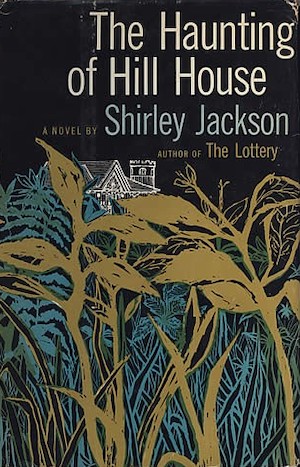
This week, we wrap up our discussion Shirley Jackson’s The Haunting of Hill House, including final thoughts from both of us and a little from Anne on the screen adaptations. Spoilers ahead.
Anne Considers the Films
Let’s start with the ultimate book-versus-movie question: Jackson’s novel is “better” than any of the three film adaptations. In the technical term for degrees of goodness, it’s waaaaaaaaaay better. That’s a ten-A “way,” the highest known to critical science. I might even throw in another A, since in my philosophy all things can go to eleven.
Hill House did pretty well for Jackson critically and financially. Then she hit the jackpot: A sale of movie rights for $67,500, what biographer Ruth Franklin calls “an astronomical fee for the time.” With Robert Wise as director and Julie Harris and Claire Bloom in the female leads, it’d be no B-movie. Jackson said the film-makers could do what they wanted once she got her money, but she did discuss the adaptation with Wise and screenwriter Nelson Gidding. Gidding’s first vision was that Eleanor had suffered a nervous breakdown; Hill House was the asylum in which she was hospitalized, and the other characters were patients or attendants. The “ghost story” took place in Eleanor’s head, with the “psychic manifestations” produced by electroshock treatments. Jackson steered him back toward a “simple” haunted-house tale, not that hers was “simple” or without profound psychological insights. After seeing the film, Jackson told a reporter it terrified her—she “couldn’t believe that [she] had written this.” Off record, she wasn’t thrilled with some plot changes, but she loved the deadly edifice itself, represented in exterior shots by Ettington Hall, a Gothic mansion near Stratford-upon-Avon.
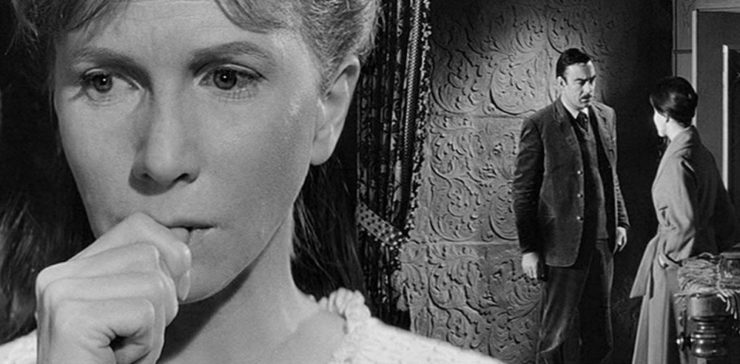
The 1963 adaptation was called simply The Haunting. I miss the original title’s alliteration, but when Wise told Jackson it wouldn’t work, she said she’d also considered this one, giving her imprimatur for the change. The 1963 theatrical poster features the tagline “You may not believe in ghosts, but you cannot deny terror.” That’s a good statement of Wise and Gidding’s approach: more psychological suspense than supernatural horror. It’s a legitimate interpretation; overall, this is the most faithful adaptation.
I give it 6.5 out of ten. My biggest beef is Humphrey Searle’s score. It’s enough to drive me out of my seat, clutching my blasted ears. Scary moment? Bam, the whole orchestra crashes in, strident, discordant, to underscore it. Even Eleanor’s first look at Hill House triggers musical screeching worthy of a blood-spattered climax.
The gratuitous character name changes bother me the way houseflies do, no catastrophe but an annoyance every time they buzz by. Why should Eleanor Vance become Eleanor Lance? Why Dr. Markway instead of Dr. Montague? There must be something repulsive to screenwriters in the doctor’s name—in the 1999 adaptation, he becomes Dr. David Marrow.
None of the adaptations make much of Mrs. Montague and Arthur. They don’t figure in the 1999 or 2018 versions (although in the series, Nell’s husband is named Arthur.) In the 1963 film, Mrs. Montague visits Hill House without her sidekick. Unlike Jackson’s character, she’s a skeptic who sleeps in the nursery to prove ghosts don’t exist. Whatever she experiences there drives her temporarily insane. Roaming in her nightie, she reaches the turret in time to lift the trapdoor and scare Eleanor senseless as Montague (not Luke) hauls her down the spiral stairs. Later Mrs. M. staggers across the driveway just before Eleanor crashes into the tree. Theodora accuses her of making Eleanor veer off the road, but Mrs. M. says Eleanor was already aimed straight at the tree.
What Mrs. Montague does kill are Eleanor’s hopes that Dr. Markway will be her journey’s end lover. Harris’ Eleanor moons over him and at crises ends up in his strong arms. She cares little for Russ Tamblyn’s Luke, maybe because he acts too street-cheeky, like his West Side Story character. Bloom’s stunning Theodora is clearly interested in Eleanor. Censors insisted that Theodora never touch Eleanor—ew, lesbian cooties! She does anyway, though I’d argue her orientation remains less obvious than in Jackson’s original, at least until Eleanor (far from wanting to move in with Theodora) spitefully calls her “a mistake of nature.”
Harris’ Eleanor is such a nervous wreck that she earns my irritation more than my sympathy. Her instability seems a remnant of Gidding’s original concept, and matches the film’s pervasive high pitch. Is Haunting a product of its era, or even of an earlier one? Not only is it filmed in black-and-white, it often flashes me back to the Universal Pictures monster classics.
***
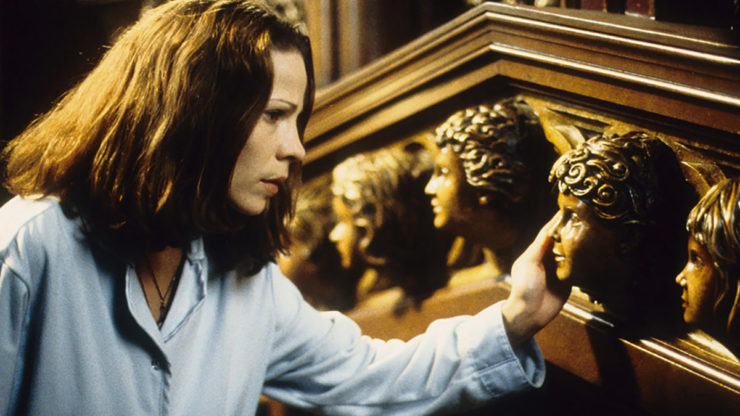
The 1999 Haunting has a few things in common with both Jackson’s novel and Haunting 1963. There’s a reputedly haunted mansion called Hill House, built by Hugh Crain. A scientist recruits three assistants to hang out: Eleanor, Theodora, and Luke. The Dudleys take care of the mansion. Things go bump in the night. There’s a rickety spiral staircase. The house likes Eleanor best. She “buys” it in the end.
After the relatively cogent opening, director Jan de Bont (Speed, Twister) starts packing in as much special effects mayhem as the budget will allow. Screenwriter David Self raids TV Tropes to render his plot ever more convoluted. Hill House itself swells to monstrous proportions. A Grand-Central-sized conservatory houses Crain’s titanic statue and the infamous spiral stairs, and there’s a mirror-lined room that rotates like a carousel. Style: Neo-Rococo Funhouse. Corridors stretch on forever. Bedrooms could serve as ballrooms. Carvings of children’s heads are everywhere. This last is semi-Jacksonian—recall Luke’s distaste for the omnipresent cherubs.
Not so Jacksonian the reason for the heads. Mill-owner Hugh Crain exploited child labor but simultaneously longed to fill his mansion with kiddies. He and his first wife were childless. To compensate, Hugh abducted mill children to Hill House, killed them so they could never leave, and hid their remains under a greatroom fireplace. (The fireplace features a flue-damper pull in the shape of a humongous lion-head that will ultimately decapitate Luke.) Hugh’s second wife Caroline uncovered his villainy and fled, pregnant. Eventually we learn she’s Eleanor’s great-grandmother! This explains why the house wants Eleanor and why only she can free its child-ghosts. Everyone is pissed at Dr. Marrow for misrepresenting his research on fear as an insomnia study. Being Liam Neeson, he’s a natural for rescuing Eleanor from the staircase, whereas Owen Wilson’s Luke is a natural to do little except freak out. Catherine Zeta-Jones makes another gorgeous Theodora. Lili Taylor convinces as Eleanor, but she’s hampered by the script’s insistence that she heroically redeem great-granddad’s misdeeds.
Anyhow, there’s this doorway in Hill House carved to represent the gates of Hell. When Eleanor casts Hugh’s marauding ghost into it, carved demons animate and drag him to damnation. Eleanor then dies but achieves apotheosis as her spirit ascends to Heaven in company with the freed child-ghosts. Dr. Marrow and Theodora walk out into the dawn to be met by the Dudleys. Mr. Dudley asks Marrow if he found out what he wanted, a question Marrow doesn’t (or cannot) answer.
Three out of ten, I’m afraid. Haunting 1963 used Jackson’s novel as its sturdy foundation. Haunting 1999, magpie-like, has randomly plucked out shiny details to decorate its much flimsier nest.
***
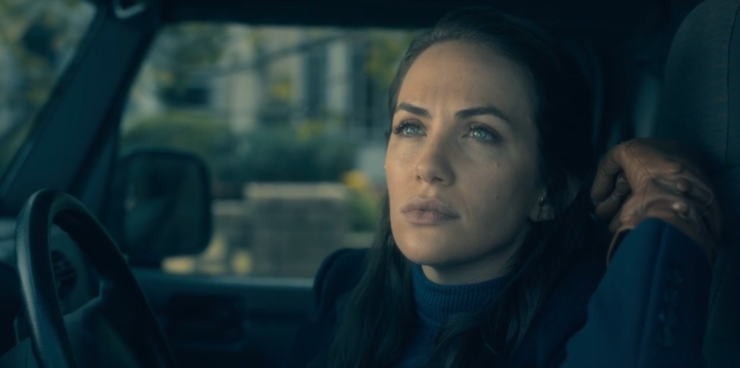
The adaptation least faithful plot-wise is, for me, the most faithful in themes and emotional resonance. That’s 2018’s Haunting of Hill House, created by Mike Flanagan for Netflix. The opening credits alone disturb me delightfully. Those statues slowly shedding their marble skins to reveal—what flesh underneath? Another plus: unlike the 1963 score, the Newton Brothers provide an eerie counterpart to the action without punishing my ears.
Hill House 2018 centers not on the Crains of the novel, but a Crain family come to renovate and flip the titular mansion over the summer of 1992. Father Hugh is the builder, mother Olivia the designer/architect. Their children are Steven, Shirley, Theodora and the twins Luke and Eleanor. The Dudleys, long-time caretakers, stay to work for the Crains. The original builders were now William Hill and wife Poppy, fortune at least partly accrued through bootlegging.
The complex plot braids events of summer 1992 with the present, twenty-six years later. Hill House, born evil, has left its mark on all the Crains. Mother Olivia died there, under mysterious circumstances Hugh never explained to the children. They grow estranged as a result. Steven Crain writes popular books on hauntings, starting with Hill House. He’s a skeptic, believing his family suffers from mental illness rather than paranormal trauma. Shirley’s become an undertaker and control freak. Psychic Theodora is a psychologist, dealing empathically with traumatized children but otherwise emotionally walled-off. Nell struggles with depression and sleep paralysis surrounding visions of her personal Hill House ghost, the Bent-Neck Lady. Luke is a heroin addict. Following the death of her husband, Nell returns to Hill House with tragic results that force the surviving Crains to confront their own hauntings.
I won’t spoil this most recent adaptation beyond one big if purposefully vague revelation. The series fruitfully worries the concepts of house versus home, parent versus child, isolation versus connection, and life versus death—and which is the true waking state, who are the true ghosts. Here comes the big difference, about which I remain ambivalent.
Jackson’s Hill House ends with the chilling assertion that whatever walks there, walks alone. The 1963 film ups the chill factor with Eleanor’s voiceover that “We who walk there, walk alone.” The 1999 film dodges messy ambiguity by having the bad ghost dragged to Hell while the good ghosts waft upward. The series’ closing contention is that “those who walk there, walk together.” For me, that both uplifts and annoys; still, in art that mixed response may be a tribute to complexity.
Has the definitive Hill House film been done? Not yet, I think, not one that remains faithful to Jackson, plot point to plot point, nuance to nuance, down to the devastating conclusion that to “walk alone” is Eleanor’s end. In death she finds a home, but only in solitude, in isolation.
That’s scary, Shirley. That’s really scary.
Ruthanna ponders her first read-through
…which I am still processing, not yet ready to explore anyone else’s riffs. I started my read-through knowing only that Shirley Jackson was a genius and that this was a foundational modern haunted house story. I wasn’t sure what to expect, though I could certainly anticipate complex women in tricky relationships. I definitely didn’t expect my uncertainty to continue for most of the book—the way it all hangs together and looks like a plot and character arc from the vantage of the ending, while leaving the reader nearly as befuddled as the characters throughout, is truly impressive.
So as I process, here are listsicles.
Five Things That Confused Ruthanna:
- What exactly walks alone in Hill House? Is it the ghost of Hugh Crain, or a daughter, or one or more wives, or the companion, or evil architecture, or the hills themselves—or Eleanor’s telekinesis? Could it be more than one, alone even in company? Resolution: none in the text, but I’m going for “all of the above, and the house is building a collection of mentally isolated psychics.”
- What the hell is absolute reality, and why is it incompatible with sanity? Is this secretly cosmic horror, with the house playing on and then stripping away facades of human self-importance? Resolution: No clue; I don’t even trust any of the opening claims at this point, so am hard-pressed to say whether Hill House really does live in conditions of absolute reality or just imposes its own conception of said reality on inhabitants. Though maybe if you use non-Euclidean geometry, the walls are upright and the bricks do meet neatly.
- What the hell is with the sitcom-like emotional reset at the beginning of most of the chapters? This was deeply surreal and creepy, one of the creepiest things in the book. Plenty of haunts can bang on your doors and bloody your clothes; fewer can play your emotions like a fiddle to keep you around for more. Resolution: I’m pretty sure this is Hill House as abuser, bringing flowers after every assault, gaslighting everyone about whether its attacks were serious or even happened at all. This fits with the supernaturally dry-cleaned clothing, too.
- What the hell is up with Mrs. Dudley? Why does she—except for one overheard conversation that probably isn’t accurately reported—act like a limited-script bot? Is she the house’s puppet, or some sort of weird anti-guardian spirit, or is this just the result of going to Hill House every day for years? Resolution: no clue whatsoever.
- Is there anything Hill House can’t do? Resolution: Within its own walls, probably not. Especially if it gets to set the conditions of absolute reality.
Two Books Hill House Reminded Me Of Even Though It’s Not Actually Like Either One:
- Italo Calvino’s Invisible Cities. Particularly mid-book, before the episodes and jarring emotional shifts started clearly coming together and going somewhere terrible, I thought of Calvino’s linked, thematically rich vignettes, that only create a clear impression as their commonalities build up.
- Jean-Paul Sartre’s No Exit. I’m honestly not convinced that this isn’t a deliberate No Exit riff, though I tend to see parallels any time 3-4 characters get into psychologically-fraught relationships that keep them from leaving a terrible situation. Hauntings are other people?
Three Things That Were Awesome:
- The detailing. Hill House is full of exact observation, even when you can’t trust those observations as far as you can throw them. The cup of stars. The little songs. That damned statue. The knocking. When things go vague—like the movement that may not be a rabbit—it stands out, and feels like its own sort of specificity.
- The psychology. The central relationships are vivid, despite the house fiddling with them almost as soon as we see them. But it’s the relationship with the house—a darker mirror to bad parents, sisters, lovers, all at once—that stands out, a distillation of abuse and attachment and isolation. Eleanor, as its focus, also stands out, fiercely building and then losing her selfhood in that little sliver of space and imagination between mother and death. You can see her flaws from the start, and can never be quite sure whether the house makes them worse or just more obvious.
- My ship, dammit. I know it goes down, but it means something that despite initial plays at a stupid love triangle, the house quickly identifies the connection between Eleanor and Theo as the most intense and therefore the richest possible node of pain to mine. And it’s Theo that’s the house’s greatest competition for Eleanor’s affections—Theo who might be lover or cousin or first friend, Theo who offers physical caresses rather than psychic ones, Theo with whom Eleanor begs to build a life so that Hill House won’t remain her only possible home.
Anyway, that was amazing, and I suspect I’m going to wake in the middle of the night with insights into what happened, and nightmares about midnight wakings in Hill House, for a long time to come.
Next week, we cover an earlier haunted house with Oliver Onions’s “The Beckoning Fair One.” Then join us the following week for our new longread, T. Kingfisher’s The Hollow Places!
Ruthanna Emrys is the author of the Innsmouth Legacy series, including Winter Tide and Deep Roots. Her short story collection, Imperfect Commentaries, is available from Lethe Press. You can find some of her fiction, weird and otherwise, on Tor.com, most recently “The Word of Flesh and Soul.” Ruthanna is online on Twitter and Patreon, and offline in a mysterious manor house with her large, chaotic household—mostly mammalian—outside Washington DC.
Anne M. Pillsworth’s short story “The Madonna of the Abattoir” appears on Tor.com. Her young adult Mythos novel, Summoned, is available from Tor Teen along with sequel Fathomless. She lives in Edgewood, a Victorian trolley car suburb of Providence, Rhode Island, uncomfortably near Joseph Curwen’s underground laboratory.

There is one other glaring sign of Theodora’s orientation in The Haunting: Luke touches her arm and tries his smoothest “When are you going to show me your ESP?” line. Theodora pulls away, “Keep your hands to yourself!” Markway asks what’s going on, Luke looks to Eleanor and back to Theodora, raises an eyebrow. “Oh, more than meets the eye.” (because who else besides a lesbian could resist that?!)
I was always more familiar with the films than the book. I enjoyed the 60’s version much more than the 90’s one. I thought the 60’s one atmospheric and scary. The ending always makes me sad. The 90’s one is just overwrought and special effects happy, the ending also doesn’t have the same punch. I know the story so I never watched the 2018 Netflix series even though it had some good reviews and sounded interesting. I really don’t like scary things and hate it when the “monster” wins in the end. I wanted Elenore to break free of the house and her sister and live her best life with Theodora or someone else or learn to live alone without being crushingly lonely. I don’t need snow white and the singing animals but is a little happiness to much to ask for ? Now I think I’ll read some Guards ! Guards ! by Terry Pratchett I need a laugh.
Yay for The Beckoning Fair One! A great ghost story, with a stunning last line.
I have no plans to watch the Netflix version, because I read up on it and am utterly baffled as to why anyone would make an adaptation of this book that has so very little to do with the book.
Thank you both for the guided tour of Hill House – I probably wouldn’t have picked up the book if it weren’t for this column, and I am immensely glad that I chose to do so.
Thank you for doing this in-depth analysis of one of my favorite books of all time! It’s been much appreciated during the long solitary weeks!
I haven’t watched the films, but in my experience it’s almost impossible for film makers to resist wrecking a story in their adaptation. Sometimes- very rarely – the changes work (Jaws, though of course I was on the shark’s side). Mostly it makes the end product at least annoying, otherwise baffling, or flat out terrible.
My own personal taste in horror would have the interpretation that Hill House is just a house. The “haunting” is all either Eleanor’s poltergeist abilities (when others can sense them too) or just in her mind. Not many people genuinely believe in ghosts. Everyone has a fear of going insane.
This was a really fun re-read series, especially since I just read the book for the first time, last year.
I watched the Netflix series first, which I loved, and I can see the differences between those and the other versions, but it also got me wanting to read the book.
There was also this extremely good video essay on YouTube regarding the idea of a ‘bad house’–rather than ghosts simply being in a house and scaring people, the house itself is actively the source of the spooks. (Does include some spoilers for the games Control, and Anatomy.) https://youtu.be/mexs39y0Imw
Thanks for the re-read!
Flanagan’s use of Hill House and then multiple stories of James for springboards to stories that can’t be called adaptations has been both wonderful and frustrating to observe.
Without spoiling anything for anyone, I want to springboard, myself, off something Anna wrote about the end of the TV series: While there were things that worked well and things less well considered about the series, it still had a through-line Flanagan could have taken any number of ways. That, however, he veers so far not only from the most clear narrative arcs but also from the heart of Jackson’s brutal narrative shows that, unlike Jackson, Flanagan lacks the courage to tell the story as it deserved to be told. Jackson unfailingly beats up her readers and we come back for more. To strip her story of that truly hard stuff is a sad betrayal . . . and baffling.
@8 — I agree over all with your sentiments regarding the Netflix “adaptation”. By the end of the series, I couldn’t help but think of Ned Flanders talking about the Maison Derriere in The Simpsons: “We like the house now!”
In the end, though, I found the series to have a much too gloss finish — both in facade and ending: a family of beautiful people who seem perfectly fine to find out that their mom poisoned a child who end up getting along and being even more beautiful by the end — compared to a book that was “rough around edges” — an ill-defined but definitely creepy house, fairly 3-dimensional characters whose actions are often inexplicable but realistic in feel.
I enjoyed the Netflix series as its own separate thing. The little references to things from the book were cool, but overall, I feel like I would enjoy it just as its own self-contained story rather than an adaptation. It definitely does feel “right,” for the most part, from a standpoint of theme and elicited emotion. Not sure about the ending–it makes me go, “Well, that’s nice, but should it be nice?” (I appreciate a happy ending, I’m just not sure this story warranted one. @2 RobinM, you might be ok with this one, I think.)
I think the series does have things to recommend it on its own. Anyone else who’s seen it, did you find Mr. Dudley’s story about why he and his wife don’t stay at the house at night as existentially disturbing as I did? It’s a scene where NOTHING HAPPENS, it’s just a dude standing there talking, but it makes my skin crawl. I don’t know if it’s the acting or the writing, or the setup or whatever, that scene is way creepier than any of the actual ghosts who show up on screen.
While I haven’t seen the series, I’m pretty well acquainted with the short novel and the Robert Wise movie, The remake was silly and instantly forgettable.
And while Jackson insisted that The Haunting of Hill House was merely a ghost story, it’s well to keep in mind that she was still married to her duplicitous husband, and that so much of her work dealt with the feeling of being trapped in domesticity, convention, thwarted ambition,, as a woman in 1950s America.
I’ve run across convincing analysis of this work that suggest that the house is a symbol of that very dynamic. Eleanor longs to escape her nuclear family, hopes that this new “home” will be her salvation, falls for the daddy-figure (Markway), and finds that he is only a cardboard simile of a protector (in the story, yes, through no fault of his own.. his heart is elsewhere), and becomes absorbed into the structure of the home, of an old culture she had no part in creating. Ultimately, she succumbs.
Theo offers perhaps the only possible path to self-realization, not merely because of her gayness, but because she exists outside the masculine swagger of Luke, the paternal know-it-all remoteness of Markway. Of course Nell can’t accept that possibility. It’s the 50s, it’s alien to her, it doesn’t fit her programming. She yields to annihilation. She becomes part of the House, her personality erased.
Hi, I’m dropping back in on this wrap-up of the Haunting of Hill House read-through to point any of you who might reread at a really delightful and hilarious live-Tweeted first-time read-through on Twitter by @xoDrVenture. (Moderately Twitter-famous for their first-time live tweet-through of Dracula, a while back.)
Starting here on October 1 https://twitter.com/xoDrVenture/status/1444096248257126400
While it’s funny throughout, they also have some extremely insightful observations through the course of it – pointing out how the writing style in itself echoes Eleanor’s thought processes, noting how the description’s of some of Eleanor’s social experiences in the house are accurate descriptions of psychological dissociative episodes, and other acute observations.
https://twitter.com/xoDrVenture/status/1444463349740326912
If you don’t feel like going through the whole thing again, they added a short but excellent wrap-up analysis this past week, starting here:
https://twitter.com/xoDrVenture/status/1455538650570272771
(with a brief interlude, but continuing as a thread…)
Quoting some parts of this last that really struck me.
Anyway, go read it, it’s worth your time – it all feels very much on the mark to me.
I’ve read this book at least 10 times and only two things really still confound me. The first is the most obvious: what does Theodora see? We’ll never know, although Jackson surely intended us to think of something there.
The second is what happens to Theodora’s clothes. Everyone sees they are coated in blood. They can smell it. Then, at the end, it simply goes away? Is Theo lying at the end so Eleanor is willing to go away? This confuses me. What psychic power could possibly be in play here? The dry cleaning remark in the previous article is just as valid an explanation as any other.
Anyway, this is one of the greatest books every written and Eleanor is one of literature’s great characters. You can never know her, no matter how many times you read the book or peruse its every line. Essays fail to help much. And Jackson has said very little (and some of what Jackson has said, particularly about Theodora, doesn’t fit with teh book anyway).
Have been binge-reading your hugely enjoyable Rereading Lovecraft series and am looking forward to seeing what you have to say about Hill House. But I’m also imagining the field day you would have with some of Shirley Jackson’s less-known short stories from the collection Come Along With Me. Some of them–like “A Visit” and “Louisa, Please Come Home”–only give up their full creepitude to extended contemplation…which you and Anne could provide in spades.