







Welcome back to the Lovecraft reread, in which two modern Mythos writers get girl cooties all over old Howard’s original stories.
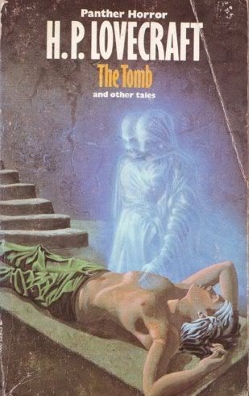
Today we’re looking at “The Tomb,” written in June 1917 and first published in the March 1922 issue of The Vagrant. You can read it here.
Spoilers ahead.
“I must have fallen asleep from fatigue, for it was with a distinct sense of awakening that I heard the voices. Of those tones and accents I hesitate to speak; of their quality I will not speak; but I may say that they presented certain uncanny differences in vocabulary, pronunciation, and mode of utterance. Every shade of New England dialect, from the uncouth syllables of the Puritan colonists to the precise rhetoric of fifty years ago, seemed represented in that shadowy colloquy, though it was only later that I noticed the fact. At the time, indeed, my attention was distracted from this matter by another phenomenon; a phenomenon so fleeting that I could not take oath upon its reality. I barely fancied that as I awoke, a light had been hurriedly extinguished within the sunken sepulchre.”
Summary: Jervas Dudley writes from the asylum to which he’s been confined since age twenty-one. Narrow-minded materialists will doubt his tale, but those who know that reality is shaped by individual perception may understand.
Wealthy but temperamentally reclusive, Dudley has always been a dreamer and a scholar of the obscure. He roams the environs of his ancestral home near Boston, Massachusetts; there he’s seen and heard things others cannot, like the dryads that preside over the gnarled oaks of a certain wooded hollow. In its darkest thicket he discovers the tomb of the Hydes, a family long extinct. Their mansion stood atop the hill in which the tomb still remains sunk. Locals whisper that divine wrath struck the Hydes in the form of lightning and burned their house to the foundations. Ten-year-old Jervas is fascinated by the “stone house” and the ponderous door that hangs ajar, fastened with chains and padlocks. He tries to squeeze into the tantalizing darkness, to no avail.
Dudley tries for months to break into the tomb. Rumor of the Hydes’ godless revels only feeds his monomania. Then he reads in Plutarch’s Lives how Theseus didn’t find the tokens of his destiny until he was old enough to lift the weighty stone over them. So let it be with Jervas Dudley! When age and Fate ordain, he’ll enter the tomb. Until then he continues to haunt the hollow by night, and to ramble through other burial places. In the morning he often astonishes his family with forgotten or unknowable lore, like how the undertaker stole Squire Brewster’s grave-clothes and how the Squire turned twice in his coffin, a day interred and six feet under.
When Dudley learns he’s distantly related to the Hydes, he envisions the tomb as his. One night he falls asleep with his eyes to the gap in the door. Waking, he hears voices inside, speaking in all the New England dialects from the Puritans onward. Something changes in him, and he goes direct to a chest in his attic, from which he takes a key that finally opens the tomb. He descends to a vault of many marble slabs, some holding coffins, some but handles and nameplates—and dust. An empty coffin labeled, ironically, “Jervas,” draws him, and he lies down in it.
He sleeps and rises at dawn marked by the sort of debauches he’s never known in sober waking life. Every night thereafter he goes into the tomb and does what he will never reveal. His diction and demeanor change. His knowledge of the Georgian period grows uncanny. He even spouts a ribald drinking song: “But fill up your goblets and pass ’em around—better under the table than under the ground!”
About the same time he develops a phobia for fire and thunderstorms, and begins frequenting the ruined Hyde mansion. Alarmed, his parents set servants to watch him. The dreaded morning comes when he emerges from the tomb to see a spy peering from a thicket. Not too good a spy, though, because eavesdropping on the man’s report, he learns the fellow only saw him lying outside the tomb, eyes on the gap. Obviously some supernatural agency is protecting him! Emboldened, he goes into the tomb whenever he likes, to enjoy a “charnel conviviality” he still must not describe.
One night, when the clouds thunder and phosphorescence rises from the tomb’s hollow, he goes to the cellar of the Hyde House. Time shifts, and he sees the house whole, with a wild party underway. He himself is the wildest of the revelers, blasphemy pouring from his lips. As if in response, lightning strikes the house. Flame engulfs it. All escape but our narrator, whose terror of death in the fire is augmented by the realization that his ashes will be dispersed to the winds, not placed in the tomb as they should be. He vows his soul will seek through the ages for another body to represent it on the vacant slab of Jervas Hyde!
Time shifts back to the present. Jervas Dudley finds himself struggling in the grip of two men, while his father looks sadly on. The mansion is gone, though scorched blackness marks the cellar floor to show where lightning has recently struck. Curious villages unearth an antique box from this spot. Among its valuables, Dudley has eyes only for the miniature of a young man in Georgian costume. It bears the initials “J. H.”
The face of Jervas Hyde is the mirror image of Jervas Dudley’s.
The next day sees Dudley’s confinement. His father claims Dudley could never have entered the Hyde tomb, because its rusted padlocks remain intact and untouched. Too bad Dudley’s lost that key from the attic. He won’t believe his father, or others who claim they always saw him lying outside the tomb, gazing into the darkness hour after hour.
One faithful servant does his bidding, breaking into the tomb and descending to find just what Dudley did: an empty coffin with a tarnished plate bearing only the name “Jervas.”
In that tomb and that coffin, they promise to bury Jervas Dudley.
What’s Cyclopean: Nothing, the adjectives are mostly under control.
The Degenerate Dutch: Aside from a bit of rudeness about “uncouth” Puritans, the only degeneracy in this story belongs to the Hydes.
Mythos Making: Nothing formally connected to the Mythos this early on, but some interesting hints of things to come.
Libronomicon: Jervas’s parents insist that he must have learned all those ancient secrets from the family library. What kind of books do they keep there, anyway?
Madness Takes Its Toll: Confinement in an asylum is merely an impediment to Jervas explaining his situation.
Anne’s Commentary
If not the very first, this is certainly one of Lovecraft’s early adult efforts, with Poe’s influence lying over it like an incense-redolent mantle. It begins with the narrator’s plea for credulity, even though he knows most people won’t be able to grant it. They just don’t understand that reality’s a highly subjective matter.
In modern parlance, Jervas Dudley’s one speshul snowflake. He hears and sees stuff others don’t. Like dryads and the tomb-bound conversations of the dead. The doctors probably label him schizophrenic, but they’re prosaic materialists—can Dudley trust them? Can we? After all, if Dudley never penetrated the Hyde tomb, how’d he know about the empty coffin labeled “Jervas?” And does it really matter if he entered the tomb physically or only psychically?
This read I feel many low tremors of future fictions, of motifs and authorial obsessions that will often rear their hoary and/or gory heads. Most obviously we have the eternal question of whether our narrator’s a madman, either full-fledged or having suffered from a momentary mania or hallucination. Another frequent motif is the bit of evidence appearing at story’s end to sway us from prosaic materialism. You know, a clawed paw breaking through a door, or a photograph found in a pocket, or an alien book written in one’s own hand. Or does Dudley also fabricate old Hiram’s trip into the tomb?
Lovecraft’s love for the Georgian era appears here, producing a decent imitation of a drinking song. Dudley’s reclusive childhood among ancient books and dark groves will find still darker iteration in “The Outsider.” He does unspeakable things in that tomb. Not the sort of things, one hopes, that the narrator of “The Hound” is only too willing to discuss. As his identification with Jervas Hyde strengthens, he’s infected with Hyde’s understandable terror of thunderstorms. Thunderstorms, you know, the Martense phobia. And then there’s the key, in the attic, to which the narrator’s led in dream. Didn’t we see that somewhere recently?
But the fore-echoes I hear loudest resound to Charles Dexter Ward. The principal part of Curwen’s back story occurs in 18th-century New England, allowing Lovecraft to revel in the period details more modestly featured in “Tomb,” such as the burial regalia of Squire Brewster and Jervas Hyde’s smartly curled bag-wig. That Dudley suddenly has specific memories of this historical period is a sign something’s amiss, as is his new habit of haunting graveyards. It turns out Dudley’s being possessed by his ancestor, and for a while that seems to be what’s happening to Charles Dexter Ward. For both Dudley and Ward, the ancestor is a person of highly questionable character on the mother’s side, and when that ancestor’s portrait comes to light, his descendent proves an identical twin. It’s the shadow of the past, for sure, subtly or not so subtly creeping over the present.
Necromancy is prominent in both works. Dudley first hears the many-accented chatter of the dead, then descends into the tomb to join in. He communicates with the deceased elsewhere, as well, presumably learning from Squire Brewster himself that his graveclothes were plundered and that he wasn’t quite dead when buried. His link to the other side seems innate, psychic. In contrast, Joseph Curwen and friends have to work hard for their information. In novel-length Charles Dexter Ward, Lovecraft can really netherworld-build his magic. He can also complicate the way Ward’s snared by the past. Jervas Hyde vows to return through the possession of a descendent, mostly so he can have a body to lie in his coffin. Maybe he also goes debauching while in Dudley’s body (fore-echo of Ephraim/Asenath Waite!), but Dudley’s too shy to tell. That Curwen may be possessing Ward’s body is a red herring. Instead he influences Ward’s mind through the magic he set breeding in the Outside as a precaution against his death. Way more sophisticated than Hyde’s magic, which seems to be a simple powerful WILL to return, like Ligeia’s. When Dudley starts looking older than his years, when his persona and memory change, well, naturally: He’s become Hyde! When Ward does the same, extra twists—that’s not Ward at all, that’s the truly reincarnated Curwen. Who looks just like Ward, except when he wears his Dr. Allen disguise.
A final fore-echo of Charles Dexter Ward: Rational people attribute Dudley’s impossible knowledge of the past to his “omnivorous browsing among the ancient volumes of the family library.” Just as the alienists attribute Ward’s impossible knowledge to his antiquarian obsessions. Old books can really screw you up, guys, and they don’t even have to be the Necronomicon, though that will greatly accelerate the screwing-up process.
Oh, and another caveat. Wild parties are asking for it. You could fall in with Asenath Waite, or a walking corpse could show up, or you could call down lightning from the heavens and then be too drunk to get your sorry butt out of the burning house. Just saying, as, perhaps, was teetotaler Lovecraft.
Ruthanna’s Commentary
If you’d asked me, with no access to the documented timeline, to put Lovecraft’s stories in order from his earliest just-publishable stories to latest mature and nuanced work, I probably wouldn’t have picked this out as the very first item (or at least close, depending on how you count). (I would have picked “The Outsider,” in fact.) Tomb holds up remarkably well. The language is esoteric but well-controlled, the setting vivid, the horror and temptation horrible and tempting. Its early status shows largely in a couple of places where the author hasn’t yet settled into his own style, and for the larval appearance of several themes and tropes that he’ll go back to throughout his career.
Stylistic quirks first. Unlike most of HPL’s horror, this is straight-out fantasy, with no hint of the rationalist, science fictional explanations that will mark much later work. The narrator’s connection with Jervas Hyde of old appears to be simple reincarnation of the soul, something I don’t think we see at all later in spite of the massive prevalence of body switching and identity blurring. There are dryads in the woods—one rather gets the feeling that the Jervas belongs in a Dreamlands story but got lost on the way. More on that in a moment.
Later Lovecraftian narrators will struggle over their own sanity, alternately fearing and hoping that their experiences are mere products of delusion—sometimes both within the same sentence. Here Jervas himself never questions his own experiences. It’s only others’ perceptions of aberration that get in the way.
Larval themes and tropes. Jervas reminds me a great deal of Randolph Carter. Connections with the world of dreams, insights without rational explanation, plus he lugs around an extremely important key. Unlike Jervas, Carter finds what he’s looking for and manages to keep up appearances well enough to carry on the life he desires, at least in some parts of the space-time continuum. Maybe the young Lovecraft, not yet in touch with his varied correspondents, couldn’t imagine anything good coming from a meeting of true minds. On the other hand, Jervas does somewhat better than Charles Dexter Ward, whose obsession with the past also leads to familial worries and awkward ancestral connections. The Hydes themselves perhaps have some connection with the Martenses and De la Poers, all old and noble families fallen like the house of Usher. (The Hydes do seem more directly pulled from a Poe story.)
And even this early, horror and temptation intermingle—indeed, are often scarcely distinguishable. What young and imaginative man wouldn’t want to drink and dance with the dead all night, even if their faces are a little worm-eaten? And Jervas gets not only pleasure but knowledge from these gatherings, learning secrets (or at least juicy gossip) of the long-buried past.
This is also one of the few ‘happy endings’ in Lovecraft, and one of the stranger and more ambiguous. It presages a much later one—and another where incarceration in an asylum keeps someone from their rightful resting place. Perhaps the Hydes’ eternal revels have something in common with the wonder and glory of Y’ha’nthlei.
Speaking of revels, this story has something else you won’t see later: a pretty awesome ribald (and ironically morbid) drinking song! I’ll bet that was not on your list of “Things H. P. Lovecraft Was Most Likely to Write” either. If you’ve been reading these commentaries without actually reading the stories, you should at least skim for the lyrics.
Next week, join us for another wickedly creepy museum exhibit in Lovecraft and Hazel Heald’s “Out of the Aeons.”
Ruthanna Emrys’s neo-Lovecraftian novelette “The Litany of Earth” is available on Tor.com, along with the more recent but distinctly non-Lovecraftian “Seven Commentaries on an Imperfect Land.” Her work has also appeared at Strange Horizons and Analog. She can frequently be found online on Twitter and Livejournal. She lives in a large, chaotic household—mostly mammalian—outside Washington DC.
Anne M. Pillsworth’s short story “Geldman’s Pharmacy” received honorable mention in The Year’s Best Fantasy and Horror, Thirteenth Annual Collection. “The Madonna of the Abattoir” is published on Tor.com, and her first novel, Summoned, is available from Tor Teen. She currently lives in a Victorian trolley car suburb of Providence, Rhode Island.

Well, “The Tomb” is alright, if not all that memorable.
Weird Tales: January 1926 wasn’t a very interesting issue from our perspective, save for the E. Hoffmann Price poem “Adam, to Lilith” and a reprint of Poe’s “Lenore”.
Hi-Neighbor!: Apparently, Zadok Allen’s drink of choice was “a bold yet balanced English-style Olde Ale”: http://www.narragansettbeer.com/beer/innsmouth-olde-ale. I’m still trying to work out whether the brewers have actually read any Lovecraft.
It’s a decent little story that, had it been written by anybody else, would be long forgotten. The sort of story that you encounter in a magazine or collection, read and enjoy, and then promptly forget.
OTOH, this may well be HPL’s most successful unreliable narrator. The whole thing, including the supposed hard evidence of the miniature and empty coffin, could easily be the product of Dudley’s insanity. And while it’s clearly influenced by Poe, it’s not so strongly Poe-esque as some of his other work in that vein.
What kind of books do they keep in the family library for Jervas to learn all that stuff? Probably just family and regional histories, references in some local religious tracts, and maybe a diary or two. It wouldn’t take much for him to pick up a few rumors about the Hydes and the destruction of their house. The stuff about the theft of the grave-clothes and the Squire turning over is never actually corroborated and could easily be part of his fantasies.
I have to say that the drinking song is pretty impressive. Most of Lovecraft’s poetry is fairly uninspired and often a bit stilted. Maybe he adapted an actual period drinking song? I’m sure somebody has set this to music. I’d think it would be reasonably popular a filking events.
Add my thumbs-up to the drinking song. I believe HPL wasn’t a music aficionado (do I remember that he was tone-deaf?), but maybe he had a copy of the Child Ballads to hand?
@2: The lyrics of the song are said to be inspired by “Gaudeamus igitur” and I’ve read that the melody is from “The Coleraine”. The song, according to Joshi, was written before the story. A pair of recorded versions I found: http://lynchedfolkmiscreants.bandcamp.com/track/drinking-song-from-the-tomb and https://www.youtube.com/watch?v=IdwG3iwCYpU.
@3: Lovecraft claimed that his dislike of music arose from the experience of violin lessons when younger. Joshi reports a letter of 1918 where Lovecraft recalls making recordings of himself singing back in 1906, said recordings meeting with “accidents” shortly after he played them back.
@@@@@ 1 I obtained the last six pack of Olde Innsmouth Ale at the liquor store — there had been quite the run on it. It’s a decent dark brew, as long as you don’t mind scraping off scales in the morning and wearing turtlenecks to hide your incipient gills. The art on the can is outstanding! But I’m not sure the brewers are also close readers of our canon.
@@@@@ 2 About the books, I imagine that Hyde bride brought some eldritch and/or naughty tomes with her, concealed within innocuous covers like “Flora of Eastern Massachusetts” and “Friendship’s Offering.” Jervas was psychically drawn to these, of course.
Oh, you wanted to hear the drinking song you say?
https://www.youtube.com/watch?v=Ww_NCkBaT1k
https://www.youtube.com/watch?v=ldwG3iwCYpU
Oh you would prefer a punk rock version?
I found the version that by Lynched that both Schuyler and MTCaprenter linked to a tad slow for a drinking song, a little too dirge-y. I think the intent of the song as we have it is more to defy death than to bemoan the upcoming lack of drink and women. Alas, since I’m in Germany, I’m denied access to the first video that MTCarpenter linked to @6, but I did find the punk version. Not bad, though I prefer my punk more on the melodic Clash end of the scale.
@@.-@ Schuyler
It’s a pity about those recordings. He probably shouldn’t have expected too much, considering the quality of non-professional recording available at the time. Not to mention, his voice probably hadn’t settled down yet at the age of 15 or just barely 16. It would be interesting to hear what he sounded like, even as a teen.
“But the fore-echoes I hear loudest resound to Charles Dexter Ward. ”
Yeah, this is a good example of Lovecraft essentially re-working older material (cf “Dagon” and “Call of Chtulhu” for another instance)
As others have said, this is an OK story.Not major Lovecraft but still quite readable.
When I lived in Lancaster, Pennsylvania, during the warm months I would bicycle to the south end of town to the Woodward Hill Cemetery, the burial place of President Buchanan. It is a large cemetery with some very old sections and, at least at the time of my visits, the upkeep was not so tidy. I would go there to read under the trees, in the peace and quiet; I rarely encountered other visitors. Sometimes I would put down my book and explore. I found a grave in the side of a hill with door ajar, much as Lovecraft describes in “The Tomb.” But there was no chain or lock and it would have been easy to venture inside. But I am not as brave as Jervas and never had any great desire to commune with the dead, so I stayed outside in the light of day. For all I know, if I had ventured inside, I may have found my way to Buchanan’s underground abode and learned some 19th-century governmental secrets, or at least gossip, from a dead-but-not-dead 15th President.
I imagine the conversation between Jervas and his still loyal retainer who came to visit him in the asylum went something like this:
Servant: “Yes, Master, I went into the crypt just as you asked. You were right. There on the north side–”
Jervas: “South side.”
Servant: “Oh, yes. South side. There was a slab labelled ‘Jervas Hood–‘”
Jervas: “Hyde.”
Servant: “Of course, Jervas Hyde. Oh, and I took good care of that small portrait you found that, no matter what your mother says, doesn’t look anything like something you would have drawn. Now, just stay calm, take your medicine, and do what the doctors say. We’ll have you out of here in no time.”
Jervas: “That will only happen once the doctors realize I’ve been sane all along and that everything I’ve told them is the exact true.”
Servant: “Oh, well, in that case, could you sign this letter of recommendation for me? The Stark family has an opening I’d like to apply for.”
Jervas: “What’s in it for me?”
Servant: “I’ll name a son after you.”
Jervas: “And you expect me to one day have my soul reborn in him the way Hyde has been reborn in me? Hah! As if I would demean myself with one of the Degenerate Dutch!”
Servant: “We’re from Shrewsbury, but I’ll tell him to avoid mysterious crypts, just in case.”
@@@@@ 11: Ah hah! So the faithful family retainer (or descendant) ends up with his brain downloaded into a virtual butler/majordomo!
Actually a much better fate than just lying around a tomb.
@@@@@ 10: I love a bit untidy cemeteries, like our Riverside. Their old receiving tomb stands open most of the time, but it has so much lumber scattered about it like a man-made deadfall that I haven’t ventured inside, either. I fear ending up trapped, as In the Vault.
@@@@@ 9: As I’ve often heard asserted, we writers keep circling around the same topics, like sharks never quite bold enough to dash in and gobble down the alluring prey whole.