







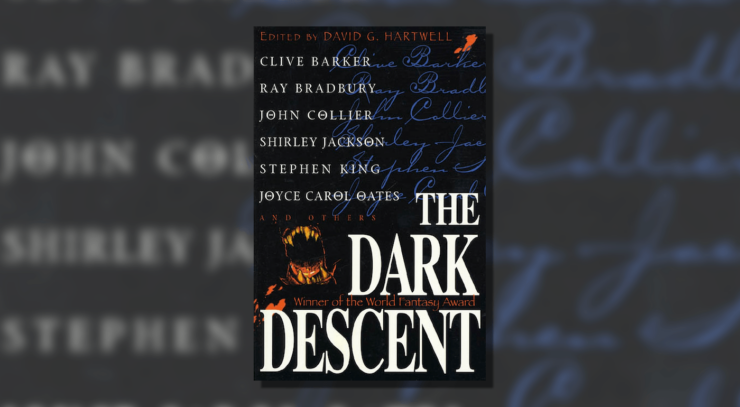
Welcome back to Dissecting The Dark Descent, where we lovingly delve into the guts of David Hartwell’s seminal 1987 anthology story by story, and in the process, explore the underpinnings of a genre we all love. For an in-depth introduction, here’s the intro post.
Algernon Blackwood is one of the more unusual figures in The Dark Descent. An occult investigator (he was a member of the Golden Dawn and the Ghost Club during his storied life), journalist, and writer of the weird by trade, he strove in his work to instill a sense of awe, along with the idea that the world was larger than our perceptions would have us believe. His best-known work, “The Willows,” is perhaps the story that best codifies modern weird fiction, using that idea of a world beyond perception and the idea of powers beyond consciousness to show what happens when its protagonists trespass in an area controlled by natural powers beyond their understanding. While the travel, nature, and exploration tropes woven through “The Willows” remain buried in the past, it’s Blackwood’s depictions of horrors just beyond the borders of our perception that keep the story firmly in the present.
Two men set off in a canoe down the Danube, hoping to eventually navigate the length of the river. In the stretch between Austria and Hungary, they find themselves in an unnerving and treacherous area of swamps and deltas penned in by ominous willow bushes, which inspire a kind of quiet, menacing horror in the narrator. When the pair run aground on a sandy delta to make camp, the strangeness they feel blossoms into outright horror as they’re beset by strange noises, sudden windstorms, flooding rapids, and most of all, the encroaching presence of those horrid willow bushes. As the willows close in and their avenues of escape are cut off, the presence of something beyond their understanding makes itself known…and demands sacrifice.
Nature itself is inherently weird when you stop to think about it, especially for those who don’t live in its midst. While there are plenty of explanations for the weird things that happen—trees moving when there’s no wind, an odd oscillating noise humming through the air, foxes and rabbits emitting horrifying shrieks that usually set the other animals off in an endless loop of terror—for someone not used to any of that, it’s already pretty terrifying. Stories in The Dark Descent have used the natural world before to great effect, as well; “Sticks” sets the placid beauty of nature against the horror of going off to war and the disturbing ruins in the woods, “The Damned Thing” comes out of the woods and returns the same way, and most of “Young Goodman Brown” and “The New Mother” take place well outside “civilization,” in the wilderness where weird things routinely happen.
While Blackwood’s touches in “The Willows” are certainly unique—with the implied menace of the willows, the odd sand funnels, and the dread-inducing presence of whatever entities inhabit the sacrifice delta—“weird holes,” “directionless unnatural humming,” and “the feeling that trees are moving around and there’s something lurking out in the darkness” are all things that tend to happen outside. Anyone who has lived near a significant insect population can tell you that the moment the weather goes north of 80 during the day, the air is filled with hissing, humming, and oscillating sounds from noon to sunrise. Plenty of animals and bugs burrow, leaving “sand-funnels” in their wake. Blackwood touches on this at the beginning of the novella, when our protagonists witness an otter rolling around in the shallows of the delta and initially mistake it for a dead body, something that sets up the final image as the men return to their canoe at the end.
Which brings us once again to common targets of weird fiction and horror, especially in this section of The Dark Descent: the romanticization of travel and nature by those with the privilege to freely experience both. Blackwood’s novella begins with a long poetic tribute to the Danube River (a passage a colleague of mine delights in using as a kind of literary Rickroll at times) as the narrator and his companion canoe through the wilderness. Rather than marvel at the untouched beauty of nature and the protagonists’ leisurely journey through the swamps of the European riverbanks, Blackwood instead immediately strands them in a nightmare scenario where they’re forced to survive multiple nights under threat from a malevolent presence in the wilderness (a presence similar to one explored in Scott Smith’s novel The Ruins (2006), though obviously at more length and in a much more grotesque manner), effectively draining any romanticism from the travel and wilderness.
Further underscoring this, the weirdness of the island begins shortly after the travelers have an odd encounter with a local in a boat who attempts to communicate, yelling something they can’t make out due to a language barrier—the protagonists are not welcome, and the area is completely foreign to them. It could also be implied that the protagonists get the same local killed, as the “sacrifice” at the end is described as a peasant local to the region. Blackwood further swipes at exploration narratives and the idea of crashing through an unwelcome area with the “folk wisdom” dispensed by the non-native who accompanies the narrrator, the unnamed Swede, who is both a foreigner to the region and, by the time he starts talking about gods, is completely whacked out of his skull by the humming noises, wind, and encroaching willows.
Even with the explanations, it’s the quiet menace, isolation, and removal from the status quo that makes “The Willows” all the more upsetting. When one is far enough away from the comforts of daily life, the world can become every bit as alien and otherworldly as a far-off planet, a place with its own gods and rules. The certainly applies to the sacrifice delta in “The Willows,” given the obvious dangers, both natural and unnatural, that ramp up throughout the story. For all nature may be explainable, it’s still untamed— “wild” is a key component of the world “wilderness”— the besieging willow bushes, the godlike entities the narrator sees ascending into the sky, and the means the delta uses to keep its intended sacrifices penned in all point to that. The “weird” in the story is merely the intersection of an isolated patch of wilderness with its own minor gods and the narrators’ unfamiliarity with nature.
The characters’ unfamiliarity with basic nature, lack of romanticism about “The Great Outdoors” that’s found in more lighthearted works (even those where the wilderness is hostile), and direct skewering of adventure, nature, and travel narratives in which protagonists experience the bountiful idyll of their surroundings are what give “The Willows” its staying power. Its savage critique of men setting out into nature and its willingness to take what are commonplace elements of the natural world to their most menacing supernatural extremes mean “The Willows” has outlasted most of the things it was mocking, but the story’s unnerving alienness and strange, encroaching horror have ensured that its influence continues to reverberate into the modern day.
And now to turn it over to you: Why do you think “The Willows” has such an influence on the modern weird? Is Blackwood’s critique of the “great outdoors” narrative warranted? What’s the weirdest experience you’ve had when camping?
Please join us in two weeks for “The Asian Shore,” as we revisit the work of queer horror and science fiction writer Thomas M. Disch.

Three men? Trio? There’s the unnamed first-person narrator and his unnamed Swedish friend. Who on earth is the third?
You made me doubtful enough of this to go to Gutenberg and check out the story again, and I think I can definitely say that there are only two.
Anyone who liked “The Willows” should read “T. Kingfisher” (Ursula Vernon)’s novel inspired by it, The Hollow Places.
That’s my mistake, David, and I’ll own it, I read “my companion” and “the Swede” as two different people because it seemed like he was talking about them like two different people. It was also, I thought, an inspired shot across the bow at Jerome K. Jerome (author of the obvious inspiration Three Men in a Boat (To Say Nothing of the Dog)), but I guess I’ll settle for the mundane over the sublime.
Sorry for any confusion–we’ve updated the article!
I have not read this, but I know the willows themselves from having read T. Kingfisher’s “The Hollow Places”, which has a portal that comes out among them… not recognized as such, but stated by the author. Highly recommend it!
One of those stories I retain a very distinct memory of reading for the first time, which left me feeling at once in awe and a tad genuinely dusturbed. It’s a beautifully orchestrated piece of work and flows more like a dark tone poem than a piece of prose even though it is narratively very well-constructed.
I’ve always felt that Blackwood deserved the honor as being the original, master architect of cosmic horror that was bestowed upon Lovecraft and this may be the best of many examples demonstrating just why. Anyone with a desire for a thorough education in weird and horror fiction needs to read and then re-read a thick Blackwood collection.
I finished reading this, and like apparently a few other I thought of T. Kingfisher’s “The Hollow Places”. Actually, it’s really the same story! It’s so alike I wonder why you would write “The Hollow Places” to begin with?
This piece I have wanted to read since HPL wrote about it, and I can see why he admired it so. One of the best stories in the book so far.