







“Darkness Ascending”
Written by J. Michael Staczynski
Directed by Janet Greek
Season 5, Episode 15
Production episode 516
Original air date: June 3, 1998
It was the dawn of the third age… Garibaldi has a nightmare that sees him walking through a trashed Zocalo and everyone is dead. Franklin blames him before he dies. Then he discovers that he himself, carrying a big fucking gun, is responsible for the carnage. He then “wakes up” in his cabin to see Alexander with glowy white eyes saying she’s experimenting with her fancy Vorlon-enhanced telepathy. Then he wakes up for real (or does he????) and is surprised by a visit from Lise. Once he gets past the confusion and annoyance of his nightmare—which he doesn’t tell Lise about—they fall into bed together.
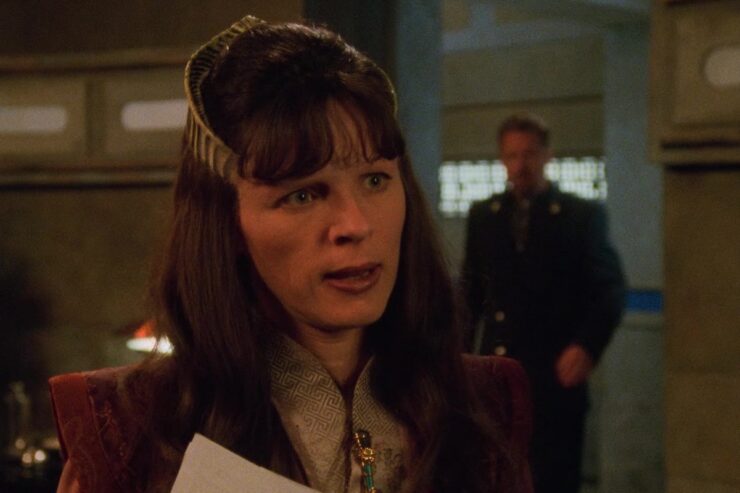
Lennier covertly contacts Delenn from Maria. He’s detected a coded Centauri signal exactly 20 hours prior to every cargo ship attack. He’s working on decoding it. As they talk about how this is still a secret only between the two of them that even Sheridan doesn’t know about, Sheridan walks toward the open doorway, and then hides in the corridor, overhearing the rest of the communication. Delenn conveniently walks out of the office in a manner that prevents her from seeing her husband lurking right on the other side of the doorway.
Alexander is trying to convince a business person to employ some of Byron’s gaggle of rogue telepaths, the sweetener being that they can have as many telepaths as they want on each ship—Psi Corps only allows one telepath per ship. And in exchange, all they ask is to borrow a ship to find a homeworld. But that would violate their contracts with Psi Corps, so the business person has to decline. He suggests she find someone who doesn’t have contracts with Psi Corps.
Mollari is confused and annoyed, as the Royal Court is asking for information on trade deals with other IA worlds—which they don’t normally do—and important appointments for practical governmental matters with the Drazi and Gaim ambassadors have been cancelled.
Lise goes to prep some breakfast while Garibaldi is in the shower, and she discovers an open and half-empty bottle of booze. She confronts Garibaldi, who gets all defensive, insists he’s a different person now, and that Bester’s mindfucking him has left him feeling out of control, but he insists that he’s in control of this. Lise insists that he not drink as long as she’s there, and he agrees, pouring the booze into the sink.
On Maria, Lennier and Montoya discuss his attempts to decode the Centauri signals. (Huh. Coulda sworn this was a secret covert mission…) Montoya also announces that they’ve been recalled to B5 by Sheridan.
For his part, Sheridan confronts Delenn about her sending Lennier on this covert mission without telling her, but then Delenn short-circuits his high dudgeon by capitulating, saying he’s right, but also saying that she did it because if he knew about it, he’d have forbidden it, because Delenn and Lennier are friends. But Lennier is also the best person for the job.
Montoya then contacts Sheridan to inform him that Lennier absconded with a fighter and is now missing.
In the stolen fighter, Lennier records a log entry outlining his plan to trace the signal. He then goes into a meditative state to preserve his air supply.
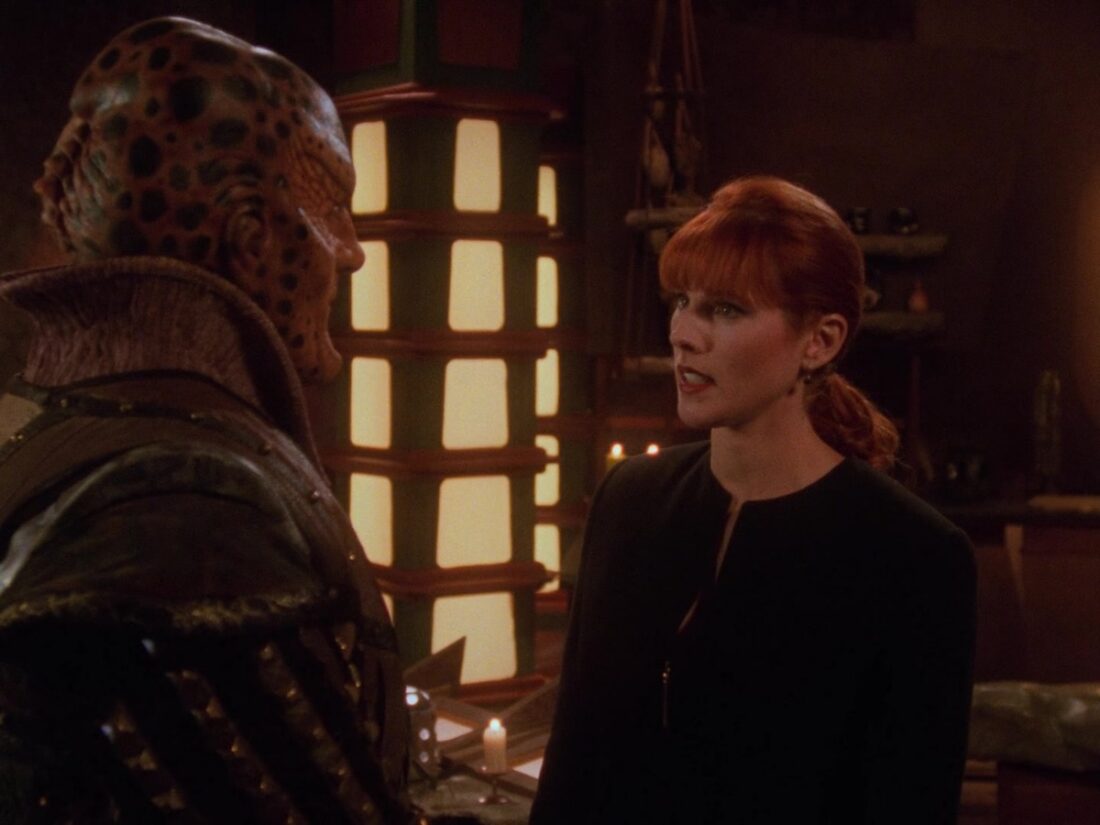
On B5, Alexander goes to G’Kar’s quarters and revisits the transaction G’Kar requested of her way back in “The Gathering”: she’ll provide the genetics sequences of a whole mess of telepaths for the Narns to try to develop their own telepaths, in exchange for a few bottom-end ships to find a homeworld and total secrecy. G’Kar points out that the need for telepaths is less urgent with the Shadows no longer being a factor, but he will bring it to the Kha’Ri.
Garibaldi and Lise have a romantic dinner at Fresh Air. Garibaldi comments that he hasn’t eaten here since Sinclair and Sakai told him and Ivanova of their engagement—shortly after that, Garibaldi was shot in the back and when he woke up, Sinclair was reassigned. He also orders coffee to drink, which the server assumes is for dessert, not as part of the meal, which proves that the server is spectacularly incompetent (I’ve ordered coffee with my meal many many times, and never did the server bat an eyelash). Garibaldi then sneaks off to pour booze into the coffee under the guise of bringing it to the kitchen to complain about its poor quality.
Montoya contacts Sheridan and informs him and Delenn that they’re now past the point where Lennier’s air supply should have run out. However, Lennier has encountered a Centauri vessel and is able to tether himself to it while in stealth mode, also siphoning off some of its air supply. He sadly has to watch helplessly as the ship goes into hyperspace and then comes out and blows up a Brakiri ship, but he does record the whole thing. He disconnects when the attack is over, hiding as a piece of debris. Once the Centauri ship jumps to hyperspace, he sends out a distress call.
On B5, Mollari gets a call from Minister Cholini, saying that the Centauri are being framed for being responsible for the attacks on the cargo ships.
G’Kar tells Alexander that the Narns will go for the deal, but only if the telepaths psionically eavesdrop on other ambassadors from time to time. Alexander says that’s a deal-breaker and starts to leave, but G’Kar says that that was a test—if she’d agreed to that stipulation, the deal would’ve been off. They do, in fact, have a deal.
Montoya informs Sheridan and Delenn that Lennier is safe and sound and has irrefutable evidence of the Centauri’s responsibility for the raids. Delenn is hugely relieved and moves into the corridor so she can cry in peace. Mollari sees her, and Delenn hugs him, to his surprise.
Lennier arrives on the station and hands over the evidence, then goes to take a desperately needed nap. Sheridan calls a meeting for all the ambassadors except for Mollari. Vir informs Mollari of this, and Garibaldi also goes to Lise and tells her to leave the station immediately, as it looks like they’re about to go to war with the Centauri.
Get the hell out of our galaxy! Sheridan is justifiably pissed at Delenn for keeping him in the dark, but she gets him to apologize for being pissed in fairly short order, because she is way better at manipulating people than he is.
The household god of frustration. Garibaldi is still drinking and still lying about it, even to the woman he loves. He hasn’t yet told Sheridan and the others that he plans to move back to Mars to help Lise run Edgars Industries, as he promised Lise he’d do, and he also has decided that he should never eat at Fresh Air because something bad always happens after he does so.
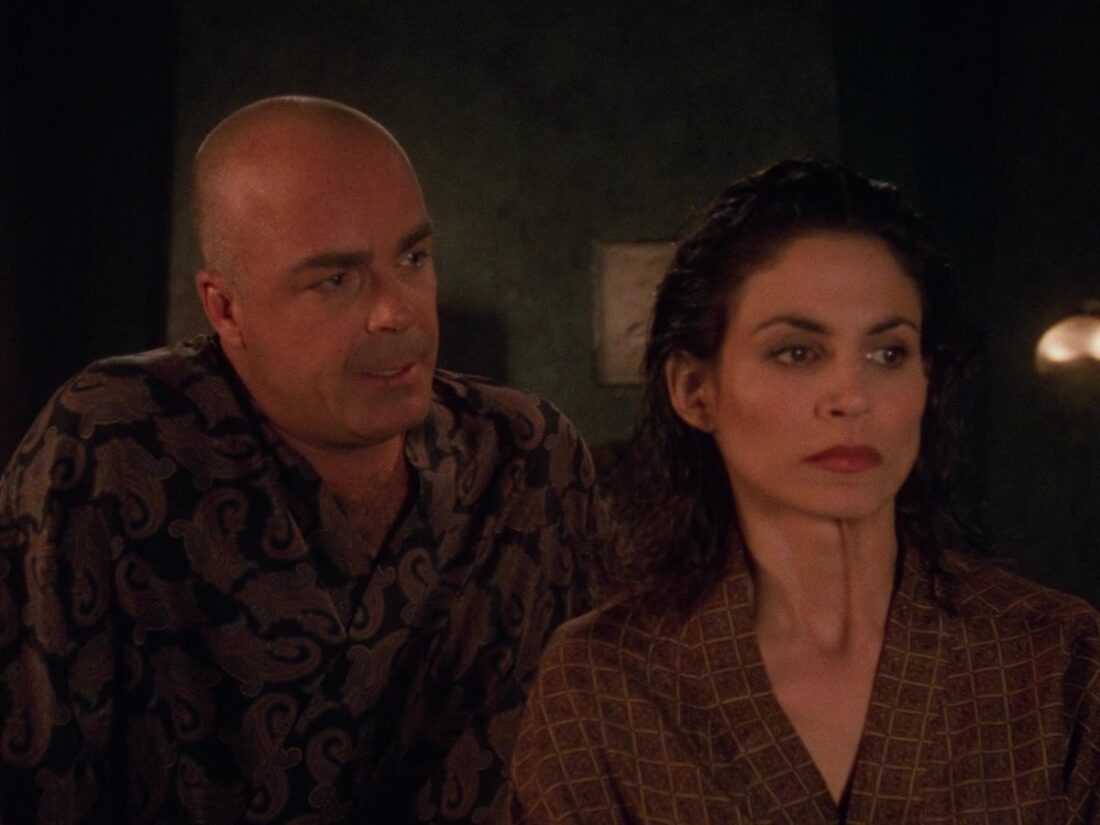
If you value your lives, be somewhere else. Delenn is able to justify her keeping Sheridan in the dark, but at the cost of fear and grief over the possibility of Lennier being dead.
In the glorious days of the Centauri Republic… Apparently, his experiences over the past few years have caused Mollari to lose all interest in casino gambling. This leaves him with no idea what to do with leisure time…
Though it take a thousand years, we will be free. G’Kar and Alexander get to replay their conversation from “The Gathering,” but this time it’s about 75% less sleazy, especially since G’Kar actually behaves honorably and nobly this time.
The Corps is mother, the Corps is father. Psi Corps regs are apparently that only one telepath can be assigned to a post. (This also explains why Alexander and Winters were both the only telepaths officially detached to B5.) It takes Alexander a surprisingly long time to think of approaching non-humans with her proposal, since Psi Corps would cut off any human avenue.
We live for the one, we die for the one. Lennier gets the evidence they need to prove the Centauri are behind the raids. Because he’s just that awesome.
No sex, please, we’re EarthForce. Alexander reminds G’Kar of the fact that sexual congress was part of the deal when he first proposed it five years earlier, and she makes a lewd comment about her high sexual threshold to torment G’Kar in one of those scenes that was so obviously written by a man….
Welcome aboard. Thomas MacGreevy commences the recurring role of Minister Cholini; he’ll be back next time in “And All My Dreams, Torn Asunder.” Richard Yniguez concludes the recurring role of Montoya (who is criminally underused in this one), back from “Meditations on the Abyss.” Denise Gentile continues the recurring role of Lise, back from “Rising Star,” to return in “Wheel of Fire.”
Wesley Mask plays the snotty Fresh Air server who annoys Garibaldi and Edmund Shaff plays the business person who disappoints Alexander.
Trivial matters. Garibaldi, had dinner with Sinclair, Sakai, and Ivanova at Fresh Air right before he got shot in “Chrysalis.” He says that he hasn’t eaten there since, though we did see him order takeout pizza from there at the end of “Meditations on the Abyss.” He may only be referring to eating in the restaurant—or he may not remember ordering the pizza, as he was really drunk when he ordered it…
Garibaldi also comments that the other three people at that dinner are all gone. Sinclair was reassigned between “Chrysalis” and “Points of Departure,” and he buggered back to the past to become Valen in “War Without End, Part 2.” Ivanova was promoted to ship captain and left the station in “Rising Star.” Sakai has not been seen onscreen since “Chrysalis”; Garibaldi mentions that she disappeared “over a year ago,” but that disappearance happened two-and-a-half years prior to this episode, as chronicled in the novel To Dream in the City of Sorrows by Kathryn Drennan.
G’Kar proposed Alexander sharing her genetic sequence with the Narn so they could breed telepaths—and also proposed mating with her—in “The Gathering.” Apparently, the pair of them hadn’t had a real one-on-one conversation since then until this episode.
Delenn sent Lennier on a covert mission to find evidence of who is responsible for the raids last time in “Meditations on the Abyss.”
The echoes of all of our conversations.
“I want you to get out of this part of the space and back home just as fast as you can. Because barring an act of God—and since I don’t believe in God, that kinda narrows the odds a bit—by this time tomorrow, we’re gonna be at war with the Centauri.”
—Garibaldi urging Lise to leave, the final line of dialogue of the episode.
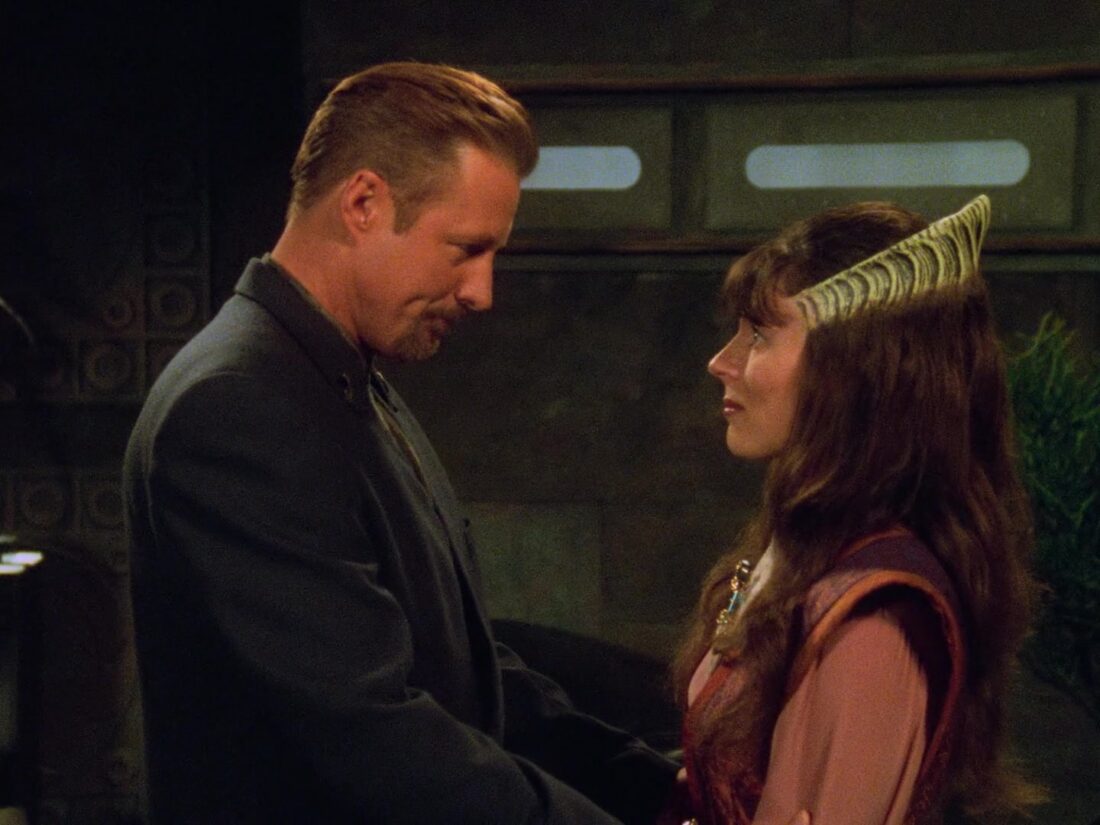
The name of the place is Babylon 5. “I have been working up a good mad all day, and I am not about to let you undercut it by agreeing with me!” There were some comments in last week’s rewatch that talked about how absolutely horrid Delenn was to Lennier, using his infatuation with her to manipulate him. I didn’t get into it in the comments there, though I thought about it, but I actually want to talk about it here, because this episode also is a good showcase for Delenn’s ability to manipulate people and events.
Which is not only strong, but has been part of her character from jump. It’s easy to forget because Mira Furlan has that 50,000-megawatt smile and she and Sheridan have their incredibly adorable chemistry, but Delenn is incredibly manipulative and has a superlative capacity for cruelty. We were reminded in this episode of what G’Kar was doing in “The Gathering” with Alexander, and it’s worth reminding everyone what else G’Kar did in that episode: approach Delenn about an alliance, but the moment G’Kar mentioned the Grey Council, Delenn nearly killed him in a particularly painful manner. She spent most of the first season manipulating Sinclair, she circumvented the wishes of the Grey Council whenever it pleased her, she’s barreled forward with her own plans whether or not they made sense.
Delenn is not a nice person. These last two episodes, in which she has played both Lennier and Sheridan like a two-dollar banjo, demonstrate that rather impressively.
Anyhow, this is a strong episode that moves things forward nicely—and, for a change, speedily. Lennier finally gets the proof that the Centauri are responsible, while the Centauri have already got their plausible deniability plan going. And the IA proves themselves to not be handling this at all well, as excluding Mollari from the meeting—especially since they’re fairly sure he has no knowledge of it—is not a great idea. But then, we had pundits spending ten minutes in “The Deconstruction of Falling Stars” talking about how the IA shit the bed in their first year, and while their evidence was the botching of the Byron thing, this qualifies, too…
It’s nice to see Garibaldi’s falling off the wagon (not getting on it as I stupidly said last week, sorry about that) is finally being dealt with directly. Denise Gentile hasn’t impressed me overmuch as Lise, though the scripting for her hasn’t done her any favors. However, she nailed this episode, especially the way her body language completely changes when she finds the half-empty booze bottle. Lise was there the last time Garibaldi left the wagon behind, and she knows more than anyone currently on the station how bad this can get.
(Garibaldi also mentions at one point that he’s a war hero, and what the what? His primary role in the recent war was as Benedict Arnold, not as George Washington…)
Finally, this episode is another reminder that Lennier is a total badass. Bill Mumy plays him with enough low-key modesty to mute the badassery, but that just makes it all the more effective when the badassery comes out to play.
Next week: “And All My Dreams, Torn Asunder.”

Delenn’s conversation with Sheridan always bugs me because she is specifically undercutting his very reasonable emotions because she finds them inconvenient to deal with. And it also serves to circumvent a discussion that might get into touchy territory regarding Lennier. JMS claims that it was based on yet another personal experience, almost word for word, but I don’t think it’s as “cute” as he does.
Anyway, I agree that it’s a huge mistake to leave Londo out of these discussions. They should have included him from the very start. At the very least, he might have helped to figure out how to manage the situation while the full truth was discovered. It might not have changed things overly much in the end, but for all his previous mistakes, I think he had earned that much.
If only Lyta had considered talking to G’Kar about a deal back when Byron was alive. Things might have ended differently. Turning to the Narn was such an obvious solution that Lyta seems a bit foolish for not having thought of it immediately.
Garibaldi did rescue Sheridan from torture and imprisonment on Mars, getting stabbed for his trouble, but given that he was the one who betrayed Sheridan in the first place we may not want to count that even though he was under psionic manipulation. As for more genuine acts that would count towards being a “war hero,” he did 1) lead combat that repelled a boarding party in Severed Dreams, 2) led the team that attempted to evict Kosh 2 (Ulkesh) during which their breathing masks were compromised, and 3) he led a raid that took over a bunker on Mars from which Lyta launched the psi attack that activated the frozen teeps that disabled the Earth fleet around Mars.
I don’t believe that either 1) or 2) occurred during the war, though, so those wouldn’t count as war heroism.
The boarding party was during the battle immediately after B5 seceded from Earth Alliance, thus starting the civil war. Declaring Ulkesh persona non grata was during the Shadow War… different war of course, but it’s not clear to me what war Garibaldi thought he was a hero of. (I haven’t seen this ep in years)
That betrayal wasvery public, and that Psi Corps manipulated him is not common knowledge. (If it was, Garibaldi wouldn’t have had to threaten Bester at gunpoint.) At best, he’s somebody who changed sides. Calling him a war hero is ridiculous.
—Keith R.A. DeCandido
Fair, and his actions against Ulkesh were also not public to the people of the EA, given that they didn’t even know there WAS a Shadow War. Anyway, I’m not arguing that Garibaldi actually was a war hero objectively, just pointing out that he wasn’t without some valorous actions that he could choose to construe as heroic, especially in his alcoholic denial phase.
I don’t know, I have the impression that saying someone is a war hero implies that they’ve been formally recognized as such with a medal or citation. Yes, we viewers can find it implausible that Garibaldi’s reputation would have been cleared so completely that he’d be considered a war hero, but it’s the way JMS has been writing the character since the late fourth season. Keith has commented before on how implausible it was that everyone just shrugged off Garibaldi’s betrayal and trusted him with authority again. But apparently that’s how JMS wanted it to be, so I think he intended Garibaldi’s “war hero” line to be objectively true, regardless of how little sense it makes to us.
Exactly. My issue since “The Darkness and the Light” has been that the scripts keep insisting that Garibaldi’s all okay now and all is forgiven, and I don’t buy that.
—Keith R.A. DeCandido
It’s okay Keith; Sheridan said Garibaldi’s a good guy now, so it must be true. ;p
It’s a very alcoholic thing for Garibaldi to say however.
It really has come home to me on this rewatch just how manipulative Delenn is. As Keith points out, Mira Furlan makes it really easy to overlook, as does Delenn when she has the opportunity to be playful. It’s not something I’ve ever considered before, and I may have to reassess what I think about the character.
It’s been fascinating to me on this time through to see how the show’s morality does (and doesn’t) work. On the one hand, JMS wants to present his characters as flawed but well-meaning for the most part. On the other hand, it’s clear that it’s very important that our heroes remain heroic, even when they’re not competent or actively do dirty things. Sheridan using the frozen telepaths as weapons? Horrors of war, it’s distasteful, and… then it’s never mentioned again, even in the telepath arc. Sheridan mishandling the telepaths in the telepath arc, and generally actually being a bad president (hello, Peter Principle)? Doesn’t matter, because he was “a good man”. Delenn being responsible for genocide of the human race? It’s fine, she got better in her heart, and she’s never going to mention it to her human husband. That would be awkward. Even “Electric Bleachers” Garibaldi, but it’s cute when he breaks into the post office or funny when he abuses his authority, instead of being one of many massively career-ending moves. But because they’re good people doing things for the right reasons, they don’t suffer the consequences of people who do things for the wrong reasons. Marcus, Findell, Lennier? They all joined the Rangers for the ‘wrong’ reasons, and the universe made sure bad things happened to them, as if there’s an ontological force to well-meaningness. All the academics in “The Deconstruction of Falling Stars” are made of so much straw, but it’s sometimes hard to think they’re actually wrong.
And that’s fine, really! For all that we’ve all been critical of various parts of the show, it’s supposed to be entertaining not edifying, and, though it has its ups and downs, it usually is. But it does feel to me, especially on this latest rewatch, that JMS never quite wants to commit to dirtying up his characters. He’ll do it for a bit of drama, but he’ll eventually dust them off before he puts them back on the shelf for the next episode.
(This is not to say that I want to watch a show of morally gray characters being dirty — I really don’t — but there’s something slightly off or lacking about the moral complexity of the show that’s hard for me to articulate, much as I’ve tried to above.)
The very end of the series would suggest that JMS was hoping to show that imperfect people who make mistakes can still end up doing the right thing and/or finding a noble purpose. For example, I don’t think it’s a mistake that Sheridan is shown to be an inexperienced and error-prone president, because it’s very different from the leadership roles he had in the past and he relied far too much on everyone having good intentions.
“Delenn conveniently walks out of the office in a manner that prevents her from seeing her husband lurking right on the other side of the doorway.”
Given that it took several seconds before Sheridan came back into view, I think the idea was that he retreated a little way down the hall and wasn’t directly visible. Still, it drives home how absurd it is to design the captain’s/president’s office with no door.
And yes, the waiter practically acting like a booze pusher was highly contrived. Surely restaurants get non-drinking patrons all the time (we know there are Muslims on the station, for example). I also found it contrived that Garibaldi, who’s recovered from alcoholism twice now, apparently doesn’t remember that addiction is a biochemical or neurological process that isn’t subject to willpower or strength of character. His talk about wanting to be in control is hard to square with letting himself fall under the control of his addiction. Okay, maybe he’s in denial, but it seems like the kind of denial of someone who’s never been through recovery before.
I was kind of hoping we’d get a fun subplot about Londo finding something novel to do with his free time. I guess we’re past the point in the season where we can just have a character-driven subplot that doesn’t drive the arc.
A nearly endless ability to convince yourself that this time things will be different and to ignore any evidence to the contrary is actually quite a common part of the addictive cycle. That part of Garibaldi’s reaction felt quite credible to me.
Yes, I agree with that in theory, but I don’t find it convincing the way it was presented here. As I said, Garibaldi’s rationalizations sounded like they were coming from someone who didn’t understand how alcoholism worked, who was still new at being an addict in denial. I think that someone who’s been through recovery would know better than to make those specific arguments and would come up with different ways of convincing himself that he could handle it this time.
As someone who’s been in AA for 38 years, and sober for 32, Garibaldi’s actions are very believable here. It’s not uncommon for the alcoholic to think that *this time* they can control it. Or at least control the *consequences*. And of course we have to tell those around us that we’re fine, dammit! We’re OK! It’s *NOT* a problem!
Until we realize that it’s not OK and it is a problem, but even then we may not be able to stop, even with help.
I defer to your greater experience.
I am a middle-aged non-drinker. Today, I wouldn’t expect to see any issues rejecting drinks when I do fine dining or join people for “drinks” after an event.
Fifteen years ago? Friction maybe 1 in 20 times.
Thirty years ago? I never went through this experience, but high-end places were often bad about non-alcoholic options and I felt pressured to order drinks with fair frequency (1 in 8 times, with high-end venues most likely to do it).
JMS does not drink, and he was in LA in the 90s. I would bet money he’d run across multiple servers who he’s only exaggerating slightly in this episode. Pure antecdata, of course, but JMS would be in a good position to know.
I know this scene was based on his personal experience, but it hadn’t occurred to me that this might have been something particular to high-end LA dining venues. I think the issue is translating that to Fresh Aire, which as others have noted, would have had experience with non-drinking patrons.
However, I do think Eduardo made a good point that this could very well be a direct follow-up to Garibaldi’s drunken pizza order in the previous episode. For whatever reason, I never quite saw the cause and effect there, and it would still be very unprofessional of the waiter, but it would be an interesting context for the scene.
I thought the waiter was pushing a drink to Garibaldi during that dinner because of that drunken pizza call last episode. He more or less humiliated himself to the restaurant staff with that call – especially considering he was the station’s former security chief (too bad the show couldn’t have predicted the rise of food order apps where you don’t talk to a single soul).
Lise being the first person close to Garibaldi to uncover his recent binge is damn effective. It finally lets the secret out, while still able to keep it under wraps from Sheridan, Franklin and the others, thanks to the Centauri plot kicking into high gear. And her reaction is a welcome reminder of what’s coming to him. And at the same time, him kicking her off the station for her safety is not only a chilling ending to the episode, but also a chilling reminder that he’s still going to fall painfully hard due to that bottle.
This episode, much like last week’s, really brings back that palpable feeling of tension and danger that’s been missing from the show since the Shadow War and Earth Civil War arcs. We really feel anxious for Lennier as he dives into the battlefield – the way he covertly records the whole thing, finally putting the Centauri front and center in the evidence bin. Speaking of which, the battle footage – you can tell how much the VFX has improved during this final season. It’s up there with VOY’s “Year of Hell” and any DS9 Dominion War sequence.
I always figured Montoya had to know at least about Lennier’s attempts at decoding the Centauri signals. No way he would be able to hide that activity from his commanding officer – we know from last episode that the so-called “secure” fighter-to-fighter comm chatter is in fact monitored. Of course, absconding with a fighter is the part he kept under wraps from Montoya, and Delenn presumably knew Lennier would go above and beyond to get that evidence. An effective, gripping spy story all the way through.
And G’Kar and Lyta? What a moment to see things coming full circle. Few characters have changed so dramatically as these two. And to see her response to his previous “offering” back in the pilot – yeah, it’s written by a man, but Lyta owns the line, really impressing G’Kar. Lyta finally has what she needs to finish the story on her terms, all thanks to an offer that at the time had zero chance of happening given her place and her job at that point. Breaking from the Psi Corps and becoming a direct part of Vorlon heritage really makes a difference. And G’Kar is so far past his ambitious shrewd days, it’s a blessing to see these two interact in such different contexts.
I thought the waiter was pushing a drink to Garibaldi during that dinner because of that drunken pizza call last episode.
Galaxy brain move is to make Garabaldi an alcoholic coffee without the argument or making his date aware of it. Dude is never going to earn a tip this way.
“…pushing a drink to Garibaldi during that dinner because of that drunken pizza call”
Yes, that’s what I always assumed. The waiter was bringing directed, personalized sarcasm, not general snooty waiter haughtiness.
Which would be even more unprofessional (to the extent front of house is a “profession”) but that’s neither here nor there.
Moderator: The title above the credits reads “Meditations from the Abyss” rather than “Darkness Ascending”.
Updated, thanks!
Noticed that about Delenn, hey? (and I say that with love in my voice; I’ve always liked the Delenn character).
I agree it was a mistake to leave Londo out of the discussions (I can sort of understand why, but since he’s obviously in the dark, it should have been incumbent on the council to include him.
While the “outcome” wsn’t so sucky, I did find the exchange between G’Kar and Lyta kind of exriciating (not as bad as “The Gathering,” but…)
And, yeah; Lennier is a bad-ass, but he’s a bad-ass to prove himself to Delenn. That’s my story, anyway.
In all, not a bad episode.
I dunno, I can kind of see an argument in favor of leaving Londo out of the loop. The bad guys back on Centauri Prime are no doubt watching Londo closely, and if Londo knew the truth, it might change his behavior in a way that his watchers would notice, which might get Londo killed or at least compromise the Alliance’s plans against them. So it’s kind of like Sun-Tzu said: To fool your enemies, first fool your allies.
That’s indeed the argument that G’Kar makes, but I wonder if that underestimates Londo’s ability to keep a secret. He managed to make his move against Cartagia fairly well despite the extreme personal danger. Granted, in this scenario, the nature and extent of the threat is unknown, but I would think that would make him more careful, not less. And he is well aware that there is some unknown faction at play from earlier episodes. He even saw that they didn’t look particularly Centauri.
(In fact, if Londo were to describe what he saw, Delenn might recall how the Drakh emissary looked, someone might recall the Keepers, and they might actually start putting two and two together. Which is probably why JMS made sure those conversations never happened!)
Then again, the others would have to make it very clear that they were dedicated to 1) keeping Londo safe, and 2) figuring out the truth behind the Centauri attacks with the goal of doing what Londo thinks is best for his people. That would be the way to gain his trust and cooperation, because it’s been a driving motivation of his since the start. In other words, it might require more nuance than Sheridan and co. have been shown to possess, thus far.
That was expressly G’Kar’s reasoning for insisting they leave Londo out of the loop.
Oh, that must be where I got it from, then. (Insert “sheepish” emoji.)
I can’t really blame Our Heroes for being wary about telling Londo. It’s often been hard to discern Londo the Person from Londo the Ambassador (his performance next episode will be another instance of this), and to anticipate what he would do if his friendship conflicted with his duties to and loyalty to his own people (that his own people don’t know what’s actually going on is a separate matter). It’s easy enough for me to believe that all things being equal they’d want to tell him everything they could, but under the circumstances, even beyond the other concerns mentioned, aren’t quite sure which way he’d jump in the moment.
G’Kar tells Alexander that the Narns will go for the deal, but only if the telepaths psionically eavesdrop on other ambassadors from time to time. Alexander says that’s a deal-breaker and starts to leave, but G’Kar says that that was a test—if she’d agreed to that stipulation, the deal would’ve been off. They do, in fact, have a deal.
As happened a couple of times with Bester, this test doesn’t make sense. If she was willing to scan people without their consent, then she would just read G’Kar’s mind and tell him what he wants to hear. Apparently she’s not, but he can’t tell the difference…
I think there’s a difference between being willing to bend her ethics if required and being casually ready to throw out ethics altogether. I mean, a mercenary might be willing to be hired to kill or torture someone, but they wouldn’t just up and kill or torture the person offering them the job. Context matters. So if Lyta had been willing to scan people illegally, it doesn’t automatically follow that she would’ve casually scanned G’Kar then and there.
It does seem like there’s a bit of irony to the fact that G’kar asks Lyta to do what Byron previously asked his telepaths to do (and what they willingly did) and she turns him down…and yet, she’ll prove to be far more destructive and violent than Byron ever would have approved of. For all Lyta’s talk of “Remember Byron” she doesn’t seem to particularly remember him at all in the long run.
I think the difference is that she was willing to do it to serve her own people’s agenda but not to serve someone else’s. Also, we don’t really know for certain if Byron’s people actually did steal any secrets; they just claimed they did and let the others’ fear do the rest. It could’ve been a bluff.
Well, in this case serving G’kar’s agenda would also have been serving her people’s agenda, because he wasn’t going to agree to the deal otherwise (or so she thought…)…unless she had other options she was considering as well.
I don’t remember the flow of the episodes well enough to say with certainty, but do we have any real reason to believe Byron was bluffing? Doesn’t he talk about the plot freely in front of his people? We do see some of the telepaths trailing the ambassadors. It’s a neat idea that he was just bluffing, but I don’t think that’s the conclusion JMS intends for us to draw.
“in this case serving G’kar’s agenda would also have been serving her people’s agenda”
But it would still have been agreeing to use telepaths in service to others’ agendas, which would put them right back where they’ve always been. That’s what makes it different from Byron’s plan, which was entirely in service to the telepaths’ own goals. Taking secrets for themselves is fundamentally different from taking them on someone else’s behalf.
“do we have any real reason to believe Byron was bluffing?”
It’s not about belief, just evidence. You don’t assume one hypothesis is correct unless you can rule out every possible alternative based on the evidence. Byron’s people never actually revealed anyone’s secrets, so the hypothesis that he was bluffing cannot be ruled out, any more than the hypothesis that he wasn’t bluffing can be ruled out. They’re both equally on the table.
We’re not talking about the real world here though; we’re talking about an episode of television. Which is to say that I think if TPTB had meant for the viewing audience to seriously consider the possibility that Byron was bluffing that they would have done more to make it clear that that was a possibility, especially given that Byron’s maneuver here made the telepath colony even more unsympathetic than they arguably already were.
If the story had needed Byron to actually steal secrets, then it follows that at least one of those secrets would have been mentioned. All the story needed, all Byron needed, was the Alliance members’ fear that their secrets had been compromised. Sure, maybe he actually stole the secrets, but the story doesn’t require it.
Anyway, it’s a secondary point, so let’s not take it out of context. I merely raise it as one possible, yet nonessential contributing factor that might help account for why Lyta was more willing to go along with Byron’s plan than with G’Kar’s (fake) condition. The main reason was that she wants telepaths to serve their own needs instead of others’ agendas, but if, hypothetically, Byron only faked taking the secrets, that could be another reason she was more willing to go along with it.
Okay, let’s put it this way instead: Even if Byron took the secrets, he didn’t intend to use them unless he had to, so there was a good chance they wouldn’t come out. If she had spied on other governments for the Narn, then (if it had been a real condition) the Narn presumably would have used the secrets against their foes. So that would’ve made a difference to Lyta.
I agree that from a story perspective there’s no need for Byron & Co. to actually steal secrets, but I also feel the way the story is executed as shown indicates that it was the intention that the audience not doubt that B&C weren’t bluffing.
You’re right, though, that it’s a minor factor in the overall scheme of things. Whatever happened, happened.
I don’t really agree that Byron didn’t intend to use them “unless he had to”, because there was nothing forcing him to go to the Alliance and say, “Give us a planet or we’ll leak your secrets!”, unless you count his emotional state after finding out the truth of his origins as an involuntary compulsion. He could have gone to the Alliance and said, “We’d like a planet and we feel we deserve one; how can we work with you to make that happen?” He didn’t even try the velvet glove approach before reaching for the iron fist.
Agreed, though, that G’kar’s condition if it had been real would have indicated that the Narn fully intended to utilize whatever knowledge they might gain…not even just against their enemies, but even to do things like negotiate more favorable trade pacts or such.
I meant only that Byron wouldn’t have had to reveal the secrets in order for his plan to succeed, since he was trading his silence for a homeworld. The ideal outcome of Byron’s plan would have meant the secrets were not exposed to rival governments, whereas the ideal outcome of G’Kar’s alleged demand to Lyta would have meant the secrets were exposed to the Narn government. I’m suggesting that as a reason why Lyta was open to one but not the other.
Gotcha.
Apropos of nothing other than that I kind of hate just giving a one-word response, I wonder when it would have occurred to anyone to try to abduct one or more of the telepaths and coerce them to reveal whatever they’d learned about the other ambassadors.
I’m specifically amused that you called out the “war hero” line, because I also did a double-take at that moment and found myself trying to recall what Garbaldi might have done during the Shadow War or the Civil War that would distinguish him as such, and in the moment I came up empty. Or is Sheridan so beloved at this point that if he says, “Garibaldi did some very heroic things!” that that suffices? :p
I saw this was discussed elsewhere in the comments, and don’t want to reiterate anything; just wanted to say I LOLed when I saw you call it out as well.
Hey, he was a GROPO during the Earth-Minbari war and survived. There’s a good chance he was decorated for that, I guess.
His line was, “I am not the same person that I was. I’ve got a good job now. I’m a war hero, if you can believe that.” It’s pretty clear he meant the war hero thing to be a recent development.
Now that you mention it, based on that quote, he’s definitely saying it like it’s something that has happened since the last time they were together. And that really doesn’t make sense, because the wars were already over by the time they reunited in “Rising Star”. Nothing that has happened in the past few months would remotely qualify. Unless he means that him being considered a war hero is something that’s emerged in the public eye since the beginning of the season, but that still doesn’t track.
He means he’s a different person now than he was when Lise knew him back on Mars in 2255, before he left her to come to Babylon 5. That relationship happened after the Earth-Minbari War (2245-7), so the war hero thing must be more recent. And the only wars he’s been in since then are the Shadow War and the Earth civil war.
What I was thinking of was the “if you can believe that” part. As if she was unaware of what had happened in his life since those earlier days on Mars, despite the fact that they had reconnected after the recent wars in “Rising Star”. As though in the time since then, he’s been perceived as a war hero for what he did in the Shadow War and the Earth Civil War. But JMS hasn’t exactly shown us much about how those under Sheridan are perceived by the Earth Alliance public.
Anyway, I think he was referring to those wars, perhaps the Shadow War more than the civil war (given how his activities during that war played out).
“If you can believe that” is a rhetorical device. It doesn’t literally mean he thought she was unaware, it’s just a figure of speech to express how unlikely the speaker finds something to be. He’s self-effacingly saying how hard it is to believe that Michael Garibaldi of all people could be regarded as a war hero.
Not to belabor the topic any further, but I believe Garibaldi’s argument is “I am not the same person that I was [when I was a drunk years ago on Mars]. I’m a war hero now.” Thus comparing his current situation to his previous life on Mars, and that he can handle it now, not that he became a hero in the last few months.